
SLS-101 · Lesson 1 of 12 · 19 min
What selling is and why it matters
▶ Video coming soon A video version of this lesson is on the way.
On a gray Monday at the end of August 2026, Maya Chen walked into the Sioux Falls office of Ridgeline Workplace Solutions for her first day as an account executive. For three years she had sold appliances on the floor at Juniper & Pine Home, with the odd sofa and mattress on busy Saturdays, a few blocks away, and she had been good at it. Now she would be selling office furniture, multifunction printers, meeting-room technology and a cloud room-booking subscription called RoomFlow to schools, clinics, law firms and manufacturers. Her new manager, Darnell Brooks, met her at reception with a coffee and a question: "What do you think a salesperson is for?"
Maya gave the answer most people give. "To bring in revenue." Darnell nodded. "That is what the company needs from you. Now tell me what the customer needs from you." She thought about it for longer. "Help deciding," she said at last. "Most people who came into the store already knew they needed a new fridge or washer. They didn't know which one, or whether it would fit, or whether it was worth the money." Darnell smiled. "Then you already understand the job. Everything else in this program is technique."
This course follows Maya at Ridgeline and, on the retail side, Aiden Laroque, who started as a sales associate at Juniper & Pine Home the same week, coached by store manager Bev Halvorsen. Their two worlds look different. One sells to organizations through long conversations, proposals and contracts; the other sells to households across a counter in a single visit. Underneath, they share the same foundations, and this course lays them down.
A working definition of selling
Selling is the process of helping a customer recognize a need or opportunity, choose a solution, and commit to buying it, in a way that creates value for both the customer and the seller. Three parts of that definition matter. First, selling is a process: it unfolds over steps, from first contact to purchase and beyond, and each step can be done well or badly. Second, selling is about the customer's decision. A salesperson does not buy anything; the customer does, and the salesperson's work is to make a good decision easier. Third, a sale only counts as good selling if both sides are better off. A sale that the customer regrets, returns or complains about costs the seller more than it earned.
It helps to separate selling from the activities around it. Marketing works on markets and groups: it decides which customers to serve, what to offer them, how to price it and how to make people aware of it. Selling works on individual customers and specific decisions. Marketing might run an advertising campaign that brings a hundred school business officers to Ridgeline's website; selling is Maya's conversation with one of them about why the division's printers keep jamming. Customer service helps people after they have bought, and good service often leads to the next sale. In small firms one person may do all three jobs. In larger firms they are separate teams that must hand customers to each other carefully.
| Activity | Works with | Main question | Example at Ridgeline or Juniper & Pine |
|---|---|---|---|
| Marketing | Markets and segments | Whom do we serve, with what offer and message? | A spring campaign aimed at clinics replacing waiting-room furniture |
| Selling | Individual customers and decisions | What does this customer need, and will they buy from us? | Maya meeting the office manager of Northfield Family Clinic |
| Customer service | Existing customers | Is the customer getting what they paid for? | Fixing a delivery date for a family whose new fridge arrived dented |
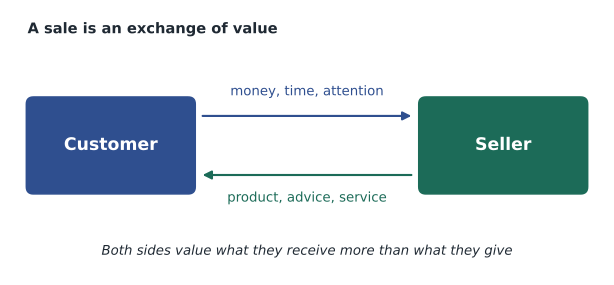
Why selling matters
Almost every organization depends on someone persuading someone else to buy. A manufacturer can make the best grain dryer in the state, but until a farm or a dealer orders it, the factory has only built inventory. Selling turns products and services into revenue, and revenue pays wages, suppliers, taxes and the investment in next year's products. For many small and mid-sized businesses the sales team is the single largest influence on whether the year is good or bad.
Selling is also one of the largest kinds of work in the economy. The Bureau of Labor Statistics counted about 4.0 million retail salesperson jobs and about 1.57 million jobs for wholesale and manufacturing sales representatives in 2025, and many other roles, from insurance agents to advertising sales agents, are sales jobs under another name. The BLS reports a median hourly wage of about 17.03 dollars for retail salespersons in May 2025, and a median annual wage of 76,460 dollars for wholesale and manufacturing sales representatives in 2025, rising to 104,920 dollars for those who sell technical and scientific products. The difference between those figures says something about the skills this program builds: selling complicated products to organizations pays considerably more than selling at a register.
Selling matters to customers too. Buyers have more information than ever, from websites, reviews and comparison tools, and some purchases need no salesperson at all. Nobody needs advice to reorder printer paper. But when a purchase is expensive, risky, complicated or new to the buyer, information is not the same as a decision. A school division choosing furniture for a new building has to balance budgets, durability, accessibility, delivery timing and the opinions of teachers, caretakers and trustees. A family choosing a refrigerator must work out whether it fits the space, whether the energy use matters, and how to pay for it. A skilled salesperson shortens that work, catches mistakes before they are made and stays accountable afterwards.
What good selling looks like, and what it does not
Many people picture selling as pressure: the car lot, the cold call during dinner, the pitch that will not stop. That kind of selling exists, and it usually works badly. It may win one sale, but it loses the referral, the repeat purchase and the online review. It also invites legal trouble, because consumer protection law in every state limits misleading claims and high-pressure tactics. Professional selling is built on a different idea: the seller earns the right to the sale by understanding the customer's situation better than competitors do and by being honest about what the product will and will not do.
Bev Halvorsen sums it up for new associates at Juniper & Pine with three questions she wants them to ask before every close. Does this product actually solve what the customer told me? Would I be comfortable if the customer's friend overheard everything I just said? Will this customer be glad they bought from us a year from now? If the answer to any of them is no, the associate has more work to do before asking for the sale. Those three questions compress most of the ethics this program will teach.
Good selling also respects the customer's time. At Ridgeline, Darnell reviews Maya's call notes each Friday. He is less interested in how long she talked than in what she learned. A twenty-minute call in which the customer spoke for fifteen minutes and agreed to a site visit is a good call. A forty-minute product presentation that ends with "send me something in writing" usually is not. The habits behind that difference, preparing, asking good questions and listening, run through the rest of this course.
Kinds of selling
Selling is not one job. It varies with what is sold, to whom, and how often. A useful first division is between transactional and relationship selling. In transactional selling, the purchase is simple and the customer mainly wants convenience and a fair price; the seller's task is to make buying quick and pleasant. Most counter sales of small appliances, phone accessories and office supplies are transactional. In relationship selling, the customer buys repeatedly or the purchase is large and complex, so the value lies partly in the ongoing relationship: advice, service, follow-through and trust built over years. Maya's managed print contracts, which run for three to five years and include servicing, are relationship sales.
A second division is between business-to-consumer (B2C) and business-to-business (B2B) selling. B2C customers buy for themselves or their households, usually with their own money and often in one visit. B2B customers buy on behalf of an organization, often with several people involved, written rules for purchasing and a budget approved by someone else. The B2B track of this program follows Maya; the retail track follows Aiden. Several courses, including negotiation and sales leadership, serve both.
| Feature | Typical retail (B2C) sale | Typical B2B sale |
|---|---|---|
| Buyer | A person or household | An organization, through several people |
| Decision time | Minutes to a few weeks | Weeks to many months |
| Value of one sale | Tens to a few thousand dollars | Thousands to millions of dollars |
| How the buyer pays | Card, cash or consumer financing | Purchase order, invoice and payment terms |
| Main risk for the buyer | Wrong fit, regret, poor service | Wasted budget, disruption, personal reputation |
| Where the seller adds most | Advice, demonstration, reassurance | Diagnosis, business case, implementation |
Worked problem
How one sale ripples through a business
Aiden sells a refrigerator for 2,400 dollars before tax. Juniper & Pine paid its supplier 1,680 dollars for the unit. The store pays Aiden a commission of 3 percent of the selling price. How much gross margin does the sale create, how much of it goes to Aiden, and what is left for the store's other costs and profit?
Show solution
- Gross margin is the selling price minus the cost of the goods sold.
- \[\text{Gross margin} = 2{,}400 - 1{,}680 = 720 \text{ dollars}\]
- Aiden's commission is 3 percent of the selling price.
- \[0.03 \times 2{,}400 = 72 \text{ dollars}\]
- What remains must cover rent, delivery, wages, utilities, marketing and profit.
- \[720 - 72 = 648 \text{ dollars}\]
- As a share of the sale, the gross margin is 720 out of 2,400, or 30 percent, and the commission takes one-tenth of that margin.
Answer: The sale creates 720 dollars of gross margin; 72 dollars goes to Aiden as commission and 648 dollars remains for the store's other costs and profit. Every discount comes straight out of that 720 dollars, which is why a 10 percent discount (240 dollars) would wipe out a third of the margin.
The example shows why sellers in every industry need to understand margin, not just price. A salesperson who thinks of the 2,400 dollars as the store's money will give discounts casually. One who knows that only 720 dollars of it is margin will defend the price, offer value instead, and save discounts for when they truly win the sale. Retail math gets a full course of its own on the retail track, and value selling gets one on the B2B track.
What the rest of this course covers
The remaining lessons follow the shape of a sale. Lesson 2 looks at the roles and careers available in sales. Lesson 3 maps the buyer's journey against the seller's process. Lessons 4 and 5 examine value and trust, the two things every buyer is really weighing. Lessons 6 to 10 walk through the steps of a sale: preparing, opening, asking for the business, handling objections and following up. Lesson 11 explains how salespeople are paid and measured, and lesson 12 brings everything together in Maya's and Aiden's first month on the job.
Darnell finished Maya's first morning with a reading list and one piece of advice. "For the first month, don't try to sell anything. Learn the products, learn the customers, and learn how they buy. The selling will follow." Bev gave Aiden almost the same advice on the same day, in fewer words: "Listen more than you talk."
Common mistakes
MistakeThinking of selling as talking customers into things.
InsteadSelling is helping a customer make a good decision; the customer's needs come first and the seller earns the sale by understanding them.
MistakeTreating marketing, selling and service as the same job.
InsteadMarketing works on groups, selling on individual decisions and service on existing customers; each must hand customers to the next carefully.
MistakeThinking of the selling price as the company's money.
InsteadOnly the gross margin is available for costs and profit, so discounts come directly out of margin.
MistakeAssuming every sale needs a salesperson.
InsteadSimple, familiar purchases are often better served by self-service; salespeople add most where purchases are expensive, complex, risky or new to the buyer.
Summary and key terms
- Selling is the process of helping a customer recognize a need, choose a solution and commit to buying it in a way that creates value for both sides.
- Marketing works on markets and groups, selling on individual customers and decisions, and customer service on existing customers.
- Selling turns products into revenue and is one of the largest kinds of work in the economy, and it pays more as the products and customers become more complex.
- Good selling earns the sale through understanding and honesty rather than pressure.
- Transactional and relationship selling, and B2C and B2B selling, call for different emphasis but share the same foundations.
- Sellers need to understand gross margin, because discounts come directly out of it.
- Selling
- Helping a customer recognize a need, choose a solution and commit to buying it, creating value for both sides.
- Marketing
- Deciding which customers to serve, what to offer them, at what price, and how to make them aware of it.
- Transactional selling
- Selling simple purchases where convenience and price matter most.
- Relationship selling
- Selling where value comes partly from an ongoing relationship of advice, service and trust.
- B2B
- Business-to-business: selling to organizations that buy on their own behalf.
- B2C
- Business-to-consumer: selling to people buying for themselves or their households.
- Gross margin
- Selling price minus the cost of the goods sold.
Practice problems
Work each problem on paper first, then reveal the answer to check.
Explain in one sentence the difference between marketing and selling.
Show answer
Marketing decides whom to serve and how to reach them as a group; selling works with an individual customer on a specific decision.
A television sells for 900 dollars and cost the store 630 dollars. What is the gross margin in dollars and as a share of the price?
Show answer
900 − 630 = 270 dollars, which is 270 out of 900, or 30 percent.
Give one example of a purchase that usually needs no salesperson and one that usually benefits from one, and explain the difference.
Show answer
Reordering printer paper needs none because it is simple and familiar; furnishing a new school benefits from one because it is complex, expensive and involves several decision makers.
Lesson quiz · 5 questions
Score 60% or more to complete this lesson.
Create a free account to save your progress, take quizzes and earn a certificate.