
ROB-420 · Lesson 10 of 12 · 27 min
Human factors and ethics of automated vehicles
Automated vehicles are built to serve people and share roads with them, so their success depends as much on human factors and ethics as on algorithms. Drivers must understand what a partially automated system can and cannot do, and take over in time when asked. Pedestrians and other drivers must be able to read the vehicle's intentions. The public must trust the technology enough to use it, but not so much that they misuse it. Deployments raise questions of fairness: who benefits, who bears the risks and who loses work. And automated vehicles collect large amounts of data about their surroundings and occupants. This lesson examines these issues, including a critical look at the trolley problem, which dominates popular discussion of automated vehicle ethics but says little about the real decisions engineers face.
The handover problem
At Levels 2 and 3, the human remains part of the system. At Level 2, the human must supervise continuously and is responsible for driving. At Level 3, the human may disengage from monitoring but must take over within a reasonable time when the system requests it. Both arrangements run into well-documented limits of human attention. People are poor at sustained vigilance over a system that rarely fails: attention drifts, the mind wanders, and eyes go to phones. When a takeover is needed, the driver must notice the request, look at the road, understand the situation, decide what to do and act, all from a disengaged state.
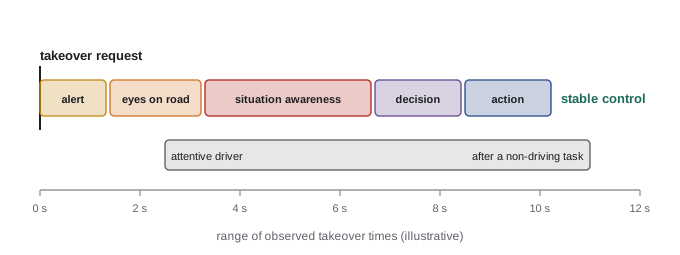
Driving simulator studies find that drivers who have been disengaged often take several seconds to resume control and that the quality of their driving remains degraded for some time afterward. Times vary widely with the situation, the alert design and what the driver was doing; non-driving tasks such as reading or watching video lengthen takeover times. Engineers use these findings to set minimum warning times for Level 3 systems, typically on the order of 10 seconds in regulations such as UN Regulation 157, and to design systems that can reach a minimal risk condition on their own if the human does not respond.
Worked problem
Takeover distance
A Level 3 system on a highway at 62 mph (100 km/h) detects that it will leave its ODD at a construction zone ahead. If the driver needs 7 s to take over safely and the system provides a 3 s margin, how far ahead must it detect the zone?
Show solution
- Speed: \( 100/3.6 = 27.8 \) m/s.
- Time needed: \( 7 + 3 = 10 \) s.
- Distance: \( 27.8 \times 10 = 278 \) m.
Answer: About 280 m ahead, which exceeds typical sensor range in poor weather, so the system relies on map data and connected information about work zones to give enough warning.
Mode confusion and automation complacency
Mode confusion occurs when the human's understanding of what the automation is doing differs from what it is actually doing. A driver may believe adaptive cruise control is active when it has silently disengaged, or believe a lane-keeping system will steer through a sharp curve when it will not. Aviation has long experience with mode confusion, which has contributed to serious accidents; the lessons apply directly to cars. Clear, consistent indication of system state, distinct sounds for engagement and disengagement, and avoiding hidden mode changes are basic design requirements.
Automation complacency is over-reliance on a system that usually works. As drivers gain experience without incidents, they monitor less. Marketing names that suggest more capability than the system has can make this worse. Investigations of crashes involving Level 2 systems have repeatedly found drivers who were not watching the road. Regulators and safety organizations have responded with expectations for driver monitoring systems: cameras that track eye gaze and head position, escalating alerts when attention lapses, and locking out the feature after repeated misuse. Driver monitoring is now an important part of Level 2 system design, and its effectiveness is assessed by consumer safety ratings programs.
Trust and its calibration
Trust is not something to maximize. The goal is calibrated trust: users trust the system exactly as much as its actual capability warrants. Undertrust leads people to avoid a beneficial system or to intervene unnecessarily; overtrust leads to misuse beyond its limits. Calibration is helped by transparency about limitations, by system behavior that is consistent and predictable, by feedback that shows what the system perceives, such as displays of detected vehicles and pedestrians, and by honest communication from manufacturers. A single high-profile crash can collapse public trust in a whole category of technology, while a long safe record builds it slowly.
Other road users also need to understand automated vehicles. Pedestrians usually rely on eye contact and gestures with drivers, which a driverless vehicle cannot give. Researchers have studied external human-machine interfaces, eHMIs, such as light bars or text displays that signal yielding. Results suggest that clear vehicle motion, slowing early and stopping well back, communicates more than displays alone, and that any external signals should be standardized so people do not have to learn each company's conventions.
Remote assistance and the humans behind driverless fleets
Driverless does not mean that no humans are involved. Robotaxi and delivery operators employ remote assistance staff who help vehicles that are uncertain or stuck, for example by confirming that a lane blocked by a double-parked truck can be passed, or that a police officer is waving traffic through. In most designs the remote operator does not steer the vehicle directly; they give high-level guidance, such as choosing a path or confirming an object, and the vehicle remains responsible for safe driving. Direct remote driving over a mobile network is difficult because of latency, limited situational awareness and the risk of lost connection. Remote assistance raises its own human factors questions: how many vehicles can one person support, how quickly must they respond, how are they trained and how is fatigue managed? Regulators increasingly ask operators to describe these arrangements, and the ratio of vehicles to remote staff strongly affects the economics of a service.
The trolley problem and its limits
The trolley problem is a philosophical thought experiment: a runaway trolley will kill five people unless you divert it onto a track where it will kill one. Popular discussions ask how automated vehicles should choose whom to harm in an unavoidable crash, and a large online survey, the Moral Machine experiment published in 2018, collected millions of responses about such dilemmas across many countries and found both shared preferences and cultural variation.
Most engineers and many ethicists argue that the trolley problem is a poor guide to automated vehicle ethics. Real crash situations rarely present clean binary choices with certain outcomes; the vehicle has uncertain perception, many possible actions and probabilistic consequences. The overwhelming priority is to avoid getting into dilemmas at all, by driving cautiously, keeping safe distances and slowing early, which is where the ethical weight of design decisions really lies. Choosing a speed in a school zone, setting the following distance, deciding how much uncertainty in pedestrian detection is acceptable before braking: these everyday trade-offs between safety, mobility and comfort affect far more lives than rare dilemmas. Germany's 2017 Ethics Commission on Automated and Connected Driving offered principles still widely cited, including that protecting human life takes priority over property and animals and that, in unavoidable accidents, any distinction based on personal features such as age or gender is strictly prohibited.
Worked problem
Ethics in a parameter choice
A planner limits speed near parked cars so it can stop if a child steps out 10 m ahead. With 0.3 s system latency and 7 m/s² braking, what is the maximum speed? How does raising latency to 0.6 s change it?
Show solution
- Stopping distance \( v t_r + v^2/(2a) = 10 \).
- With \( t_r = 0.3 \): \( v^2/14 + 0.3v - 10 = 0 \), so \( v^2 + 4.2v - 140 = 0 \) and \( v = (-4.2 + \sqrt{17.6 + 560})/2 \approx 9.9 \) m/s.
- With \( t_r = 0.6 \): \( v^2 + 8.4v - 140 = 0 \), so \( v = (-8.4 + \sqrt{70.6 + 560})/2 \approx 8.4 \) m/s.
Answer: About 22 mph (36 km/h), falling to about 19 mph (30 km/h) if latency doubles. Such engineering parameters, not trolley dilemmas, embody most of a vehicle's ethical choices.
Equity and social impact
Automated vehicles could bring large benefits: fewer crashes caused by impairment, distraction and fatigue; mobility for people who cannot drive because of age or disability; and cheaper goods movement. They also raise equity questions. Services usually launch in affluent, dense urban areas with good roads and mild weather, so rural, northern and lower-income communities may wait longest. Vehicles must be accessible to wheelchair users and to people with visual, hearing or cognitive disabilities, which requires designing for them from the start rather than as an afterthought. Perception systems must work equally well for all pedestrians; early research found differences in detection performance across groups, a reminder that training data must be representative. Cheaper automated travel could also increase total vehicle travel and congestion, or draw riders away from public transit, unless policy steers it toward shared and transit-supporting uses.
Work is another concern. Professional drivers, of taxis, ride-hailing vehicles, buses and trucks, are a large workforce. Automation is likely to change these jobs gradually, starting in specific corridors and applications, but the transition still affects real people and communities. Thoughtful deployment includes retraining, new roles in fleet operations, remote assistance and maintenance, and honest public discussion of the trade-offs.
Data and privacy
Automated vehicles record a great deal: camera images of streets and people, lidar scans, precise location histories, and sometimes interior video of occupants for driver monitoring or safety. These data are valuable for safety investigations and improvement but sensitive. Location histories can reveal where someone lives, works and worships; images capture bystanders who never agreed to be recorded.
In the United States, there is no comprehensive federal private-sector privacy law. Instead, a growing number of state laws, beginning with the California Consumer Privacy Act as amended by the California Privacy Rights Act, give consumers rights to know, delete and limit the use of personal information, with sensitive data such as precise geolocation receiving extra protection; sector laws and Federal Trade Commission enforcement against unfair or deceptive practices fill in some gaps. In Canada, by comparison, PIPEDA sets national principles for commercial use of personal information. Engineers should apply privacy by design: collect only what is needed, blur faces and license plates in stored imagery, minimize retention, secure data and be transparent with riders.
| Issue | Canada | United States |
|---|---|---|
| Main private-sector privacy law | PIPEDA, with similar laws in Quebec, Alberta and British Columbia | State laws such as California's CCPA as amended by CPRA; no general federal law |
| Sensitive data | Context-based; location and images may be sensitive | Precise geolocation is sensitive in several state laws |
| Regulator | Office of the Privacy Commissioner and provincial commissioners | Federal Trade Commission and state attorneys general or agencies |
Common mistakes
MistakeAssuming a disengaged driver can take over instantly.
InsteadTakeovers take seconds and performance stays degraded; design warnings and fallbacks accordingly.
MistakeTrying to maximize user trust.
InsteadAim for calibrated trust that matches real capability.
MistakeTreating the trolley problem as the core ethics question.
InsteadEveryday parameters like speed and margins carry most of the ethical weight.
MistakeDeploying only where easiest without considering equity.
InsteadConsider accessibility, underserved areas, transit effects and workforce impacts.
MistakeStoring raw imagery and location indefinitely.
InsteadMinimize, anonymize, secure and limit retention under privacy law.
Summary and key terms
- Level 2 and 3 systems depend on human attention, which is poor at sustained monitoring.
- Takeovers take several seconds and longer after non-driving tasks; systems need warnings and fallbacks.
- Mode confusion and complacency are addressed with clear state displays and driver monitoring.
- Trust should be calibrated to actual capability; external signals and legible motion help other road users.
- The trolley problem is a limited guide; real ethical choices lie in everyday design parameters.
- Equity concerns include access, accessibility, fair perception, transit and jobs.
- Vehicle data are sensitive; PIPEDA and US state laws set different privacy frameworks.
- Takeover request
- A system prompt asking the human to resume control.
- Mode confusion
- A mismatch between the human's belief about the automation's state and its actual state.
- Automation complacency
- Reduced monitoring due to over-reliance on automation.
- Driver monitoring system
- Sensors and logic that check driver attention and readiness.
- Calibrated trust
- Trust that matches a system's real capability.
- eHMI
- External human-machine interface signaling a vehicle's intent to others.
- Trolley problem
- A thought experiment about choosing between harms.
- Privacy by design
- Building privacy protections into systems from the start.
- PIPEDA
- Canada's federal private-sector privacy law.
- CCPA
- California Consumer Privacy Act.
Practice problems
Work each problem on paper first, then reveal the answer to check.
Why are humans poor supervisors of reliable automation?
Show answer
Sustained vigilance declines when failures are rare.
At 30 m/s, how far does the vehicle travel during an 8 s takeover?
Show answer
240 m.
Give an example of mode confusion.
Show answer
Believing adaptive cruise is active after it silently disengaged.
What does a driver monitoring system track?
Show answer
Eye gaze, head position and responsiveness.
What is calibrated trust?
Show answer
Trust matching actual capability.
Why is the trolley problem a limited guide?
Show answer
Real situations are uncertain, and avoiding dilemmas matters more.
What did Germany's 2017 Ethics Commission prohibit?
Show answer
Distinguishing between people by personal features in unavoidable accidents.
Name two equity concerns.
Show answer
Access for underserved areas, accessibility, detection fairness, transit effects or jobs.
What law governs private-sector personal data in most of Canada?
Show answer
PIPEDA.
Name a privacy-by-design practice for vehicle imagery.
Show answer
Blurring faces and plates or limiting retention.
Lesson quiz · 5 questions
Score 60% or more to complete this lesson.
Create a free account to save your progress, take quizzes and earn a certificate.