
ROB-400 · Lesson 2 of 12 · 30 min
End effectors and grippers
The end effector is where a manipulator meets the world, and choosing it is often the single most important decision in a manipulation system. A clever grasp planner cannot rescue a gripper that cannot physically hold the object, and a simple gripper matched well to the task can make the rest of the system easy. This lesson surveys the main families of end effectors, how each works, what it is good and bad at, and how engineers choose between them.
What an end effector must do
Every end effector has to do some combination of the following: make contact with the object at suitable locations, apply enough force or suction to resist gravity and the accelerations of transport, conform to the object's shape well enough to hold it securely, release cleanly, and survive the environment (dust, washdown, temperature, impacts). Many also need to sense: report whether an object is present, measure grip force, or detect slip.
Requirements come from the objects and the task. Object properties include mass, size range, shape, surface (porous, smooth, oily, textured), stiffness and fragility, and whether the object may be marked or deformed. Task properties include cycle time, required placement accuracy, whether the object must be reoriented, how cluttered the pick location is, and hygiene or safety rules. Robot properties also constrain the choice: payload capacity must cover the gripper plus the object, the tool flange has a standard bolt pattern (commonly ISO 9409-1), and the robot's controller determines what electrical or pneumatic signals are available.
Parallel-jaw grippers
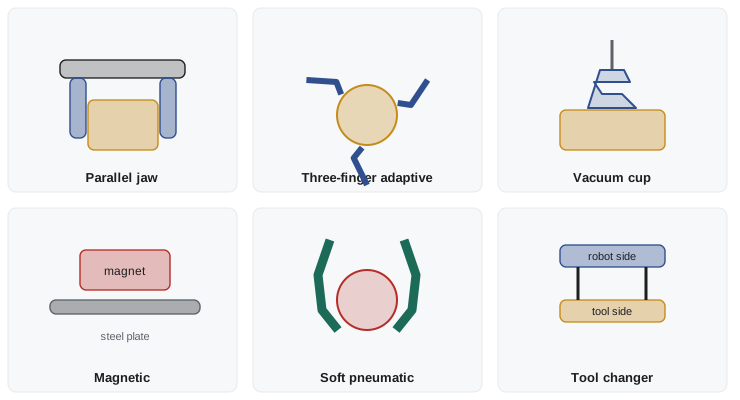
The parallel-jaw gripper is the workhorse of industry and research. Two fingers move toward each other along a straight line, driven by a pneumatic cylinder, an electric motor with a lead screw or rack, or a servo. The object is held by friction between the fingertips and its surfaces, or by the finger shape enclosing it.
Pneumatic grippers are cheap, fast and strong, with grip forces from tens to thousands of newtons. Their limitation is control: they are usually either open or closed, with force set by supply pressure. Electric grippers allow programmable position, speed and force, can report finger width (useful for grasp verification and rough size measurement), and need only electrical connections. Many collaborative-robot grippers are electric for this reason.
Finger design matters as much as the actuator. Flat fingertips work for boxes. V-groove fingertips center cylinders and give two contact lines per finger. Custom fingers shaped to a specific part, often 3-D printed, can make an awkward part trivial to hold. Fingertip material controls friction: polyurethane or silicone pads give friction coefficients well above bare aluminum, while hard fingers are better for precise location.
Multi-finger and adaptive grippers
Three-finger grippers can hold cylinders and spheres more securely than two fingers, because three contacts surround the object. Underactuated or adaptive grippers have fewer motors than joints: a single motor closes several finger links, and springs or linkages let the fingers wrap around whatever they touch. The result is a hand that conforms to varied shapes without complex control. The well-known Robotiq adaptive grippers and several research hands use this principle.
Fully actuated anthropomorphic hands with twenty or more joints exist, but they are expensive, delicate and hard to control. Outside research and a few humanoid platforms, industry favors simpler grippers with good finger design. Lesson 9 returns to dexterous hands.
Grasp types for fingered grippers are often described as power grasps, in which the palm and fingers wrap the object for maximum security, and precision grasps, in which only fingertips touch so the object can be positioned finely. Power grasps resist large loads; precision grasps allow small adjustments.
Suction and vacuum grippers
Vacuum grippers hold objects by lowering the air pressure inside a cup sealed against the surface. Atmospheric pressure on the outside then pushes the object against the cup. The holding force is roughly the pressure difference times the effective cup area, reduced by a safety factor; lesson 7 does the arithmetic. Vacuum is generated by an ejector, which uses compressed air through a venturi, or by an electric vacuum pump or blower.
Suction dominates e-commerce picking because it needs access to only one face of an object, works well on boxes, bags and flat items, and tolerates position error, since the cup just needs to land somewhere on a suitable surface. Cup shape and material matter. Flat cups give stiff, precise holding on smooth surfaces. Bellows cups, with one or more folds, conform to uneven or tilted surfaces and add a short vertical compliance that cushions contact. Soft silicone lips seal on textured surfaces. Foam pads with many small holes can grip irregular or porous items with a high-flow blower.
Suction struggles with porous items (fabric, open-weave bags, some cardboard), very small or curved surfaces where a seal cannot form, heavy items that would need large cups, and items with labels or loose plastic that peel away. Leaks reduce holding force, so suction systems monitor vacuum level to verify grasps and detect slip.
| Cup type | Best for | Weaknesses |
|---|---|---|
| Flat cup | Smooth flat surfaces, precise placement, high lateral stiffness | Needs a flat, clean surface and accurate approach |
| Bellows cup (1.5 to 3.5 folds) | Uneven or tilted surfaces, bags, cushioning contact | Less lateral stiffness; object can sway |
| Oval or elongated cup | Long narrow items such as tubes or rails | Orientation must match the item |
| Foam or multi-hole pad | Irregular, porous or mixed items with high-flow vacuum | Higher air consumption; lower pressure difference |
Magnetic, electroadhesive and needle grippers
Magnetic grippers hold ferromagnetic parts such as steel sheet and machined parts. Electromagnets switch on and off with current; permanent magnets with a mechanical or electrical switching mechanism hold without power, which is safer if power fails. Magnetic grippers cannot handle non-ferrous metals or most other materials, and residual magnetism can make thin sheets stick together.
Electroadhesive grippers use high voltage across interleaved electrodes to induce electrostatic attraction, and can hold fabrics, paper and flat items with low force. Needle grippers drive small needles into textiles or composites. Freeze grippers and Bernoulli grippers (which hold wafers without contact using airflow) serve specialist niches.
Soft grippers
Soft grippers are made from elastomers and other compliant materials. A common design has fingers with internal air chambers that bend when pressurized, wrapping gently around objects of varied shape. Granular jamming grippers use a bag of granular material that flows around an object and then stiffens when air is evacuated. Fin-ray fingers, inspired by fish fins, bend toward the object when pushed. Soft grippers excel at fragile and irregular items such as fruit, baked goods and some medical supplies, and are cheap to make. Their weaknesses are lower precision, lower load capacity and wear.
Tool changers and multi-tool heads
A single robot often needs more than one end effector. Automatic tool changers have a robot-side plate and tool-side plates that lock together mechanically, pneumatically or electrically, passing air, power and signals through. The robot sets one tool in a stand and picks up another in a few seconds. Alternatively, a combined head may carry a suction cup and fingers together, so the system can choose per item without changing tools. Many warehouse picking systems use exactly this hybrid.
Choosing an end effector
Engineers often use a weighted selection matrix: list the criteria that matter for the application, weight them, score each candidate, and compare totals. The matrix forces explicit discussion of what matters and exposes where a candidate fails a hard requirement. Hard requirements, such as food-safe materials or a payload limit, eliminate candidates before scoring.
# Weighted selection matrix for a mixed-item picking cell
import numpy as np
criteria = ["item coverage", "speed", "reliability", "cost", "maintenance"]
weights = np.array([0.35, 0.20, 0.25, 0.10, 0.10])
scores = {                       # 1 (poor) to 5 (excellent)
    "parallel jaw (electric)": [3, 3, 4, 3, 4],
    "bellows suction":         [4, 5, 4, 4, 3],
    "suction + fingers combo": [5, 4, 4, 2, 2],
    "soft pneumatic fingers":  [3, 3, 3, 4, 3],
}
for name, s in scores.items():
    print(f"{name:26s} total = {weights @ np.array(s):.2f}")
best = max(scores, key=lambda k: weights @ np.array(scores[k]))
print("highest score:", best)parallel jaw (electric) total = 3.35 bellows suction total = 4.10 suction + fingers combo total = 3.95 soft pneumatic fingers total = 3.10 highest score: bellows suction
Worked problem
Reading the selection matrix
In the matrix above, the combined suction-and-fingers head scores highest on item coverage but lower on cost and maintenance. If the client doubles the weight on cost (to 0.20) and takes it from item coverage (now 0.25), does the ranking change?
Show solution
- New weights: coverage 0.25, speed 0.20, reliability 0.25, cost 0.20, maintenance 0.10.
- Bellows suction: \( 0.25(4) + 0.20(5) + 0.25(4) + 0.20(4) + 0.10(3) = 4.10 \).
- Combined head: \( 0.25(5) + 0.20(4) + 0.25(4) + 0.20(2) + 0.10(2) = 3.65 \).
- Electric parallel jaw: \( 0.25(3) + 0.20(3) + 0.25(4) + 0.20(3) + 0.10(4) = 3.35 \).
Answer: With the original weights bellows suction and the combined head are close; with cost weighted more heavily, bellows suction wins clearly. Always test how sensitive the choice is to the weights.
Worked problem
Robot payload check
An electric gripper weighs 1.1 kg, its fingers 0.3 kg, a quick-change adaptor 0.4 kg, and the heaviest object 2.5 kg. The robot is rated for 5 kg at its flange. Is there enough margin?
Show solution
- Total mass: \( 1.1 + 0.3 + 0.4 + 2.5 = 4.3 \) kg.
- Margin: \( 5.0 - 4.3 = 0.7 \) kg, or 14 % of rating.
- Payload ratings also depend on how far the center of mass sits from the flange; a long gripper reduces the allowable mass. Check the manufacturer's load diagram.
Answer: The mass fits, but the margin is small and the center-of-mass offset must be checked against the load diagram; high accelerations further reduce what is allowable.
Sensing in the end effector
Simple presence sensing, such as a proximity sensor in the palm or a vacuum switch, confirms that something is held. Electric grippers report finger position and motor current, from which grip force can be estimated. Wrist force-torque sensors measure the full six-axis wrench between flange and gripper, which reveals the object's weight, contact forces during insertion, and collisions. Tactile sensors in the fingertips, covered in ROB-220, measure the pressure distribution and can detect incipient slip. Cameras mounted on the wrist give close-up views for final alignment.
Sensing adds cost and cabling but often pays for itself through better verification and recovery. A rule of thumb in industrial cells is that every grasp should be verified by at least one independent signal before the arm moves away at speed.
Practical details that decide success
Several practical details repeatedly decide whether an end effector works in production. Compliance in the right place, such as a bellows or a spring-loaded finger, absorbs small position errors. Fingertip pads wear and must be inspected and replaced. Hoses and cables must be routed so they do not snag during wrist rotation. Pneumatic systems need clean, dry air and correctly sized lines, or response slows. And the end effector must be safe if power or air fails: a gripper that opens on air loss will drop its object, while a spring-closed or self-locking gripper will hold it.
Worked problem
Fail-safe behavior
A pneumatic gripper lifts 8 kg castings over a walkway. Should it be single-acting (spring-return open), single-acting spring-closed, or double-acting with a check valve?
Show solution
- If air is lost with a spring-return-open gripper, the casting drops: unacceptable over a walkway.
- A spring-closed gripper holds the part on air loss, using spring force alone. Check that the spring force with the friction coefficient and safety factor still holds 8 kg.
- A double-acting gripper with pilot-operated check valves traps air in the closing chamber on supply loss, holding for some time.
Answer: Use a design that holds on loss of air, spring-closed or double-acting with check valves, sized so the hold force alone is adequate, and keep the walkway out of the load path wherever possible.
Common mistakes
MistakeChoosing the gripper after designing the rest of the cell
InsteadSelect and test the end effector early; it constrains perception, planning and cycle time.
MistakeIgnoring the center-of-mass offset in payload checks
InsteadUse the robot's load diagram, which depends on mass and offset from the flange.
MistakeUsing suction on porous items with an ejector sized for sealed boxes
InsteadPorous or leaky items need high-flow vacuum or a different gripper.
MistakeAssuming a gripper is safe if power fails
InsteadSpecify fail-safe behavior: spring-closed, self-locking or check valves.
MistakeRelying on one verification signal
InsteadCombine finger width, force, vacuum or weight to confirm the grasp.
Summary and key terms
- The end effector must contact, hold, conform to, release and sense objects while surviving its environment.
- Parallel-jaw grippers are versatile; electric versions add programmable force and position feedback.
- Adaptive and multi-finger grippers wrap irregular objects; fully actuated hands remain mostly in research.
- Suction needs only one accessible face and tolerates position error, but fails on porous, tiny or heavy items.
- Magnetic, electroadhesive, needle and soft grippers serve specific materials and fragile items.
- Tool changers and combined heads let one robot use several grasp methods.
- Weighted selection matrices, payload checks and fail-safe design guide the choice.
- Parallel-jaw gripper
- A gripper whose two fingers move toward each other along a line.
- Underactuated gripper
- A gripper with fewer actuators than joints that adapts to object shape.
- Power grasp
- A grasp in which fingers and palm wrap the object for security.
- Precision grasp
- A grasp using fingertips only, allowing fine positioning.
- Vacuum ejector
- A device that creates vacuum from compressed air using a venturi.
- Bellows cup
- A folded suction cup that conforms to uneven surfaces and adds vertical compliance.
- Soft gripper
- A gripper made of compliant materials that conforms gently to objects.
- Tool changer
- A coupling that lets a robot swap end effectors automatically.
- Load diagram
- A chart showing allowable payload versus center-of-mass offset from the flange.
- Fail-safe gripper
- A gripper that keeps hold of its object if power or air is lost.
Practice problems
Work each problem on paper first, then reveal the answer to check.
Why do electric grippers help with grasp verification?
Show answer
They report finger position and force, so the robot can check the object was caught.
What advantage does an underactuated gripper have?
Show answer
It conforms to varied shapes with simple control.
Why is suction popular for e-commerce picking?
Show answer
It needs one accessible face and tolerates position error.
Name two items suction struggles with.
Show answer
Porous fabric bags and very small curved items (also heavy items).
What does a bellows cup add compared with a flat cup?
Show answer
Conformity to uneven surfaces and vertical compliance.
When is a magnetic gripper unsuitable?
Show answer
For non-ferrous parts such as aluminum or plastic.
What is the purpose of a tool changer?
Show answer
To let one robot use several end effectors automatically.
A gripper set weighs 1.8 kg and the object 2.9 kg on a 5 kg robot. Total?
Show answer
4.7 kg, leaving 0.3 kg before offset and acceleration effects.
What gripper behavior is safe on air loss over a walkway?
Show answer
One that holds the part, such as spring-closed or with check valves.
What does a wrist force-torque sensor reveal about a grasped object?
Show answer
Its weight and the contact forces and torques acting on it.
Lesson quiz · 5 questions
Score 60% or more to complete this lesson.
Create a free account to save your progress, take quizzes and earn a certificate.