
ROB-400 · Lesson 10 of 12 · 29 min
Mobile manipulation
A fixed robot arm works within the reach of its base. Put the arm on a mobile base and its workspace becomes a whole building: the robot can fetch items from shelves, tend several machines, restock store aisles, open doors and help people at home. Mobile manipulation combines everything in this program, from localization and navigation (ROB-340) and motion planning (ROB-350) to grasping and force control, and it adds its own difficulties: the base is never positioned perfectly, the arm and base must cooperate, and the robot works among people in spaces not designed for robots.
This lesson covers the architectures of mobile manipulators, how base and arm motion are coordinated, the error budget that decides whether a grasp will succeed after driving to it, perception strategies that correct base errors, and the safety requirements that apply when a moving base carries a moving arm.
Kinds of mobile manipulators
Mobile manipulators come in several forms. Industrial autonomous mobile robots with a collaborative arm on top tend machines, move parts between stations and handle totes, often docking at each station before the arm works. Warehouse picking robots combine a mobile base with a lift and a gripper or suction head to pick items from shelves. Service and research robots have one or two arms on a wheeled or legged base, sometimes with a torso that raises and lowers. Legged robots with an arm on the body can climb stairs and step over obstacles. Humanoid robots, an area of intense development at the time of writing, aim to use human environments and tools directly.
The base type shapes everything. A differential-drive base cannot move sideways, so positioning in front of a shelf often requires a maneuver. An omnidirectional base with mecanum or swerve wheels can move in any direction, which simplifies fine positioning. Legged bases handle rough terrain but move the arm's mounting point with every step.
Sequential versus whole-body motion
The simplest strategy is sequential: drive the base to a parking pose near the target, stop, then move the arm while the base stays still. It is easy to plan, safe and predictable, and most industrial mobile manipulators work this way. Its costs are time, because the arm waits while the base drives and vice versa, and sensitivity to parking error, because the arm must compensate for wherever the base actually stopped.
Whole-body motion treats the base and arm as one kinematic chain, with the base's planar position and heading as extra joints. The planner or controller can then move both at once, for example sweeping the base along a shelf while the arm picks, or using a small base motion to extend reach when the arm is near its limit. Whole-body control resolves the redundancy with priorities: keep the gripper on the target first, avoid obstacles and joint limits second, prefer comfortable arm configurations third. The coupled system is more capable but harder to plan, to verify and to make safe, and wheels add nonholonomic constraints that a simple joint model does not capture.
Worked problem
Extending reach with the base
An arm on a mobile base has a comfortable reach of 0.85 m from its shoulder. The shoulder is 0.20 m behind the front of the base. The base can safely park with its front 0.30 m from a shelf. Can the arm reach an item 0.45 m deep on the shelf, and if not, what are the options?
Show solution
- Horizontal distance from shoulder to item: \( 0.20 + 0.30 + 0.45 = 0.95 \) m.
- That exceeds the 0.85 m comfortable reach by 0.10 m.
- Options: park closer (only 0.20 m allowed if bumpers and safety fields permit), lean or extend a torso, raise the base side so the arm reaches straight, or pull the item forward with a non-prehensile push before grasping.
- A whole-body planner can consider these together and choose the safest combination.
Answer: Not as parked. Either reduce the parking distance by at least 0.10 m, if safety allows, or use a push or a different arm pose; the reach budget should be checked for the deepest shelf positions during design.
The error budget
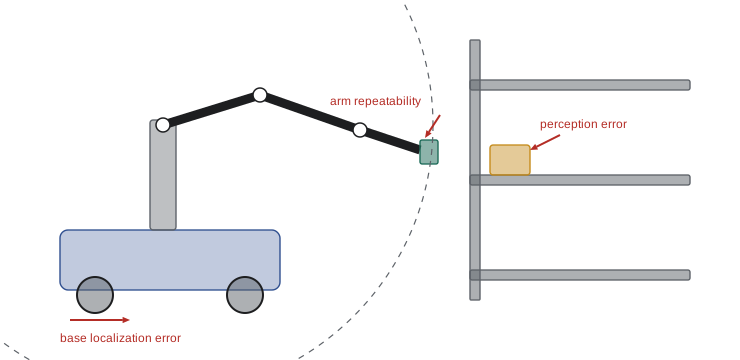
A fixed arm in a calibrated cell can be accurate to a fraction of a millimeter. A mobile manipulator adds the base localization error, which with lidar localization in a known map is typically a few centimeters in position and around a degree in heading, plus any error in the map itself. Heading error matters most at long reach: a one-degree heading error moves the gripper by \( r \sin 1^\circ \approx 0.017 r \), about 15 mm at 0.9 m reach.
Independent error sources combine approximately as the root sum of squares. The total must be smaller than what the grasp tolerates, which lesson 5 estimated from the gripper's clearance and the antipodal margin. If it is not, the system needs a correction: re-perceiving the target after parking, so that the arm moves relative to what the camera sees rather than relative to the map; docking against fixed features; or using fiducial markers on stations.
# Mobile manipulation error budget: root sum of squares versus Monte Carlo, with and without re-perception
import numpy as np
rng = np.random.default_rng(10)
r = 0.9                                       # reach from base middle to gripper, m
sig_xy, sig_th = 0.020, np.radians(1.0)       # base localization (per axis) and heading
sig_arm, sig_cam = 0.0005, 0.003              # arm repeatability and camera pose error (per axis)
tol = 0.010                                   # lateral tolerance the grasp accepts, m
n = 200000
# lateral error at the gripper when moving to a map-based target (no re-perception)
lat_map = rng.normal(0, sig_xy, n) + r * np.sin(rng.normal(0, sig_th, n)) + rng.normal(0, sig_arm, n) + rng.normal(0, sig_cam, n)
# after parking, the wrist camera re-measures the target: base errors cancel, camera and arm remain
lat_rep = rng.normal(0, sig_cam, n) + rng.normal(0, sig_arm, n)
rss = np.sqrt(sig_xy**2 + (r*sig_th)**2 + sig_arm**2 + sig_cam**2)
print(f"RSS lateral sigma (map-based): {1000*rss:.1f} mm")
print(f"Monte Carlo sigma (map-based): {1000*lat_map.std():.1f} mm, within ±10 mm: {100*np.mean(abs(lat_map) < tol):.1f} %")
print(f"Monte Carlo sigma (re-perceived): {1000*lat_rep.std():.1f} mm, within ±10 mm: {100*np.mean(abs(lat_rep) < tol):.2f} %")RSS lateral sigma (map-based): 25.6 mm Monte Carlo sigma (map-based): 25.7 mm, within ±10 mm: 30.3 % Monte Carlo sigma (re-perceived): 3.0 mm, within ±10 mm: 99.90 %
The numbers make the design decision for you. Grasping from the map pose alone would miss a ±10 mm tolerance about seven times in ten, while re-measuring the target with a wrist camera after parking brings success to about 99.9 % in this model. That is why nearly every practical mobile manipulator looks again after it stops, and why camera calibration (ROB-330) is a first-class concern.
Docking, fiducials and station design
Where a mobile manipulator visits the same stations repeatedly, the cheapest accuracy comes from the environment. Mechanical docking guides align the base to a few millimeters. Fiducial markers such as AprilTags or ArUco markers fixed to each station let the robot measure its pose relative to the station with a camera to about a millimeter at short range. Some machine-tending systems touch off against reference features with the gripper, as a CNC machine probes a part. Designing stations with these features is part of deploying mobile manipulators, not an afterthought.
Worked problem
Fiducial correction after parking
A robot parks at a machine with lidar localization error of 25 mm. A marker on the machine, 0.5 m from the wrist camera, is measured with 0.8 mm position error and 0.3 degree rotation error. The part sits 0.25 m from the marker. Estimate the part position error after correcting with the marker.
Show solution
- After correction, the base error no longer matters, because the arm moves relative to the marker frame.
- Rotation error projected to the part: \( 0.25 \times \sin 0.3^\circ \approx 1.3 \) mm.
- Combine with the marker position error: \( \sqrt{0.8^2 + 1.3^2} \approx 1.5 \) mm, plus arm repeatability of well under a millimeter.
Answer: About 1.5 mm, compared with 25 mm or more without the marker. Placing markers close to the work point keeps rotation errors small.
Interacting with the environment
Mobile manipulators in buildings must interact with things designed for people: doors, drawers, elevator buttons, light switches, carts. Opening a door means grasping a handle and moving along a circular path whose radius and hinge location are only roughly known; lesson 11 shows how to estimate them from motion. Force control (ROB-300) is essential here, because a stiff arm pulling along a slightly wrong arc would fight the hinge and either stall or damage something. Compliance, either from impedance control or from a compliant wrist, lets the constraint guide the motion.
Whole-body considerations return in these tasks: a robot opening a heavy door may need to move its base while pulling, and pushing a cart requires the base to supply the force while the arm holds the handle. The base's own stability, the risk of tipping when the arm extends with a load, must be checked like any placement in lesson 8: the combined center of mass must stay inside the wheel support polygon with margin, including during accelerations.
Worked problem
Tip-over check with an extended arm
A 120 kg mobile base has its center of mass at its geometric center. Its front wheels are 0.30 m ahead of that center. The arm and a payload, together 18 kg, extend so their combined center of mass is 0.80 m ahead of the base center. Is the robot statically stable?
Show solution
- Total mass: \( 120 + 18 = 138 \) kg.
- Combined center of mass position: \( (120 \times 0 + 18 \times 0.80) / 138 = 0.104 \) m ahead of center.
- The front wheels are at 0.30 m, so the margin is \( 0.30 - 0.104 = 0.196 \) m: stable.
- Braking hard while extended shifts the effective center of mass forward; at 2 m/s² with a combined center of mass 0.9 m high, the shift is about \( 0.9 \times 2 / 9.81 \approx 0.18 \) m, leaving only about 16 mm.
Answer: Statically stable with about 0.2 m margin, but nearly at its limit when braking hard with the arm extended. Limit deceleration or retract the arm before driving.
Safety for mobile manipulators
Mobile manipulators combine the hazards of mobile robots, such as collisions with people and objects while driving, with those of arms, such as pinching and impact. Standards address both. ANSI/A3 R15.08, in parts published in 2020 and 2023, covers industrial mobile robots and is used in both the United States and Canada; ISO 3691-4 covers driverless industrial trucks; and the robot standards ISO 10218-1 and -2 (2025 editions), adopted in Canada through CSA Z434 and in the United States through ANSI/A3 R15.06, cover the arm. Collaborative operation and power and force limits from those standards apply when the arm works near people. A typical risk assessment defines safety fields for the base's scanners that shrink as it slows, limits arm speed and force when people are near, and specifies what the robot does when someone enters its workspace while the arm is extended.
Common mistakes
MistakeGrasping from the map pose after driving
InsteadRe-perceive the target or a station marker after parking and move relative to that measurement.
MistakeIgnoring heading error
InsteadHeading error times reach often dominates position error; budget it explicitly.
MistakeChecking reach only at the nearest shelf positions
InsteadCheck the deepest and highest targets against the parking constraints during design.
MistakeDriving with the arm extended and a load
InsteadRetract the arm or limit acceleration so the combined center of mass stays well inside the wheel base.
MistakeTreating base and arm safety separately
InsteadAssess the combined system: base safety fields, arm speed and force limits and their interaction.
Summary and key terms
- Mobile manipulators extend an arm's workspace to a whole facility but inherit base positioning errors.
- Sequential motion is simple and safe; whole-body motion is faster and more capable but harder to plan and verify.
- Independent errors combine roughly as a root sum of squares; heading error times reach is often the largest term.
- Re-perceiving the target after parking, docking guides and fiducial markers remove most base error.
- Interacting with doors and carts needs force control and coordinated base motion.
- The combined center of mass must stay inside the wheel support polygon, including during braking.
- Safety assessments cover the base, the arm and their interaction under R15.08, ISO 3691-4, ISO 10218, CSA Z434 and R15.06.
- Mobile manipulator
- A robot arm mounted on a mobile base.
- Sequential motion
- Moving the base and then the arm, never both at once.
- Whole-body control
- Controlling base and arm together as one redundant system.
- Error budget
- An accounting of error sources and their combined effect on task accuracy.
- Root sum of squares
- Combining independent errors as the square root of the sum of their squares.
- Parking pose
- The base pose from which the arm performs a task.
- Fiducial marker
- A printed pattern whose pose a camera can measure precisely.
- Docking
- Aligning a mobile base mechanically or optically with a station.
- Tip-over margin
- The distance from the combined center of mass to the edge of the wheel support polygon.
- Safety field
- A scanner-monitored zone that slows or stops the robot when entered.
Practice problems
Work each problem on paper first, then reveal the answer to check.
Gripper error from a 2 degree heading error at 0.6 m reach?
Show answer
About 21 mm.
Combine independent errors of 3, 4 and 12 mm.
Show answer
About 13 mm.
Why do practical mobile manipulators re-perceive after parking?
Show answer
To remove base localization error from the grasp.
Name one advantage of whole-body motion.
Show answer
Faster tasks and extended reach by using base motion.
What is the main risk when braking with the arm extended?
Show answer
Tipping forward as the effective center of mass shifts.
Why place fiducial markers close to the work point?
Show answer
Rotation measurement errors then cause smaller position errors.
Which standard covers industrial mobile robots in North America?
Show answer
ANSI/A3 R15.08.
How does compliance help when opening a door?
Show answer
It lets the hinge constraint guide the motion instead of fighting it.
A 100 kg base with a 10 kg arm load 0.7 m ahead. COM shift?
Show answer
About 64 mm ahead of the base center.
What cheap environmental feature gives millimeter docking?
Show answer
Mechanical docking guides or fiducial markers.
Lesson quiz · 5 questions
Score 60% or more to complete this lesson.
Create a free account to save your progress, take quizzes and earn a certificate.