
RAC-410 · Lesson 5 of 12 · 17 min
Cooling towers and condenser water systems
In early April, Raj, Theo and two of Grace's operators started up Riverbend's cooling tower for the season. The tower had been drained in November, except for the cell that fed the free-cooling heat exchanger, which had run all winter with its basin heaters on. Theo had cleaned small towers with Raj before, at the seniors' residence in RAC-210, where they had dealt with Legionella risk and scaled fill. This tower was ten times the size, and Raj used the start-up to teach him how the whole condenser water system worked, not just the tower.
RAC-210 lesson 7 introduced cooling towers, range and approach, and the basics of water management for Legionella control. This lesson goes deeper, at the scale of a central plant: how towers are selected and controlled, how condenser water flow and temperature affect the chillers, how much water a tower uses, how free cooling with a waterside economizer works, and how towers are protected in winter.
How a tower rejects heat
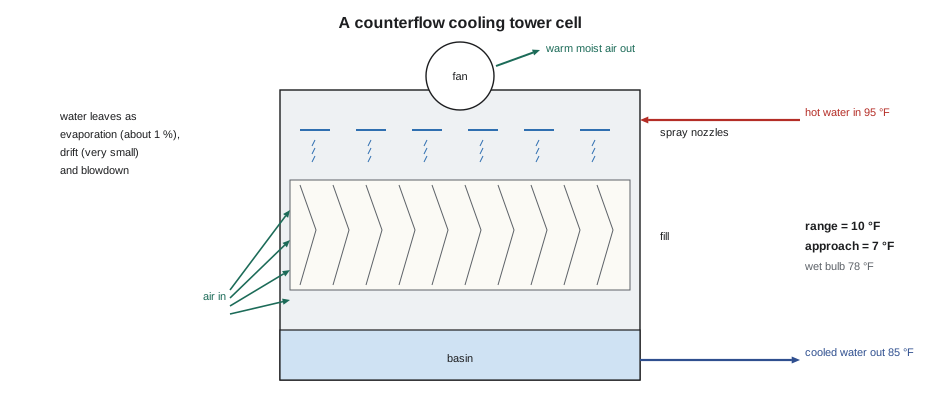
A cooling tower cools water mainly by evaporating a small part of it. Warm condenser water is distributed over a fill, a pack of corrugated plastic sheets or splash bars that spreads it into thin films and droplets, while fans move outdoor air through the fill. A little of the water evaporates, taking with it about 1,000 Btu per pound evaporated, and the rest falls, cooler, into a basin and returns to the chillers. Because the limit is evaporation, the lowest temperature a tower can reach is the outdoor wet-bulb temperature, not the dry bulb, and on a hot, dry day that can be many degrees below the air temperature.
Two numbers describe a tower's duty. The range is the temperature drop of the water through the tower, which equals the condenser's temperature rise: it depends on the heat rejected and the water flow. The approach is how close the leaving water comes to the wet bulb: it depends on the tower's size and how hard its fans are working. A larger tower, or one running more fans, achieves a smaller approach.
Large plants use induced-draft towers, with fans on top drawing air through, in counterflow, where air rises against the falling water, or crossflow, where air moves sideways across it. They are built in cells, each with its own fan, fill and basin section, so that cells can be staged and one can be taken out of service. Riverbend's tower had three cells with variable-speed fans, sharing a common basin.
Tower and chiller together
The tower and the chillers are a system. The heat the tower must reject is the chilled-water load plus the energy the compressors put in, so a plant's heat rejection is about 15 to 20 % more than its cooling load with efficient water-cooled chillers. The condenser water temperature that the tower produces sets the chillers' lift: each degree colder lowers the condensing temperature and the compressor energy, but costs tower fan energy. The best plant operation balances the two.
The design point is chosen by the plant designer. Riverbend's designers used a conservative wet bulb of 78 °F, the AHRI condenser water conditions of 85 °F to the chillers with a 10 °F range, and therefore an approach of about 7 °F. The script works out the heat rejected, the condenser water flow and how much water the tower evaporates at design.
# Riverbend cooling towers: heat rejected, water flow, evaporation, and hours of free cooling
tons, chiller_kw = 1000.0, 600.0
reject = tons * 12000 + chiller_kw * 3412      # Btu/h: the load plus the compressor energy
rng = 10.0                                     # F, condenser water range
gpm = reject / (500 * rng)
wb, leaving = 78.0, 85.0
print(f"heat rejected {reject / 1e6:.1f} million Btu/h ({reject / 15000:,.0f} tower tons), condenser water {gpm:,.0f} gpm")
print(f"range {rng:.0f} F, approach {leaving - wb:.0f} F")
evap = 0.0008 * gpm * rng                      # gpm: rule of thumb, about 0.1 % of flow per F of range
print(f"evaporation about {evap:.1f} gpm ({evap * 60:,.0f} gal/h), {evap / gpm:.1%} of the flow")
print(f"drift at 0.005 % of flow: {gpm * 0.00005 * 60:.1f} gal/h")
chw_free = 50.0                                # F, chilled water supply the hospital accepts in winter
hx_app, tower_app = 3.0, 9.0                   # F, exchanger approach and tower approach at light load
wb_max = chw_free - hx_app - tower_app
print(f"full free cooling when wet bulb is at or below {wb_max:.0f} F")
wb_bins = [(5, 500), (15, 700), (25, 1000), (35, 1300), (45, 1400), (55, 1500), (65, 1700), (75, 660)]
full = sum(h for t, h in wb_bins if t + 5 <= wb_max)    # bins are 10 F wide; count those wholly below
print(f"hours a year with full free cooling about {full:,} of {sum(h for _, h in wb_bins):,}")heat rejected 14.0 million Btu/h (936 tower tons), condenser water 2,809 gpm range 10 F, approach 7 F evaporation about 22.5 gpm (1,349 gal/h), 0.8% of the flow drift at 0.005 % of flow: 8.4 gal/h full free cooling when wet bulb is at or below 38 F hours a year with full free cooling about 2,200 of 8,760
At design the tower rejected about 14 million Btu/h, about 940 tower tons (a tower ton is 15,000 Btu/h, the heat of one ton of cooling plus its compressor), needing about 2,800 gpm of condenser water, and evaporated about 22 gpm, more than 1,300 gallons an hour, under 1 % of the flow. Drift, the droplets carried out with the air, was much smaller with modern eliminators, about 8 gal/h. The evaporation is why towers need a constant supply of makeup water, and lesson 6 shows how much more is needed to control the water's chemistry.
Condenser water flow and temperature control
Condenser water is usually pumped at a constant flow per running chiller, often about 3 gpm per ton, with one condenser pump for each chiller. Each chiller's condenser has a minimum flow, below which the tubes foul and the heat transfer suffers, and a maximum, above which the tubes erode. Some newer plants vary condenser water flow too, but that needs careful coordination with the chillers' minimum flows and the tower's minimum flow for good water distribution over the fill.
The tower's leaving water temperature is controlled by its fans: staging cells and varying fan speeds to hold a setpoint. Three control strategies are common:
- Fixed setpoint. The tower holds a constant temperature, often the design value. Simple, but it wastes chiller energy whenever cooler water is available, and it set up the surge trip in lesson 3.
- Wet-bulb reset. The setpoint follows the outdoor wet bulb plus a fixed approach, down to the minimum the chillers allow. Cooler water at part load lowers the lift and the chiller energy, especially with variable-speed chillers.
- Optimized control. The plant controls choose the setpoint that minimizes the combined chiller and tower fan power, using the equipment's performance curves, as lesson 9 describes.
Every chiller has a minimum entering condenser water temperature, often around 55 to 65 °F for centrifugals at start-up, below which the condensing pressure is too low to drive refrigerant through the metering device or to keep the oil system working. Towers therefore have a bypass valve that returns some of the warm water directly to the basin, or fan controls that stop the fans, to hold the minimum during cold-weather starts.
Running more tower cells at lower fan speed is usually more efficient than running fewer cells at high speed, because fan power falls with roughly the cube of speed and spreading the water over more fill improves the approach. Riverbend's controls ran all available cells whenever there was enough flow to wet their fill properly. Each cell's distribution system has a minimum flow; below it, water channels through part of the fill and dry spots scale.
Free cooling with a waterside economizer
In cold weather a tower can make water cold enough to cool the chilled water directly, without running a chiller. A waterside economizer places a plate heat exchanger between the condenser water and the chilled water, so the tower's water never enters the clean chilled-water loop. When the wet bulb is low enough, the chillers shut off and the tower and exchanger carry the load. This is free cooling, although the pumps and fans still use energy.
Full free cooling is possible when the tower's leaving water, plus the exchanger's approach, is no warmer than the chilled-water supply the building needs. In winter, towers run at larger approaches, because the load is small and fans are slowed or the water cools less efficiently at low wet bulbs. Riverbend's hospital accepted chilled water at 50 °F in winter, because the air handlers did little dehumidification then, so the script found the wet-bulb limit and estimated the hours available from local wet-bulb bins. With a 3 °F exchanger approach and a 9 °F tower approach, full free cooling was available whenever the wet bulb was at or below about 38 °F, about 2,200 hours of a typical Louisville year. Many plants also use partial free cooling, with the exchanger precooling the return water ahead of a chiller in the shoulder seasons.
Free cooling is why lesson 1's year looked the way it did: much of the cooling below 50 °F outdoors cost only pump and fan energy. Raising the winter chilled-water temperature, as the hospital had done, was what made it possible.
Winter operation and freeze protection
A tower that runs in winter must be protected from freezing. The basin has electric or steam heaters controlled by a thermostat and a low-level switch. Fans can be reversed on some towers to melt ice from the louvers. The water must keep moving: a tower cell with flow but no heat load can freeze its fill quickly, so cells are taken out of service, isolated and drained when they are not needed. Makeup and blowdown lines, sensing lines and the piping between the tower and the building need heat tracing and insulation. Some plants use an indoor sump tank instead of the outdoor basin, so that the tower drains into the building when the pumps stop. At Riverbend, the operators checked the free-cooling cell twice a shift on cold nights, looking for ice at the air inlet and listening for the fan, and logged the basin temperature.
In spring, starting up drained cells follows the water management plan from RAC-210: clean and disinfect the basin and fill if needed, check the drift eliminators and nozzles, restart the water treatment before the tower runs under load, and record the start-up. Raj's checklist also included the mechanical parts: fan blade pitch and condition, gearbox oil level and condition, belt tension where used, vibration switches, bearings, motor insulation resistance and the basin heaters. A cooling tower is a machine as well as a water system.
Water use and the alternatives
Cooling towers use a lot of water, and in some places that is a growing concern. Alternatives include hybrid and adiabatic coolers, which run dry, as air-cooled heat exchangers, in cool weather and wet the air or coil only in hot weather, and air-cooled chillers for smaller loads. They save water at the cost of higher energy use on hot days. For a hospital in a water-rich region with a large load, an evaporative tower remains the normal choice, but the water use is worth measuring, and lesson 6 shows how the chemistry program affects it.
Common mistakes
MistakeHolding the tower at its design setpoint all year.
InsteadReset with the wet bulb, or optimize with chiller and fan power.
MistakeRunning fewer cells at high fan speed to save effort.
InsteadRun more cells at lower speed, within the minimum flow for each cell's distribution.
MistakeIgnoring the chillers' minimum condenser water temperature in cold weather.
InsteadUse the tower bypass and fan control to hold the minimum during starts.
MistakeLetting a tower cell run with flow but no load in freezing weather.
InsteadIsolate and drain idle cells, and keep heat and flow on active ones.
MistakeTreating the tower only as a water system.
InsteadInspect the fans, gearboxes, bearings and motors as well.
Summary and key terms
- Towers cool water mainly by evaporating part of it; they can approach but not reach the wet bulb.
- Range is the water's temperature drop; approach is how close the leaving water comes to the wet bulb.
- Towers reject the cooling load plus compressor energy; colder condenser water lowers chiller lift.
- Wet-bulb reset or optimized control usually saves energy over a fixed setpoint, within the chillers' minimums.
- A waterside economizer uses tower water through a plate exchanger to cool the chilled water when the wet bulb is low.
- Winter towers need heat, flow and attention to prevent freezing; start-ups follow the water management plan and include the mechanical parts.
- Cooling tower
- A device that cools water by evaporating part of it into moving air.
- Range
- The temperature drop of water through a cooling tower.
- Approach
- The difference between the tower’s leaving water temperature and the wet bulb.
- Fill
- The material in a tower that spreads water into films or droplets for contact with air.
- Drift
- Water droplets carried out of a tower with the air.
- Waterside economizer
- A heat exchanger that lets tower water cool chilled water directly in cold weather.
- Wet-bulb reset
- Control that lowers the tower setpoint as the outdoor wet bulb falls.
- Tower ton
- 15,000 Btu/h, the heat rejected for one ton of cooling plus compressor energy.
Practice problems
Work each problem on paper first, then reveal the answer to check.
Water enters a tower at 95 °F and leaves at 85 °F with the wet bulb at 75 °F. What are the range and approach?
Show answer
Range 10 °F, approach 10 °F.
Why does a tower reject more heat than the chillers' cooling load?
Show answer
It also rejects the energy the compressors add.
What limits how low a chiller's condenser water can go at start-up?
Show answer
The chiller's minimum condensing pressure for refrigerant flow and oil management.
When is full free cooling available?
Show answer
When tower water plus the exchanger approach is no warmer than the chilled water the building needs.
Lesson quiz · 5 questions
Score 60% or more to complete this lesson.
Create a free account to save your progress, take quizzes and earn a certificate.