
RAC-410 · Lesson 2 of 12 · 17 min
Chiller types and ratings
Raj's first assignment for Theo was a desk job. He gave him the submittal books for Riverbend's three chillers, the rating certificates and the operators' logs from the previous summer, and asked him one question: "If the hospital could run only one of these machines all year, which one should it be, and why?" Theo assumed it would be a quick answer, since all three had similar full-load efficiencies. It was not, and the reason is the subject of this lesson.
This lesson describes the main types of chiller, how air-cooled and water-cooled chillers differ, and how chillers are rated: the standard rating conditions, the integrated part-load value and the way to compare machines for a real building.
What every chiller has in common
A vapor-compression chiller is the same refrigeration system as the ones in earlier courses, packaged for water. Its evaporator is a heat exchanger in which refrigerant boils while chilled water flows past it, usually a shell-and-tube vessel with the water in the tubes and the refrigerant in the shell, or a brazed-plate exchanger on smaller machines. Its condenser rejects the heat to condenser water from a tower or to outdoor air. Between them are the compressor, the metering device and a control panel that runs the machine to hold a leaving chilled-water setpoint. What distinguishes chiller types is mainly the compressor.
Scroll and reciprocating chillers
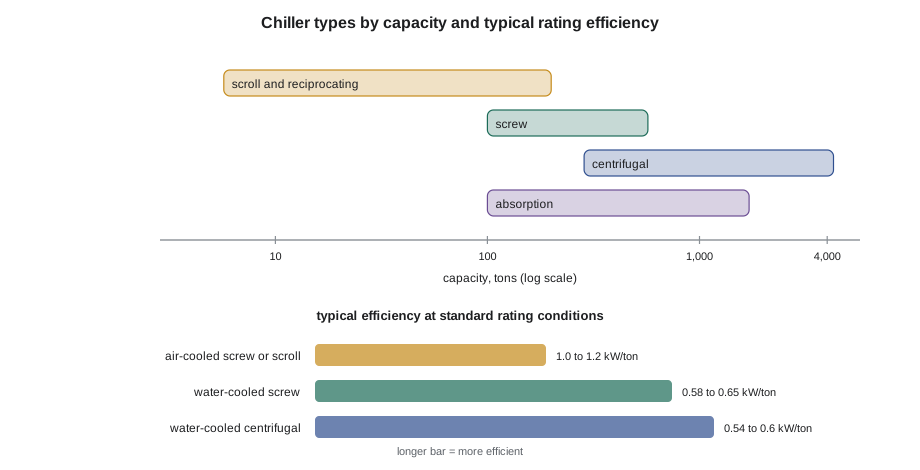
Small chillers, from about 5 to 200 tons, usually use several scroll compressors in parallel on one or more refrigerant circuits, or, in older machines, reciprocating compressors. Capacity is controlled by staging compressors on and off, sometimes with one variable-speed or digital scroll for finer control. These chillers are simple and widely serviced, and many of the skills from RAC-210 and RAC-220 apply directly. The brewery's glycol chiller from earlier courses was a small machine of this kind.
Screw chillers
Screw chillers, from roughly 100 to 600 tons or more, use one or more rotary screw compressors, which RAC-210 lesson 4 described. They unload with a slide valve or by varying speed, they tolerate high lift well, and they are common in both water-cooled and air-cooled designs. The seniors' residence chiller that Theo had worked on with Raj in RAC-210 was a water-cooled screw machine of about 100 tons, and CH-3 at Riverbend was a larger one.
Centrifugal chillers
Centrifugal chillers dominate large water-cooled plants, from about 300 to 3,000 tons and more. A centrifugal compressor raises the refrigerant's pressure by spinning it outward at high speed in an impeller and converting that velocity into pressure in a diffuser. It is efficient, quiet, compact for its capacity and has few wearing parts. It also has a particular weakness, surge, which lesson 3 explains in detail along with the variable-speed drives, magnetic bearings and low-pressure refrigerants that modern centrifugals use. CH-1 and CH-2 at Riverbend were both centrifugals.
Absorption chillers
Absorption chillers use heat instead of a compressor to drive the cycle, with water as the refrigerant and a lithium bromide solution as the absorbent. They are used where steam, hot water or waste heat is cheap, or where electrical capacity is limited. Lesson 4 covers them, along with heat-recovery chillers that deliver useful heat as well as cooling.
Air-cooled and water-cooled
An air-cooled chiller has its condenser coils and fans built in and sits outdoors, usually on a roof or a pad. It needs no cooling tower, no condenser pumps and no tower water treatment, so it is simpler and cheaper to install and maintain, and it uses no water. But it rejects heat to the outdoor dry-bulb temperature, which on a hot day is much higher than the wet-bulb temperature a tower works to. Its condensing temperature is therefore higher, its lift greater and its efficiency lower: a typical air-cooled chiller at its rating conditions uses about 1.0 to 1.2 kW/ton, against 0.55 to 0.65 kW/ton for a water-cooled centrifugal.
A water-cooled chiller sits indoors in a mechanical room and needs a cooling tower, condenser pumps, condenser piping and water treatment, which lessons 5 and 6 cover. It is the normal choice for large plants because of its efficiency, long life and the fact that a centrifugal or large screw machine in a mechanical room is easier to maintain and lasts longer than the same capacity of rooftop equipment. Many campuses use both: water-cooled machines in the central plant and air-cooled chillers for small remote buildings or as emergency backup.
Rating conditions
Chiller performance changes with the temperatures and flows it works at, so ratings are given at standard conditions. In North America the standard is AHRI 550/590, Performance Rating of Water-Chilling and Heat Pump Water-Heating Packages Using the Vapor Compression Cycle, and manufacturers certify their ratings to it through AHRI's program. For water-cooled chillers, its standard rating conditions include:
- Chilled water leaving at 44 °F and entering at 54 °F, a 10 °F difference, with a flow of about 2.4 gpm per ton.
- Condenser water entering at 85 °F and leaving at 95 °F, with a flow of about 3.0 gpm per ton.
- Fouling allowances in the evaporator and condenser tubes, so that the rating reflects a machine in service rather than one with perfectly clean tubes.
Air-cooled chillers are rated with the same chilled-water conditions and 95 °F outdoor air at full load. A chiller selected for a real building is rarely run at exactly these conditions. Riverbend's design called for a 12 °F chilled-water temperature difference, for example, which needs less flow than the rating condition. Manufacturers' selection software calculates performance at the project's actual conditions, and AHRI's program allows certified ratings at those conditions too; that is what a good submittal shows.
Integrated part-load value
Because a chiller spends most of its hours at part load, AHRI 550/590 also defines a single number for part-load performance, the integrated part-load value, IPLV. It is a weighted average of the efficiency measured at four points: 100 %, 75 %, 50 % and 25 % of capacity, called A, B, C and D. At each lower load the entering condenser water is colder, because on the days when a building needs less cooling the outdoor wet bulb is usually lower and the tower can make colder water. For water-cooled chillers the standard lowers the entering condenser water from 85 °F at full load to 75 °F at 75 % and 65 °F at 50 % and 25 %. The weights reflect how a typical building's hours are spread:
When efficiency is expressed in kW/ton, the weights are applied to the reciprocals, as shown, because kW/ton is the inverse of efficiency. With COP or EER the IPLV is simply the weighted average of the four values. When the same calculation is done at a project's own conditions instead of the standard ones, the result is called the non-standard part-load value, NPLV.
The weights are worth noticing. The full-load point carries only 1 % of the weight; the 75 % and 50 % points together carry 87 %. A chiller that is excellent at full load but poor at part load will have an unimpressive IPLV, and the reverse.
Comparing Riverbend's three chillers
Theo took the four AHRI points from each chiller's certified data and worked out its IPLV, then asked how much electricity each would use if it carried the whole year's cooling from lesson 1. That last step is a simplification, because no single chiller could carry the peak and the real plant mixes machines, but it shows the difference in a way the hospital's managers would understand.
# Part-load efficiency at the four AHRI rating points (A = 100 %, B = 75 %, C = 50 %, D = 25 % load)
# values are kW/ton, from the submittals (illustrative)
chillers = {
    "CH-1 constant-speed centrifugal (2009)": [0.58, 0.55, 0.58, 0.80],
    "CH-2 variable-speed centrifugal (2024)": [0.56, 0.42, 0.32, 0.36],
    "CH-3 water-cooled screw (2015)":         [0.62, 0.55, 0.50, 0.58]}
weights = [0.01, 0.42, 0.45, 0.12]
for name, e in chillers.items():
    iplv = 1 / sum(w / x for w, x in zip(weights, e))   # kW/ton: weighted harmonic mean
    print(f"{name}: full load {e[0]:.2f} kW/ton, IPLV {iplv:.3f} kW/ton (COP {3.517 / iplv:.2f})")
    print("    kW/ton at A, B, C, D:", "  ".join(f"{x:.2f}" for x in e))
# what the difference means at Riverbend: 2.26 million ton-hours a year, mostly at part load
ton_hours = 2.26e6
for name, e in chillers.items():
    iplv = 1 / sum(w / x for w, x in zip(weights, e))
print(f"{name[:4]} would use about {ton_hours * iplv / 1e6:.2f} million kWh if it carried the whole year")CH-1 constant-speed centrifugal (2009): full load 0.58 kW/ton, IPLV 0.586 kW/ton (COP 6.00)
kW/ton at A, B, C, D: 0.58 0.55 0.58 0.80
CH-2 variable-speed centrifugal (2024): full load 0.56 kW/ton, IPLV 0.363 kW/ton (COP 9.70)
kW/ton at A, B, C, D: 0.56 0.42 0.32 0.36
CH-3 water-cooled screw (2015): full load 0.62 kW/ton, IPLV 0.530 kW/ton (COP 6.64)
kW/ton at A, B, C, D: 0.62 0.55 0.50 0.58
CH-1 would use about 1.32 million kWh if it carried the whole year
CH-2 would use about 0.82 million kWh if it carried the whole year
CH-3 would use about 1.20 million kWh if it carried the whole yearCH-1, the 2009 constant-speed centrifugal, had a full-load efficiency of 0.58 kW/ton, but its IPLV was no better, about 0.59, because its efficiency fell off at low load: at 25 % it used 0.80 kW/ton. CH-2, the variable-speed machine, had a similar 0.56 kW/ton at full load, but an IPLV of about 0.36, because at part load, with colder condenser water, its drive slowed the compressor and its efficiency rose sharply, to 0.32 kW/ton at 50 %. CH-3, the screw, fell between them. Carrying the whole year, CH-2 would use about 0.82 million kWh against 1.32 million for CH-1, nearly 40 % less.
So the answer to Raj's question was CH-2, and the reason was not its nameplate but its part-load curve and its ability to take advantage of cold condenser water. Theo then asked the obvious follow-up: which machine did the operators run first? The log sheets showed that CH-1 had been the lead chiller for fifteen years and had stayed the lead out of habit after CH-2 arrived. Lesson 9 returns to that.
Limits of the ratings
IPLV is useful for comparing chillers, but it is not a prediction of a building's energy use. Its weights represent a generic building with a single chiller. A plant with several chillers runs each one at loads that depend on the staging sequence, and a building with cold winters and a waterside economizer, like Riverbend, spends fewer hours on the chillers at low load than the weights assume. Energy codes set minimum efficiencies for both full load and IPLV. In the United States, ASHRAE 90.1 and the energy codes based on it set these minimums by chiller type and size, and Kentucky's commercial energy code, which RAC-230 noted, refers to an edition of 90.1. Designers who want a true comparison model the actual plant hour by hour.
For a technician, the ratings matter in two practical ways. They are the benchmark against which a machine in service is judged: if the logs show a chiller using 20 % more energy than its rating at similar conditions, something is wrong, and lessons 10 and 11 show how to find it. And they explain why the right machine to run depends on the conditions, which is the heart of plant sequencing.
Common mistakes
MistakeChoosing a chiller by full-load efficiency alone.
InsteadCompare IPLV or, better, model the plant's actual hours.
MistakeAveraging kW/ton values directly with the IPLV weights.
InsteadWeight the reciprocals, or work in COP, which is averaged directly.
MistakeAssuming an air-cooled chiller is as efficient as a water-cooled one.
InsteadAir-cooled machines work to the dry bulb and use roughly half again as much energy.
MistakeComparing a chiller in service with its rating at different conditions.
InsteadCorrect for the actual water temperatures and flows, or compare with selection data at those conditions.
Summary and key terms
- Chillers differ mainly in their compressors: scroll and reciprocating, screw, centrifugal, or an absorption cycle.
- Air-cooled chillers are simpler and use no water; water-cooled chillers are more efficient and last longer.
- AHRI 550/590 sets standard rating conditions for chilled water, condenser water and fouling.
- IPLV weights the efficiency at 100, 75, 50 and 25 % load by 1, 42, 45 and 12 %, with colder condenser water at part load.
- Variable-speed chillers gain most at part load with cold condenser water.
- Ratings are benchmarks for comparison and for judging a machine in service, not predictions of a plant's energy use.
- Chiller
- A packaged refrigeration machine that cools water or a water and glycol mixture.
- Shell-and-tube heat exchanger
- A vessel with water in tubes and refrigerant in the surrounding shell.
- AHRI 550/590
- The North American standard for rating water-chilling packages.
- IPLV
- Integrated part-load value: a weighted average of efficiency at four standard load points.
- NPLV
- Non-standard part-load value: the same calculation at a project’s own conditions.
- Fouling allowance
- An assumed thermal resistance of deposits in tubes, included in ratings.
- Air-cooled chiller
- A chiller with a built-in condenser cooled by outdoor air.
- Water-cooled chiller
- A chiller whose condenser is cooled by water from a cooling tower or other source.
Practice problems
Work each problem on paper first, then reveal the answer to check.
Which load points carry most of the IPLV weight?
Show answer
75 % and 50 %, with 42 % and 45 % of the weight.
A chiller uses 0.60, 0.50, 0.44 and 0.50 kW/ton at A, B, C and D. What is its IPLV?
Show answer
1 ÷ (0.0167 + 0.84 + 1.023 + 0.24) = about 0.47 kW/ton.
Why is the condenser water colder at the part-load rating points?
Show answer
Part-load days usually have lower wet-bulb temperatures, so towers make colder water.
Why might an owner still choose an air-cooled chiller?
Show answer
No tower, pumps or water treatment, no water use, and a lower installed cost.
Lesson quiz · 5 questions
Score 60% or more to complete this lesson.
Create a free account to save your progress, take quizzes and earn a certificate.