
RAC-410 · Lesson 10 of 12 · 17 min
Start-up, operation and daily logs
Every morning at Riverbend, the operator coming on shift walked the plant with a clipboard and filled in a log sheet for each running chiller: temperatures, pressures, amps, oil readings, purge time and a line for remarks. Theo had seen the sheets on his first visit and thought of them as paperwork. By June he had learned to read them the way a doctor reads a chart. When the condenser approach on CH-1 started to drift up, lesson 6 told the story of the cause; this lesson tells how the logs found it first.
This lesson covers the commissioning start-up of a chiller, the routine of daily operation, what a chiller log records and why, and how to read logs for the trends that point to problems before they become failures.
Factory start-up and commissioning
A new large chiller is started for the first time by the manufacturer's service technician, usually with the installing contractor and the owner's representative present. The start-up is part of the warranty and is documented on the manufacturer's forms. Before the compressor turns, the checks include:
- Installation: the machine level and on its isolators, piping connected and supported without strain on the nozzles, water boxes vented, strainers clean, flow switches and sensors installed and wired.
- Water systems: both loops filled, flushed, vented and treated; flows measured and set at the design values through each barrel, from the water pressure drop and the manufacturer's curves or a flow meter.
- Electrical: incoming voltage and phase balance, insulation resistance of the motor, starter or drive settings, control wiring and interlocks with the pumps and towers.
- Refrigerant: the factory charge holding, or the machine leak tested, evacuated and charged as the manufacturer specifies; the oil level and heater, where used, on for the required time before start.
- Controls: setpoints, safeties and communication with the building automation system configured and tested.
Then the compressor is started and run through its range, with readings logged at several loads, the safeties tested and the operators trained. The first set of readings at known conditions becomes the baseline against which the chiller will be judged for the rest of its life. When CH-2 was started in 2024, its start-up report recorded approaches and amps at four loads; Raj had a copy in the plant binder and used it as the reference for every inspection since.
Commissioning, as RAC-230 and RAC-330 described, goes beyond the chiller to the plant: the sequence of operation, the pumps and towers, the alarms and the trends, verified over time in real operation. For CH-2 it had included a two-week trend of the new staging and the emergency power test.
The daily round
A large plant is checked by people as well as by sensors. An operator's round includes looking and listening as much as reading: oil leaks under the compressor, water on the floor, a pump seal dripping, a noise that was not there yesterday, a hot motor, a gauge that does not agree with the screen. The round sheet guides it, but experienced operators notice what is not on the sheet. At Riverbend, after the water treatment incident in lesson 6, the round also included the chemical feed pumps and drum levels.
What the log records
Chiller logs vary by manufacturer and type, but most record:
- Chilled water: entering and leaving temperatures, and flow or pressure drop across the evaporator.
- Condenser water: entering and leaving temperatures, and flow or pressure drop across the condenser.
- Refrigerant: evaporator and condenser pressures and their saturation temperatures, refrigerant level or subcooling, and discharge temperature.
- Compressor and motor: percent load or vane position, motor amps and volts, drive speed and power on variable-speed machines, motor winding temperature.
- Oil: pressure difference, temperature, sump level, and on some machines the oil heater status.
- For low-pressure machines: purge run time and pump-out counts since the last reading.
- Remarks: alarms, starts and stops, unusual noises, work done.
Modern chiller panels record most of these automatically, and the building automation system trends them, but many plants still keep a written or electronic log taken by an operator, because writing a number down makes someone look at it and compare it with yesterday's. The best plants do both, and the service technician reviews the trends and the logs at every visit.
| Reading | What it tells you | Typical warning sign |
|---|---|---|
| Evaporator approach (leaving chilled water minus evaporator saturation) | Evaporator heat transfer and refrigerant charge | Rising approach: fouling on the water side, low refrigerant charge, oil logging or low flow |
| Condenser approach (condenser saturation minus leaving condenser water) | Condenser heat transfer | Rising approach: tube fouling or scale, non-condensables, overcharge or low flow |
| Water pressure drop across each barrel | Flow through the tubes | Change from baseline: strainer blocked, valve closed, tubes plugged |
| Lift | How hard the compressor works | Higher than expected for the conditions: approaches rising or setpoints wrong |
| Motor amps at a given load | Compressor work and motor health | Higher amps for the same load and lift: mechanical wear or electrical trouble |
| Oil pressure and temperature | Bearing lubrication | Falling pressure or rising temperature: filter, pump, cooler or refrigerant in oil |
| Purge run time | Air leaking into a low-pressure machine | Rising run time: leak on the vacuum side |
Approach: the most useful number
Of all the log readings, the approaches are the most useful for spotting problems early. The evaporator approach is the difference between the leaving chilled water and the evaporator saturation temperature; the condenser approach is the difference between the condenser saturation temperature and the leaving condenser water. In a clean, properly charged chiller at a given load they are small and steady, often 1 to 3 °F at full load on modern machines, and the start-up report gives the baseline. They rise when heat transfer suffers. Because they compare the refrigerant with the water, they are not affected by the load or the weather in the way that pressures and temperatures alone are, so a trend in an approach means something has changed in the machine.
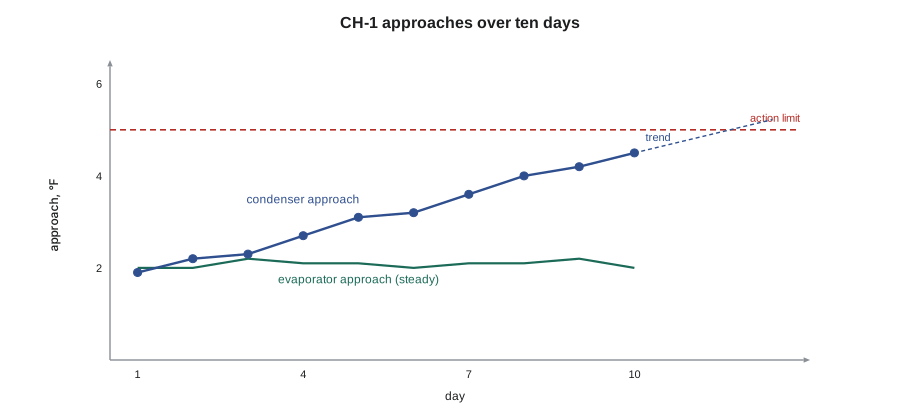
Theo pulled the first ten days of June from CH-1's log and calculated both approaches. The script repeats his calculation, fits a straight line to the condenser approach and estimates when it would reach the action limit Raj used for that machine.
# Ten days of CH-1 log readings: approaches tell the story (temperatures in F)
log = [  # day, leaving chilled water, evaporator saturation, leaving condenser water, condenser saturation, % amps
    (1, 44.1, 42.1, 93.6, 95.5, 82), (2, 44.0, 42.0, 94.3, 96.5, 85), (3, 44.1, 41.9, 93.2, 95.5, 80),
    (4, 44.2, 42.1, 93.9, 96.6, 84), (5, 44.0, 41.9, 94.6, 97.7, 86), (6, 44.1, 42.1, 93.4, 96.6, 81),
    (7, 44.0, 41.9, 94.1, 97.7, 85), (8, 44.2, 42.1, 94.8, 98.8, 87), (9, 44.1, 41.9, 93.7, 97.9, 83),
    (10, 44.0, 42.0, 94.3, 98.8, 86)]
ev = [r[1] - r[2] for r in log]
co = [r[4] - r[3] for r in log]
n = len(log); xs = [r[0] for r in log]
xm, ym = sum(xs) / n, sum(co) / n
slope = sum((x - xm) * (y - ym) for x, y in zip(xs, co)) / sum((x - xm) ** 2 for x in xs)
print(f"evaporator approach {min(ev):.1f} to {max(ev):.1f} F (steady)")
print(f"condenser approach {co[0]:.1f} F on day 1, {co[-1]:.1f} F on day 10; trend {slope * 7:+.2f} F per week")
limit = 5.0
days = (limit - (ym + slope * (10 - xm))) / slope
print(f"at this rate it reaches the {limit:.0f} F action limit in about {days:.0f} days")
print(f"compressor lift rose by about {(log[-1][4] - log[-1][2]) - (log[0][4] - log[0][2]):.1f} F at the same load")
print("residence chiller: clean 2.5 F, fouled 8 F: brushed tubes restored it")evaporator approach 2.0 to 2.2 F (steady) condenser approach 1.9 F on day 1, 4.5 F on day 10; trend +2.07 F per week at this rate it reaches the 5 F action limit in about 2 days compressor lift rose by about 3.4 F at the same load residence chiller: clean 2.5 F, fouled 8 F: brushed tubes restored it
The evaporator approach stayed steady at about 2.0 to 2.2 °F, so the evaporator was fine. The condenser approach, though, rose from about 1.9 °F to 4.5 °F in ten days, about 2 °F a week, at similar loads. At that rate it would cross the 5 °F action limit in a couple of days, and the compressor's lift had already risen by about 3.4 °F, costing energy every hour. A steady rise in condenser approach with a steady evaporator points to the condenser's water side, and a fast rise points to something active, such as scale forming or biological growth, rather than slow, normal fouling. That was why Raj called the water treatment company before opening the chiller.
The seniors' residence chiller from RAC-210 had shown the same pattern over a much longer time: a condenser approach that had crept from 2.5 to 8 °F over two years of neglected tower treatment, fixed by brushing the tubes. The difference at Riverbend was speed, and the logs caught it in ten days.
Reading the other signs
Approaches are not the only clues, and the logs are most useful when readings are compared with each other:
- High condenser approach with high condenser pressure but normal water temperatures can mean non-condensables, especially on a low-pressure machine with a busy purge, as lesson 3 showed.
- High evaporator approach with low refrigerant level or low subcooling usually means a refrigerant leak; with normal level, it can mean oil in the evaporator or fouled tubes.
- A change in water pressure drop at the same pump settings means a flow change: a blocked strainer, a closed valve or tubes plugged by debris, which RAC-210 lesson 7 warned about for towers that shed fill or scale.
- Rising motor amps at the same load and lift suggest mechanical trouble in the compressor or a motor or drive problem, and call for an electrical check, as RAC-130 described.
- Oil pressure falling slowly over weeks suggests a clogging filter; oil foaming or a rising level can mean refrigerant migrating into the oil, often linked to the oil heater.
Because the readings interact, it is worth plotting them over time instead of looking at each day's sheet alone. Many service companies keep a spreadsheet or use software that calculates approaches and lift from the logs and flags changes automatically. Theo built a simple one for the three Riverbend chillers, and Grace's team began entering their readings in it every morning.
Seasonal operation
A central plant changes through the year. Spring brings the tower start-up of lesson 5 and the first full chiller loads. Summer is the time for monitoring approaches closely and keeping the towers clean. Autumn is for planning the winter shutdown: which chillers will be opened, which tubes cleaned, what tests done. Winter, at Riverbend, meant one chiller or the free-cooling exchanger carrying the plant, freeze protection on the tower, and the annual maintenance outage for the others, which lesson 11 describes. A chiller that will be idle for months is laid up according to the manufacturer: some are left full of water with circulation, some drained and dried, and low-pressure machines are kept under positive pressure or with the purge running so that air and moisture do not enter.
Common mistakes
MistakeRecording log readings without comparing them with earlier ones.
InsteadCalculate approaches and plot trends over time.
MistakeJudging a chiller by its pressures alone.
InsteadUse approaches, which separate machine problems from load and weather.
MistakeOpening a chiller to clean tubes without asking why they fouled.
InsteadCheck the water treatment and fix the cause first.
MistakeLeaving out the start-up baseline.
InsteadKeep the start-up report and compare every inspection with it.
MistakeTreating automatic trends as a replacement for the operator's round.
InsteadLook and listen; many problems are seen or heard before they are measured.
Summary and key terms
- New chillers are started by the manufacturer with documented checks; the start-up readings become the baseline.
- Daily rounds combine readings with looking and listening.
- Logs record chilled and condenser water, refrigerant, compressor, motor, oil and purge readings.
- Evaporator and condenser approaches are the best early indicators of heat transfer problems.
- Readings are most useful compared with each other and over time; a rising condenser approach with a steady evaporator points to the condenser water side.
- Plants follow a seasonal rhythm of start-up, monitoring, planning and maintenance, with proper lay-up of idle chillers.
- Start-up report
- The manufacturer’s record of a chiller’s first operation, checks and baseline readings.
- Evaporator approach
- Leaving chilled-water temperature minus evaporator saturation temperature.
- Condenser approach
- Condenser saturation temperature minus leaving condenser water temperature.
- Baseline
- Reference readings at known conditions used to judge later performance.
- Operator round
- A regular walk through a plant to check equipment by reading, looking and listening.
- Action limit
- A value at which a reading calls for investigation or maintenance.
- Lay-up
- Preparing equipment for a long idle period to prevent damage.
- Pressure drop
- The loss of water pressure across a heat exchanger, used to judge flow.
Practice problems
Work each problem on paper first, then reveal the answer to check.
Leaving chilled water is 44 °F and the evaporator saturation is 41.3 °F. What is the evaporator approach?
Show answer
2.7 °F.
A chiller's condenser approach is rising while its evaporator approach is steady. Where would you look first?
Show answer
The condenser water side: tube fouling or scale, water treatment, flow, or non-condensables.
Why are approaches better than pressures alone for spotting problems?
Show answer
They compare refrigerant and water temperatures, so they are less affected by load and weather.
What should be done with a low-pressure chiller that will sit idle for months?
Show answer
Lay it up as the manufacturer specifies, keeping air and moisture out, for example with positive pressure or the purge.
Lesson quiz · 5 questions
Score 60% or more to complete this lesson.
Create a free account to save your progress, take quizzes and earn a certificate.