
RAC-410 · Lesson 1 of 12 · 17 min
Large systems and central plants
In September of Theo's fourth year, Northfield won the service contract for the central plant at Riverbend Health Campus, a hospital and outpatient complex on the edge of Louisville. Dana called Theo into her office with Raj, who would lead the chiller work. "You've spent three years on systems you can carry in a van," she said. "This one fills a basement. Raj will teach you the plant, and by spring I want you to be able to read it the way you read a split system." The contract started with a walk-through, and Raj made Theo draw the plant from memory afterwards.
This course is about chillers and the systems around them: the water-cooled and air-cooled chillers themselves, cooling towers, the chilled-water and condenser-water loops, pumps, controls, water treatment and maintenance. This first lesson describes what a central plant is, why buildings use one, and how its size and performance are measured.
From packaged units to central plants
The systems in RAC-310 to RAC-330 cooled the space they served directly: refrigerant evaporated in a coil that the air passed over. That works well up to a point. In a large building, running refrigerant lines from rooftop units to every floor becomes impractical, the charge becomes very large, and many separate machines must be maintained. A central plant separates the job into two parts. Chillers make cold water, or a water and glycol mixture, in one mechanical room, and pumps carry it through pipes to air handlers and fan coils throughout the building, where coils transfer the heat from the air to the water. The heat the chillers remove, plus the energy their compressors add, is rejected outdoors by cooling towers or air-cooled condensers.
Water is an excellent heat carrier. It holds about 3,500 times as much heat per unit volume as air for each degree of temperature change, so a pipe can move the same heat as a duct many times its size. A chilled-water system also keeps the refrigerant in one room, which makes leaks easier to find and refrigerant safety easier to manage, and lets the owner run, repair and replace the cooling equipment without entering the occupied spaces.
Central plants serve hospitals, universities, office towers, airports, data centers and district energy networks. Hospitals are typical: they need cooling all year for operating rooms, imaging equipment, laboratories and interior zones, they cannot tolerate long outages, and they usually have a staff of plant operators who keep logs and run the equipment around the clock.
The Riverbend plant
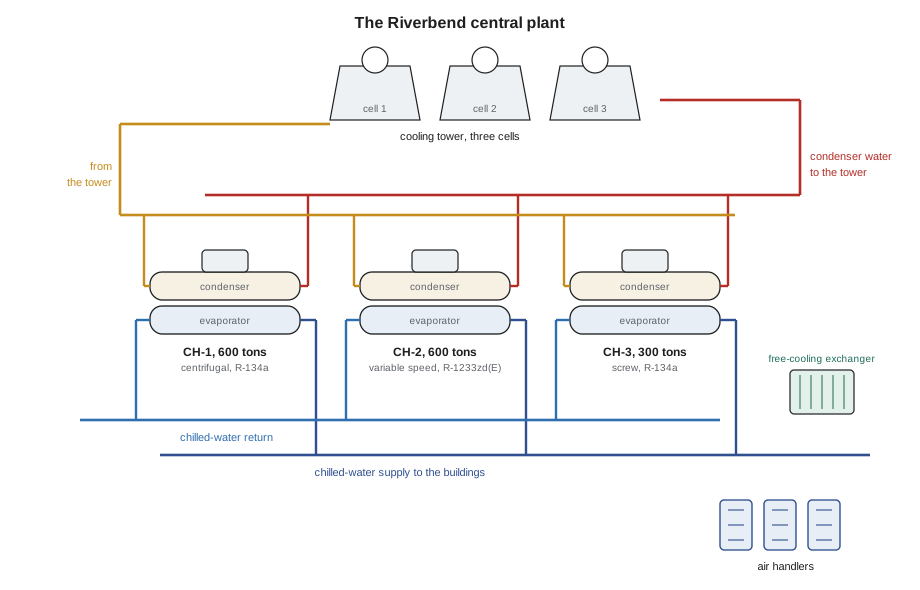
The walk-through started in the chiller room. Riverbend had three water-cooled chillers. CH-1, installed in 2009, was a 600-ton constant-speed centrifugal chiller using R-134a, with a charge of about 1,500 lb. CH-2, installed in 2024 when the hospital added a surgical wing, was a centrifugal of the same size with a variable-speed drive, using the low-pressure refrigerant R-1233zd(E). CH-3, from 2015, was a 300-ton screw chiller using R-134a, which the operators ran at night and in the shoulder seasons. Together they could carry the plant's design load of about 1,000 tons, with one large machine to spare on all but the hottest days.
The condenser water from all three went up to a three-cell cooling tower on the roof of the plant building. The chilled water left the plant through a primary-secondary piping system, which lesson 7 explains: constant-speed primary pumps, one for each chiller, circulated water through the chillers, and variable-speed secondary pumps sent it out to the buildings. A plate heat exchanger beside the chillers let the towers cool the chilled water directly in winter. In a control room at the end of the plant, the building automation system displayed the plant's temperatures, flows and alarms, and the operators' log sheets hung on a clipboard beside the screen.
Grace Adeyemi, the hospital's chief plant engineer, walked them through the operating rules. Two people from her team were on site at all times. The plant had to keep chilled water at 44 °F to the operating rooms whatever happened, and the hospital's emergency generators could carry one large chiller and its pumps if the grid failed. "Our biggest problem," she said, "is that the plant runs more chillers than the load needs, and the second chiller comes on when the first is only half loaded. We think it's the water side, but we've never had the time to prove it." Raj wrote that down. It would take most of the year to answer, and the answer is in lesson 7.
Units: tons, kilowatts and efficiency
Chiller capacity in the United States is stated in tons of refrigeration. One ton is 12,000 Btu/h, the cooling of melting a short ton of ice in a day, or about 3.517 kW in SI units, which European and Canadian submittals sometimes use.
Chiller efficiency is expressed in three common ways. The coefficient of performance, COP, is the cooling delivered divided by the electrical input, both in the same units. Energy efficiency ratio, EER, divides cooling in Btu/h by input in watts. And kilowatts per ton, kW/ton, is the electrical input divided by the cooling in tons; it is the reverse of the other two, so a lower kW/ton is better. They convert easily:
A modern water-cooled centrifugal chiller at its rating conditions uses about 0.55 to 0.6 kW/ton, a COP of about 6. An air-cooled chiller, rejecting heat to hotter outdoor air instead of to water from a tower, uses roughly half as much again. A complete plant also runs pumps and tower fans, so its whole-plant efficiency is worse than the chiller's alone; plant designers and operators track both.
Load, ton-hours and the shape of a year
A plant is sized for its design load, the cooling needed on a near-worst day. But a plant spends almost all of its time at part load. Riverbend's design load was about 1,000 tons, but its hours were spread over a whole year, and most of the year's cooling was done far below that. Plant energy is counted in ton-hours: one ton-hour is one ton of cooling for one hour. Dividing the year's cooling by the design load gives the equivalent full-load hours, the number of hours the plant would have to run at design load to deliver the same cooling.
Grace's team had the plant's meter data, and Raj sorted it into outdoor temperature bins to see where the year's cooling actually happened. The script reproduces his summary and estimates the year's electricity, using a typical chiller efficiency and a separate allowance for pumps and towers.
# Riverbend Health Campus central plant: a year of cooling in outdoor temperature bins (illustrative)
bins = [  # (outdoor dry-bulb band, hours per year, average plant load in tons)
    ("above 86 F", 60, 940), ("77 to 86 F", 420, 770), ("68 to 77 F", 980, 540),
    ("59 to 68 F", 1250, 355), ("50 to 59 F", 1300, 230), ("below 50 F", 4750, 128)]
peak = 1000                        # tons, the plant's design load
chiller_kw_per_ton = 0.60          # chiller input
aux_kw_per_ton = 0.25              # pumps and tower fans
ton_hours = sum(h * q for _, h, q in bins)
print(f"hours counted {sum(h for _, h, _ in bins)}")
print(f"annual cooling {ton_hours / 1e6:.2f} million ton-hours, equivalent full-load hours {ton_hours / peak:,.0f}")
for name, h, q in bins:
    print(f"{name:11s} {h:5d} h at {q:4d} tons = {h * q / ton_hours:5.1%} of the year's cooling")
chiller_kwh = ton_hours * chiller_kw_per_ton
aux_kwh = ton_hours * aux_kw_per_ton
print(f"chiller electricity {chiller_kwh / 1e6:.2f} million kWh, pumps and towers {aux_kwh / 1e6:.2f} million kWh")
total = chiller_kw_per_ton + aux_kw_per_ton
print(f"whole plant {total:.2f} kW/ton (COP {3.517 / total:.2f}, EER {12 / total:.1f}); chiller alone COP {3.517 / chiller_kw_per_ton:.2f}")
print(f"at 0.11 $/kWh the plant's electricity costs about ${(chiller_kwh + aux_kwh) * 0.11:,.0f} a year")hours counted 8760 annual cooling 2.26 million ton-hours, equivalent full-load hours 2,260 above 86 F 60 h at 940 tons = 2.5% of the year's cooling 77 to 86 F 420 h at 770 tons = 14.3% of the year's cooling 68 to 77 F 980 h at 540 tons = 23.4% of the year's cooling 59 to 68 F 1250 h at 355 tons = 19.6% of the year's cooling 50 to 59 F 1300 h at 230 tons = 13.2% of the year's cooling below 50 F 4750 h at 128 tons = 26.9% of the year's cooling chiller electricity 1.36 million kWh, pumps and towers 0.56 million kWh whole plant 0.85 kW/ton (COP 4.14, EER 14.1); chiller alone COP 5.86 at 0.11 $/kWh the plant's electricity costs about $211,287 a year
The year's cooling came to about 2.26 million ton-hours, equivalent to about 2,260 full-load hours. Only 2.5 % of it was done above 86 °F outdoors. More than a quarter was done below 50 °F, mostly by one chiller at low load or by the free-cooling heat exchanger, because the hospital's interior zones, imaging rooms and data rooms need cooling in every season. The pumps and towers added about 0.25 kW/ton to the chillers' 0.60, bringing the whole plant to about 0.85 kW/ton.
Two lessons follow from the numbers, and the rest of the course keeps returning to them. First, the efficiency that matters most is part-load efficiency, because that is where the plant spends its time; lesson 2 shows how part-load ratings work. Second, the auxiliaries are not small: a pump or tower fan running at full speed when it does not need to can waste as much energy as a poorly chosen chiller.
Who does what in a large plant
Large plants are a team effort, and a technician needs to know where his or her work fits. The owner's plant operators run the plant day to day: they start and stop equipment, keep logs, respond to alarms and do routine checks. A service contractor, like Northfield at Riverbend, does the preventive maintenance, repairs and annual inspections, often with the chiller manufacturer's own service technicians for major work such as compressor overhauls and controls upgrades. A water treatment company manages the chemistry of the tower and closed loops, as lesson 6 describes. A controls contractor maintains the building automation system. And consulting engineers design changes and retrofits.
In the United States, some states and cities require licensed stationary engineers or refrigeration operators for plants over a certain size, so the rules for Louisville and for any other jurisdiction should be checked; the work itself falls under the mechanical code, ASHRAE 15 for refrigeration safety and EPA's Section 608 rules for refrigerant handling, which earlier courses described.
For Theo, the contract meant learning a new rhythm: monthly visits with Raj for inspections and log reviews, a shutdown each winter for tube cleaning and eddy current testing, the start-up of the towers each spring, and a call whenever the operators found something they could not explain. The plant was not more difficult than the systems he already knew. The same refrigeration cycle ran inside every chiller. But it was larger, more connected and more expensive to get wrong, and it rewarded patience with the logs.
| Part of the plant | What it does | Where in this course |
|---|---|---|
| Chillers | Remove heat from the chilled water | Lessons 2 to 4 |
| Cooling towers and condenser water | Reject the heat outdoors | Lesson 5 |
| Water treatment | Prevents scale, corrosion and biological growth | Lesson 6 |
| Chilled-water piping | Delivers cold water to the coils | Lesson 7 |
| Pumps and balancing | Move the water and divide it among the coils | Lesson 8 |
| Controls and sequencing | Decide which machines run and at what settings | Lesson 9 |
| Operation, logs and maintenance | Keep the plant reliable and efficient | Lessons 10 and 11 |
Common mistakes
MistakeJudging a chiller by its full-load efficiency alone.
InsteadCompare part-load efficiency, where the plant spends most of its hours.
MistakeForgetting the pumps and tower fans.
InsteadTrack whole-plant efficiency as well as the chiller's.
MistakeConfusing kW/ton with COP.
InsteadA lower kW/ton and a higher COP are both better; convert with COP = 3.517 ÷ kW/ton.
MistakeTreating a plant as a collection of separate machines.
InsteadChillers, towers, pumps and coils interact; a problem in one shows up in another.
Summary and key terms
- A central plant makes chilled water in one place and pumps it to coils throughout the buildings it serves.
- Chillers reject the heat they remove, plus their compressor energy, through cooling towers or air-cooled condensers.
- Capacity is stated in tons; one ton is 12,000 Btu/h, or 3.517 kW.
- COP, EER and kW/ton express efficiency; COP = 3.517 ÷ kW/ton.
- Plants spend most of their hours at part load, so part-load efficiency and auxiliaries matter.
- Operators, service contractors, manufacturers, water treaters and controls contractors share the work.
- Central plant
- A room or building of chillers, pumps and heat rejection equipment that serves many coils.
- Chilled water
- Water cooled by chillers and pumped to coils to remove heat from air.
- Ton of refrigeration
- 12,000 Btu/h, about 3.517 kW of cooling.
- Coefficient of performance (COP)
- Cooling delivered divided by energy input in the same units.
- kW/ton
- Electrical input in kilowatts per ton of cooling; lower is better.
- Ton-hour
- One ton of cooling delivered for one hour.
- Equivalent full-load hours
- Annual cooling divided by design load.
- Design load
- The cooling needed on a near-worst day, used to size the plant.
Practice problems
Work each problem on paper first, then reveal the answer to check.
A chiller uses 0.50 kW/ton. What is its COP?
Show answer
3.517 ÷ 0.50 = about 7.0.
A chiller has an EER of 20. What is that in kW/ton?
Show answer
12 ÷ 20 = 0.60 kW/ton.
A plant delivers 1.6 million ton-hours a year with a design load of 800 tons. What are its equivalent full-load hours?
Show answer
2,000 hours.
Why do hospitals need cooling in winter?
Show answer
Interior zones, operating rooms, imaging equipment and data rooms produce heat all year.
Lesson quiz · 5 questions
Score 60% or more to complete this lesson.
Create a free account to save your progress, take quizzes and earn a certificate.