
RAC-330 · Lesson 11 of 12 · 19 min
Ventilation, filtration and indoor air quality
Lesson 1 left the Novaks with sweating windows and a recommendation: a heat recovery ventilator. In April, with the basement ceiling open for the duct work, Northfield installed one. Irene had read about them and had a list of questions. How much air did the house need? Why not an energy recovery ventilator instead? Would it make the house dry in winter or damp in summer? And what about filters: the dog had been shedding all winter, and her son had allergies. Theo, who had now done the loads, the ducts and the outlets, was ready for most of them.
This lesson covers why buildings need ventilation, how much the codes require for houses and commercial buildings, heat and energy recovery ventilators, filtration and MERV ratings, and simple indicators of indoor air quality such as carbon dioxide.
Why ventilate
People and buildings produce pollutants: moisture, as lesson 1 showed; carbon dioxide and odors from breathing; volatile organic compounds from furniture, finishes and cleaning products; combustion products from cooking; particles from cooking, pets and outdoors; and, in some areas, radon from the soil. Ventilation dilutes them by replacing indoor air with outdoor air. Older, leaky houses got that replacement by accident, unevenly and at the mercy of the weather: plenty on a cold windy day, almost none on a calm mild one. Tighter houses, like the Novaks' after the air sealing, need it provided deliberately.
The principle of good ventilation is to build tight and ventilate right: make the envelope as airtight as practical, then supply a controlled amount of outdoor air where it is needed and exhaust stale air from where pollutants are produced, such as kitchens and bathrooms. Source control comes first: a range hood that captures cooking pollutants at the stove does more good than general ventilation, and the best way to deal with a pollutant is not to bring it into the house.
How much ventilation houses need
The International Residential Code, as adopted in Kentucky with state amendments, requires whole-house mechanical ventilation in new houses tight enough to need it, at a rate based on floor area and bedrooms: in recent editions about 1 cfm for each 100 ft² plus 7.5 cfm for each occupant, taken as bedrooms plus one. ASHRAE Standard 62.2, Ventilation and Acceptable Indoor Air Quality in Residential Buildings, which many programs and some codes reference, sets a higher total rate of 3 cfm for each 100 ft² plus 7.5 cfm per occupant, with a credit for measured air leakage in existing houses. Kitchens and bathrooms also need local exhaust, by fans or ventilator connections, with minimum rates for each.
Ventilation systems for houses come in three basic types. Exhaust-only systems run a quiet bathroom fan continuously and let outdoor air leak in wherever it can; they are cheap but depressurize the house and give no control over where the air comes from. Supply-only systems bring outdoor air into the return of the furnace or air handler, filtered and tempered, and pressurize the house slightly, which can push moist air into walls in cold climates. Balanced systems, HRVs and ERVs, supply and exhaust equal amounts and recover heat, which is why they are the usual choice in cold climates.
HRVs and ERVs
A heat recovery ventilator, HRV, has two fans and a core in which the outgoing stale air and the incoming fresh air pass on opposite sides of thin plates without mixing. Heat flows through the plates from the warmer stream to the colder, so in winter the incoming air is warmed by the outgoing air. Its sensible recovery efficiency, the fraction of the possible temperature change it achieves, is typically about 60 to 85 %. An energy recovery ventilator, ERV, has a core that also transfers moisture, by a permeable membrane or a desiccant wheel, so in winter it returns some of the indoor moisture to the incoming air, and in summer it keeps some of the outdoor moisture out.
Which to choose depends on the climate and the house. In a cold climate, an HRV removes moisture as well as heat in winter, which suits a house with high indoor humidity, such as the Novaks'. An ERV retains moisture in winter, which suits a house that is too dry with an HRV, and reduces the latent load from ventilation in a humid summer, which matters more in Kentucky than in Ontario. In very cold weather, HRVs and ERVs need defrost: the exhaust air leaving the core can fall below freezing, and the core frosts; units defrost by recirculating indoor air through the core for a few minutes, by preheating the outdoor air, or by reducing the supply fan speed.
The ventilator's own ducts matter. The fresh-air intake must be away from the exhaust outlet, the dryer vent, the gas meter and any vehicle exhaust, typically by at least about 6 ft or as the code and manual require; both outdoor ducts must be insulated, with a vapor barrier, because cold outdoor air in the duct will condense room moisture on the outside of it. The supply air is distributed to bedrooms and living areas, through the furnace ducts or its own small ducts, and the exhaust is taken from bathrooms and the kitchen area, away from the range. Most importantly, the supply and exhaust flows must be balanced, measured at the unit's flow stations or with a calibrated device and adjusted with its dampers.
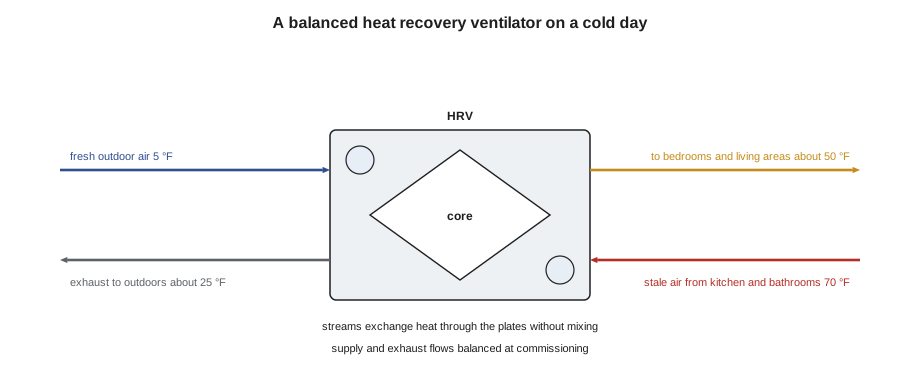
The Novak ventilator
The script works out the ventilation the Novak house needed, the indoor humidity the family's moisture would produce on a cold day with and without the HRV, the heat the ventilation air would take on the design day with and without recovery, and, for comparison, the carbon dioxide level at the clinic with its economizer at minimum outdoor air.
import math
def p_atm(z_m):
    """Standard atmospheric pressure, kPa, at an elevation in meters (feet x 0.3048)."""
    return 101.325 * (1 - 2.25577e-5 * z_m) ** 5.2559
def pws(t):
    """Saturation pressure of water vapor over water, kPa, t in deg C (Magnus form)."""
    return 0.61094 * math.exp(17.625 * t / (t + 243.04))
def w_from_rh(t, rh, p):
    """Humidity ratio, kg of water per kg of dry air."""
    pv = rh * pws(t)
    return 0.622 * pv / (p - pv)
def pv_from_w(w, p):
    return w * p / (0.622 + w)
def dew_point(pv):
    a = math.log(pv / 0.61094)
    return 243.04 * a / (17.625 - a)
def enthalpy(t, w):
    """kJ per kg of dry air."""
    return 1.006 * t + w * (2501 + 1.86 * t)
def spec_volume(t, w, p):
    """Cubic meters per kg of dry air."""
    return 0.287042 * (t + 273.15) * (1 + 1.607858 * w) / p
def wet_bulb(t, w, p):
    """Thermodynamic wet-bulb temperature found by bisection."""
    lo, hi = -40.0, t
    for _ in range(60):
        m = (lo + hi) / 2
        ws = w_from_rh(m, 1.0, p)
        wc = ((2501 - 2.326 * m) * ws - 1.006 * (t - m)) / (2501 + 1.86 * t - 4.186 * m)
        lo, hi = (lo, m) if wc > w else (m, hi)
    return (lo + hi) / 2
def rel_humidity(t, w, p):
    return pv_from_w(w, p) / pws(t)
def c(f): return (f - 32) / 1.8
def f(c_): return c_ * 1.8 + 32
def h_ip(t_c, w):
    """Enthalpy in Btu per lb of dry air (0 deg F datum)."""
    return enthalpy(t_c, w) * 0.4299 + 7.686
GR = 7000   # grains per lb

P = p_atm(460 * 0.3048)
area, bedrooms = 2600, 3
irc = 0.01 * area + 7.5 * (bedrooms + 1)          # recent IRC whole-house mechanical ventilation formula
a622 = 0.03 * area + 7.5 * (bedrooms + 1)         # ASHRAE 62.2 total ventilation rate
print(f"IRC minimum about {irc:.0f} cfm continuous; ASHRAE 62.2 total about {a622:.0f} cfm before any infiltration credit")
G = 31 / 24                                       # lb/h: about 31 lb (3.7 gal) of water a day, laundry drying indoors included
t_out, rh_out, t_in = 5.0, 0.75, 70.0
w_out = w_from_rh(c(t_out), rh_out, P)
for name, q in (("air leakage only", 38), ("leakage + HRV 60 cfm", 38 + 60), ("leakage + HRV 100 cfm", 38 + 100)):
    m = q * 60 * 0.075                            # lb/h of air
    w_in = w_out + G / m
    print(f"{name:22s} {q:3d} cfm: indoor {w_in * GR:.0f} gr/lb, {rel_humidity(c(t_in), w_in, P):.0%} RH, "
          f"dew point {f(dew_point(pv_from_w(w_in, P))):.0f} F")
dT = 70 - 10
for eff in (0.0, 0.70):
    print(f"sensible recovery {eff:.0%}: ventilation load at design {1.08 * 60 * dT * (1 - eff):,.0f} Btu/h")
people, gen = 12, 0.011                           # occupants, cfm of CO2 each (light activity)
oa = 0.25 * 1200
print(f"clinic: {oa:.0f} cfm outdoor air, steady CO2 about {420 + people * gen / oa * 1e6:.0f} ppm (outdoor 420)")IRC minimum about 56 cfm continuous; ASHRAE 62.2 total about 108 cfm before any infiltration credit air leakage only 38 cfm: indoor 59 gr/lb, 53% RH, dew point 52 F leakage + HRV 60 cfm 98 cfm: indoor 27 gr/lb, 24% RH, dew point 32 F leakage + HRV 100 cfm 138 cfm: indoor 21 gr/lb, 19% RH, dew point 26 F sensible recovery 0%: ventilation load at design 3,888 Btu/h sensible recovery 70%: ventilation load at design 1,166 Btu/h clinic: 300 cfm outdoor air, steady CO2 about 860 ppm (outdoor 420)
The IRC formula gave a minimum of about 56 cfm and ASHRAE 62.2 about 108 cfm. With only the house's air leakage on a cold, calm morning, about 38 cfm, the family's moisture held the house at about 53 % relative humidity and a dew point of about 52 °F, matching Theo's January reading closely. With the HRV running at 60 cfm continuously, the humidity fell to about 24 % in the same weather, with the dew point near freezing, so the windows would stay dry. On the design day, warming 60 cfm of ventilation air would take about 3,900 Btu/h without recovery and only about 1,200 Btu/h with a 70 % HRV.
The numbers also showed a risk at the other end. On the coldest days, a continuously running HRV would make the house rather dry, below 25 %, which would bother Irene's son. Northfield set the HRV to run at its low speed continuously, with a boost from the bathroom timers and a dehumidistat that raised its speed only when the humidity climbed, and showed the Novaks how to lower its speed on the coldest days. Dana noted that if the house still felt too dry in a cold winter, the core could be swapped for an energy recovery core of the same size, which the manufacturer offered.
Commercial ventilation
Commercial buildings follow ASHRAE Standard 62.1, Ventilation and Acceptable Indoor Air Quality, or the code based on it. Its ventilation rate procedure gives a rate per person and a rate per unit floor area for each type of space, such as about 5 cfm per person plus 0.06 cfm per square foot for offices, adds them for each zone, and corrects for how well the air distribution delivers outdoor air to the breathing zone and for multi-zone systems. Health-care spaces, including dental clinics, have additional requirements in ASHRAE Standard 170 and state health-facility rules, such as minimum air changes, pressure relationships and filtration, for some rooms.
Carbon dioxide is a useful indicator, though not itself a pollutant at normal indoor levels: people exhale it at a predictable rate, so its concentration above outdoors shows roughly how much outdoor air each person is getting. Outdoor air is now about 420 ppm. Indoor levels of 800 to 1,100 ppm in an occupied office are common, and much higher levels suggest too little ventilation for the number of people. Demand-controlled ventilation uses CO2 sensors to vary outdoor air with occupancy, as RAC-230 described for the clinic's economizer. At the clinic, the script estimated about 860 ppm at minimum outdoor air with twelve people, a reasonable level.
Filtration
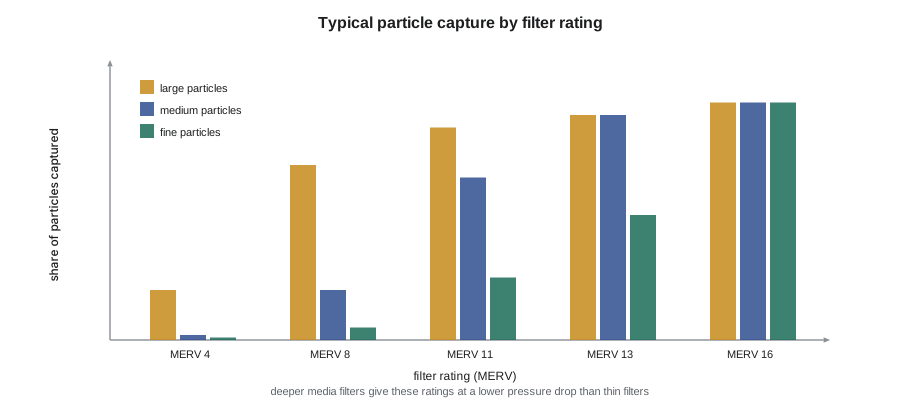
Filters protect the equipment, keeping coils and blowers clean, and can improve indoor air by removing particles. Their efficiency is rated by the minimum efficiency reporting value, MERV, from ASHRAE Standard 52.2, on a scale from 1 to 16, based on how well they capture particles in three size ranges. A typical thin fiberglass filter is about MERV 2 to 4 and protects equipment only. MERV 8 captures most large particles such as pollen and dust mite debris. MERV 11 to 13 captures a large share of fine particles, including much of the smoke, bacteria-sized and some virus-carrying particles, and was widely recommended during the COVID-19 pandemic. ISO 16890 is an international rating system used by some manufacturers.
Higher efficiency usually means more resistance, and lesson 7 showed what resistance does to airflow. A one-inch high-MERV filter in a slot designed for a cheap filter can choke a residential system. The usual answer is a deeper filter with more surface area, a 4 in. or 5 in. media filter in a proper cabinet, which gives higher efficiency at a lower pressure drop and lasts longer. Filters must also fit their racks without gaps, or air bypasses them. Electronic air cleaners and portable HEPA units are other options; ozone-generating air cleaners are not recommended for occupied spaces.
For the Novaks, Theo replaced the original one-inch filter slot with a 5 in. MERV 13 media cabinet at the air handler, which measured about 0.12 in. w.c. clean at the design airflow, less than the old filter had. The HRV's own filters protected its core and were to be washed every few months. He added both to the Novaks' maintenance schedule.
Other indoor air quality measures
Combustion safety and radon are part of indoor air quality too. Houses with fuel-burning appliances need carbon monoxide alarms, and exhaust fans and ventilators must not depressurize the house enough to backdraft them, which is one reason balanced ventilation suits cold climates; makeup air is needed for large range hoods in some jurisdictions. Radon, a radioactive gas from the soil, is found in many regions of the United States; the EPA recommends testing every house and mitigating above its guideline, usually with a sub-slab depressurization system. Northfield's technicians did not install radon systems, but they recommended a test whenever a basement was being renovated, as the Novaks' was.
Common mistakes
MistakeRelying on air leakage to ventilate a tightened house.
InsteadProvide controlled mechanical ventilation, preferably balanced in cold climates.
MistakeInstalling an HRV without balancing its supply and exhaust.
InsteadMeasure and balance the flows at commissioning.
MistakePutting a high-MERV one-inch filter in a slot designed for a cheap filter.
InsteadUse a deeper media filter with low pressure drop, and check static pressure.
MistakeRunning an HRV at high speed all winter in a dry house.
InsteadUse low continuous speed with humidity control, or consider an ERV core.
MistakeTreating CO2 as the pollutant to remove.
InsteadUse CO2 as an indicator of outdoor air per person.
Summary and key terms
- Ventilation dilutes indoor pollutants; tight houses need it provided mechanically, with source control first.
- The IRC and ASHRAE 62.2 set house ventilation rates from rooms or floor area and bedrooms.
- HRVs recover heat; ERVs recover heat and moisture; both must be balanced and need defrost in cold weather.
- ASHRAE 62.1 sets commercial rates per person and per floor area; CO2 indicates outdoor air per person.
- MERV ratings describe filter efficiency; deeper filters give high efficiency at low pressure drop.
- Combustion safety and radon testing are part of indoor air quality.
- Ventilation
- Replacing indoor air with outdoor air to dilute pollutants.
- Heat recovery ventilator (HRV)
- A balanced ventilator that transfers heat between outgoing and incoming air.
- Energy recovery ventilator (ERV)
- A balanced ventilator that transfers both heat and moisture.
- Sensible recovery efficiency
- The fraction of the possible temperature change an HRV or ERV achieves.
- MERV
- Minimum efficiency reporting value, a filter rating from 1 to 16 under ASHRAE 52.2.
- Demand-controlled ventilation
- Varying outdoor air with occupancy, often using CO2 sensors.
- Source control
- Reducing or capturing pollutants where they are produced.
- Radon
- A radioactive soil gas that can enter houses through the foundation.
Practice problems
Work each problem on paper first, then reveal the answer to check.
Using ASHRAE 62.2, what is the total rate for a 2,000 ft² house with three bedrooms?
Show answer
0.03 × 2,000 + 7.5 × 4 = 90 cfm.
An HRV supplies outdoor air at −4 °F to a house at 70 °F with 70 % sensible recovery. About what temperature does the supply air reach?
Show answer
About 48 °F, since 0.7 × 74 ≈ 52 °F of rise.
An office reads 1,800 ppm CO2 with outdoor air at 420 ppm. What does that suggest?
Show answer
Too little outdoor air per person.
Why choose a 4 or 5 inch media filter over a 1 inch high-MERV filter?
Show answer
More surface area gives high efficiency with low pressure drop.
Lesson quiz · 5 questions
Score 60% or more to complete this lesson.
Create a free account to save your progress, take quizzes and earn a certificate.