
RAC-330 · Lesson 4 of 12 · 18 min
Thermal comfort and humidity control
Wes Kaminski had a list. Every winter the residents' council at the seniors' residence brought him the same complaints, and this year he wanted Northfield's help to answer them properly. The lounge was cold in the mornings, even though the thermostat said 72 °F. Residents who sat by the big windows wore sweaters while those in the middle of the room did not. In summer, the dining room felt stuffy after lunch. And one resident, a retired nurse, had told him firmly that the air was too dry and was giving everyone nosebleeds. "The thermostat says everything's fine," Wes said. "The residents say it isn't. Who's right?"
Theo went with Raj, who had brought a box of instruments Theo had not used before. This lesson explains what thermal comfort depends on, how comfort standards define it, why a thermostat reading is not enough, and how humidity affects comfort, health and buildings.
What comfort depends on
The body produces heat all the time, from about 100 W for a person sitting quietly to several hundred watts for someone working hard, and must lose it at the same rate to keep its core temperature steady. It loses heat by convection to the air, by radiation to the surrounding surfaces, by evaporation of sweat and moisture from the lungs, and by conduction to whatever it touches. People feel comfortable when they can lose that heat without shivering, sweating noticeably or feeling a draft on part of their body.
Comfort therefore depends on six factors, which the comfort standards use:
- Air temperature, the dry bulb.
- Mean radiant temperature, the average temperature of the surfaces a person can see, weighted by how much of the view each one fills. A cold window or a warm sunlit wall changes how warm a person feels as much as the air does.
- Air speed: moving air carries heat away faster, welcome in summer and a draft in winter.
- Humidity, which affects how easily sweat evaporates.
- Metabolic rate, measured in met units, where 1 met is a person seated quietly, about 58 W per square meter of body surface; a dental assistant moving around the chair is about 1.6 met.
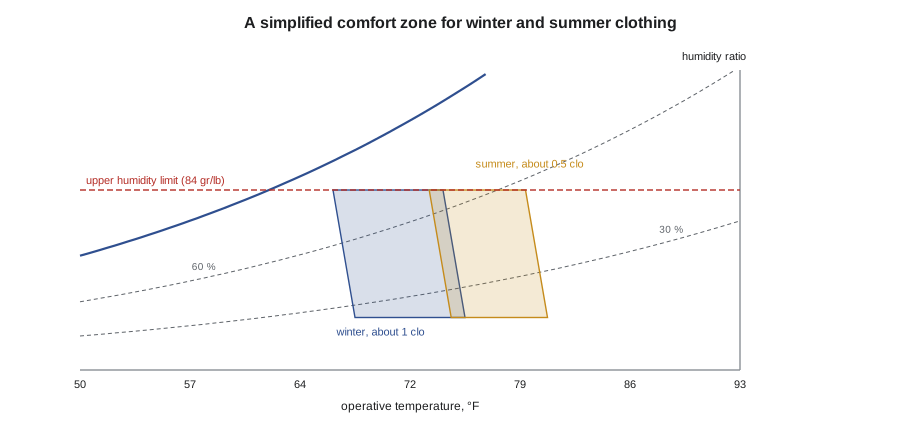
- Clothing insulation, in clo units, where 1 clo is roughly a business suit or winter indoor clothing, and 0.5 clo light summer clothing.
The first four belong to the building and its systems; the last two belong to the people. A thermostat measures only the first, which is why it can be satisfied when people are not.
Comfort standards
ASHRAE Standard 55, Thermal Environmental Conditions for Human Occupancy, is the main North American comfort standard and is referenced by US codes, green building programs and contracts; ISO 7730 is the international equivalent. Both use the method developed by P. O. Fanger in the 1970s, which combines the six factors to predict the average vote a large group of people would give on a seven-point scale from −3 (cold) through 0 (neutral) to +3 (hot). That is the predicted mean vote, PMV. From it comes the predicted percentage dissatisfied, PPD: even at a PMV of zero, about 5 % of people would be dissatisfied, because people differ. Standard 55's usual comfort range is a PMV between −0.5 and +0.5, which corresponds to about 10 % dissatisfied.
The standard also sets limits on local discomfort, which affects part of the body even when the whole-body balance is fine:
- Draft, from cold air moving on the neck, ankles or face.
- Radiant asymmetry, such as a cold window on one side or a hot ceiling above.
- Vertical air temperature difference between head and ankles, which is common in rooms heated from the ceiling or with poor air mixing.
- Floor surface temperature, too cold or too warm for feet.
For naturally ventilated buildings where occupants can open windows, Standard 55 has a separate adaptive method, based on field studies showing that people accept a wider range of temperatures when they have control and the outdoor climate changes. And it gives a simplified graphical method for typical offices: a comfort zone drawn on the psychrometric chart for given clothing and activity.
Measuring comfort
Raj's box held a globe thermometer, a temperature sensor inside a matte black sphere about 6 in. across, which settles at a temperature that combines the air temperature, the radiant temperature and the air speed; a hot-wire anemometer for low air speeds; a surface thermometer; and a data logger with temperature and humidity sensors. From the globe and air temperatures and the air speed, the mean radiant temperature can be calculated. At the low air speeds found indoors, the operative temperature, the average of the air and mean radiant temperatures, is a good single number for how warm a space feels.
They measured at seated head height, 43 in., and at ankle height, 4 in., in the middle of the lounge and beside the big windows, on a cold morning when the outdoor temperature was 10 °F.
The lounge in numbers
In the middle of the lounge the air was at 71.6 °F, the mean radiant temperature close to it, and the air speed low. Beside the windows, the air temperature was the same, but the mean radiant temperature was about 64 °F, because half of what a seated resident could see was cold glass, and the air speed was higher, from a cold downdraft off the windows. The script calculates PMV and PPD for those conditions, for a warmer setpoint, and, for comparison, for the dental assistants at the clinic from lesson 3.
import math
def pmv_ppd(ta, tr, vel, rh, met, clo, wme=0.0):
    """Fanger's PMV and PPD (ISO 7730 / ASHRAE 55 method), ta and tr in deg C, vel in m/s, rh in %."""
    pa = rh * 10 * math.exp(16.6536 - 4030.183 / (ta + 235))
    icl = 0.155 * clo
    m, w = met * 58.15, wme * 58.15
    mw = m - w
    fcl = 1 + 1.29 * icl if icl <= 0.078 else 1.05 + 0.645 * icl
    hcf = 12.1 * math.sqrt(vel)
    taa, tra = ta + 273, tr + 273
    tcla = taa + (35.5 - ta) / (3.5 * icl + 0.1)
    p1 = icl * fcl; p2 = p1 * 3.96; p3 = p1 * 100; p4 = p1 * taa
    p5 = 308.7 - 0.028 * mw + p2 * (tra / 100) ** 4
    xn, xf = tcla / 100, tcla / 50
    for _ in range(150):
        if abs(xn - xf) < 0.00015:
            break
        xf = (xf + xn) / 2
        hcn = 2.38 * abs(100 * xf - taa) ** 0.25
        hc = max(hcf, hcn)
        xn = (p5 + p4 * hc - p2 * xf ** 4) / (100 + p3 * hc)
    tcl = 100 * xn - 273
    hl1 = 3.05e-3 * (5733 - 6.99 * mw - pa)
    hl2 = 0.42 * (mw - 58.15) if mw > 58.15 else 0
    hl3 = 1.7e-5 * m * (5867 - pa)
    hl4 = 0.0014 * m * (34 - ta)
    hl5 = 3.96 * fcl * (xn ** 4 - (tra / 100) ** 4)
    hl6 = fcl * hc * (tcl - ta)
    ts = 0.303 * math.exp(-0.036 * m) + 0.028
    pmv = ts * (mw - hl1 - hl2 - hl3 - hl4 - hl5 - hl6)
    ppd = 100 - 95 * math.exp(-0.03353 * pmv ** 4 - 0.2179 * pmv ** 2)
    return pmv, ppd
c = lambda f: (f - 32) / 1.8
cases = [
    # name, air F, mean radiant F, air speed fpm, RH %, met, clo
    ("resident, center of lounge", 71.6, 70.7, 20, 30, 1.0, 1.0),
    ("resident, beside the big window", 71.6, 64.4, 40, 30, 1.0, 1.0),
    ("same, with a warmer setpoint", 74.3, 67.1, 40, 30, 1.0, 1.0),
    ("dental assistant, 50 % RH", 75.2, 75.2, 20, 50, 1.6, 0.7),
    ("dental assistant, 60 % RH", 75.2, 75.2, 20, 60, 1.6, 0.7),
    ("dental assistant, 72 F and 50 %", 71.6, 71.6, 20, 50, 1.6, 0.7),
]
for name, ta, tr, fpm, rh, met, clo in cases:
    pmv, ppd = pmv_ppd(c(ta), c(tr), fpm * 0.00508, rh, met, clo)
    op = (ta + tr) / 2
print(f"{name:34s} operative {op:4.1f} F PMV {pmv:+.2f} PPD {ppd:3.0f} %")resident, center of lounge operative 71.2 F PMV -0.55 PPD 11 % resident, beside the big window operative 68.0 F PMV -1.15 PPD 33 % same, with a warmer setpoint operative 70.7 F PMV -0.73 PPD 16 % dental assistant, 50 % RH operative 75.2 F PMV +0.68 PPD 15 % dental assistant, 60 % RH operative 75.2 F PMV +0.73 PPD 16 % dental assistant, 72 F and 50 % operative 71.6 F PMV +0.30 PPD 7 %
In the middle of the lounge, a seated resident in winter indoor clothing had a PMV of about −0.55, just outside the comfort range. Beside the windows the operative temperature was only about 68 °F, the PMV −1.15 and about a third of people would be dissatisfied, which matched the sweaters. Raising the setpoint by about 3 °F helped, to −0.73, but did not fix the windows.
Raj explained what the numbers meant for Wes. The residents were not imagining it: they sat still for long periods, so their metabolic rate was low, and many of them, being older, preferred warmer conditions than the standard's average person. The windows were the main problem, through both radiation and downdraft. The cures were partly in the building, such as better glazing, or warm air supplied along the glass from floor diffusers or a perimeter heater to block the downdraft, and partly in the systems: the lounge's supply diffusers were in the ceiling at the inside wall, throwing warm air away from the windows, which lesson 10 discusses. A cheap first step was to move the favorite chairs a little away from the glass.
The dental assistants' results showed something else. Raising the humidity from 50 to 60 % changed their PMV only from about +0.68 to +0.74, yet the staff had found 60 % unpleasant. The PMV method underestimates the effect of humidity on how people feel when they are active, warm and sweating a little, because damp skin and clothing feel uncomfortable in ways the heat balance alone does not capture. The bigger improvement came from the temperature: at 72 °F and 50 % the assistants' PMV fell to about +0.30, comfortably inside the range.
Humidity, health and buildings
Humidity matters for more than comfort. Very low humidity, below about 20 to 30 %, dries the eyes, skin and mucous membranes, increases static shocks and lets some airborne viruses survive longer; very high humidity, above about 60 %, encourages dust mites and mold and makes rooms feel stuffy. Many guides therefore recommend keeping indoor relative humidity roughly between 30 and 60 % where the building allows, and research reviews often cite the middle of that range as best for health. The retired nurse had a point.
The building sets limits, though. In a cold climate, the higher the indoor humidity in winter, the higher its dew point, and the more likely condensation on windows, inside exterior walls and in attics, as the Novak house showed in lesson 1. A common guide for houses with double-glazed windows is to lower the winter humidity setpoint as the outdoor temperature falls, from about 40 % in mild weather to 25 to 30 % in the coldest weather. Many humidifier controls do this automatically with an outdoor sensor. Buildings with high-performance windows and well-detailed walls can hold more.
At the residence, the logger showed 22 to 25 % relative humidity in the lounge on cold days, with the central humidifier running and its setpoint at 30 %. Raj traced the shortfall to the humidifier's outdoor reset, which was set aggressively, and to high ventilation rates in the corridors. He recommended raising the setpoint slightly in mild weather and checking window condensation, rather than trying to hold 40 % on the coldest days, which would have soaked the older windows.
In summer the concern is the other way. A cooling system that controls only temperature can let the humidity drift above 60 % in humid weather, particularly when the system is oversized and runs in short cycles that never let the coil dry the air, as RAC-320 lesson 7 explained. The dining room's stuffiness after lunch was a crowded room with a high latent load, served by a large rooftop unit that satisfied the thermostat quickly and then stopped.
Codes and contracts
Building codes rarely set comfort conditions directly. They set the indoor design temperatures used for sizing heating equipment, such as 70 °F for heating and 75 °F for cooling in ACCA Manual J, ventilation rates, as lesson 11 explains, and limits on humidification and reheat energy. State and local rules for nursing homes, workplaces and rental housing may set minimum or maximum temperatures, and owners and designers should check the current rules. Comfort conditions for commercial buildings are usually set in the design documents, often by reference to ASHRAE 55, and confirmed during commissioning.
For the technician, the useful lesson is that complaints are data. When occupants say a room is too cold, too warm, drafty or stuffy, they are usually describing something real that a thermostat cannot see: radiant asymmetry, a downdraft, stratification, humidity or air that is not reaching them.
Raj's report
Raj's report to Wes had five recommendations in order of cost: move seating back from the windows and open the drapes during sunny hours; adjust the humidifier's outdoor reset and raise its mild-weather setpoint; rebalance the lounge's supply diffusers and check their throw, which Theo would do as part of lesson 10's work; add a dehumidification mode or a lower blower speed on the dining room unit at lunch times, as at the clinic; and, when the residence next replaced windows, choose glazing with a warmer inner surface. He attached the PMV numbers and the logger graphs. "Now when the residents' council asks," he told Wes, "you can show them we measured what they feel."
Common mistakes
MistakeTreating the thermostat reading as proof that a room is comfortable.
InsteadConsider radiant temperature, air speed, humidity, activity and clothing.
MistakeRaising the setpoint to cure discomfort near cold windows.
InsteadAddress radiant asymmetry and downdrafts with glazing, perimeter heat or air supply.
MistakeHolding high winter humidity in a building with ordinary windows.
InsteadReset the humidity setpoint down as outdoor temperature falls.
MistakeIgnoring humidity when a cooling system satisfies the thermostat.
InsteadCheck space humidity; short cycling and high latent loads leave rooms clammy.
MistakeMeasuring comfort only at the thermostat.
InsteadMeasure at seated head and ankle height where people actually are.
Summary and key terms
- Comfort depends on air temperature, mean radiant temperature, air speed, humidity, metabolic rate and clothing.
- ASHRAE 55 and ISO 7730 use PMV and PPD; the usual comfort range is a PMV between −0.5 and +0.5.
- Local discomfort from drafts, radiant asymmetry, stratification and floors is limited separately.
- Operative temperature combines air and mean radiant temperature and is measured with a globe thermometer.
- Indoor humidity of roughly 30 to 60 % suits health, but winter limits depend on window and wall performance.
- Occupant complaints often describe real conditions a thermostat cannot measure.
- Thermal comfort
- The condition of mind that expresses satisfaction with the thermal environment.
- Mean radiant temperature
- The uniform surface temperature that would give the same radiant heat exchange as the actual surroundings.
- Operative temperature
- A combination of air and mean radiant temperature that describes how warm a space feels.
- Predicted mean vote (PMV)
- The predicted average thermal sensation of a large group, from −3 to +3.
- Predicted percentage dissatisfied (PPD)
- The predicted share of people who would be dissatisfied, from the PMV.
- Met
- The unit of metabolic rate; 1 met is a person seated quietly.
- Clo
- The unit of clothing insulation; 1 clo is typical winter indoor clothing.
- Radiant asymmetry
- A difference in radiant temperature between opposite sides of a person, such as a cold window.
- Globe thermometer
- A sensor in a black sphere used to find mean radiant and operative temperature.
Practice problems
Work each problem on paper first, then reveal the answer to check.
Name the six factors that determine thermal comfort.
Show answer
Air temperature, mean radiant temperature, air speed, humidity, metabolic rate and clothing.
The air is at 72 °F and the mean radiant temperature at 64 °F. Estimate the operative temperature at low air speed.
Show answer
About 68 °F, the average of the two.
Why should the winter humidity setpoint fall as outdoor temperature falls?
Show answer
Cold surfaces get colder, so a lower dew point is needed to avoid condensation.
A PMV of +0.3 is calculated. Is it inside the usual comfort range?
Show answer
Yes; the range is −0.5 to +0.5.
Lesson quiz · 5 questions
Score 60% or more to complete this lesson.
Create a free account to save your progress, take quizzes and earn a certificate.