
RAC-310 · Lesson 5 of 12 · 17 min
Display cases: air curtains, glass doors and anti-sweat control
Nadia's first draft of the Harvest Lane layout had a long run of open multideck dairy cases down one side of the store, the way the old store had it. Meera asked what it would cost to run them. Nadia sent back a comparison with the same run fitted with glass doors, and Meera forwarded it to Northfield with one line: "Is this right?" Dana gave it to Theo. "Display cases are where most of a store's refrigeration energy goes," she told him. "If you understand where a case's load comes from, you can answer most of the questions a store owner will ever ask you."
Display cases are refrigerated merchandisers: they have to keep product cold while showing it to customers, who must be able to see it and reach it easily. That conflict shapes every case design. This lesson covers how open cases use air curtains, why glass doors save so much energy, how anti-sweat heaters and lighting add load, and what technicians check when a case will not hold temperature.
Types of display case
- Open multideck: tall cases with shelves and no doors, for dairy, produce, deli and beverages. Cold air flows from a grille at the top front to a return grille at the bottom, forming an air curtain across the opening.
- Glass-door reach-in merchandisers: for frozen food, ice cream and, increasingly, dairy and beverages. Doors keep the cold air in; heaters keep the glass clear.
- Service cases: curved-glass meat, fish and deli counters, with staff serving from the back. Many use gravity coils that let cold air fall gently over the product, so it does not dry out.
- Island and coffin cases: open-top chest cases for frozen food or ice cream, where cold air settles in the well. They are efficient for open cases, because cold air is heavier than warm air and stays in.
- Self-contained merchandisers: beverage coolers, ice cream freezers and small open cases with their own condensing unit, often on propane as lesson 4 described.
Remote cases on a rack, such as Harvest Lane's, have only the evaporator, fans, valves, controller and heaters in the case; the compressors are in the machine room. Each case or group of cases is a circuit, with its own liquid line solenoid or electronic expansion valve and its own temperature control, as lesson 8 explains.
How an air curtain works
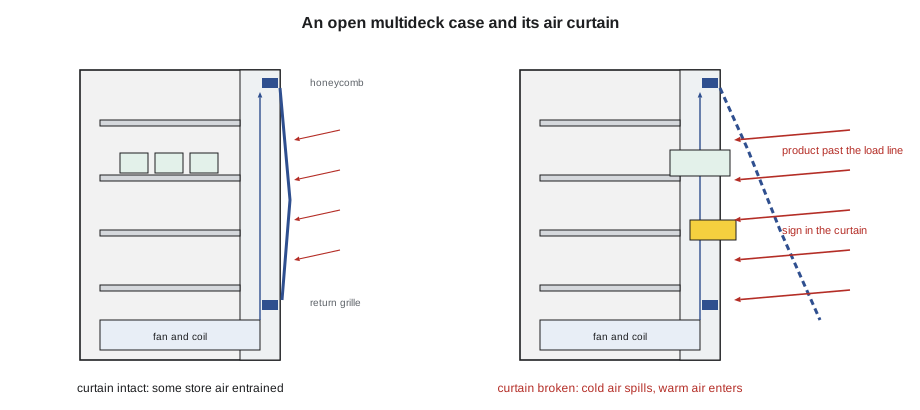
An open multideck case keeps its product cold by blowing a sheet of cold air down across the front opening, from a discharge honeycomb at the top to a return grille at the bottom. The air curtain separates the cold product zone from the warm store air. It is never perfect. Along its length, the curtain mixes with store air and entrains some of it; the warmed, moister air is pulled into the return grille and has to be cooled and dried by the coil. In a typical open multideck case, this entrained air is the largest part of the refrigeration load, often more than half and sometimes far more, because the opening is so large.
Anything that disturbs the curtain increases the load and warms the product. Product stacked beyond the case's load line sticks out into the curtain and deflects it. Price tags and signs hanging from the shelves break it up. A blocked return grille, often from product, packaging or a mat, stops the air returning, so it spills onto the floor. Drafts from the store's heating and air conditioning diffusers, entrance doors or ceiling fans push it away. Strong store air movement can double the infiltration into an open case. A case set beside a sunny window or under a heating diffuser will never perform as rated.
Where a case's load comes from
A display case's refrigeration load is rated by the manufacturer per meter or per foot of case, at a stated store condition, usually around 75 °F and 55 % relative humidity. The rating includes everything the coil must remove: entrained or infiltrated air, radiation from the warm store surfaces to the cold product, conduction through the case walls, and the heat of the case's own fans, lights and heaters. For open cases, infiltration dominates. For glass-door cases, the door heaters, lights and fans become a large share of a much smaller total.
Radiation is easy to forget. Cold product sees the store's ceiling, lights and walls, all much warmer than itself, and absorbs radiant heat from them. Product on the top shelf of an open case and on the surface of an island case gains noticeably more heat than product lower down. Night covers, roll-down blinds pulled over open cases when the store is closed, cut both radiation and air infiltration and can reduce an open case's overnight load substantially.
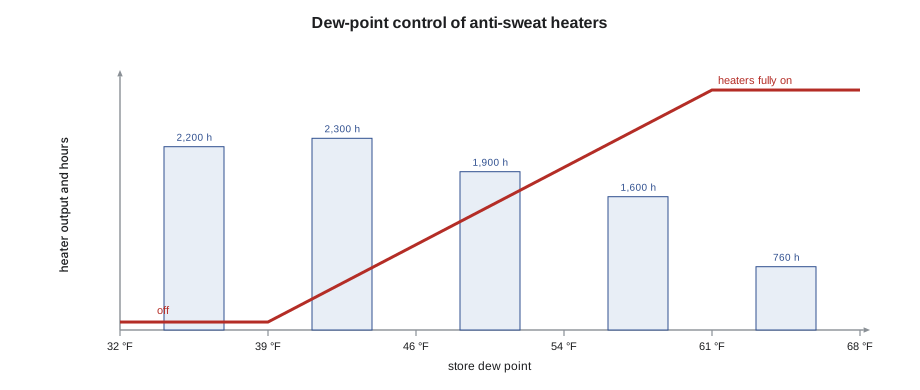
The script below works through Nadia's comparison for the dairy line, using typical loads for an open multideck and a glass-door case of the same length, and then estimates what dew-point control saves on the anti-sweat heaters of the store's fourteen frozen food doors.
# Dairy line: open multideck versus glass doors, and anti-sweat heater control on the frozen food doors
# Typical loads per foot of case at store design conditions (illustrative; use the manufacturer's data)
LENGTH = 80.0                # ft of dairy case
OPEN, DOORS = 1400, 500      # Btu/h per ft refrigeration load
COP = 2.5                    # medium-temperature rack, annual average
PRICE = 0.14                 # dollars per kWh
for name, btu_per_ft in (('open multideck', OPEN), ('with glass doors', DOORS)):
    load = LENGTH * btu_per_ft                      # Btu/h on the rack
    kwh = load / 3412 / COP * 8760
    print(f"{name:17s} load {load:7,.0f} Btu/h, rack input {kwh:7.0f} kWh/yr, ${kwh * PRICE:6.0f}/yr")

# Anti-sweat heaters on 14 frozen food doors, 160 W each when fully on
DOORS_LT, HEATER_W = 14, 160
# hours per year the store's dew point falls in each band (illustrative, heated store in winter, humid summer)
bins = {36: 2200, 43: 2300, 50: 1900, 57: 1600, 64: 760}     # dew point F : hours
def duty(dp, lo=39.0, hi=61.0):          # heaters off below lo, fully on above hi, proportional between
    return min(1.0, max(0.0, (dp - lo) / (hi - lo)))
always = DOORS_LT * HEATER_W * 8760 / 1000
controlled = sum(DOORS_LT * HEATER_W * duty(dp) * h for dp, h in bins.items()) / 1000
print(f"anti-sweat heaters always on: {always:5.0f} kWh/yr; with dew point control: {controlled:5.0f} kWh/yr "
f"({100 * (1 - controlled / always):.0f} % less, before the rack's saving on the heat it no longer removes)")open multideck load 112,000 Btu/h, rack input 115020 kWh/yr, $ 16103/yr with glass doors load 40,000 Btu/h, rack input 41079 kWh/yr, $ 5751/yr anti-sweat heaters always on: 19622 kWh/yr; with dew point control: 7699 kWh/yr (61 % less, before the rack's saving on the heat it no longer removes)
The glass doors cut the dairy line's refrigeration load by almost two thirds, saving about 74,000 kWh a year on the rack before counting the smaller fans and less heating needed in the aisle. That was close to Nadia's figure, and Theo said so. Meera chose doors for the dairy and kept open multidecks for produce, where her customers liked to pick through the displays. The anti-sweat calculation shows a saving of about 60 % in heater energy with dew-point control, plus a smaller saving at the rack because every watt of heater energy that ends up in the case is a watt the compressors must remove.
Glass doors and their heaters
Glass doors on medium-temperature cases need little or no heating, because the glass rarely falls below the store's dew point. Doors on low-temperature cases have double or triple glazing with a low-emissivity coating and gas fill, and they usually need heat in the frame and on the glass to stay clear. The heaters are low-voltage or line-voltage resistance elements; on the glass they are a transparent conductive coating. Heater faults cause the most visible display case complaint: doors that fog up or frost, hiding the product.
- Fogging that clears slowly after a door opens is normal in a humid store. Persistent fog or frost on one door, with the others clear, usually means a failed heater, a loose connector at the hinge or a damaged glass coating.
- Frost inside the glass means the door is not sealing: a torn gasket, a door out of adjustment or a failed door closer.
- All doors fogging at once on a humid day can mean the anti-sweat control's humidity sensor has failed or is reading low, so the heaters are being held off.
Anti-sweat heater controls, as RAC-230 described, switch or pulse the heaters based on the store's dew point. Their sensor is usually in the store, away from the cases, where it reads typical store air. When the control fails, it should fail with the heaters on, so the doors stay clear and only energy is wasted. Newer doors use low-wattage or no-heat designs with better glazing, and some use a sensor in each door frame.
Lighting, fans and other internal loads
Every watt of electrical energy used inside a case ends up as heat the refrigeration system must remove. Older fluorescent case lighting and shaded-pole fan motors used a lot of energy; LED lighting and electronically commutated fan motors, as RAC-130 described, use much less, and their heat load is smaller. When Theo checked the old store's records, its cases had fluorescent lamps and shaded-pole fans that together accounted for a noticeable share of the rack load. Retrofitting existing cases with LEDs and EC fans is one of the most common energy projects in grocery refrigeration, and technicians often install them.
Defrost in display cases
Medium-temperature cases usually defrost with off-cycle or timed off defrost: the refrigerant feed stops while the fans keep circulating the case's own air across the coil. Low-temperature and ice cream cases use electric or hot-gas defrost, as lesson 8 describes for rack systems. Case defrosts are usually scheduled so not all cases on a rack defrost at once, which would drop the rack's load suddenly, and so they avoid the busiest shopping hours. Frozen food cases often defrost one to three times a day; ice cream cases may defrost only once. Termination is on coil temperature, with a fail-safe time, just as for walk-ins.
Why a case runs warm
A display case that will not hold temperature is the commonest grocery refrigeration call. The causes fall into four groups, and most of them can be found before connecting gauges.
| Group | Examples | Quick check |
|---|---|---|
| Air path | Overloaded shelves, blocked return or discharge grille, failed fan, iced coil | Look at the load line, grilles and fans; feel the discharge air |
| Environment | Drafts from diffusers or doors, sun, a heater nearby, store humidity high | Smoke or tissue test at the curtain; store temperature and dew point |
| Refrigerant supply | Case valve or solenoid not opening, low superheat control fault, rack suction too high | Discharge air temperature, coil inlet and outlet temperatures, case controller status |
| Defrost | Defrost too long or too frequent, termination set wrong, failed heater | Controller defrost log, coil frost pattern |
A useful first measurement is the discharge air temperature, at the top honeycomb, compared with the manufacturer's specification. If the discharge air is correct and the product is warm, the problem is the air curtain or the environment. If the discharge air is warm, the problem is the coil, the refrigerant supply or the defrost. Store staff are often the cause of air path problems without knowing it: a case that has been stocked past its load line for a promotion, or a return grille covered by a display, will run warm whatever the refrigeration system does.
Common mistakes
MistakeStocking product beyond the load line.
InsteadKeep product inside the load line so the air curtain is not deflected.
MistakePlacing open cases under heating diffusers or near entrances.
InsteadKeep drafts away from open cases.
MistakeAssuming a warm case needs refrigerant.
InsteadCheck the air path, environment and defrost first, using discharge air temperature.
MistakeDefeating anti-sweat controls by wiring heaters permanently on without telling anyone.
InsteadRepair the control; if heaters must be left on, record it and plan the repair.
MistakeDefrosting all cases on a rack at the same time.
InsteadStagger case defrosts.
Summary and key terms
- Display cases keep product cold while showing it, which makes their loads large.
- In open cases the air curtain's entrained store air is usually the largest part of the load.
- Glass doors can cut a medium-temperature case's load by about two thirds.
- Low-temperature doors need frame and glass heaters; dew-point control cuts their energy.
- Case lights, fans and heaters all add to the refrigeration load.
- Discharge air temperature separates air path problems from refrigeration problems.
- Air curtain
- The sheet of cold air across the front of an open case that separates product from store air.
- Load line
- The marked limit of where product may be stocked in a case.
- Discharge honeycomb
- The grille that straightens the cold air leaving the top of an open case.
- Return grille
- The grille at the bottom front of an open case through which air returns to the coil.
- Night cover
- A blind pulled over an open case when the store is closed.
- Anti-sweat heater
- A heater in a door, frame or glass that prevents condensation.
- Gravity coil
- A coil that cools by letting cold air fall over product without fans.
Practice problems
Work each problem on paper first, then reveal the answer to check.
An open dairy case's discharge air is at specification, but the product on the front of the shelves is warm. What should be checked?
Show answer
The air curtain: load line, signs, drafts and the return grille.
One frozen food door frosts while its neighbors stay clear. Name two likely causes.
Show answer
A failed door or frame heater or connector, or a gasket that does not seal.
Why do night covers save energy?
Show answer
They reduce both infiltration and radiation into open cases when the store is closed.
Why should anti-sweat controls fail with the heaters on?
Show answer
So the doors stay clear and only energy is wasted if the control fails.
Lesson quiz · 5 questions
Score 60% or more to complete this lesson.
Create a free account to save your progress, take quizzes and earn a certificate.