
RAC-310 · Lesson 3 of 12 · 19 min
Walk-in freezers: doors, heaters, relief ports, floors and defrost
Two weeks after the Harvest Lane walk-ins were assembled, Theo was back at the first restaurant for a call he had heard about before. The kitchen staff said the walk-in freezer door was "sucking shut" so hard that the cook could not open it again for a minute after closing it, and that the door frame was sweating and dripping onto the floor. Dana met him there. She opened the door, let it close, and tried to open it again; it resisted as if someone were holding it from inside. Then she put her hand over a small grille in the wall beside the door. "No air," she said. "The relief port's heater has failed and it's frozen solid. That's the door. Now let's look at why the frame sweats."
A walk-in freezer is a walk-in cooler with every problem made worse. The temperature difference to the room is two to three times larger, moisture that enters freezes instead of draining away, the floor can freeze the ground beneath it, and the coil needs heat to defrost. This lesson covers the parts of a freezer that a cooler does not need, and the faults that come from them.
Why freezer doors stick
When a freezer door opens, warm room air flows in at the top of the opening and cold box air spills out at the bottom. When the door closes, the warm air trapped inside cools to box temperature. A fixed volume of air that cools loses pressure, in proportion to its absolute temperature, so the box ends up at a lower pressure than the room. A well-sealed freezer can hold that vacuum long enough to make the door hard to open, and the pressure difference can pull room air in through the door gaskets, carrying moisture that freezes in the seals.
The script below estimates the pressure difference and the force on the door for a sealed box when different fractions of the air are exchanged during an opening. Real boxes leak, so the actual numbers are smaller and fall quickly, but the calculation shows why even a short opening can make a door difficult to open again.
# Why freezer doors stick: the pressure drop when warm air trapped in the box cools at constant volume
# Ideal gas, box sealed after the door closes (no relief port); illustrative values
P_ATM = 14.70            # psia
T_ROOM = 70.0 + 459.67   # R, air entering from the back room
T_BOX = -10.0 + 459.67   # R, freezer air
DOOR_AREA = 36 * 80      # in2, door leaf

for exchanged in (0.05, 0.10, 0.20):
    # fraction of the box air replaced by room air during the opening
    t_mix = 1 / ((1 - exchanged) / T_BOX + exchanged / T_ROOM)   # mixed air just after the door shuts
    p_end = P_ATM * T_BOX / t_mix                                 # cools back to box temperature
    dp = P_ATM - p_end                                            # psi below the store
    force = dp * DOOR_AREA                                        # lb on the door leaf
    print(f"{exchanged:4.0%} of the air exchanged: {dp * 27.68:5.1f} in. w.c. below the store, "
          f"{force:6.0f} lb pushing the door shut")

# A heated pressure relief port lets air flow in so the difference falls to a small fraction of an inch5% of the air exchanged: 3.1 in. w.c. below the store, 320 lb pushing the door shut 10% of the air exchanged: 6.1 in. w.c. below the store, 639 lb pushing the door shut 20% of the air exchanged: 12.3 in. w.c. below the store, 1279 lb pushing the door shut
Even with only a twentieth of the air exchanged, the force on the door is far more than anyone can pull. In practice the box leaks enough that the difference drops within seconds to a minute, but that minute is what the restaurant's cook was complaining about.
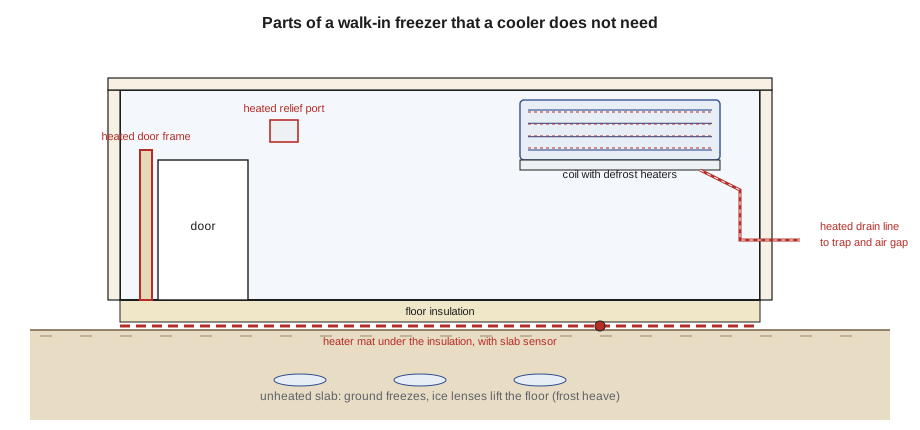
The cure is a pressure relief port, a small vent through the panel, usually beside the door, with a pair of flaps or a valve that opens to let air in when the box is below room pressure, and out when it is above, such as during a hot-gas or electric defrost. On a freezer, the port contains a small heater so the moisture in the incoming air does not freeze the flaps shut. When the heater fails, the port ices up and the door starts sticking again. Checking the relief port's heater, by feeling for warmth and confirming its supply, is part of every freezer maintenance visit.
Door frame and gasket heaters
The metal door frame of a freezer is a thermal bridge: it connects the cold inside to the warm room, so its outer surface can fall below the room's dew point and sweat, or below freezing and ice up. Freezer frames therefore have perimeter heaters, low-wattage resistance wires or tapes behind the frame, that keep the surface warm. Glass doors on reach-ins and display cases have heaters in the frame and, often, a transparent conductive coating on the glass. As RAC-230 described, anti-sweat controls can reduce their run time when the room is dry.
- A failed frame heater causes sweating, dripping and, eventually, ice on the frame that stops the door sealing.
- A gasket that does not seal lets moist air in, which forms frost or ice on the inside of the frame and in the gasket itself, holding the door open slightly and making the leak worse.
- A sagging door, worn hinges or a box that has settled out of level makes the gasket seal on only part of the frame.
At the restaurant, the frame heater was working. The sweating came from a torn section of the door's bottom gasket and a sweep that had been worn away by a cart; room air was being pulled in continuously through the gap, cooling the frame from the inside. Theo replaced the gasket and sweep, Dana replaced the relief port heater, and the door closed normally within the hour.
Floors and frost heave
A freezer sitting on a concrete slab on the ground slowly chills the soil beneath it. Insulation under the floor slows the heat flow but does not stop it, and over months or years the ground temperature beneath a freezer that runs all the time can fall below freezing. If the soil is moist, ice lenses form and grow, lifting the slab. This is frost heave. It cracks floors, lifts door thresholds so doors bind, and can damage the building's foundation. It is a slow problem, but once it starts it is expensive to fix, because the freezer has to be emptied and warmed and the ground allowed to thaw.
Freezers on grade are protected in one of three ways. Electric heater cables or mats can be laid in the slab beneath the insulation, controlled by a thermostat or sensor in the slab. Glycol or heat-reclaim piping can circulate warm fluid in the slab, often using rejected heat from the refrigeration system. Or ventilation pipes can be cast into the slab beneath the insulation so outdoor or building air flows through them. Small freezers on upper floors, or with an air space below, may not need heave protection. The freezer manufacturer's installation instructions say what is needed for each floor type.
For service, the important thing is to check that the floor heating, where fitted, is working, and to recognize early signs of heave: a freezer door that has started binding at the bottom, a threshold that is higher than it was, or cracks radiating from the freezer's corners. A floor heater circuit that has been switched off, perhaps to save energy or because someone did not know what it was, will do no harm for months and then cause a failure that costs far more than the energy saved. At Harvest Lane, the freezer was on the original slab, so Nadia's design included a heater mat beneath new insulation, with a slab sensor wired to the freezer's controller as an alarm input.
Defrost on freezers
A cooler's coil can defrost during the off cycle because the box air is above freezing. A freezer's coil cannot; the frost must be melted with added heat. RAC-210 and RAC-230 described the methods and controls. This section covers what goes wrong with them in walk-in freezers, because that is where defrost causes most callbacks.
- Electric defrost: heater elements in or behind the coil, switched by a contactor from the controller or timer. A failed element leaves part of the coil frosted after every defrost, and the ice grows defrost by defrost until airflow is blocked.
- Hot-gas defrost: discharge gas is sent through the coil, usually on rack systems and larger condensing units. It is faster and puts less heat into the box, but needs correct valve sequencing and a way to return the condensed refrigerant safely.
- Drain line heaters: the drain pan has its own heater, and the drain line inside the box is wrapped with a heater cable and insulated, so the meltwater does not freeze before it leaves the box. The drain must be trapped outside the box, in a warm space, and run to an indirect waste with an air gap.
- Termination and fan delay: defrost should end on coil temperature, with a fail-safe time, and the fans should stay off until the coil is cold again, as RAC-230 described.
Drain problems are the commonest freezer defrost fault. A failed drain line heater lets the meltwater freeze in the line; the next defrost's water backs up in the pan and freezes there; the ice in the pan grows into the coil; and within a week or two the coil is a block of ice. The symptoms are a freezer that warms slowly, ice on the floor under the coil and a defrost that ends on its fail-safe time because the termination sensor sits in ice. The repair is to defrost the coil completely, by hand with warm water or with repeated defrost cycles, find and fix the failed heater, check the drain's slope and trap, and check that the pan heater works.
| Symptom | Likely cause | Check |
|---|---|---|
| Ice on the floor under the coil, drain pan full of ice | Drain line or pan heater failed, drain not sloped or trapped wrongly | Heater resistance and supply; drain slope and trap location |
| Frost left on one section of the coil after defrost | One defrost element open | Element resistance; current on each element during defrost |
| Defrost always ends on the fail-safe time | Termination sensor loose or in ice, or heaters weak | Sensor clamp and location; heater current |
| Water sprayed into the box after defrost | Fans restarting before the coil is cold | Fan delay setting and sensor |
| Ice on the ceiling above the coil | Too many or too long defrosts, steam leaving the coil | Defrost schedule, termination temperature, coil shroud |
Defrost heat as part of the load
Every defrost puts heat into the box: some melts frost and drains away, but much of it warms the coil, the drain pan and the air around them, and the refrigeration system then has to remove it. A coil with 10,000 Btu/h of electric heaters that runs four defrosts a day of 20 minutes each uses 13,300 Btu a day, and perhaps half of that becomes load. Too many defrosts, or defrosts that run too long because the termination is set too high, waste energy twice: once in the heaters and again in the compressor. Demand defrost, described in RAC-230, reduces the number of defrosts when the frost load is light.
Safety: people inside freezers
Walk-in freezers can be dangerous for the people who work in them. A person trapped in a freezer can become hypothermic in a surprisingly short time. Every walk-in, and especially every freezer, must have an inside door release that opens the door even if it is locked from outside, and it must work. Many freezers also have an inside emergency alarm button and a light that stays on. When servicing a freezer, check that the inside release works, that it is not blocked by stored product, and that its mechanism is not frozen. Make sure someone knows you are inside, and wear clothing suited to the time you will spend there. If you find an inside release that does not work, it is a safety issue to report to the customer immediately, not an item for the next maintenance visit.
Technicians working on freezers also face slippery floors from ice and meltwater, cold metal that can stick to skin, and ladders set on wet or icy floors to reach ceiling-mounted coils. Defrost heaters and drain heaters are line-voltage circuits that must be locked out before they are touched, as RAC-130 described. A defrost heater circuit can be energized by the controller at any time, so switching the controller off at its keypad is not isolation.
Common mistakes
MistakeIgnoring a relief port that has iced up.
InsteadCheck the port's heater and flaps on every freezer visit.
MistakeSwitching off a slab heater circuit to save energy.
InsteadKeep floor heave protection working; check it during maintenance.
MistakeChipping ice off a frozen coil with a tool.
InsteadMelt the ice completely and find the cause, usually a drain or heater fault.
MistakeRestarting fans immediately after defrost.
InsteadUse a fan delay so the coil is cold before air moves.
MistakeLeaving a non-working inside release for a later visit.
InsteadReport it as an immediate safety issue.
Summary and key terms
- Cooling trapped air drops a freezer's pressure below the room; a heated relief port lets air in and out.
- Frame heaters keep door frames above the dew point; gaskets and sweeps keep moist air out.
- Freezers on grade need floor heave protection, and its controls must be kept working.
- Freezer coils need heated defrost, heated drain pans and drain lines, and correct termination and fan delay.
- Drain heater failures cause most iced-coil callbacks.
- Inside door releases must always work; check them and report failures immediately.
- Pressure relief port
- A vent beside a freezer door that equalizes pressure between the box and the room, usually heated.
- Perimeter heater
- A heater behind a door frame that keeps its surface above the dew point.
- Frost heave
- Lifting of a floor or foundation by ice forming in frozen soil below it.
- Heater mat
- An electric heating element laid under a freezer floor to keep the ground from freezing.
- Drain line heater
- A heater cable on a freezer drain line that stops meltwater freezing.
- Inside release
- A device that lets a person open a walk-in door from the inside even if it is locked.
- Thermal bridge
- A conductive path through insulation, such as a metal door frame.
Practice problems
Work each problem on paper first, then reveal the answer to check.
A freezer door is hard to open for a minute after it closes. What should be checked first?
Show answer
The pressure relief port and its heater.
Ice fills a freezer's drain pan and is growing into the coil. Name two likely causes.
Show answer
A failed drain line or pan heater, or a drain without proper slope or trap.
A freezer door has started binding at the bottom and the threshold seems higher. What problem should be suspected?
Show answer
Frost heave under the slab.
Why is turning the controller off at its keypad not enough before working on a defrost heater?
Show answer
The circuit is still live and the controller can energize it; lock out the supply.
Lesson quiz · 5 questions
Score 60% or more to complete this lesson.
Create a free account to save your progress, take quizzes and earn a certificate.