
RAC-310 · Lesson 1 of 12 · 19 min
Commercial refrigeration: applications, temperatures and food safety
The building that housed the old grocery store sat empty for less than a year. Theo remembered it well: in RAC-120 he had spent two cold October days helping Raj recover the R-22 from its worn-out parallel rack, four recovery cylinders and a long list of records, before the building was sold. In the spring a new owner, Meera Shah, signed the lease. She had run a successful produce stand for ten years and was opening Harvest Lane Market, an independent grocery of about 15,000 ft² with a butcher counter, a deli, a bakery and a large produce section. The refrigeration was being designed by Nadia Brooks, an engineer with the case manufacturer's sales agency, and Northfield Mechanical won the contract to install it, start it up and look after it.
Dana put Theo on the job from the first site meeting. He was now a third-year apprentice, and Level 3 of the program is where the work changes scale. Levels 1 and 2 taught the refrigeration cycle, refrigerant handling, electrical work, the major components, metering and charging, and controls. This course applies all of that to commercial refrigeration: the walk-ins, reach-ins, display cases, ice machines and parallel rack systems that keep food safe in restaurants, grocery stores, arenas and institutions. Most commercial refrigeration calls are not about a broken part. They are about food that is too warm, an energy bill that is too high or a leak that keeps coming back. A commercial technician needs to understand the customer's business as well as the equipment.
What commercial refrigeration covers
Commercial refrigeration is usually divided by where the equipment is used and how it is built. The same physics applies to all of it, but the duty, the regulations and the service expectations differ.
- Food service: restaurants, cafeterias, hospitals and residences. Walk-in coolers and freezers, reach-ins, prep tables, under-counter units, bar coolers and ice machines, mostly self-contained or with small condensing units.
- Food retail: grocery and convenience stores. Display cases and walk-ins served by parallel rack systems or remote condensing units, plus self-contained beverage coolers and ice cream merchandisers.
- Cold storage and distribution: warehouses, distribution centers and food processors. Large coolers and freezers, often on industrial ammonia or carbon dioxide systems, which RAC-420 covers.
- Specialty: arenas and curling rinks, florists, wineries, laboratories, pharmacies and breweries, each with its own temperature and humidity needs.
The equipment is described by how its refrigeration system is arranged. A self-contained or stand-alone unit has the compressor, condenser and evaporator in one cabinet, connected at the factory. A remote condensing unit puts the compressor and condenser outdoors or on a roof, connected by field-installed piping to one or a few evaporators. A centralized or parallel rack system serves dozens of evaporators from one set of compressors in a machine room, with a remote condenser on the roof. The way the equipment is arranged affects who can service it, how much refrigerant is in it, which regulations apply and how a failure affects the business. A failed reach-in loses one cabinet of food. A failed rack can put an entire store's perishables at risk within hours.
Temperature classes
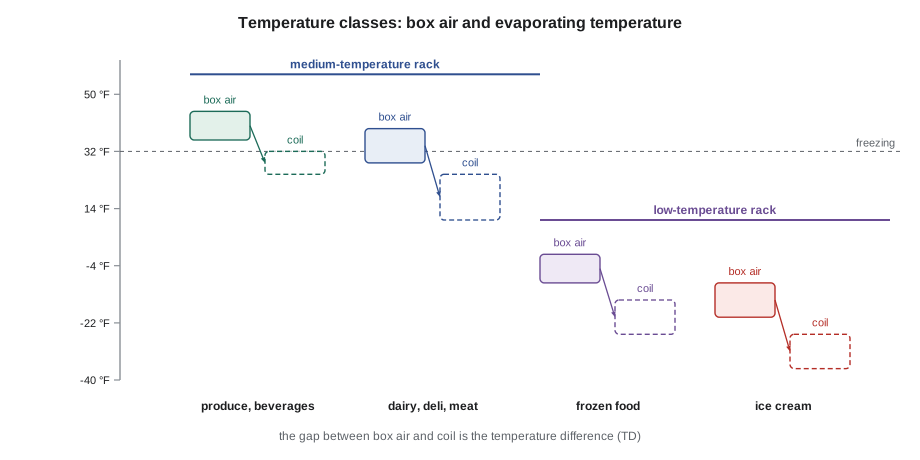
Commercial refrigeration is grouped into temperature classes by the product it holds. The box or case temperature is what the customer and the inspector care about. The evaporating temperature, which depends on the coil's temperature difference, is what the system designer and the technician care about, because it decides the compressor, the refrigerant pressure and the defrost method.
| Class | Typical product | Typical box or case air | Typical evaporating temperature |
|---|---|---|---|
| High medium temperature | Produce, flowers, beverages | 36 to 45 °F | 25 to 32 °F |
| Medium temperature | Dairy, deli, meat, fish | 28 to 40 °F | 10 to 25 °F |
| Low temperature | Frozen food | −10 to 0 °F | −25 to −15 °F |
| Ice cream | Ice cream and frozen desserts | −20 to −10 °F | −36 to −25 °F |
The gap between the box temperature and the evaporating temperature is the coil's temperature difference, or TD, which RAC-210 linked to humidity. A small TD keeps the coil surface close to the air temperature, so less moisture condenses out of the box air and produce, flowers and uncovered meat do not dry out. A large TD dries the box and frosts the coil faster, but needs a smaller, cheaper coil. Meat coolers and produce coolers are designed with small TDs, often 8 to 10 °F, while freezers and packaged-product coolers can use larger ones. Nadia's design for Harvest Lane put all the medium-temperature fixtures on one rack and all the low-temperature fixtures on another, so each rack's compressors could run at an evaporating temperature suited to its group.
Why food safety drives the work
Cold slows the growth of the bacteria that spoil food and make people sick, but it does not stop them. Most disease-causing bacteria grow fastest between about 41 °F and 140 °F, which food safety training calls the danger zone. Some, such as Listeria, can still grow slowly at refrigerator temperatures, which is why time matters as well as temperature. Freezing stops growth but does not kill most bacteria, so food that thaws warms back into the danger zone with its bacteria intact. A refrigeration failure in a food business is therefore a public health event as well as an equipment problem.
In Kentucky, the retail food code adopts the FDA Food Code, which requires time and temperature control for safety foods to be held at 41 °F or colder, or at 135 °F or hotter, and frozen food to be kept frozen. Health department inspectors check the temperatures during inspections, and the operator must have accurate thermometers in each refrigerated space. Other provinces and states use similar numbers, and some operators set tighter internal limits for products such as fresh fish or infant formula. Many food businesses follow a food safety plan based on HACCP, hazard analysis and critical control points, in which refrigeration temperatures are a critical control point with set limits, monitoring, records and corrective actions.
For the technician, this means three things. First, the customer's temperature log, or the controller's data, is evidence; read it before you touch anything, and never adjust a probe offset to make a log look better. Second, a repair that leaves a box running warm is not finished, however neat the work. Third, when food has been above its limit, the decision about whether it is safe belongs to the operator and the health inspector, not to the refrigeration technician. Your job is to report accurately how long the box was warm and how warm it got, from the data, and to get it back into range as fast as is safely possible.
Product temperature and air temperature
A box's air temperature and the product's temperature are not the same thing. Air temperature swings with every compressor cycle, door opening and defrost. A large mass of product changes temperature slowly. A walk-in cooler might show air at 45 °F for twenty minutes after a delivery while the milk in the middle of the cases is still at 37 °F. Equally, a box whose air reads 37 °F can hold product at 46 °F if warm product was loaded an hour ago and the system cannot pull it down. Inspectors measure product temperature with a probe thermometer; controllers measure air. Some stores put a product-simulating probe, a sensor buried in a small bottle of glycol or a plastic block, in each case, so the logged temperature behaves more like the food than the air.
Equipment is designed to hold product cold, not to cool hot product quickly. Commercial reach-ins and walk-ins are sized to maintain product that arrives already cold. A restaurant that puts a full stock pot of hot soup into a reach-in will warm everything around it, and its compressor may run for hours. Blast chillers and roll-in rapid chill cabinets are designed for cooling cooked food quickly, with large coils and high airflow. When a restaurant complains that a reach-in cannot keep up, ask what is being put into it.
Commercial duty and what customers expect
Commercial equipment works harder than domestic equipment. A restaurant reach-in may be opened two hundred times in a lunch service, sit in a kitchen at 95 °F beside a fryer and be cleaned with hot water and chemicals every night. A grocery display case runs around the clock in front of customers. Downtime costs money directly: lost product, lost sales, staff overtime and, sometimes, a failed inspection. Customers judge their refrigeration contractor on response time, on whether the food stayed safe and on whether the same problem comes back.
This is why commercial service involves more than repairs. Preventive maintenance, which lesson 11 covers, catches dirty condensers, worn gaskets and failing fan motors before they become emergencies. Temperature monitoring and alarms, which RAC-230 covered on the controls side, let problems be found at 3 a.m. instead of at opening. Good records show the customer, the inspector and the next technician what was done. And clear communication matters: a store manager needs to hear what failed, what product is at risk, how long the repair will take and what will prevent it happening again.
The Harvest Lane project
Nadia's design gave Northfield a set of drawings and a fixture schedule. The old store's single R-22 rack had served everything; the new design used two racks on R-448A in the existing machine room, one medium-temperature and one low-temperature, with a new air-cooled condenser on the roof, heat reclaim for the store's heating and a refrigerant monitoring system. The checkout beverage coolers and an ice cream island were self-contained units on propane, R-290, plugged into the floor. Theo spent his first afternoon matching every fixture to its rack circuit, its temperature class and its controller.
| Fixture | Temperature class | Air setpoint | System |
|---|---|---|---|
| Produce multideck cases | High medium | 38 °F | Medium-temperature rack |
| Dairy multideck cases | Medium | 36 °F | Medium-temperature rack |
| Meat and deli service cases | Medium | 32 °F | Medium-temperature rack |
| Produce and dairy walk-in cooler | Medium | 36 °F | Medium-temperature rack |
| Meat walk-in cooler | Medium | 32 °F | Medium-temperature rack |
| Glass-door frozen food cases | Low | −6 °F | Low-temperature rack |
| Walk-in freezer | Low | −10 °F | Low-temperature rack |
| Ice cream island | Ice cream | −15 °F | Self-contained, R-290 |
| Checkout beverage coolers | High medium | 37 °F | Self-contained, R-290 |
The script below takes part of that schedule, subtracts each fixture's design TD from its air setpoint to estimate the coil's evaporating temperature, and checks two things Theo was asked to confirm: that every fixture on a rack can be served at that rack's suction temperature, and that each fixture's high-temperature alarm limit sits below the food safety limit with some margin.
# Fixture schedule check: evaporating temperature from setpoint and TD, rack assignment, alarm margin
# Values are from the Harvest Lane design sheets (illustrative)
FOOD_LIMIT = 41.0      # cold-holding limit, F
RACK_SST = {'MT': 20.0, 'LT': -25.0}   # rack saturated suction temperatures, F

fixtures = [
    # name, air setpoint, design TD, rack, high alarm limit
    ('produce multideck', 38.0, 10.0, 'MT', 38.0),
    ('dairy multideck',   36.0, 12.0, 'MT', 38.0),
    ('meat service case', 32.0, 9.0, 'MT', 37.0),
    ('dairy walk-in',     36.0, 10.0, 'MT', 38.0),
    ('frozen food doors', -6.0, 14.0, 'LT', None),
    ('walk-in freezer',   -10.0, 13.0, 'LT', None),
]

for name, setp, td, rack, alarm in fixtures:
    evap = setp - td
    margin = evap - RACK_SST[rack]      # the coil must run warmer than the rack's suction
    ok = 'ok' if margin >= 0 else 'TOO COLD FOR RACK'
    line = f"{name:18s} evap {evap:6.1f}, rack {RACK_SST[rack]:6.1f}, margin {margin:4.1f} {ok}"
    if alarm is not None:
        line += f"; alarm {alarm} vs limit {FOOD_LIMIT}: " + ('ok' if alarm < FOOD_LIMIT else 'raise concern')
print(line)produce multideck evap 28.0, rack 20.0, margin 8.0 ok; alarm 38.0 vs limit 41.0: ok dairy multideck evap 24.0, rack 20.0, margin 4.0 ok; alarm 38.0 vs limit 41.0: ok meat service case evap 23.0, rack 20.0, margin 3.0 ok; alarm 37.0 vs limit 41.0: ok dairy walk-in evap 26.0, rack 20.0, margin 6.0 ok; alarm 38.0 vs limit 41.0: ok frozen food doors evap -20.0, rack -25.0, margin 5.0 ok walk-in freezer evap -23.0, rack -25.0, margin 2.0 ok
Every fixture's coil runs warmer than its rack's suction temperature, which is how it should be: the difference is taken up by the case's own control of refrigerant flow, which lesson 8 covers. The fixtures with the smallest margin, such as the meat service case and the walk-in freezer, are the ones that will suffer first if the rack's suction pressure drifts up. All the alarm limits on the medium-temperature fixtures sit below the food safety limit, so staff are warned before product is at risk.
Reading the customer's business
The first visit to any commercial customer should include a walk-through with someone who knows the operation. Which fixtures matter most? A florist's cooler failing on Valentine's Day is a disaster; the same cooler failing in a quiet week in August is an inconvenience. When are deliveries, and where does the product go first? When does the store clean, and with what? Who should be called when an alarm goes off at night? Meera's answers shaped how Northfield planned the start-up: the meat department would be stocked first, the frozen aisle last, and no refrigeration work would be scheduled on a Friday or the day before a holiday weekend.
Commercial work also brings commercial paperwork. Service contracts set response times and what is covered. Purchase orders authorize repairs above a certain value. Large customers may require their own site safety orientation, hot work permits and lockout procedures in addition to Northfield's. Refrigerant records, covered in RAC-120, are required by law, and a grocery rack's records will be read by regulators, auditors and the store's own environmental staff. Getting into the habit of writing clear, complete service reports now will save Theo trouble for the rest of his career.
Common mistakes
MistakeTreating a warm box as an equipment problem only.
InsteadTreat it as a food safety problem first: record how warm and for how long, and tell the operator.
MistakeAdjusting a probe offset to make the log match what the customer wants to see.
InsteadCheck probes against a calibrated reference and correct real errors only.
MistakeAssuming air temperature and product temperature are the same.
InsteadMeasure product with a probe thermometer when it matters.
MistakeBlaming the equipment when a reach-in is used to cool hot food.
InsteadAsk what is loaded; holding equipment is not designed for rapid cooling.
MistakeIgnoring how the business runs when scheduling work.
InsteadLearn delivery times, critical fixtures and busy days before planning repairs.
Summary and key terms
- Commercial refrigeration covers food service, food retail, cold storage and specialty uses.
- Equipment is self-contained, served by a remote condensing unit, or on a central parallel rack.
- Temperature classes set the box temperature; the coil's TD sets the evaporating temperature below it.
- Food safety rules set cold-holding limits, 41 °F for potentially hazardous food in the local rules, and frozen food must stay frozen.
- Air and product temperatures differ; holding equipment is not designed to cool hot food.
- Good commercial service depends on understanding the customer's business, records and communication.
- Self-contained unit
- Equipment with its compressor, condenser and evaporator in one factory-built cabinet.
- Remote condensing unit
- A compressor and condenser installed away from the evaporator, connected by field piping.
- Parallel rack system
- A group of compressors on common headers serving many evaporators, also called a centralized system.
- Medium temperature
- The class of refrigeration that holds fresh product just above freezing.
- Low temperature
- The class of refrigeration that holds frozen product.
- Danger zone
- The temperature range in which disease-causing bacteria grow quickly.
- HACCP
- Hazard analysis and critical control points, a system for managing food safety risks.
- Product-simulating probe
- A sensor in a small mass that responds to temperature changes like food rather than air.
Practice problems
Work each problem on paper first, then reveal the answer to check.
A dairy case's air setpoint is 36 °F and its coil TD is 12 °F. What is the approximate evaporating temperature?
Show answer
24 °F.
Why are produce coolers designed with a small coil TD?
Show answer
To keep humidity high so produce does not dry out.
A reach-in holding the right air temperature contains warm product. Name a likely cause that is not an equipment fault.
Show answer
Warm or hot product was loaded into holding equipment.
Who decides whether food that was above its limit can be sold?
Show answer
The operator, with the health inspector; the technician reports the facts.
Lesson quiz · 5 questions
Score 60% or more to complete this lesson.
Create a free account to save your progress, take quizzes and earn a certificate.