
PRIN-150 · Lesson 7 of 12 · 25 min
Tailoring the people element, sustainability and digital and data management
PRINCE2 7 made three areas more visible than earlier editions did: people, sustainability and digital and data management. All three must be tailored like everything else. A project in a consensus-minded public library needs a different style of engagement from a project on a construction site. A project with large environmental effects needs sustainability targets with real tolerances; a project with small effects needs a sentence in the business case. A project that handles personal data needs a serious data approach; one that does not can say so briefly. This lesson works through these areas with Harbor City Libraries' digital library card project.
The digital library card
Harbor City wants patrons to be able to use a digital card in a phone wallet or the library app instead of a plastic card, to sign up online without visiting a branch, and to link family accounts. The 140 thousand project will run for nine months with a hybrid delivery approach: the integration with the library management system and the wallet pass are built in sprints by the library's small digital team and a vendor, while branch changes (new procedures, staff training, signage and a card amnesty) are planned predictively.
The executive is the chief librarian, Dr. Tomás Ruiz. The senior user role is shared by the head of branch services, Alicia Fernandes, and the head of collections and digital services. The senior supplier is the vendor's account director, with the library's IT manager for in-house resources. Dev Sharma, fresh from the makerspace, is the project manager.
Tailoring the people element
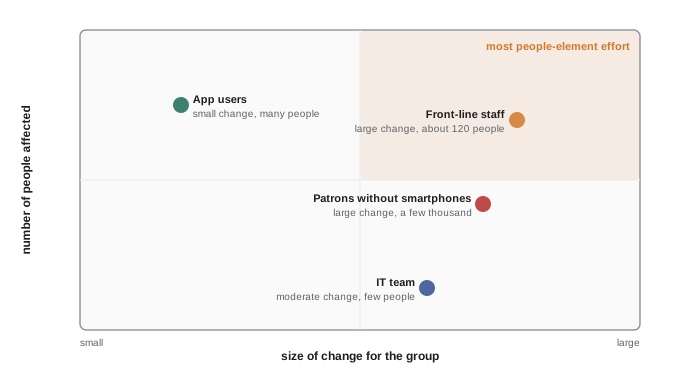
The people element is about how the project leads change, builds teams, communicates and works with the organization's culture. Its purposes are constant: people must understand the change, be able to work together, and be willing to adopt what the project delivers. How much effort that needs depends on how many people are affected, how big the change is for them and how the organization usually makes decisions.
For the digital card, the change is small for patrons who already use the app and large for front-line staff, who will change sign-up procedures, handle questions about phones they have never seen and explain privacy choices. Library culture at Harbor City is consultative: staff expect to be asked before procedures change, and the staff union has a joint committee for workplace changes. Dev tailors the people element accordingly.
| People-element purpose | Tailoring for the digital card | Why |
|---|---|---|
| Leading successful change | A change lead in each branch; staff testing sessions in every sprint review | Front-line staff carry most of the change |
| Engaging stakeholders | Early briefing to the union's joint committee; patron advisory panel including seniors and newcomers | Consultative culture; equity concerns |
| Building effective teams | Weekly joint stand-up of the digital team and vendor; shared definition of done | Hybrid in-house and vendor team, partly remote |
| Communication | Staff newsletter each sprint; patron campaign only after stage 3 release | Avoid promising a feature before it works |
| Developing capability | Short training videos plus a desk guide; a 'digital card champion' at each branch | Shifts vary; not all staff can attend sessions |
Tailoring sustainability
PRINCE2 7 treats sustainability as something to manage throughout the project, not an afterthought. In practice that means agreeing sustainability objectives where they matter, setting measures and, if the board wishes, tolerances for them, and reporting progress like any other performance target. The same proportionality applies: projects with significant environmental or social effects need explicit targets; projects with minor effects need less.
The digital card has modest environmental effects, mostly positive: fewer plastic cards and mailed notices. Its social effects matter more. If the project made digital sign-up easier while making in-person service worse, it would widen the gap between patrons with smartphones and those without. The board therefore sets two sustainability targets with tolerances: plastic cards issued must fall by at least 50 % within a year of launch, and the share of new members who are seniors or recent newcomers must not fall below the current 22 %, with a tolerance of 2 percentage points.
baseline_cards, target_drop = 18000, 0.50         # plastic cards issued per year
months = [1, 2, 3, 4, 5, 6]
cards_issued = [1200, 1050, 900, 820, 760, 700]      # monthly, after launch
annualized = sum(cards_issued[-3:]) / 3 * 12
drop = 1 - annualized / baseline_cards
equity_share = [0.23, 0.21, 0.20, 0.205, 0.21, 0.215]  # seniors and newcomers among new members
target, tol = 0.22, 0.02
print(f"annualized plastic cards: {annualized:,.0f} ({drop:.0%} below baseline; target {target_drop:.0%})")
low = min(equity_share)
print(f"lowest equity share: {low:.1%}; floor {target - tol:.1%}")
print("equity tolerance:", "breached - escalate" if low < target - tol else "within tolerance")annualized plastic cards: 9,120 (49% below baseline; target 50%) lowest equity share: 20.0%; floor 20.0% equity tolerance: within tolerance
The card reduction is on track at about 52 %. The equity share dipped to 20.0 % in month 3, exactly at the floor of the tolerance, and has recovered to 21.5 % since branch staff began offering assisted digital sign-up. The dip was not a breach, but it was a signal, and it was reported in the highlight report so that the board saw it early. Treating a social target with the same discipline as cost and time is what tailoring sustainability in looks like.
Tailoring digital and data management
PRINCE2 7 includes a digital and data management approach, describing how the project handles its own information and the data its products create or use. For a project like the makerspace, a few sentences are enough. For the digital card, which creates accounts, links family members and stores phone wallet tokens, the approach is a substantial document.
| Topic | Digital card approach |
|---|---|
| Personal data in products | Name, address, date of birth, email, phone, card number, family links; no reading history |
| Privacy assessment | Privacy impact assessment before stage 2; updated before launch |
| Consent and minors | Parental consent for children's accounts; family links visible only to the account holder |
| Retention | Expired accounts deleted after the period in the library's records schedule |
| Vendor data handling | Data processing terms in the contract; data stored in the country; breach notice within set hours |
| Project information | Backlog and registers in the library's project tool; board papers in the records system |
| Data quality | Address validation at sign-up; duplicate account check |
Harbor City's library is a public body, and like nearly every US state, its state protects library patron records by statute, limiting disclosure to narrow exceptions such as a court order. State privacy and breach notification laws also apply. The library's privacy officer acts as project assurance for data, and the vendor contract keeps data storage in the United States.
Data handling also connects to the people element and sustainability. Library staff value patron privacy highly, and the project's credibility with them depends on showing that the digital card does not track reading habits. That point appears in the staff briefings and the patron campaign, not just in the data approach.
Keeping it proportionate
The danger with these three areas is adding them to every project at full weight because the manual mentions them. The tailoring test from lesson 1 still applies: what purpose does this serve here? A one-line statement that the makerspace has no significant data or sustainability concerns, apart from a note on recycling packaging and safe disposal of printer resin, is legitimate tailoring. A forty-page data approach for a project that touches no personal data is waste.
Worked problem
Proportionate or missing?
Three Harbor City project PIDs are reviewed. The makerspace PID says: 'No personal data is processed; sustainability: recycle packaging, dispose of resin as hazardous waste.' The digital card PID has full people, sustainability and data approaches. A third project, moving the library's catalog to a new vendor, says nothing about data at all. Which is the problem?
Show solution
- Tailoring keeps the purpose and scales the effort.
- The makerspace states briefly that data is not in scope and covers its sustainability points. Proportionate.
- The digital card handles significant personal data and social effects. Full approaches are proportionate.
- A catalog migration moves patron and loan data to a new vendor, so data handling is central. Saying nothing is not tailoring; a purpose has been missed.
Answer: The catalog migration PID is the problem. It needs a digital and data management approach covering migration, vendor processing, retention and privacy.
Hybrid working and team tailoring
The digital card team is spread across three places: the library's digital team in the central branch, the vendor's developers working remotely in another city, and branch staff who test new features during their shifts. Dev tailors the way the team works together rather than adding reports. The joint stand-up is held online three times a week at a time that suits both the library and the vendor. The team board is shared in a tool both organizations can see. Sprint reviews are held in a branch, with the vendor joining by video, so that front-line staff can try the features on real patron accounts in a test environment.
Two small decisions made a large difference. First, the vendor's lead developer spent the first sprint on site, so that relationships were built in person before the team relied on video. Second, the definition of done included 'tested by at least two branch staff members who were not involved in building the feature', which brought the users' perspective into every sprint instead of waiting for user acceptance at the end. Both decisions appear in the tailoring record under the people element, with their reasons.
| Team practice | Purpose served | Recorded in |
|---|---|---|
| Online stand-up three times a week | Coordination across organizations | Team plan and tailoring record |
| Shared team board in a common tool | Visibility of work package progress for the project manager | Digital and data management approach |
| Sprint reviews held in a branch | User feedback and acceptance | Quality management approach |
| Vendor lead on site for sprint 1 | Building working relationships | People element section of the PID |
| Two independent staff testers per feature | Quality and user engagement | Definition of done |
None of these practices is described in the PRINCE2 manual. All of them serve purposes the manual cares about: coordination, visibility, quality and engagement. That is what tailoring the people element usually looks like in practice: choosing ways of working that suit the people involved, and recording why.
Common mistakes
MistakeTreating the people element as communication only.
InsteadCover change leadership, stakeholder engagement, teams, communication and capability, scaled to the change.
MistakeAdding sustainability targets to every project at full weight.
InsteadSet explicit targets where effects are significant; state briefly when they are not.
MistakeMeasuring cost and time with tolerances but sustainability with good intentions.
InsteadGive significant sustainability targets measures and, where useful, tolerances.
MistakeLeaving data handling to the vendor contract alone.
InsteadCover data in the digital and data management approach and align the contract with it.
MistakeIgnoring organizational culture when planning engagement.
InsteadTailor engagement to how the organization makes decisions, including unions and staff committees.
Summary and key terms
- People, sustainability and digital and data management are tailored like the rest of PRINCE2: same purposes, proportionate effort.
- The people element is tailored to the size of the change for each group and the organization's culture.
- Significant sustainability effects get objectives, measures and tolerances, reported like other targets.
- Social sustainability, such as equitable access, can matter as much as environmental effects.
- The digital and data management approach scales from a sentence to a substantial document depending on the data involved.
- Missing a purpose entirely is not tailoring; stating briefly that an area is not relevant is.
- People element
- The PRINCE2 7 integrated element covering change leadership, teams, stakeholders, communication and capability.
- Sustainability target
- A project objective for environmental or social performance, with a measure.
- Sustainability tolerance
- Permitted deviation from a sustainability target before escalation.
- Digital and data management approach
- The approach describing how a project manages its information and the data its products use.
- Privacy impact assessment
- An assessment of how a product or process affects personal information and how risks are reduced.
- Change champion
- A respected member of an affected group who helps colleagues adopt a change.
Practice problems
Work each problem on paper first, then reveal the answer to check.
What delivery approach does the digital card use?
Show answer
Hybrid: sprints for the system work, predictive planning for branch changes.
Which group faces the largest change?
Show answer
Front-line branch staff.
Why is the union's joint committee briefed early?
Show answer
Harbor City's culture is consultative and procedures are changing.
What are the two sustainability targets?
Show answer
Plastic cards down at least 50 %, and the share of seniors and newcomers among new members at least 22 % (tolerance 2 points).
What happened to the equity share in month 3?
Show answer
It fell to 20.0 %, exactly at the tolerance floor, then recovered with assisted sign-up.
Name three topics in the digital card's data approach.
Show answer
Any three of personal data, privacy assessment, consent and minors, retention, vendor handling, project information and data quality.
Who provides project assurance for data?
Show answer
The library's privacy officer.
What is a proportionate data statement for the makerspace?
Show answer
A short statement that no personal data is processed.
What is wrong with the catalog migration PID?
Show answer
It ignores data handling, which is central to the project.
Why does privacy appear in staff briefings?
Show answer
Staff value patron privacy, and the project's credibility depends on showing the card does not track reading.
Lesson quiz · 5 questions
Score 60% or more to complete this lesson.
Create a free account to save your progress, take quizzes and earn a certificate.