
PRIN-150 · Lesson 6 of 12 · 25 min
Tailoring for regulated, public-sector and commercial contexts
Some projects are shaped less by their size than by the rules around them. A regulator may set deadlines and technical standards that cannot be negotiated. Public money brings procurement law, open records and council approvals. A contract with an outside supplier brings two organizations, two sets of interests and often two project managers. Each of these changes how PRINCE2 should be tailored, usually by tightening some controls and making others more formal. This lesson uses Ridgeline Water's lead service line replacement project, which has all three.
The lead service line replacement project
Some older streets in Ridgeline's service area still have lead service lines: the small pipes that connect the water main to a building. Lead can dissolve into drinking water, especially after long periods of stagnation, and there is no known safe level of lead exposure for children. Ridgeline's inventory, built partly from the smart meter installation records, has identified about 2,400 lead or suspected lead service lines. The project will replace them over six years, 6.2 million for the utility-owned portions, with a program to encourage and help owners replace the private side at the same time.
In the United States, the EPA's Lead and Copper Rule Improvements, finalized in 2024, require most water systems to replace lead service lines within about ten years, with compliance beginning in November 2027 and a lead action level of 0.010 mg/L. Ridgeline's state primacy agency enforces the rule, and the utility's council has committed to a faster six-year program.
The executive is the general manager's deputy for operations, Grace Mbeki. The senior user role is shared by the director of water quality, who answers to the regulator, and the manager of customer service, who handles the homeowners. The senior supplier is the director of engineering, whose crews will replace about a third of the lines; the rest go to two contractors selected by public tender.
Regulation as a source of requirements
A regulator is not usually a member of the project board. It does not direct the project and it does not accept the project's products. But its rules shape almost everything. In PRINCE2 terms, regulatory requirements become part of the project product description and the quality criteria, regulatory deadlines become fixed points in the plans with zero time tolerance, and the regulator becomes a key stakeholder in the communication management approach. Project assurance includes someone who understands the regulations and checks compliance independently of the project manager.
| Regulatory feature | Where it goes in PRINCE2 | Lead service line project |
|---|---|---|
| Mandatory deadlines | Plans, with zero time tolerance on compliance milestones | Replacement targets by year; inventory updates by fixed dates |
| Technical standards | Quality criteria and quality methods | Approved materials, flushing and sampling after replacement |
| Reporting to the regulator | Communication management approach; project controls | Annual progress reports; sampling results |
| Inspection and audit | Quality register, configuration records, retention rules | Photo and GPS record of every replacement |
| Public notification | Communication management approach | Letters to every affected address before and after work |
| Penalties for non-compliance | Risk register; tolerance setting | Compliance risk rated very high impact |
A mandatory project still needs a business case. The question it answers changes: not whether to do the project at all, but which way of doing it gives the best value while meeting the obligations. Ridgeline's business case compares three options: replacing utility-side lines only, replacing both sides with owners paying for the private side, and replacing both sides with a utility grant covering half the private cost. The third costs more, but partial replacements can temporarily raise lead levels and leave homes still exposed, so it best meets the health objective. The business case is reviewed at every boundary like any other.
Hold points and stage boundaries
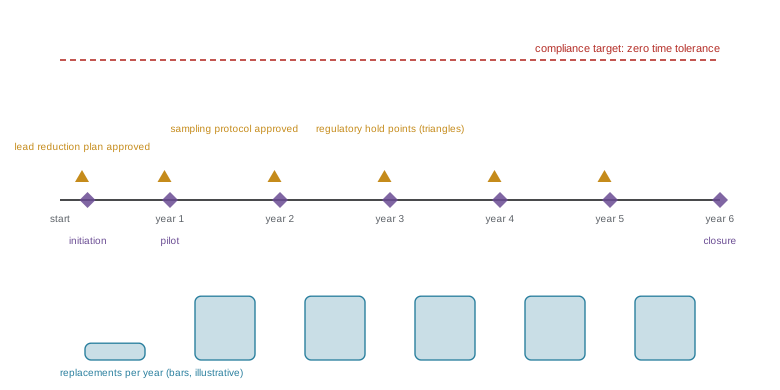
In regulated work, some decisions cannot be made until an outside body has approved something. Those approvals are hold points. Ana Costa's plan places stage boundaries just after the major ones, so that the board commits money only once the approval is in hand. The first delivery stage is a pilot of 120 replacements to prove the methods, the sampling protocol and the homeowner process before the full contracts are let.
total, pilot, years = 2400, 120, 6
per_year_capacity = {"utility crews": 160, "contractor A": 170, "contractor B": 170}
capacity = sum(per_year_capacity.values())
remaining = total - pilot
years_after_pilot = years - 1
needed = remaining / years_after_pilot
print(f"needed per year after the pilot: {needed:.0f}; planned capacity: {capacity}")
print(f"margin: {capacity - needed:+.0f} replacements a year")
done, by_year = pilot, []
for y in range(2, years + 1):
    done = min(total, done + capacity)
    by_year.append((y, done))
print("cumulative:", ", ".join(f"year {y}: {d}" for y, d in by_year))needed per year after the pilot: 456; planned capacity: 500 margin: +44 replacements a year cumulative: year 2: 620, year 3: 1120, year 4: 1620, year 5: 2120, year 6: 2400
The plan has a margin of about 24 replacements a year, which is thin. Owner refusals, access problems and winter weather will all eat into it. Because the compliance milestones have zero time tolerance, Ana proposes that the board hold a capacity reserve: an option in contractor B's contract to add a second crew for up to two years. Using the option is a board decision, but having it in the contract means the decision can be made quickly if the margin disappears.
Public-sector rules
Public bodies operate under rules that shape the commercial practice and the communication management approach. Procurement law requires open competition above set thresholds, fair evaluation and records that can withstand challenge. Council or board approvals are needed for contracts and budgets above delegated limits, and their meeting cycles affect the plan. Open records laws mean that board papers, highlight reports and emails can be requested by the public. Tailoring for public-sector projects usually adds time for approvals, formalizes evaluation and decision records, and writes reports on the assumption that they may be published.
Ridgeline's tenders follow the city's procurement code and state public bidding law, plus federal procurement standards where State Revolving Fund money is used. Council approves contract awards above the general manager's delegated authority, and its meeting cycle sets the earliest dates for each award. State public records law can reach any project record.
Customer and supplier: two views of one project
When an external supplier does a large part of the work, there are really two projects: the customer's project, which wants an outcome, and the supplier's project, which wants to deliver its contract profitably. PRINCE2 describes this as a customer-supplier environment. Each side may run its own project management, and the contract defines how they interact. The customer's project manager sees the supplier's work as work packages; the supplier's project manager sees the customer's requirements as the basis of their own project. Tailoring makes those views compatible.
| Contract feature | Effect on PRINCE2 tailoring |
|---|---|
| Unit-rate contract (price per replacement) | Cost tolerance tracks quantity; change control covers rate changes and unusual sites |
| Fixed-price lump sum | Supplier carries cost risk; customer's change control must capture every scope change, because each becomes a variation |
| Cost-reimbursable | Customer carries cost risk; tighter progress reporting and audit rights needed |
| Liquidated damages for delay | Supplier's time tolerance effectively fixed; customer still needs its own contingency |
| Contract administrator role | Often held by the design consultant; must align with the project manager's authority |
For the lead lines, Ridgeline uses unit-rate contracts: the contractors are paid per completed replacement, with rates for different pipe lengths and surfaces. That fits the uncertain quantity, because the final count depends on owner participation and on how many suspected lines turn out to be copper. The commercial management approach sets out how the contracts and the work packages stay consistent, how payment links to accepted replacements (each needs photos, GPS location and a post-replacement sample) and how disputes are escalated.
Worked problem
Tailoring for compliance
A board member proposes to save time by letting crews start full-scale replacements before the regulator has approved the post-replacement sampling protocol, 'since the protocol is almost certainly fine'. The pilot is complete and successful. What should the project manager advise?
Show solution
- The sampling protocol approval is a regulatory hold point.
- Starting before approval risks replacements that do not meet the approved method and may need resampling or rework.
- Compliance milestones have zero tolerance and the compliance risk is rated very high impact.
- The stage boundary after the pilot was placed after the hold point so that the board commits money only once approval is in hand.
- A legitimate option is to authorize preparatory work, such as owner outreach and contractor mobilization, while waiting.
Answer: Do not start full replacements before the hold point. Authorize preparatory work only, keep the boundary after the approval, and record the decision.
Equity and the people side of a regulated project
Regulation sets the minimum, but the project's success depends on people. A lead service line can only be fully replaced if the property owner agrees to the private-side work, and owners differ enormously in their circumstances. Some are landlords with little interest in tenants' water; some are older homeowners worried about cost and disruption; some are newcomers who are still learning the main local language. The people element of the project is therefore tailored up. Ridgeline hires two community liaison officers, prints notices in the five most common languages in the affected streets, offers evening and weekend appointments and partners with a tenants' association.
The business case includes a target for the share of full (both sides) replacements, because partial replacements can temporarily raise lead levels. The board sets a tolerance on that measure: at least 85 % of replacements must be full replacements in each year, with a tolerance of 5 percentage points. When year 2 showed 81 %, still inside tolerance, the project manager reported the trend and the reason, landlords in rental streets, and the board approved a targeted landlord outreach campaign within the stage's change budget.
| Group | Barrier | Tailored response |
|---|---|---|
| Landlords | Low interest; tenants bear the risk | Direct letters, a landlord information session, and tenant notification |
| Older homeowners | Cost, disruption, distrust | Grant explained in person; restoration guarantee |
| Newcomers | Language, unfamiliar systems | Translated notices; community liaison officers |
| Shift workers | Daytime appointments impossible | Evening and weekend appointments |
This is a good example of how the people element, sustainability and regulation interact. The regulation sets the deadline, the equity target protects health outcomes, and the people tailoring is what makes both achievable.
Common mistakes
MistakePutting the regulator on the project board.
InsteadTreat the regulator as a key stakeholder whose rules become requirements and quality criteria.
MistakeWriting no business case because the project is mandatory.
InsteadUse the business case to choose the best-value way of meeting the obligation.
MistakeSetting normal time tolerance on regulatory milestones.
InsteadUse zero tolerance on compliance milestones and hold contingency elsewhere.
MistakeIgnoring council meeting cycles in the plan.
InsteadPlan contract awards and approvals around the governing body's calendar.
MistakeLetting contracts and work packages drift apart.
InsteadKeep them consistent through the commercial management approach and change both together.
Summary and key terms
- Regulation, public-sector rules and contracts change tailoring more than project size does.
- Regulatory requirements become project product description content, quality criteria, fixed milestones and stakeholder communication.
- Mandatory projects still need a business case to choose the best-value option.
- Stage boundaries are placed after regulatory hold points so money is committed only after approvals.
- Public-sector projects add approval time, formal evaluation records and reporting that may be published.
- In a customer-supplier environment, contracts and work packages must align, and the contract type shapes tolerances and change control.
- Hold point
- A point at which work must stop until an outside approval is obtained.
- Mandatory project
- A project required by law or regulation; its business case justifies the chosen option.
- Customer-supplier environment
- A project in which an external supplier delivers work under a contract with the customer.
- Unit-rate contract
- A contract that pays a set price per unit of completed work.
- Capacity reserve
- A pre-agreed option to add resources quickly if progress falls behind.
- Compliance milestone
- A date set by a regulator by which a requirement must be met.
Practice problems
Work each problem on paper first, then reveal the answer to check.
How many lead or suspected lead service lines are in the project?
Show answer
About 2,400.
Is the regulator a member of the project board?
Show answer
No. It is a key stakeholder whose rules become requirements and quality criteria.
What question does the business case answer on a mandatory project?
Show answer
Which way of meeting the obligation gives the best value.
Which business case option did Ridgeline prefer, and why?
Show answer
Replacing both sides with a grant for half the private cost, because partial replacement can leave homes exposed.
What time tolerance applies to compliance milestones?
Show answer
Zero.
Why are stage boundaries placed after hold points?
Show answer
So that the board commits money only once outside approvals are in hand.
What is the yearly margin between capacity and need?
Show answer
About 24 replacements a year.
What does the capacity reserve consist of?
Show answer
An option in contractor B's contract to add a second crew for up to two years.
Why does a unit-rate contract suit this project?
Show answer
The final quantity is uncertain, so paying per replacement matches the work done.
What evidence is needed before a replacement is paid for?
Show answer
Photos, GPS location and a post-replacement sample.
Lesson quiz · 5 questions
Score 60% or more to complete this lesson.
Create a free account to save your progress, take quizzes and earn a certificate.