
PRIN-150 · Lesson 2 of 12 · 25 min
How to tailor: a repeatable way of making and recording decisions
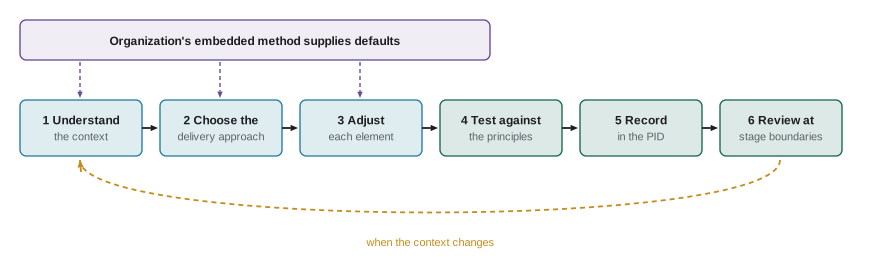
Lesson 1 explained what tailoring is and what it cannot remove. This lesson is about how to do it. Good tailoring is not a matter of taste or habit. It follows a short, repeatable sequence: understand the context, decide the delivery approach, adjust each element, test every adjustment against the principles, record the decisions where people can find them, and review them as the project moves on. Organizations that do this well also build the common decisions into their own project method, so that each project manager starts from a sensible default instead of a blank page.
The running example is Ridgeline Water's project management office. After the smart metering project closed, the utility's executive team asked the office to turn the project's lessons into a tailoring guide for future projects. The guide is used throughout this course.
Start from the organization's own method
Most organizations that use PRINCE2 do not apply the manual directly. They embed it in their own project management method, with templates, approval thresholds, tools and terminology that suit them. Embedding is done once, at organizational level, by a project management office or center of excellence. Tailoring is then done for each project, within the organization's method. The two are easily confused, but they answer different questions. Embedding asks: how should this organization run projects in general? Tailoring asks: how should this particular project be run, given its context?
Ridgeline's office answered the embedding question with three tiers, based on value, risk and the number of external suppliers. Each tier has a default set of products, roles and controls. A project manager starts from the default for the project's tier and then tailors further, up or down, with the board's agreement.
| Tier (Ridgeline guide) | Typical project | Default stages | Default reporting | Default products |
|---|---|---|---|---|
| A: small | Under 250 thousand, one team, low risk | Initiation plus one or two delivery stages | Fortnightly email highlight | Combined brief and PID, one-page business case, simple logs in one workbook |
| B: standard | 250 thousand to 5 million, or one external supplier | Initiation plus two to four stages | Fortnightly highlight report, dashboard | Full PID with short approaches, registers in the project tool |
| C: major | Over 5 million, several suppliers or a regulator | Initiation plus stages of no more than six months | Monthly report plus weekly dashboard; formal assurance | Full set, independent assurance, configuration management role |
Step 1: understand the context
The factors from lesson 1 are the starting point: scale, complexity, risk, delivery approach, organizational standards, commercial arrangements, regulation, team capability, sustainability and data. The project manager gathers what is known about each during starting up a project, usually from the mandate, the executive, the senior user and any previous lessons. The output is a short context statement, a few sentences that anyone can read to understand why the project will be run the way it is.
For Ridgeline's outage alert app, for example, the context statement reads: a six-month, 420 thousand project to give customers push notifications about water outages; one in-house agile team plus a small supplier for the notification service; moderate risk because outage messages affect public health advice; personal data in scope; delivery by two-week sprints. Each phrase in that statement points to a tailoring decision.
Step 2: choose the delivery approach
The delivery approach is how the specialist work will be done: predictive (plan the whole product, then build it), iterative or agile (build and release in increments, learning as you go), or a mix. The project approach, decided in starting up a project, records this choice. It affects tailoring more than any other single factor, because it changes how plans are expressed, how products are described, how progress is measured and how often the board needs information. PRINCE2 is compatible with all of these; lesson 4 shows how it fits agile delivery in detail.
Step 3: adjust each element
With the context and delivery approach known, the project manager works through the elements one at a time. A simple checklist keeps the work honest.
| Element | Questions to ask | Outputs |
|---|---|---|
| People and roles | Who holds each role? Which roles are combined? Is assurance independent enough? | Project management team structure and role descriptions |
| Practices | How much depth does each practice need: business case, organizing, plans, quality, risk, issues, progress? | Management approaches, scaled to the project |
| Processes | Which processes are combined, shortened or run more often? | Stage plan and controls in the PID |
| Management products | Which products are merged, renamed, shortened or held in tools? | Product list with format and location |
| Reporting and tolerances | How often does the board need information, and in what form? Which tolerances matter most? | Project controls section of the PID |
The most common technique for management products is merging. On a small project, the project brief and the project initiation documentation can be one document, the stage plan can live inside the project plan, and the logs and registers can sit in one workbook. Other techniques are renaming (using the organization's own terms), shortening (a one-page product description), holding products in a tool (a backlog for requirements, a dashboard for highlights) and recording verbal communications (a board decision taken in a meeting and confirmed by email). Each is fine provided the purpose is met and the record survives.
Step 4: test every adjustment against the principles
Before the tailoring is proposed, each adjustment is tested against the seven principles and the purpose of the element it changes. Project assurance is useful here, because people other than the project manager notice when a convenient shortcut has removed something essential. The test also works the other way: an element kept at full size that serves no purpose for this project is a candidate for tailoring down.
products = {   # name: (hours per use at full format, uses in project)
    "highlight report": (3.0, 12), "end stage report": (8.0, 2),
    "checkpoint report": (1.5, 24), "product descriptions": (2.0, 18),
    "registers and logs": (1.0, 26), "business case update": (6.0, 3),
}
tailored = {   # share of full effort after tailoring
    "highlight report": 0.3, "end stage report": 0.5, "checkpoint report": 0.0,
    "product descriptions": 0.4, "registers and logs": 0.6, "business case update": 0.7,
}
project_hours = 3800
full = sum(h * n for h, n in products.values())
light = sum(h * n * tailored[k] for k, (h, n) in products.items())
print(f"management product effort, full format: {full:.0f} h ({full / project_hours:.1%} of project)")
print(f"after tailoring: {light:.0f} h ({light / project_hours:.1%} of project)")
dropped = [k for k, v in tailored.items() if v == 0]
print("purposes to re-check for dropped items:", ", ".join(dropped))management product effort, full format: 168 h (4.4% of project) after tailoring: 61 h (1.6% of project) purposes to re-check for dropped items: checkpoint report
The calculation shows a large saving, but it also flags something to check. Checkpoint reports have been dropped entirely. That may be fine if the team is co-located and the project manager sees progress daily in the team's board, because the purpose of checkpoint reports, keeping the project manager informed about work package progress, is met another way. The tailoring record should say so. If the team were remote, the same decision might leave the project manager blind.
Step 5: record the decisions
The tailoring decisions are recorded in the project initiation documentation, usually in a short section that describes how PRINCE2 has been tailored for the project and why. The record does not need to be long. A table that lists each significant adjustment, the reason and the purpose it still serves is usually enough. The section is approved by the board when it authorizes the project, and it becomes part of the baseline.
| Adjustment (outage alert app) | Reason | How the purpose is still met |
|---|---|---|
| Release plan and sprint backlog replace detailed stage plans | Agile delivery in two-week sprints | Release plan shows stage scope, budget, tolerances and dependencies |
| Highlight reports every sprint, as a dashboard page | Board wants frequent, short updates | Board sees progress, forecasts, issues and risks each sprint |
| Product owner holds senior user role | Product owner already represents customers | Senior user accountability is unchanged |
| No checkpoint reports | Daily stand-up and visible team board | Project manager attends stand-ups twice a week and reviews the board |
| Data protection impact assessment added | Personal data in push notifications | Digital and data management approach covers consent and retention |
Records rules affect how products can be held in tools. US local governments usually follow a state records retention schedule, and state public records laws can reach project documents, including board decisions recorded only by email. The tailoring record should say where each management product lives and how long it is kept.
Step 6: review the tailoring as the project moves on
Tailoring decisions are reviewed at each stage boundary, as part of reviewing the project initiation documentation. Signs that tailoring is wrong are easy to spot once you look for them: reports that nobody reads, board meetings full of surprises, a team spending more time on administration than on products, or assurance finding the same gaps repeatedly. Each is evidence for a change, either lighter or heavier. Changes are made under change control and recorded, so that the PID always describes how the project is actually being run.
Worked problem
Embedding or tailoring?
Ridgeline's project office proposes three things: (a) all projects over 5 million must have independent assurance; (b) the outage alert app will use sprint dashboards instead of highlight report documents; (c) the treatment plant upgrade will add a monthly report to the regulator on top of the tier C defaults. Which are embedding decisions and which are tailoring decisions, and who approves each?
Show solution
- Embedding sets rules for projects in general; tailoring adapts the method for one project.
- Proposal (a) applies to every project above a threshold, so it is embedding, approved at organizational level.
- Proposal (b) applies to one project's context, so it is tailoring, proposed by the project manager and approved by that project's board.
- Proposal (c) adds control for one project because of its regulator, so it is tailoring up, approved by that project's board and recorded in its PID.
Answer: (a) is embedding, owned by the organization; (b) and (c) are tailoring decisions for individual projects, approved by their boards and recorded in their PIDs.
Tailoring conversations with the board
Tailoring proposals land better when they are framed around the board's own concerns rather than the method. Executives rarely care whether a document is called a highlight report; they care whether they will hear about trouble early enough to act. Ana Costa's tailoring briefing for the outage alert app's board was one page with three columns: what the board will see, how often, and what would trigger an immediate call. Board members could then judge the proposal against their own appetite for surprises. The same conversation also surfaced one adjustment Ana had not planned: the senior user asked for a short call-center impact note in each sprint dashboard, because her staff would feel the effect of a bad release first. That request went straight into the tailoring record, with the reason, and it changed the definition of done for every release to include a briefing for call-center staff.
Common mistakes
MistakeCopying the previous project's PID and calling it tailored.
InsteadStart from the organization's defaults and tailor for this project's context.
MistakeTailoring without recording why.
InsteadRecord each significant adjustment, its reason and the purpose it still serves.
MistakeConfusing embedding with tailoring.
InsteadEmbedding sets the organization's method; tailoring adapts it for one project.
MistakeDropping a product without checking how its purpose is met.
InsteadName the other mechanism that meets the purpose, or keep the product.
MistakeLeaving the tailoring unchanged when reports go unread or surprises appear.
InsteadTreat these as signs to review the tailoring at the next boundary, or sooner.
Summary and key terms
- Organizations embed PRINCE2 in their own method; projects tailor within it.
- Tailoring follows a sequence: context, delivery approach, adjust each element, test against principles, record, review.
- The delivery approach, recorded in the project approach, has the biggest single effect on tailoring.
- Management products can be merged, renamed, shortened, held in tools or recorded verbally.
- Tailoring decisions are recorded in the PID with their reasons and approved by the board.
- Tailoring is reviewed at each stage boundary and changed under control.
- Embedding
- Building PRINCE2 into an organization's own project management method.
- Context statement
- A short description of the factors that shape a project's tailoring.
- Project approach
- The decision on how the project's work will be delivered, made in starting up a project.
- Merging products
- Combining two or more management products into one where their purposes can be served together.
- Tailoring record
- The section of the PID that lists adjustments to the method, their reasons and the purposes they still serve.
- Tier
- An organizational category of projects with its own default level of formality.
Practice problems
Work each problem on paper first, then reveal the answer to check.
What is the difference between embedding and tailoring?
Show answer
Embedding adapts PRINCE2 for an organization; tailoring adapts it for a single project.
List the six steps of the tailoring sequence.
Show answer
Understand the context, choose the delivery approach, adjust each element, test against the principles, record in the PID, review at stage boundaries.
Which product records the delivery approach?
Show answer
The project approach.
Name four ways of tailoring a management product.
Show answer
Merging, renaming, shortening, holding in a tool, or recording verbally with a confirmation.
Who is especially helpful in testing tailoring against the principles?
Show answer
Project assurance.
Why might dropping checkpoint reports be acceptable for the outage alert app?
Show answer
The project manager sees work package progress through stand-ups and the team board, so the purpose is met another way.
Where is the tailoring record kept?
Show answer
In the project initiation documentation.
Give two signs that tailoring is too heavy.
Show answer
Reports go unread; the team spends too much time on administration.
Give one sign that tailoring is too light.
Show answer
Board meetings are full of surprises, or assurance keeps finding the same gaps.
Which Ridgeline tier would a 6 million project with one supplier fall into?
Show answer
Tier C, because it is over 5 million.
Lesson quiz · 5 questions
Score 60% or more to complete this lesson.
Create a free account to save your progress, take quizzes and earn a certificate.