
PRIN-150 · Lesson 12 of 12 · 25 min
Capstone: tailoring a project and answering an integrated scenario
This capstone brings the course together in two parts. In the first, you tailor a new project from scratch, following the sequence from lesson 2 and drawing on the contexts from lessons 3 to 7. In the second, you work through an integrated set of Practitioner-style questions on the same project, using the method from lesson 8 and the principles, practices and processes from lessons 9 to 11. The final section reviews readiness for the exam and points to PRIN-160, which covers full mock exams.
Part 1: the accessibility upgrade
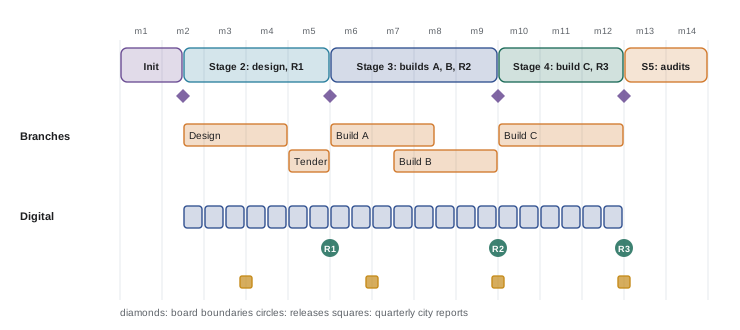
Harbor City Libraries' board has approved a project to make all six branches and the library's digital services more accessible. The work includes automatic doors and accessible service desks in three older branches, hearing loops in meeting rooms, an accessible website and app redesign, staff training and a patron advisory group of people with disabilities. The budget is 1.4 million over 14 months. A small architecture firm will design the branch changes and a contractor will build them under a fixed-price contract; the digital redesign will be done by the library's digital team and the vendor from the digital card project in sprints. The city's capital program contributes half of the funding and requires quarterly reports in its own format.
The library is subject to the ADA: Title II for state and local government services, including the Department of Justice web rule adopting WCAG 2.1 level AA with compliance dates in 2027 and 2028 depending on population, and the ADA Standards for Accessible Design for the branch alterations.
Dev Sharma, now an experienced PRINCE2 practitioner, is the project manager. Dr. Tomás Ruiz is the executive. The senior user role is shared by Alicia Fernandes for branches and the head of collections and digital services for digital. The senior supplier role is shared by the architecture firm's principal, the contractor's project director and the library's IT manager.
Step 1 and 2: context and delivery approach
The context statement reads: a 14-month, 1.4 million project, hybrid delivery (predictive for branches, agile for digital); two external suppliers on fixed-price and time-and-materials contracts; part-funded by the city's capital program, which requires quarterly reports; regulatory accessibility requirements with deadlines; public spaces open throughout construction; moderate personal data (advisory group members' disability information); strong equity objectives; an experienced project manager and a digital team familiar with sprints.
| Factor | Rating | Tailoring consequence |
|---|---|---|
| Scale | Medium (Ridgeline-style tier B) | Full PID with short approaches; registers in the project tool |
| Delivery approach | Hybrid | Release plans for digital; predictive stage plans for branches; one integrated stage structure |
| Suppliers | Two, different contract types | Two senior suppliers plus IT; customer-only commercial decisions; work packages aligned with contracts |
| Funding partner | City capital program | Quarterly report in the city's format; city is a key stakeholder, not on the board |
| Regulation | Accessibility standards with deadlines | Zero time tolerance on compliance dates; accessibility specialist in project assurance |
| Public spaces open | High disruption risk | Construction phasing per branch; communication approach for patrons |
| Personal data | Sensitive but limited | Digital and data approach covers advisory group data |
| Equity | Central objective | Sustainability and benefit targets for accessible use, with tolerances |
Step 3 and 4: adjusting the elements and testing them
Dev proposes five management stages: initiation (six weeks); stage 2, design and the first digital release (sprints 1 to 6); stage 3, construction in two branches and the second digital release; stage 4, construction in the third branch, hearing loops and the third release; stage 5, training, final accessibility audits and closure. Boundaries are placed after design approval and the fixed-price contract award, and before the final audits. Highlight reports go to the board fortnightly as a dashboard, with a quarterly version reformatted for the city. The product owner for digital, delegated by the senior user, has change authority for backlog items within the scope tolerance. Project assurance includes an accessibility specialist from the city's accessibility office, independent of the project manager.
Every adjustment is tested against the principles. Business justification is continued: the business case states the compliance obligation and compares options for meeting it, with benefits measured in accessible use and patron satisfaction. Roles are defined, with a single executive and shared senior user and senior supplier roles, and the contractor's representative steps out of claims. There are five stages, tolerances at every level and product descriptions with measurable accessibility criteria. Lessons from the makerspace and the digital card are used in planning. The tailoring keeps the purposes; it changes forms, frequencies and formality.
Step 5 and 6: recording and reviewing
The tailoring record in the PID lists the significant adjustments: hybrid stage plans, dashboard highlights with a quarterly city version, delegated backlog change authority, shared senior supplier roles with conflict-of-interest rules, the accessibility specialist in assurance, zero tolerance on compliance dates and the data approach for advisory group information. Each entry gives the reason and the purpose it still serves. Dev schedules a short tailoring review at each boundary, with the advisory group invited to comment on whether communication is working for patrons with disabilities.
Part 2: an integrated scenario set
The following questions are based on the accessibility upgrade at the start of stage 3. Assume the stage has a cost tolerance of 40 thousand, the project manager's change authority is 5 thousand per change, the board has set a change budget of 30 thousand for the project, and the time tolerance on compliance dates is zero.
| Situation | Element and process | Most appropriate response |
|---|---|---|
| The contractor finds asbestos in the branch A ceiling, adding 28 thousand and three weeks | Issue (problem with a cost and time effect); controlling a stage | Capture and examine; within cost tolerance but the delay threatens a compliance date with zero tolerance, so raise an exception report |
| The product owner reorders two should-have digital stories | Change within delegated authority; managing product delivery and controlling a stage | Product owner decides; no escalation |
| A hearing loop supplier warns of a possible six-week shortage next quarter | Risk; controlling a stage | Record, assess and plan a response such as early ordering, funded from the risk budget if needed |
| Advisory group members ask for braille signage not in the design | Request for change affecting the project product | Capture, assess cost, time and benefit; decide at the right level (likely the board, using the change budget) |
| The city asks the project manager to skip the stage 4 boundary to save a month | Tailoring and manage by stages; directing a project | Explain that the boundary decision is required; offer a shorter boundary process instead |
| The executive asks who will measure accessible use 12 months after closure | Business case and benefits; closing a project | The benefits management approach assigns post-project reviews to the business, through the executive |
The asbestos case repays a closer look, because it combines several rules. Its 28 thousand cost is within the 40 thousand stage tolerance, so on cost alone the project manager could treat it as a problem and take corrective action. But the three-week delay matters more: if it pushes the branch A works past a compliance date with zero time tolerance, a breach is forecast, so an exception report is needed regardless of the cost. Questions like this reward checking every tolerance, not just the first one you notice.
results = {   # section: (marks scored, marks available)
    "principles": (8, 10), "people and context": (5, 8),
    "business case and organizing": (7, 10), "plans, quality and risk": (9, 12),
    "issues and progress": (8, 12), "processes": (9, 12), "tailoring": (4, 6),
}
scored = sum(s for s, a in results.values())
available = sum(a for s, a in results.values())
pass_mark = 0.60
print(f"practice score: {scored}/{available} = {scored / available:.0%} (pass mark {pass_mark:.0%})")
weak = sorted(results, key=lambda k: results[k][0] / results[k][1])[:2]
for k in weak:
    s, a = results[k]
print(f"review first: {k} ({s}/{a} = {s / a:.0%})")practice score: 50/70 = 71% (pass mark 60%) review first: people and context (5/8 = 62%) review first: issues and progress (8/12 = 67%)
A practice score of 50 out of 70, about 71 %, is above the 60 % pass mark with a reasonable margin, but the breakdown shows where to focus: people and context, and issues and progress, are the weakest sections. PRIN-160 builds on this with full timed mock exams, error logs and a study plan for the final two weeks.
Readiness for the exam
By the end of this course you should be able to read a scenario, identify the process, role and element being tested, check tolerances and authority, judge whether tailoring is legitimate and choose the most appropriate response with a reason. You should also be fast with the manual: knowing where to find the responsibilities for each process activity, the composition of each management product and the guidance on tailoring. If any of those still feels slow, the lessons from this course and PRIN-130 to PRIN-141 are the places to revisit before moving to PRIN-160.
Worked problem
A tailoring judgment under pressure
In stage 4 the city's capital program office asks Dev to replace the project's fortnightly dashboard with its own monthly template, to save effort. The board likes the dashboard, which shows sprint progress and branch construction together. What should Dev do?
Show solution
- This is a request to change the project's controls, which are part of the PID baseline.
- The city is a funding partner and key stakeholder, not a member of the board.
- The purpose of highlight reports is to keep the board informed; the monthly template would reduce frequency in a stage with construction in a public branch.
- A better tailoring option is to keep the fortnightly dashboard for the board and produce the city's monthly report from the same data.
- Any change to reporting is recorded in the PID under change control with the board's agreement.
Answer: Keep the board's fortnightly dashboard and generate the city's monthly report from it; record the arrangement in the PID with the board's agreement.
Reflecting on the tailoring journey
Across this course, the same method has been tailored five very different ways: a two-stage, few-page makerspace; an agile app with sprint dashboards; a four-year treatment plant with independent assurance and three senior suppliers; a regulated, equity-driven lead line program with hold points; and a hybrid digital card and accessibility upgrade. In every case the principles stayed fixed and the purposes were met, while forms, frequencies and formality changed. That pattern is the heart of both good practice and the Practitioner exam. When you meet an unfamiliar scenario, start with the context, ask what each element is for, and choose the lightest arrangement that still serves that purpose for this project. Then check the result against the seven principles once more before committing to it.
Common mistakes
MistakeTailoring by copying the previous project's PID.
InsteadStart from this project's context and record each adjustment with its reason.
MistakeChecking only the cost effect of an issue.
InsteadCheck every tolerance, including time, scope, quality and compliance dates.
MistakeLetting a funding partner's preferences override the board's controls.
InsteadTreat funders as key stakeholders and meet their needs without weakening the board's information.
MistakeMeasuring readiness only by total practice score.
InsteadLook at section scores and target the weakest areas.
MistakeTreating accessibility as a late quality check.
InsteadBuild accessibility criteria into product descriptions and assurance from initiation.
Summary and key terms
- Tailoring a project follows the sequence: context, delivery approach, adjust, test against principles, record, review.
- Hybrid projects can use predictive and agile plans inside one stage structure.
- Funding partners and regulators shape requirements and reporting without joining the board.
- Integrated scenario questions combine several rules; check every tolerance and authority limit.
- Readiness means fluency with the five-step method and fast use of the manual.
- PRIN-160 continues with full mock exams, timing practice and final review.
- Hybrid delivery
- A project using predictive delivery for some products and agile delivery for others.
- Funding partner
- An organization that contributes money to a project and may require reports, without directing it.
- Integrated scenario question
- A question that combines principles, practices, processes and tailoring in one situation.
- Compliance date
- A deadline set by law or regulation for meeting a requirement.
- Section score
- A practice-exam score for one topic area, used to target revision.
- Tailoring review
- A check, usually at a stage boundary, that the project's tailoring still fits its context.
Practice problems
Work each problem on paper first, then reveal the answer to check.
How many management stages does the accessibility upgrade have?
Show answer
Five, including initiation.
Why is the city not on the project board?
Show answer
It is a funding partner and key stakeholder, not a decision-maker for the project.
Who provides independent assurance on accessibility?
Show answer
A specialist from the city's accessibility office.
What time tolerance applies to compliance dates?
Show answer
Zero.
Why does the asbestos discovery need an exception report?
Show answer
The delay is forecast to breach a compliance date with zero time tolerance.
Who decides on reordering two should-have stories?
Show answer
The product owner, under delegated authority.
How should the braille signage request be handled?
Show answer
As a request for change, assessed and decided at the right level, likely the board using the change budget.
Can the city's request to skip the stage 4 boundary be accepted?
Show answer
No; the boundary decision is required, though the boundary process can be kept short.
What was the practice score, and which sections need work?
Show answer
50 of 70 (about 71 %); people and context, and issues and progress.
Which course follows this one?
Show answer
PRIN-160 PRINCE2 Exam Strategy and Practice.
Lesson quiz · 5 questions
Score 60% or more to complete this lesson.
Create a free account to save your progress, take quizzes and earn a certificate.