
PRIN-150 · Lesson 10 of 12 · 24 min
Applying the practices in scenarios
The seven practices are the aspects of project management that must be addressed continually: business case, organizing, plans, quality, risk, issues and progress. Practitioner questions test them in context. A typical question gives a situation, such as a supplier reporting a defect, a sponsor asking for a new feature or a forecast showing a cost overrun, and asks what the appropriate response is, which product should be updated or who should decide. This lesson revisits each practice from the scenario angle, using the five-step method from lesson 8.
The practices as a set of questions
Each practice answers a question the project must keep asking. Thinking of them as questions makes classification, step 2 of the method, much quicker.
| Practice | Question it answers | Key products | Scenario cues |
|---|---|---|---|
| Business case | Why are we doing this, and is it still worth it? | Business case; benefits management approach | Changed benefits, costs, options or strategy |
| Organizing | Who is responsible for what? | Project management team structure; role descriptions; communication management approach | Unclear authority, missing representation, stakeholder concerns |
| Plans | How, when, by whom and at what cost? | Project, stage, team and exception plans; product descriptions for planning | Estimates, dependencies, schedules, resourcing |
| Quality | What does fit for purpose mean, and how will we know? | Project product description; quality management approach; quality register | Defects, acceptance, quality criteria, reviews |
| Risk | What might happen, and what will we do about it? | Risk management approach; risk register | Uncertain future events, threats, opportunities, risk budget |
| Issues | What has happened that needs a decision? | Issue management approach; issue register; issue reports | Requests for change, off-specifications, problems and concerns |
| Progress | Where are we, where will we be, and should we carry on? | Tolerances; reports; logs | Forecasts against tolerances, reporting, escalation |
Business case in scenarios
Business case questions usually turn on three points. First, the business case is owned by the executive, though the project manager may write and update it. Second, it is updated at stage boundaries, at exceptions and at closure, using the latest forecasts. Third, benefits are often realized after the project closes, so the benefits management approach must say who measures them and when. A distractor might have the project manager owning benefits reviews after closure, or the business case frozen at initiation.
Scenario cue: at the digital card's stage 2 boundary, sign-ups in user testing take twice as long as planned for patrons over 70. That affects the benefit of reducing branch sign-up workload and the equity target. The response is to update the business case and the benefits forecast and to present options to the board, not to ignore the finding or quietly lower the target.
Organizing in scenarios
Organizing questions test who holds which role, what each can decide and how stakeholders are engaged. The executive owns the business case and is ultimately accountable. The senior user specifies needs, provides user resources and ensures benefits can be realized. The senior supplier provides supplier resources and is accountable for the quality of what suppliers deliver. Project assurance is independent of the project manager. Change authority is set by the board and can be delegated. Look for scenario details such as combined roles and delegated authorities before answering.
Plans in scenarios
Plans questions often concern levels and timing. The project plan covers the whole project and is updated at each boundary. A stage plan is produced near the end of the previous stage. Team plans are optional and belong to team managers. Exception plans replace the plan they cover once approved. Product-based planning comes before activity planning. A distractor might suggest detailed stage plans for all stages at initiation, or a team manager changing the stage plan.
Quality in scenarios
Quality questions distinguish quality planning (agreeing expectations, acceptance criteria and product descriptions) from quality control (checking products against criteria) and quality assurance (independent checks that the project's approach is appropriate and followed, often from outside the project). Project assurance is not the same as quality assurance, although the two may overlap. A product that fails a quality check is reworked by the team; a product that will not meet its specification is an off-specification, an issue. The quality register records planned and actual quality activities.
Risk in scenarios
Risk questions test the difference between risks (uncertain future events) and issues (things that have happened), the use of the risk budget for responses to specific risks, and appropriate responses: for threats, avoid, reduce, transfer, share, accept or prepare a contingent plan; for opportunities, exploit, enhance, share or reject. The risk owner manages a risk; the risk actionee carries out a response. A distractor might use change budget to fund a risk response, or call an event that has already happened a risk.
Issues in scenarios
Issue questions are among the most common. An issue is any event that has happened, was not planned and requires management action: a request for change, an off-specification, or a problem or concern. The project manager captures and examines issues, recommends a response and decides or escalates depending on tolerance and authority. Changes are funded from the change budget if one has been set. Issues that can be handled informally may go in the daily log; others go in the issue register and may need an issue report.
def route(issue_type, cost_k, within_stage_tolerance, pm_limit_k=3, board_limit_k=50):
    if issue_type == "problem" and within_stage_tolerance and cost_k <= pm_limit_k:
        return "project manager: corrective action"
    if issue_type in ("request for change", "off-specification"):
        if cost_k <= pm_limit_k:
            return "project manager (delegated change authority)"
        if within_stage_tolerance and cost_k <= board_limit_k:
            return "project board (or its delegated change authority) via issue report"
    if not within_stage_tolerance:
        return "exception report to the project board"
    return "project board via issue report"

cases = [
    ("wallet pass certificate", "request for change", 4.5, True),
    ("kiosk screen too low for wheelchair users", "off-specification", 2.0, True),
    ("vendor sprint slips one week", "problem", 1.5, True),
    ("SMS alerts for non-smartphone users", "request for change", 35, False),
]
for name, kind, cost, ok in cases:
print(f"{name:<44} -> {route(kind, cost, ok)}")wallet pass certificate -> project board (or its delegated change authority) via issue report kiosk screen too low for wheelchair users -> project manager (delegated change authority) vendor sprint slips one week -> project manager: corrective action SMS alerts for non-smartphone users -> exception report to the project board
The routing rules are a simplification, but they capture the logic of most issue questions: decide what kind of issue it is, then check authority and tolerance. The certificate is a request for change above the project manager's 3 thousand limit but within tolerance, so it goes to the board or its delegated change authority. The kiosk height error is a small off-specification the project manager can resolve. The sprint slip is a problem within tolerance, handled by corrective action. The SMS feature would breach stage tolerance, so it needs an exception report.
Progress in scenarios
Progress questions test tolerances, controls and reports. Time-driven controls include highlight and checkpoint reports; event-driven controls include end stage reports, exception reports and issue reports. The project manager uses the daily log, registers and checkpoint reports to monitor progress and forecasts against stage tolerances. When a forecast breach appears, the project manager raises an exception report promptly, even if recovery seems possible later. The board responds by approving an exception plan, asking for more information, or, if project tolerance is threatened, referring to the business layer.
In US public-sector projects, the issue and change control rules often have to reflect council's or the board's delegated authority ordinance. A change within the project's tolerance may still need council approval if it changes a contract above a set value, so the project's change authority cannot exceed the organization's own delegation.
Worked problem
A three-mark matching question
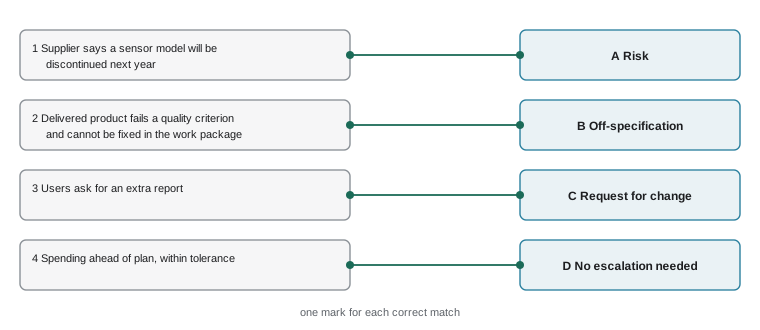
Match each situation on the treatment plant upgrade with the most appropriate response. Situations: (1) The controls integrator warns that a key programmable controller may be discontinued during the project. (2) A completed filter underdrain fails the specified flow uniformity test and cannot be fixed without replacement. (3) The plant superintendent asks for an additional chemical feed point not in the design. Responses: (A) Record and assess it as a risk and consider a contingent plan; (B) capture it as an off-specification and assess the options; (C) capture it as a request for change and assess impact on cost, time and benefits; (D) take no action until the next stage boundary.
Show solution
- Situation 1 has not happened yet: it is an uncertain future event, a risk.
- Situation 2 has happened and the product will not meet its specification: an off-specification.
- Situation 3 is a request to change a baselined product: a request for change.
- Response D is never appropriate here; waiting breaks manage by exception if a breach could follow.
Answer: 1A, 2B, 3C. Each correct match earns one mark.
Practices interacting in one situation
Real situations rarely involve one practice at a time. When the treatment plant contractor found rock in the UV building excavation (lesson 5), the issue touched almost every practice. It was an issue (a problem with a cost), it affected progress (a forecast breach of stage tolerance), it changed the plan (an exception plan was needed), it drew on the risk practice (the ground conditions risk had been on the register, with a response that had not covered rock at that depth), it affected the business case (contingency use and a possible delay to benefits), it involved organizing (the contractor's senior supplier had a conflict of interest) and it involved quality (the revised foundation design needed review and approval).
| Practice | How the rock discovery involved it |
|---|---|
| Issues | Captured and examined as a problem with cost and time effects |
| Progress | Forecast breach of stage cost tolerance; exception report |
| Plans | Exception plan for the rest of stage 5 |
| Risk | Existing ground risk updated; response reviewed; lessons recorded |
| Business case | Contingency use and possible delay to benefits assessed |
| Organizing | Contractor's senior supplier stepped out of the claim decision |
| Quality | Revised foundation design reviewed and approved before construction |
Practitioner questions sometimes ask which practice or product is most directly affected, or which should be updated first. The usual answer follows the flow of events: capture and examine the issue, check tolerances (progress), escalate if needed, then update plans, business case and risks as the board directs. Thinking through the sequence like this is often faster than searching the manual for each practice separately.
It also explains why some exam options are partly right. An option that says 'update the risk register' is not wrong in itself, but if the question asks what the project manager should do first after a forecast breach, the exception report comes before the register update. Reading the stem for words such as first, next and most directly is part of step 5 of the method.
Common mistakes
MistakeCalling an event that has already happened a risk.
InsteadThings that have happened are issues; uncertain future events are risks.
MistakeFunding risk responses from the change budget.
InsteadUse the risk budget for risk responses and the change budget for changes.
MistakeConfusing project assurance with quality assurance.
InsteadProject assurance supports the board; quality assurance checks the organization's standards, often from outside the project.
MistakeLetting the project manager own benefits reviews after closure.
InsteadThe executive, for the business layer, owns post-project benefits reviews.
MistakeDelaying an exception report because recovery may be possible.
InsteadRaise it as soon as a breach is forecast and present recovery options.
Summary and key terms
- Each practice answers a continuing question; recognizing the question speeds up classification.
- Business case: owned by the executive, updated throughout, with benefits often reviewed after closure.
- Organizing: roles, authority and stakeholder engagement, with assurance independent of the project manager.
- Plans: project, stage, team and exception plans at the right level and time; products before activities.
- Quality, risk and issues: distinguish planning from control, risks from issues, and route issues by type, authority and tolerance.
- Progress: forecasts against tolerances, time-driven and event-driven reports, and prompt exception reports.
- Off-specification
- Something the project should provide that it does not, or is forecast not to, provide.
- Request for change
- A proposal to change a baseline.
- Risk budget
- Money set aside for responses to specific risks.
- Change budget
- Money set aside for authorized requests for change.
- Risk owner
- The person responsible for managing a particular risk.
- Event-driven control
- A control triggered by an event, such as the end of a stage or a forecast breach.
Practice problems
Work each problem on paper first, then reveal the answer to check.
Who owns the business case?
Show answer
The executive.
Name the three types of issue.
Show answer
Request for change, off-specification, and problem or concern.
Which budget funds risk responses?
Show answer
The risk budget.
Who reworks a product that fails a quality check within its work package?
Show answer
The team, under the team manager.
Is a warning that a part may be discontinued a risk or an issue?
Show answer
A risk, because it has not happened yet.
Where does the wallet pass certificate go in the routing example?
Show answer
To the board or its delegated change authority, because it exceeds the PM's 3 thousand limit.
Name two time-driven controls.
Show answer
Highlight reports and checkpoint reports.
Name two event-driven controls.
Show answer
Any two of end stage report, exception report, issue report and end project report.
Which plan replaces a stage plan once approved after an exception?
Show answer
The exception plan.
Can a project's change authority exceed the organization's delegated authority?
Show answer
No; it must sit within the organization's own delegation.
Lesson quiz · 5 questions
Score 60% or more to complete this lesson.
Create a free account to save your progress, take quizzes and earn a certificate.