
PRIN-141 · Lesson 8 of 12 · 25 min
Managing a stage boundary II: the end stage report and the board's decision
Lesson 7 covered the forward-looking work of a stage boundary: the next stage plan, the updated project plan and the updated business case. This lesson covers the backward look and the decision. The project manager reports how the stage went in an end stage report and sends it, with the next stage plan and the other updated products, to the board with a request to authorize the next stage. The board then makes its decision in directing a project. At Ridgeline Water this happens at week 38, at the end of the pilot.
The end stage report
The end stage report gives the board a summary of the stage just ending and the information it needs to decide on the next one. It is produced by the project manager near the end of each stage except the final one, where the end project report takes its place. It is written for busy people: it should say plainly how the stage performed against its plan and tolerances, what was delivered and to what quality, what changed, what was learned, and what the project manager recommends.
| Section | What it covers | Ridgeline Water pilot, week 38 |
|---|---|---|
| Project manager's summary | Overall view of the stage and the project | Pilot complete within the exception plan's tolerances; business case still strong; rollout recommended |
| Review of the business case | Benefits so far; changes to costs, risks and benefits | Leak savings about 85 % of forecast in the pilot district; NPV now about 1,280 thousand |
| Review of objectives | Performance against the stage's tolerances | See the tolerance table below |
| Review of team performance | How the teams performed, and recognition | Installation and billing teams commended; network coverage gap caught at receipt |
| Review of products | Products approved, quality records, off-specifications, handovers | 2,812 meters approved; billing interface approved on daily totals; hourly data moved to rollout |
| Lessons | What went well, what did not, recommendations | Realistic installation rate; early ordering of long-lead parts; legacy data assessment in initiation |
| Issues and risks | Open issues, key risks and their status | Newer subdivisions untested; winter productivity; installer capacity |
| Forecast | Next stage and project forecasts against tolerances | Rollout stage 1 3,698 thousand, weeks 38 to 68; project forecast 9,727 thousand, close week 100 |
Reporting performance against tolerances
The heart of the end stage report is the comparison of what happened with what was approved. Because the board approved an exception plan during the pilot, the comparison is with the revised baseline, and the report says so clearly, with a short note on the original plan for context. The code below produces the comparison for all seven performance targets.
targets = [  # target, baseline, limit, actual, direction
    ("cost (thousand)", 1568, 1568 * 1.02, 1581, "max"),
    ("end week", 38, 39, 38, "max"),
    ("connections", 2800, 2750, 2812, "min"),
    ("daily read rate %", 98.0, 97.0, 98.4, "min"),
    ("largest single risk exposure (thousand)", 0, 100, 38, "max"),
    ("recycled meters by weight %", 95, 95, 97, "min"),
    ("leak savings vs forecast %", 100, 70, 85, "min"),
]
for name, base, limit, actual, d in targets:
    ok = actual <= limit if d == "max" else actual >= limit
    span = abs(limit - base) or 1
    used = (actual - base) / span if d == "max" else (base - actual) / span
    used = max(0.0, used)
print(f"{name:40} baseline {base:>7.1f} actual {actual:>7.1f} limit {limit:>7.1f} {'within' if ok else 'BREACH':7} tolerance used {used:4.0%}")cost (thousand) baseline 1568.0 actual 1581.0 limit 1599.4 within tolerance used 41% end week baseline 38.0 actual 38.0 limit 39.0 within tolerance used 0% connections baseline 2800.0 actual 2812.0 limit 2750.0 within tolerance used 0% daily read rate % baseline 98.0 actual 98.4 limit 97.0 within tolerance used 0% largest single risk exposure (thousand) baseline 0.0 actual 38.0 limit 100.0 within tolerance used 38% recycled meters by weight % baseline 95.0 actual 97.0 limit 95.0 within tolerance used 0% leak savings vs forecast % baseline 100.0 actual 85.0 limit 70.0 within tolerance used 50%
Every target is within tolerance. Cost used about 41 % of the revised cost tolerance, time none, and the read rate and recycling targets were beaten. Leak savings are below the forecast, using half of the band between the forecast and the 70 % threshold the board set, but still well clear of that threshold. The report notes, for context, that against the original pilot plan the stage cost 131 thousand more and took one week longer, for the reasons explained in the exception report from week 24.
Products and handovers at the boundary
The end stage report confirms which products have been completed and approved, which were accepted with concessions, and which have been handed over. Some projects hand products to operations at stage boundaries rather than all at the end; this is phased handover. Ridgeline handed the pilot district to customer operations at week 38: from the next billing cycle, those 2,812 customers are billed from smart meter readings. Customer operations formally accepted the meters, the billing interface on daily totals and the operating procedures, and the acceptance record is filed with the end stage report. Benefits from that district can now be measured in normal operation.
| Product | Status at week 38 | Handed over? |
|---|---|---|
| 2,812 installed and commissioned meters | Approved | Yes: to customer operations for billing |
| Pilot collector network | Approved | Yes: to the network team for operation |
| Billing interface (daily totals) | Approved | Yes: in live use for the pilot district |
| Hourly interval data | Not built; moved to rollout stage 1 | No |
| Customer communication materials | Approved; to be refreshed for rollout | Reused by the project |
| Operating procedures for meter exceptions | Approved | Yes: to customer operations |
Lessons at the boundary
The end stage report includes the lessons from the stage. Where the lessons are substantial, or useful beyond the project, the project manager may also produce a lessons report and send it to the people in the organization who can act on it. Ridgeline's pilot lessons on legacy data quality and component lead times were relevant to other utility projects, so the project manager sent a short lessons report to the corporate project office, which added a data-quality check to the utility's project initiation template.
The request to authorize the next stage
With the end stage report, the next stage plan, the updated project plan, the updated business case and any changes to the PID, the project manager sends the board a request to authorize the next stage. The board then performs the directing activity of authorizing a stage or exception plan. Its questions are simple to state and not always easy to answer. Is the project still desirable, viable and achievable? Is the next stage plan realistic? Are the stage tolerances right? Are the risks acceptable? Is the project still within project tolerances, and if not, must the business layer be involved?
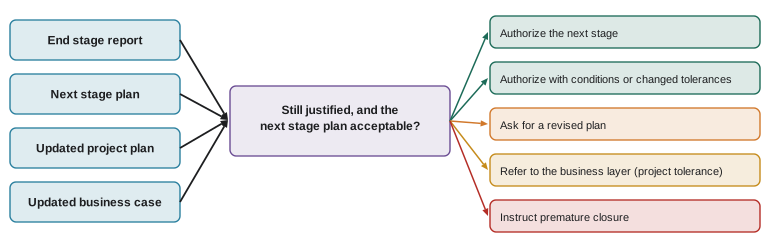
| Board option | When it fits | What happens next |
|---|---|---|
| Authorize the next stage | Project justified; plan and tolerances acceptable | Project manager starts controlling the next stage |
| Authorize with conditions | Broadly acceptable, with specific concerns | Conditions recorded; project manager reflects them in the plan or reporting |
| Ask for a revised plan | Plan not credible or risks too high | Project manager revises in managing a stage boundary; board decides again |
| Refer to the business layer | Project tolerances forecast to be breached | Business layer decides; board acts on its decision |
| Instruct premature closure | Project no longer justified | Project manager closes the project in a controlled way |
Ridgeline Water's boundary decision
The board met at week 38. The senior user asked whether customer operations could handle 16,800 new smart meter accounts during the winter billing peak; the project manager showed the phased installation schedule and the extra temporary staff in the plan. The senior supplier, Northline's director, confirmed the 14 crews in writing. The executive focused on the business case: the pilot evidence came from one district with older mains, and most of rollout stage 2 is in newer subdivisions. The board authorized rollout stage 1 with two conditions. First, leak savings must be measured in at least one newer subdivision during the stage, and reported at the next boundary as a key input to the rollout stage 2 decision. Second, highlight reports were to be weekly for the first four weeks, then fortnightly.
Because the rollout stage commits capital from the city's capital improvement plan, uses state revolving fund loan money and awards a large contract variation, the general manager took a staff report to council at its next meeting after the board's decision. Council approved the contract variation and noted the end stage report summary. The project plan had aligned the boundary with the council calendar, so the crews could mobilize at week 40 without waiting another month.
What the board should not do at a boundary
Boards sometimes treat stage boundaries as a formality: the next stage was in the project plan, so they authorize it without reading the report. That wastes the most important control PRINCE2 gives them. Others go to the opposite extreme and reopen every decision made during the stage. The board's job at a boundary is to decide on the future, using the evidence of the past. It may ask questions about the stage, but its decision is about whether the next commitment is justified. If the board needs assurance about specific claims in the report, project assurance should have checked them before the meeting.
Worked problem
Authorize, revise or refer?
At a stage boundary on another project, the next stage plan is credible and the business case remains positive, but the updated project plan forecasts a total cost 6 % above baseline against a project cost tolerance of +5 %. What should the board do?
Show solution
- The forecast breaches project tolerance, which the business layer set.
- The board cannot authorize a plan that breaches project tolerance on its own authority.
- The project manager should treat this as a project-level exception: the board refers the exception report to the business layer.
- The business layer may approve revised project tolerances, ask for options, or decide to stop the project; the board then acts on its decision.
Answer: Refer to the business layer. A forecast breach of project tolerance is not the board's to accept, even when the business case is still positive.
Project assurance at the boundary
Before the board meets, project assurance reviews the boundary products on the board's behalf. For Ridgeline's pilot boundary, business assurance checked the leak savings calculation against the network team's raw data, user assurance confirmed with customer operations that the pilot district's acceptance records were complete, and supplier assurance checked that Northline's crew commitment for rollout was confirmed in writing. Their short notes went to the board with the end stage report, so the meeting could spend its time on the decision rather than on checking figures.
Common mistakes
MistakeProducing an end stage report for the final stage.
InsteadThe final stage ends with an end project report in closing a project.
MistakeReporting stage performance against the original plan after an exception plan.
InsteadReport against the approved revised baseline and explain the difference.
MistakeTreating the boundary decision as automatic.
InsteadThe board decides afresh whether the next stage is justified.
MistakeAuthorizing a stage when the project tolerance is forecast to be breached.
InsteadRefer the matter to the business layer.
MistakeKeeping valuable lessons inside the project.
InsteadSend a lessons report to those in the organization who can act on it.
Summary and key terms
- The end stage report summarizes the stage and supports the board's decision on the next stage.
- It reviews the business case, performance against tolerances, teams, products, lessons, issues and risks, and forecasts.
- Products may be handed over at stage boundaries in a phased handover.
- A lessons report spreads valuable lessons beyond the project.
- The board authorizes, authorizes with conditions, asks for revision, refers to the business layer or instructs closure.
- Ridgeline Water's board authorized rollout stage 1 with conditions on benefits evidence and reporting.
- End stage report
- The project manager's report at the end of a stage on its performance and the project's status, used for the boundary decision.
- Lessons report
- A report that passes lessons to people in the organization who can use them.
- Phased handover
- Handing over products to operations at points during the project rather than only at the end.
- Request to authorize the next stage
- The request from the project manager to the board at a stage boundary.
- Conditions
- Requirements the board attaches to an authorization.
- Project-level exception
- A forecast breach of project tolerance, decided by the business layer.
Practice problems
Work each problem on paper first, then reveal the answer to check.
Who produces the end stage report?
Show answer
The project manager.
Which report replaces the end stage report in the final stage?
Show answer
The end project report.
Against which baseline is the pilot's performance reported?
Show answer
The exception plan's revised baseline, with the original plan noted for context.
How much of the revised cost tolerance did the pilot use?
Show answer
About 41 %.
What was handed over to customer operations at week 38?
Show answer
The pilot meters, billing interface on daily totals and operating procedures for the pilot district.
When might a project manager produce a lessons report at a stage boundary?
Show answer
When lessons are substantial or useful beyond the project.
Name three options the board has at a stage boundary.
Show answer
Authorize, authorize with conditions, ask for a revised plan (also refer to the business layer or instruct closure).
What were the two conditions on the rollout stage 1 authorization?
Show answer
Measure leak savings in a newer subdivision, and weekly highlight reports for four weeks.
What must the board do if the project tolerance is forecast to be breached?
Show answer
Refer it to the business layer.
Which directing activity covers the boundary decision?
Show answer
Authorizing a stage or exception plan.
Lesson quiz · 5 questions
Score 60% or more to complete this lesson.
Create a free account to save your progress, take quizzes and earn a certificate.