
PRIN-141 · Lesson 6 of 12 · 25 min
Managing product delivery II: delivering work packages with suppliers and agile teams
A work package is not finished when the team stops working. It is finished when its products have been approved by the people named in the approval method, the records show it, anything that had to be handed to another team or to operations has arrived, and the project manager has been told. This lesson covers that last activity of managing product delivery, then looks at two situations that shape how managing product delivery works in practice: external suppliers working under contracts, and agile teams delivering in sprints. Both appear in Ridgeline Water's pilot stage.
Delivering a work package
Delivering a work package has three parts. First, the team manager confirms that every product in the work package has passed its quality checks and has been approved using the approval method, and that the quality register and product records show this. Second, the team manager hands over the products as the work package requires: to the project manager, to another team that needs them, or into a holding area until the project hands them to operations at closure. Third, the team manager updates the team plan to show the work complete and notifies the project manager that the work package is complete. Controlling a stage then receives the completed work package, as lesson 3 described.
| Check before notifying completion | WP1 pilot meter installation, week 38 |
|---|---|
| All products built | 2,812 meters installed (12 above the revised scope; approved within scope tolerance) |
| Quality checks complete | 5 % sample complete; all rework closed; quality register up to date |
| Approvals recorded | Quality inspector's approval for each batch; customer operations' acceptance of appointment records |
| Records updated | Product register shows every meter as approved, with photo and reading |
| Handovers made | Commissioning data passed to the meter data system; 140 return visits for valves completed |
| Team plan closed | Team plan shows all tasks complete; lessons sent to the project manager |
The lessons the team manager sends at the end of a work package are often the most useful in the project. Marco's included the realistic installation rate, the value of booking appointments two weeks ahead, the seal checklist step and the advice to check component lead times before a stage starts. They went straight into the lessons log and shaped the rollout stage plan.
Work packages with external suppliers
When a team manager works for a supplier, managing product delivery sits alongside a contract. PRINCE2 7 recognizes this explicitly through its commercial management approach, which describes how suppliers will be selected, contracted, managed and paid. The work package does not replace the contract, and the contract does not replace the work package. They must say the same things about products, quality, dates and acceptance, and when one changes, so must the other.
| Topic | In the contract | In the work package |
|---|---|---|
| What is delivered | Scope and specifications, often by reference to schedules | Product descriptions and quality criteria for this piece of work |
| Price and payment | Rates, payment milestones, holdback or retainage | Joint agreement on cost and milestones |
| Quality | Standards, warranties and defects liability | Quality methods, responsibilities and approval method |
| Change | Variation procedure and pricing of changes | Change control requirements; raise requests for change |
| Reporting | Contract meetings and formal notices | Checkpoint reports and issue escalation |
| Disputes and termination | Dispute resolution and termination rights | Not covered; handled through the commercial approach |
The supplier will often have its own project management method, perhaps its own version of PRINCE2. That is fine. What matters is that the supplier's team manager works to the agreed work package interface: accepts work packages, reports checkpoints, raises issues and confirms completion. Inside its own organization, Northline uses its own scheduling system and its own crew supervisors; Ridgeline does not need to see that detail, only the reliable information the work package asks for.
Linking approvals to payment
One of the strongest controls on supplier work is to make payment depend on the same evidence as product approval. If a meter counts as installed for payment only when it has passed the inspector's sample and appears as approved in the product register, the supplier has every reason to keep the quality records complete. Ridgeline's contract pays Northline monthly for meters approved in that month, minus a percentage held back until the work is complete. The code below calculates the payment for the last month of the pilot under two holdback rates.
rate_per_meter = 0.335   # thousand, installed and commissioned (illustrative)
approved_this_month = 708
rework_open = 0
gross = approved_this_month * rate_per_meter
for label, held in [("10 % held back", 0.10), ("5 % held back", 0.05)]:
    retained = gross * held
    print(f"{label:15} gross {gross:6.1f}k  held {retained:5.1f}k  paid now {gross - retained:6.1f}k")
print(f"meters with open rework (not paid): {rework_open}")10 % held back gross 237.2k held 23.7k paid now 213.5k 5 % held back gross 237.2k held 11.9k paid now 225.3k meters with open rework (not paid): 0
In the United States, state prompt payment and public works laws often limit retainage on public contracts, commonly to 5 % or 10 % and sometimes reducing once the work is half complete, and set deadlines for paying approved invoices. Ridgeline's contract applies 5 % retainage and aligns invoice timing with the monthly approval run, so that an invoice and its approval evidence arrive together.
Agile teams in managing product delivery
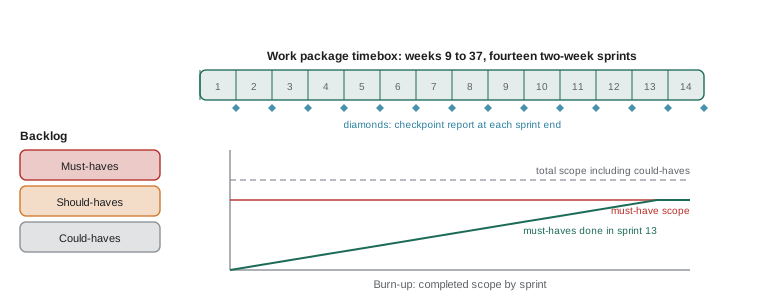
Ridgeline's billing interface team works in two-week sprints with a product owner, a team lead and developers. Managing product delivery fits this cycle well. Accepting the work package means agreeing the timebox, the team cost, the must-have features and the definition of done. Executing it means running sprints, with sprint reviews as the main quality method and automated tests as quality checks recorded in the team's tools. Delivering it means demonstrating that every must-have feature meets the definition of done and that the interface has passed integration testing with the billing system, then notifying the project manager. Checkpoint reports come at the end of each sprint and include the burn-up chart.
| Managing product delivery activity | In the billing team's sprints |
|---|---|
| Accept a work package | Agree timebox, team, must-haves, definition of done and checkpoint rhythm |
| Execute a work package | Sprint planning, daily stand-ups, development, automated testing, sprint review |
| Raise issues | When must-haves are forecast not to fit the timebox, or an external dependency fails |
| Checkpoint report | At each sprint end: burn-up, completed features, issues, risks, tolerance position |
| Deliver a work package | Demonstrate must-haves done; integration test passed; product register updated; notify completion |
The team manager of an agile team must still respect the work package's limits. A team that discovers a valuable new feature does not simply add it; it raises it with the project manager, who decides whether it fits within the flexible scope or needs a change decision. And a team that is falling behind does not quietly drop must-haves; it raises an issue as soon as the burn-up shows the risk. At week 30 the billing team had deferred two could-have reports, which was within its authority, and reported that in its checkpoint. That is self-organization inside clear boundaries, which is what PRINCE2 and agile methods both want.
Interfaces between work packages
Most of the problems in delivery happen at the joins between teams. The installation team needed the collector network live before meters could be commissioned remotely; the billing interface needed commissioned meters to test with real data; customer operations needed installation schedules to book appointments. Each work package names these interfaces, and each team manager is responsible for keeping them, but it is the project manager who coordinates them across work packages. At Ridgeline, the project manager held a 30-minute weekly interface call with the four team managers, which caught the coverage gap in WP2 and the appointment backlog in WP4 before they became issues.
| From | To | What passes | When |
|---|---|---|---|
| WP2 collector network | WP1 installation | Live collectors for remote commissioning | Before each street is commissioned |
| WP1 installation | WP3 billing interface | Commissioned meters with real readings | From week 14 onwards |
| WP1 installation | WP4 customer communication | Installation schedule by street | Three weeks ahead |
| WP4 customer communication | WP1 installation | Confirmed appointments | Two weeks ahead |
| WP3 billing interface | Customer operations (operations) | Parallel billing results | Weeks 34 to 38 |
When a supplier is struggling
Sometimes a supplier's team cannot deliver. The first response is through managing product delivery: the team manager raises issues, proposes recovery and works within the work package. If that fails, the project manager deals with it in controlling a stage, perhaps by adjusting work packages or taking corrective action. If the commercial relationship itself is in trouble, for example persistent quality failures or a dispute about payment, the commercial management approach applies, and the board may need to be involved, especially if the remedy is to change suppliers. In none of these cases should the supplier's team manager bypass the project manager and go straight to the board or to the executive.
Worked problem
Is the work package complete?
At week 37 the billing team lead notifies the project manager that WP3 is complete: all must-have features are done, the sprint review was positive and the team has moved on to another project. The integration test with the billing system is scheduled for next week, and two could-have reports were deferred. Is the work package complete?
Show solution
- Check the definition of done in the work package: it includes passing the integration test with the billing system.
- The integration test has not happened, so at least one must-have product is not yet approved.
- The deferred could-have reports were within the team's flexible scope and do not prevent completion.
- The project manager keeps WP3 open until the integration test passes and the product register shows the interface approved, and asks the team lead to keep someone available to fix any defects.
Answer: Not yet. Completion requires the products to be approved under the work package's approval method, which includes the integration test. The deferred could-haves are fine.
Closing out a work package cleanly
Completing the last work package of a stage has knock-on effects that team managers sometimes overlook. Spare materials have to be returned or recorded, temporary access permits closed, crews released or reassigned, and any warranty obligations noted for the handover at project closure. Ridgeline's installation work package left 46 spare meters, 3 spare collectors and a part box of temporary valve fittings. Marco recorded them in the product register as project stock, so that they could be used in rollout stage 1 rather than written off or forgotten in a depot. The project manager added a one-line check to the receiving completed work packages activity: what is left over, where is it, and who owns it now?
| Close-out item | Why it matters | WP1 result |
|---|---|---|
| Spare materials | Avoid waste and double ordering | 46 meters and 3 collectors recorded as project stock |
| Permits and access | Avoid fines and complaints | Road occupancy permits closed with the city |
| Crews and equipment | Release costs promptly | Fifth crew released at week 26; four crews moved to rollout planning |
| Warranties | Needed at handover to operations | Meter warranty start dates recorded per batch |
| Lessons | Improve later stages | Five lessons sent to the project manager |
Common mistakes
MistakeNotifying completion when the team has stopped working but approvals are missing.
InsteadNotify only when every product is approved and the records show it.
MistakeLetting the contract and the work package drift apart after changes.
InsteadVary both together through the commercial management approach.
MistakePaying suppliers on claimed progress rather than approved products.
InsteadLink payment to the same evidence as product approval.
MistakeLetting an agile team drop must-haves quietly.
InsteadRaise an issue as soon as must-haves are at risk.
MistakeLeaving interfaces between work packages to sort themselves out.
InsteadThe project manager coordinates interfaces across work packages.
Summary and key terms
- Delivering a work package means confirming approvals and records, making handovers and notifying the project manager.
- Team managers' end-of-work-package lessons feed the lessons log and later plans.
- With suppliers, the contract and the work package must stay consistent; the commercial management approach governs the relationship.
- Linking payment to product approval strengthens quality control.
- Agile teams fit managing product delivery through timeboxes, definitions of done and sprint-end checkpoint reports.
- The project manager coordinates interfaces between work packages.
- Completed work package notice
- The team manager's notification to the project manager that a work package's products are approved and delivered.
- Commercial management approach
- The PRINCE2 7 approach describing how suppliers are selected, contracted, managed and paid.
- Definition of done
- The criteria a product or feature must meet to count as complete in agile delivery.
- Holdback
- A percentage of payment withheld until work is complete; called retainage in the United States.
- Product owner
- In agile delivery, the person who prioritizes the backlog on behalf of users.
- Handover
- Passing approved products to another team, the project manager or operations.
Practice problems
Work each problem on paper first, then reveal the answer to check.
What three things make up delivering a work package?
Show answer
Confirm approvals and records, make handovers, and update the team plan and notify the project manager.
How many meters did WP1 finally install?
Show answer
2,812.
Which PRINCE2 7 approach governs supplier relationships?
Show answer
The commercial management approach.
Does a work package replace a supplier contract?
Show answer
No; they cover different ground and must stay consistent.
Why link supplier payment to product approval?
Show answer
It gives the supplier a reason to keep quality records complete and pays only for accepted work.
What is the gross payment for 708 approved meters at 0.335 thousand each?
Show answer
About 237.2 thousand.
When does the agile billing team send checkpoint reports?
Show answer
At the end of each two-week sprint.
Why was WP3 not complete at week 37?
Show answer
The integration test, part of the definition of done, had not yet passed.
Who coordinates interfaces between work packages?
Show answer
The project manager.
What should a supplier's team manager never do when the relationship is in trouble?
Show answer
Bypass the project manager and go straight to the board.
Lesson quiz · 5 questions
Score 60% or more to complete this lesson.
Create a free account to save your progress, take quizzes and earn a certificate.