
PRIN-141 · Lesson 11 of 12 · 25 min
Closing a project II: evaluation, lessons and premature closure
Once the products are accepted and handed over, the project manager evaluates the project and recommends closure. The evaluation is recorded in the end project report, which tells the board how the project performed against its original intentions and its approved changes, whether the business case still holds, what the team learned and what still needs doing. The board then authorizes closure in directing a project and notifies the business layer. This lesson follows those steps for Ridgeline Water, then looks at the harder case: closing a project that has been stopped before it finished.
Evaluating the project
Evaluating the project means comparing what happened with what was planned, at project level. The project manager uses the baselines in the project initiation documentation, as amended by approved changes and exception plans, and asks: did the project deliver the agreed products, at what cost, in what time, to what quality, with what risks, and with what effect on the business case? The evaluation is honest about both successes and failures. It also reviews how the team and the management approaches performed, because those lessons are as valuable as the results.
stages = {  # stage: (baseline, actual) in thousand
    "Initiation": (160, 158),
    "Pilot": (1450, 1581),
    "Rollout stage 1": (3700, 3846),
    "Rollout stage 2 and closure": (4290, 4318),
}
base = sum(b for b, a in stages.values())
act = sum(a for b, a in stages.values())
tol_cost = base * 0.05
for k, (b, a) in stages.items():
    print(f"{k:28} baseline {b:6,}  actual {a:6,}  variance {a - b:+5,}")
print(f"project: baseline {base:,}  actual {act:,}  variance {act - base:+,}  cost tolerance used {(act - base) / tol_cost:.0%}")
end_base, end_act, tol_time = 100, 101, 8
print(f"time: baseline week {end_base}, actual week {end_act}, time tolerance used {(end_act - end_base) / tol_time:.0%}")Initiation baseline 160 actual 158 variance -2 Pilot baseline 1,450 actual 1,581 variance +131 Rollout stage 1 baseline 3,700 actual 3,846 variance +146 Rollout stage 2 and closure baseline 4,290 actual 4,318 variance +28 project: baseline 9,600 actual 9,903 variance +303 cost tolerance used 63% time: baseline week 100, actual week 101, time tolerance used 12%
The project cost 9,903 thousand against a baseline of 9,600 thousand, using about 63 % of the 480 thousand cost tolerance, and finished at week 101, using one of its eight weeks of time tolerance. Two exceptions, one in the pilot and one in rollout stage 1, account for most of the cost variance, and both were decided by the board within project tolerances. That is a respectable result for a project of this size and uncertainty, and the end project report says so plainly, alongside what it cost and why.
The end project report
The end project report is the project manager's account of the project for the board. It is the counterpart, at project level, of the end stage report, and it replaces the end stage report for the final stage. It usually carries the project manager's recommendation that the board authorize closure.
| Section | Ridgeline Water at closure |
|---|---|
| Project manager's report | Project delivered 99.2 % conversion; within project tolerances; closure recommended |
| Review of the business case | Leak savings across the network about 88 % of forecast; NPV about 1,280 thousand at current evidence; benefits continue after closure |
| Review of objectives | Cost 9,903 against 9,600 (+3.2 %); week 101 against week 100; quality criteria met |
| Review of team performance | Installation and IT teams commended; supplier relationship strong after early tension over rates |
| Review of products | All products accepted; 320 refused-access properties and 210 early battery drains as concessions |
| Lessons | Legacy data assessment, materials surveys, realistic rates from pilots, early ordering |
| Follow-on action recommendations | Refused-access properties; warranty replacements; leak analytics; tariff review; benefits measurement |
Benefits after closure
Most benefits arrive after a project closes. Ridgeline's leak savings build year by year as the network team uses the data; billing savings arrive as estimated bills disappear; customer service improves as complaints fall. The project cannot measure benefits that have not happened yet, so closing a project updates the benefits management approach to say how and when the remaining benefits will be measured, by whom, and how results will be reported. Responsibility for those reviews sits with the executive, on behalf of the business layer, not with the project manager, whose role ends at closure.
| Benefit | Measure | When | Owner |
|---|---|---|---|
| Leak savings | Non-revenue water as a share of supply | Annually for three years | Network operations manager |
| Fewer estimated bills | Estimated bills per quarter | Quarterly for two years | Customer operations manager |
| Meter reading costs avoided | Reading costs against the pre-project baseline | Year 1 and year 2 | Finance manager |
| Customer satisfaction | Billing complaints per 1,000 accounts | Six-monthly for two years | Customer operations manager |
Capturing and passing on lessons
Closing a project reviews the lessons log and decides which lessons should be passed on. A lessons report goes to the people who can act on them: the corporate project office, the asset management team, the procurement team. Ridgeline's most valuable lessons were about using a pilot to test the biggest assumptions, surveying site conditions before planning installation rates, and assessing legacy data before committing to interfaces. The project office built two of them into the utility's project templates.
Recommending and authorizing closure
When the products are handed over, the evaluation is complete and the follow-on actions have owners, the project manager recommends closure to the board, usually with a draft closure notification. The board performs its last directing activity, authorizing project closure. It reviews the end project report, confirms that the products have been accepted and handed over, checks that the benefits reviews are planned and the follow-on actions owned, and then authorizes closure. It sends a closure notification to the business layer and to anyone else who needs to know, such as suppliers, support teams and finance, and the project's resources are released. The project records are archived for audit and for future projects.
Ridgeline Water's project records are kept under the state's records retention schedule for local governments. Contract and financial records, including retainage releases and loan documentation for the state revolving fund, are kept for the required periods, and the archived file is indexed so that a future project manager can find the lessons and the as-built data.
Premature closure
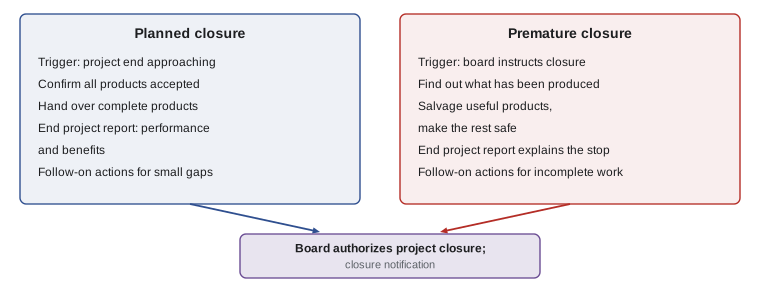
Not every project reaches its planned end. The business case may collapse, the organization's priorities may change, a better solution may appear, or an exception may show that the project cannot be recovered within any acceptable limits. When the board decides that a project should stop, it instructs the project manager to close it prematurely. Closing a project then starts with preparing premature closure instead of preparing planned closure.
Ridgeline Water had a small example. Alongside the smart meter project, the utility had started a separate customer portal project to give customers online access to their consumption and bills. During rollout stage 1, the billing system vendor announced that its next release would include a customer portal with most of the same features, at no extra license cost. The portal project's board looked at its updated business case and concluded that building its own portal was no longer justified. It instructed premature closure.
| Premature closure step | Customer portal project |
|---|---|
| Record the decision and the reason | Board decision minuted: vendor release makes the project unjustified |
| Find out what has been produced | Design and user research complete; 40 % of portal pages built; accessibility test plan written |
| Decide what to salvage | User research and accessibility test plan given to the team configuring the vendor portal |
| Make the incomplete products safe | Partly built code archived; test environment shut down; no data left exposed |
| Record follow-on actions | Configure the vendor portal using the research; check accessibility before launch |
| Evaluate the project and capture lessons | End project report explains the stop; lesson: check vendor roadmaps during initiation |
| Release resources | Two developers moved to the billing interface team; contractor engagement ended |
Premature closure is still controlled closure. The project manager does not simply stop work. Partly built products are reviewed to see what can be used, made safe or archived; anything handed over is formally accepted; follow-on actions are recorded; and an end project report explains why the project stopped and what was gained and lost. Managing a stage boundary is not performed, because there is no next stage. The board authorizes closure in the same way as for a planned closure.
Stopping is a legitimate outcome
A project that stops because its justification has gone has not failed; it has done what PRINCE2's principle of continued business justification asks. Continuing would have spent money for no return. The failure would be to carry on because the work had started, or because nobody wanted to admit the change in circumstances. The customer portal board stopped early, salvaged the most useful products and released two developers to work that mattered more. The money it did not spend is a real saving, and the end project report records it as one.
Worked problem
Planned or premature?
A project's board learns at a stage boundary that the regulator has changed a rule, so the project's main product will no longer be allowed after next year. The project manager suggests finishing the current stage anyway 'to use the budget' and then closing. What should happen?
Show solution
- The business case no longer holds, so the project is not justified.
- The board should instruct premature closure rather than authorize further work.
- The project manager prepares premature closure: identifies what has been produced, salvages anything useful, makes the rest safe and records follow-on actions.
- An end project report explains why the project stopped, and the board authorizes closure.
Answer: Premature closure, now. Spending the rest of the budget would breach the principle of continued business justification.
Who does what at the end
Closure involves every level of management, and exam questions often test the division of work. The project manager prepares closure, hands over products, evaluates the project and recommends closure. Team managers complete their final work packages and contribute lessons. Project assurance checks the acceptance evidence and the end project report on the board's behalf. The senior user confirms acceptance and, with the executive, owns the benefits reviews. The senior supplier confirms that the supplier side has delivered and can be released. The executive leads the board's decision to authorize closure and ensures the business layer is notified. Project support archives the records.
| Role | Main part in closing a project |
|---|---|
| Project manager | Prepares closure, hands over products, writes the end project report, recommends closure |
| Team managers | Deliver the final work packages and contribute lessons |
| Senior user | Confirms user acceptance; helps plan and carry out benefits reviews |
| Senior supplier | Confirms supplier delivery, warranties and release of resources |
| Executive | Leads the closure decision; owns post-project benefits reviews for the business layer |
| Project assurance | Checks acceptance evidence and the end project report |
| Project support | Archives the project records |
One question deserves special care: who decides that a project should close early? The project manager can recommend it, for example in an exception report that lists premature closure as an option, but only the board can decide, and if the decision affects commitments above the board, the business layer may need to be consulted. A project manager who simply stops work because the business case looks weak has taken a decision that was not theirs.
Common mistakes
MistakeTreating the end project report as a list of achievements.
InsteadEvaluate honestly against baselines, including variances and exceptions.
MistakeLeaving benefits measurement to the project manager after closure.
InsteadUpdate the benefits management approach and give ownership to the executive and operations.
MistakeStopping work abruptly when told to close prematurely.
InsteadSalvage useful products, make the rest safe and record follow-on actions.
MistakePerforming managing a stage boundary in premature closure.
InsteadGo directly to closing a project; there is no next stage.
MistakeContinuing a project because work has started.
InsteadStop when the business case no longer holds.
Summary and key terms
- Evaluating the project compares results with baselines, including approved changes and exception plans.
- The end project report covers the business case, objectives, team, products, lessons and follow-on actions.
- Benefits after closure are measured under the updated benefits management approach, owned by the executive.
- The board authorizes closure, notifies the business layer and releases resources.
- Premature closure salvages useful products, makes the rest safe and explains the stop in the end project report.
- Stopping an unjustified project is a legitimate, valuable outcome.
- End project report
- The project manager's report at closure evaluating the project and recommending closure.
- Closure notification
- The board's notice to the business layer and others that the project has closed.
- Premature closure
- Closing a project before its planned end on the board's instruction.
- Authorize project closure
- The directing activity in which the board approves the closure of the project.
- Benefits review
- A review that measures benefits, often after the project has closed.
- Salvage
- Making use of partly completed products from a stopped project.
Practice problems
Work each problem on paper first, then reveal the answer to check.
What is compared in evaluating the project?
Show answer
Actual results against the baselines, as amended by approved changes and exception plans.
What did Ridgeline's project cost against its baseline?
Show answer
9,903 thousand against 9,600 thousand.
How much of the cost tolerance was used?
Show answer
About 63 %.
Who owns benefits reviews after closure?
Show answer
The executive, on behalf of the business layer, with operations managers measuring.
Which directing activity ends the project?
Show answer
Authorizing project closure.
Who receives the closure notification?
Show answer
The business layer, and others such as suppliers, support teams and finance.
Why was the customer portal project closed prematurely?
Show answer
The billing vendor's next release included a portal, so the project was no longer justified.
What was salvaged from the customer portal project?
Show answer
The user research and the accessibility test plan.
Is managing a stage boundary performed in premature closure?
Show answer
No.
Which principle does stopping an unjustified project apply?
Show answer
Continued business justification.
Lesson quiz · 5 questions
Score 60% or more to complete this lesson.
Create a free account to save your progress, take quizzes and earn a certificate.