
PRIN-141 · Lesson 4 of 12 · 26 min
Controlling a stage III: issues, risks, corrective action and escalation
No stage goes exactly to plan. Suppliers miss dates, tests fail, people fall ill, stakeholders ask for more, and risks occur. Three activities of controlling a stage deal with this. Capturing and examining issues and risks makes sure every new problem or uncertainty is recorded and understood. Taking corrective action fixes problems that can be fixed within the project manager's authority and the stage tolerances. Escalating issues and risks passes upward the ones that cannot. PRIN-131 covered the issues and risk practices in depth; this lesson focuses on how the project manager uses them inside controlling a stage, continuing with Ridgeline Water's pilot stage from week 30 to week 36.
Capturing and examining issues and risks
Anyone involved in the project can raise an issue or a risk at any time: a team manager, a board member, a customer, an inspector. The project manager first decides how to handle it. Small matters that can be dealt with informally go in the daily log. Matters that need formal handling go in the issue register or the risk register, with an issue report or a risk assessment where the issue management or risk management approach requires one. The examination asks what the matter is, what caused it, what its effect is on the stage and project plans, the business case and the risks, and what the options are.
| Arrives as | Example at Ridgeline Water | Recorded in | Type |
|---|---|---|---|
| Request for change | Council asks to add 200 connections at a seniors' housing complex outside the pilot district | Issue register, with issue report | Request for change |
| Off-specification | Four accounts billed at the wrong rate in the parallel run | Issue register, with issue report | Off-specification |
| Problem or concern | Backflow valve supplier announces a six-week delay | Issue register | Problem or concern |
| New risk | Winter could freeze meter pits before the eastern streets are finished | Risk register | Threat |
| Minor matter | One crew's van broke down for a morning | Daily log | Handled informally |
The project manager's examination is not just a technical assessment. It always comes back to the tolerances and the business case. A problem that costs 5 thousand to fix is trivial if the stage has 31 thousand of cost tolerance left and nothing else is threatened. The same problem matters a great deal if the stage is already forecasting a breach. An opportunity to save money is worth pursuing only if it does not damage quality or benefits.
Taking corrective action
If a problem can be resolved within the stage tolerances and within the project manager's delegated authority, the project manager takes corrective action. That might mean moving resources between work packages, adjusting a work package and its tolerances, approving a change within the change authority the board delegated, re-sequencing work, or asking a team manager for a recovery plan. Corrective action is recorded: the issue register shows the decision, the stage plan is updated, affected work packages are revised and the registers are updated. The board sees the action in the next highlight report.
At week 33 the backflow valve delay became real. Northline Metering could not fit valves to 140 meters in older streets until the valves arrived, six weeks later, which would push those installations past the end of the stage. The project manager examined the options. The valves were needed only at locations with an older service connection, so the installers could fit the meters now with a temporary approved fitting and return to fit the valve later, at an extra cost of about 11 thousand. The board had delegated a stage change budget of 50 thousand to the project manager, with a rule that any single change above 10 thousand is reported to the board in the next highlight report. The project manager authorized the re-sequencing at once, since it cost nothing, approved the 11 thousand for the return visits from the change budget, and flagged it in the next highlight report as the rule required.
| Option | Stage cost effect | Stage end | Within authority? |
|---|---|---|---|
| Wait for valves; delay 140 installations | +2 thousand (idle crews) | Week 40: breaches time limit (week 39) | No: would need an exception report |
| Fit temporary fittings now, return later | +11 thousand | Week 38 | Yes: from the stage change budget, reported in the highlight report |
| Buy valves from a second supplier at a premium | +19 thousand | Week 38 | Yes, but more expensive |
| Remove the 140 meters from the pilot | −6 thousand | Week 38 | No: scope would fall to 2,660, below the 2,750 limit |
Escalating issues and risks
When an issue or risk cannot be dealt with inside the stage tolerances and the project manager's authority, the project manager escalates it. There are two routes. If a forecast shows a stage tolerance will be breached, the project manager sends an exception report to the board; lesson 9 covers exceptions in detail. If no tolerance is forecast to be breached but the matter needs a decision the project manager is not allowed to make, such as a change above the delegated change authority, the project manager sends an issue report to the board and asks for direction. The board responds through giving ad hoc direction in directing a project.
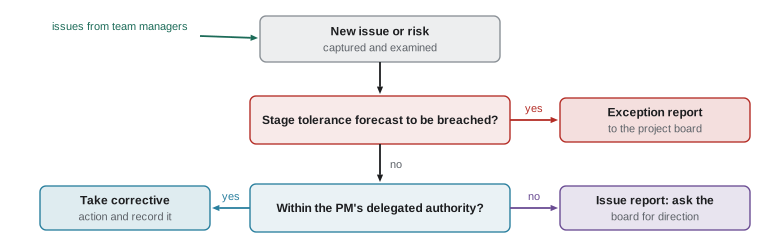
The council's request to add 200 connections at the seniors' housing complex is a good example of the second route. The examination showed the extra connections would cost about 64 thousand and add one week, which would still be within the stage time tolerance but would use more than the stage's change budget and is far above the project manager's per-change authority. The connections would also give useful data on older plumbing for rollout. The project manager sent an issue report to the board with three options: approve the change from the project-level change budget, defer the complex to rollout stage 1, or reject it. The board chose to defer it to rollout stage 1, where it would cost less because crews would already be working nearby, and asked for the decision to be reflected in the next stage plan.
How the routing works in code
The code below applies the routing rules to the four issues raised in the pilot stage between weeks 30 and 36. It checks each against the stage tolerances, the per-change authority and the remaining change budget.
limits = {"cost": 1568 * 1.02, "end_week": 39, "min_scope": 2750}
forecast = {"cost": 1560, "end_week": 38, "scope": 2800}
per_change, change_budget_left = 10, 50
issues = [  # name, cost, weeks added, scope change, change_needed
    ("wrong billing rates (rework)", 3, 0, 0, False),
    ("backflow valves: temporary fittings", 11, 0, 0, True),
    ("seniors' complex +200 connections", 64, 1, 200, True),
    ("crew illness recovery overtime", 4, 0, 0, False),
]
for name, cost, wk, sc, change in issues:
    c, w, s = forecast["cost"] + cost, forecast["end_week"] + wk, forecast["scope"] + sc
    if c > limits["cost"] or w > limits["end_week"] or s < limits["min_scope"]:
        route = "exception report to the board"
    elif change and cost > change_budget_left:
        route = "issue report to the board (beyond delegated change budget)"
    elif change and cost > per_change:
        route = "approve from change budget; report to board in highlight"
        change_budget_left -= cost
    else:
        route = "corrective action by the project manager"
    if "board" not in route or "highlight" in route:
        forecast["cost"] = c
    print(f"{name:38} -> {route}")
print(f"stage cost forecast {forecast['cost']}k; change budget left {change_budget_left}k")wrong billing rates (rework) -> corrective action by the project manager backflow valves: temporary fittings -> approve from change budget; report to board in highlight seniors' complex +200 connections -> exception report to the board crew illness recovery overtime -> corrective action by the project manager stage cost forecast 1578k; change budget left 39k
Three of the four issues are handled inside the stage. The seniors' complex would breach the stage cost tolerance if added in full, so in the code it routes to an exception report; in practice the project manager avoided that by asking the board for direction early, before treating it as part of the stage, and the board deferred it. The point is the same either way: the decision belonged to the board, not to the project manager. After the other three issues, the stage cost forecast is 1,578 thousand, within the 1,599 thousand limit.
Risks during the stage
Risk management continues throughout the stage. The project manager reviews the risk register as part of each stage status review, checks that risk owners are carrying out the agreed responses, and watches for risks that have occurred and become issues. At week 34 the frost risk to meter pits in the eastern streets rose sharply when the long-range forecast predicted an early cold spell. The response was already planned: insulated pit lids, held in stock as a fallback. The risk owner triggered it, the cost of 4 thousand came from the risk budget, and the risk register and highlight report recorded the action. No escalation was needed, because the risk budget existed precisely for this.
Ridgeline Water's frost risk response reflects the local frost depth that the state plumbing code and the city's water service standards use when setting service line and meter pit depths. Older pits in the eastern streets were built to an earlier standard, which is why they are more exposed.
Recording what was decided
Every examination and decision should leave a trail. The issue register shows the issue, its type, its priority and severity, the decision and who made it. The daily log records informal actions. The stage plan, work packages and product records are updated for approved changes. The lessons log captures anything that should be done differently next time, such as checking component lead times before the stage starts. That trail is what allows the project manager to write an honest end stage report, and it is what an auditor or a successor project manager will rely on.
| Record | What is updated when an issue is resolved |
|---|---|
| Issue register | Decision, decision maker, date, status |
| Stage plan | Revised schedule, costs and forecasts |
| Work packages | Revised scope, tolerances or dates, agreed with the team manager |
| Product register | Changed product versions and status |
| Risk register | Risks closed, new risks, secondary risks |
| Lessons log | What should be done differently next time |
| Highlight report | Summary for the board of actions taken and their effect |
Worked problem
Corrective action or escalation?
At week 36 the billing interface team finds that the upgraded billing system cannot handle meters reporting in hourly intervals without a vendor patch. The vendor can deliver the patch in three weeks at no cost. Without it, the parallel billing run cannot finish before week 40. What should the project manager do?
Show solution
- Examine the effect: the billing interface work package would finish at week 40, which pushes the stage end past the week 39 limit.
- Look for corrective actions: could the run use daily totals for the pilot and switch to hourly later? The billing team confirms that daily totals meet the pilot's acceptance criteria.
- With daily totals, the parallel run finishes by week 38, inside the time tolerance; record the hourly requirement as a product for rollout stage 1.
- If no workable corrective action existed, the forecast breach of time tolerance would require an exception report to the board.
Answer: Take corrective action (daily totals for the pilot), because it keeps the stage within tolerance without reducing what the pilot must prove. Record the decision and move the hourly requirement into the next stage plan.
Common mistakes
MistakeTaking corrective action that breaches a stage tolerance.
InsteadEscalate with an exception report when a stage tolerance is forecast to be breached.
MistakeApproving a change above the delegated change authority because it is within tolerance.
InsteadCheck both tolerance and authority; ask the board for direction when authority is exceeded.
MistakeRecording issues only in emails.
InsteadUse the daily log and issue register so decisions can be traced.
MistakeWaiting for the next highlight report to raise a decision the board must make.
InsteadSend an issue report or exception report as soon as the need is clear.
MistakeTreating a risk that has occurred as still just a risk.
InsteadClose it as occurred and raise the resulting issue.
Summary and key terms
- Every issue and risk is captured, recorded at the right level and examined against the plans, business case and tolerances.
- The project manager takes corrective action when the fix is within stage tolerances and delegated authority.
- A forecast breach of stage tolerance is escalated with an exception report.
- A decision beyond the project manager's authority, with no tolerance breach, goes to the board as an issue report.
- Risk responses and risk budgets are used during the stage without escalation when they were planned for.
- Every decision leaves a trail in the registers, plans and logs.
- Corrective action
- Action taken by the project manager within stage tolerances to resolve a problem or deviation.
- Issue report
- A report describing an issue, its impact and options, used when a decision is needed.
- Change authority
- A person or group delegated by the board to approve requests for change within limits.
- Change budget
- Money set aside to fund approved requests for change.
- Risk budget
- Money set aside to fund planned risk responses.
- Ad hoc direction
- Guidance or decisions the board gives between its planned authorizations.
Practice problems
Work each problem on paper first, then reveal the answer to check.
Which three activities of controlling a stage are covered in this lesson?
Show answer
Capture and examine issues and risks, take corrective action, and escalate issues and risks.
Where is a minor matter handled informally recorded?
Show answer
In the daily log.
What two conditions must be met for the project manager to take corrective action?
Show answer
The fix stays within stage tolerances and within the project manager's delegated authority.
How was the backflow valve delay resolved?
Show answer
Temporary fittings now and a return visit later, about 11 thousand from the stage change budget.
Why did the seniors' complex request go to the board?
Show answer
Its cost was beyond the project manager's change authority and budget.
What did the board decide about the seniors' complex?
Show answer
Defer it to rollout stage 1.
What route is used when a stage tolerance is forecast to be breached?
Show answer
An exception report to the board.
How was the frost risk handled?
Show answer
The planned fallback (insulated pit lids) was triggered from the risk budget.
What is the stage cost forecast after the three issues handled within the stage?
Show answer
About 1,578 thousand.
Name three records updated when an issue is resolved.
Show answer
Issue register, stage plan and work packages (also product register, risk register, lessons log).
Lesson quiz · 5 questions
Score 60% or more to complete this lesson.
Create a free account to save your progress, take quizzes and earn a certificate.