
PRIN-110 · Lesson 4 of 12 · 27 min
Define roles, responsibilities and relationships
The third principle states that a PRINCE2 project has defined and agreed roles and responsibilities within an organization structure that engages the business, user and supplier stakeholder interests. PRINCE2 7 extended the wording to include relationships. A perfect organization chart is useless if the people in it do not talk to each other, trust each other or understand each other's pressures. This lesson looks at the structure the principle requires, the authority that goes with each role and the relationships that make the structure work.
Three interests, always
Every project involves three primary stakeholder interests.
- The business interest needs the project to deliver value for money. It is represented by the executive, who owns the business case and has the final say on the project board.
- The user interest covers those who will use the project's products, operate and maintain them, or be affected by them. It is represented by one or more senior users, who specify what is needed and are accountable for realizing benefits.
- The supplier interest covers those who provide the expertise, resources and skills to build the products. It is represented by one or more senior suppliers, who commit supplier resources and are accountable for the quality of what is delivered.
The three interests are not always in harmony. Users want more features; the business wants lower cost; suppliers want clear requirements, realistic timescales and to be paid. Bringing all three to the same table, with defined authority, is how PRINCE2 turns those tensions into decisions rather than conflict.
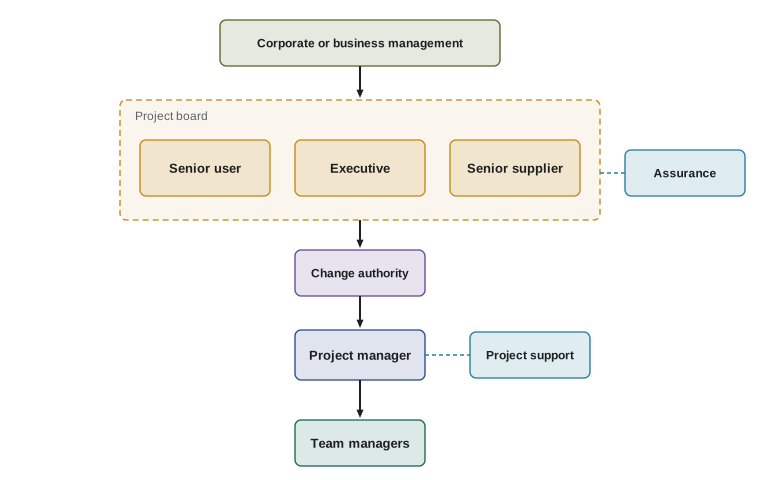
Four levels of management
The principle defines who does what across four levels.
| Level | Who | What they do |
|---|---|---|
| Business, program or corporate management | Sits outside the project | Commissions the project, appoints the executive, sets project tolerances |
| Directing | The project board | Makes key decisions, authorizes stages, provides direction and assurance |
| Managing | The project manager | Runs the project day to day within stage tolerances set by the board |
| Delivering | Team managers and teams | Create the products within work package tolerances |
Three supporting roles complete the structure. Project assurance checks, on behalf of the board members, that the project is being run properly and that the business, user and supplier interests are protected. Assurance is independent of the project manager. The change authority is a person or group delegated by the board to approve changes within agreed limits. Project support provides administrative help, configuration management and tools.
Roles are not jobs
A PRINCE2 role is a set of responsibilities, not a job title. One person can hold more than one role, and one role can be shared by several people, with some limits. On a small project the executive and senior user might be the same person. The project manager might also act as team manager. What PRINCE2 does not allow is combining roles in a way that removes accountability or independence. The executive role cannot be shared: there must be one person ultimately accountable. The project manager and executive roles should not be combined, because the person who approves the work should not be the person who manages it day to day. Project assurance should not be held by the project manager, because assurance is meant to be independent.
| Combination | Allowed? | Why |
|---|---|---|
| Executive and senior user | Yes, often on small internal projects | Business and user interests may sit with one manager |
| Project manager and team manager | Yes | Common on small projects |
| Executive shared by two people | No | There must be single-point accountability |
| Project manager and executive | No | Removes the separation between direction and management |
| Project manager and project assurance | No | Assurance must be independent of the project manager |
| Senior user shared by several people | Yes | Several user groups may need representation |
Responsibility, accountability and authority
Defining roles means more than listing names. It means agreeing who is responsible for doing something, who is accountable for its outcome, who must be consulted and who must be kept informed. A RACI matrix is a common tool for this. PRINCE2 does not require one, but many projects use it to make the principle concrete.
Worked problem
Building a RACI matrix
For three decisions on a facilities project, assign R (responsible), A (accountable), C (consulted) and I (informed) to the executive, senior user, senior supplier and project manager: approving the stage plan, approving a change that adds 3 % to cost within the change authority's limit, and accepting the final products. Assume a change authority of the senior user and executive acting together for changes up to 5 % of stage budget.
Show solution
- Approve stage plan: executive A, senior user C, senior supplier C, project manager R (prepares it).
- Approve 3 % change: executive A (as part of the change authority), senior user R (assesses user impact), senior supplier C (assesses feasibility), project manager C (assesses plan impact) and then I once decided.
- Accept final products: senior user A (confirms the products meet user needs), executive C, senior supplier C (confirms quality), project manager R (arranges acceptance).
- Check: each decision has exactly one A.
Answer: A RACI with one accountable person per decision. The rule of one A per row mirrors PRINCE2's single-point accountability.
Look again at the final check. A decision with two accountable people effectively has none, because each can assume the other will act. A decision with nobody accountable will drift until it becomes an issue.
Relationships make the structure work
PRINCE2 7 places much more emphasis on people than earlier editions, and the addition of relationships to this principle reflects that. A board whose members meet only at stage boundaries and do not trust each other will make slow, defensive decisions. A project manager who sees the senior supplier as an adversary will get less information early. Relationships are built by regular contact, honest communication, keeping commitments and understanding what each party needs.
Practical ways to build relationships include a kick-off workshop at initiation where board members agree how they will work together, short informal check-ins between stage boundaries, shared risk workshops with the supplier, and a communication management approach that sets out who needs what information and how often. The communication management approach is part of the project initiation documentation, and it is one of the clearest pieces of evidence that this principle is being applied.
Board composition and size
An effective project board is small enough to make decisions and senior enough to commit resources. A board of three to five people is typical. Large boards with many senior users from different departments slow decisions; one remedy is to create a user group that feeds a single senior user, or to appoint a lead senior user. Board members also need enough authority. A senior user who cannot commit staff time to testing, or a senior supplier who cannot commit the supplier's resources, is a sign that the role is filled by the wrong person.
Worked problem
Checking board decision speed
A project board has seven members: the executive, four senior users from different regions and two senior suppliers. Every decision needs a meeting, and meetings can only be scheduled every five weeks. The stage plan assumes a decision cycle of two weeks. What is the gap, and what change would help?
Show solution
- Planned decision cycle: 2 weeks. Actual: 5 weeks. Gap: 3 weeks per decision.
- With four board decisions expected in the stage, the potential delay is 4 × 3 = 12 weeks.
- Options: appoint one lead senior user supported by a regional user group; agree that routine decisions can be made by email or a shorter call; delegate change approval within limits to a change authority.
Answer: Up to 12 weeks of delay in the stage. Reducing board size and delegating routine decisions applies the principle more effectively.
Roles in commercial relationships
When the supplier is an external company, the principle becomes more complex. The customer and supplier each have their own organizations, management and commercial interests. PRINCE2 assumes a customer-supplier environment and recognizes that the supplier may run its own project, possibly using a different method. The senior supplier on the customer's board may be a representative of the supplier company, or the customer may appoint an internal senior supplier who manages the commercial relationship. The contract, the work package descriptions and the communication approach together define the relationship. Lesson 9 returns to commercial contexts.
Failure modes
| Failure | Symptom | Remedy |
|---|---|---|
| No real executive | Decisions are deferred or made by committee | Appoint one accountable executive with authority |
| Missing user voice | Products are rejected at handover | Appoint a senior user with authority to commit users |
| Supplier excluded from the board | Unrealistic commitments and surprises | Include supplier representation and shared risk reviews |
| Assurance not independent | Problems hidden from the board | Separate assurance from project management |
| Roles on paper only | People do not know or accept their responsibilities | Agree role descriptions and confirm them at initiation |
Role descriptions and acceptance
Defining roles is only useful if the people in them understand and accept their responsibilities. PRINCE2 provides outline role descriptions that organizations adapt. During initiation, the project manager should confirm each role with the person who holds it, including what they will decide, how much time they will need and what authority they have. A senior user who does not realize they will need to make staff available for testing, or an executive who expects the project manager to make investment decisions, will cause problems later. A short conversation at the start, recorded in the project initiation documentation, prevents many of them.
Time commitment deserves particular attention. Board members are usually senior people with other responsibilities. A project that needs a decision every week from a board that can meet only monthly will stall. Estimating the board's time, for stage boundary reviews, exception handling and assurance, and agreeing it in advance, is part of applying this principle.
Project assurance in practice
Project assurance is often misunderstood. It is not quality assurance of the specialist products, though it may check that quality methods are being followed. It is the board's own independent view of whether the project is being run properly. Each board member is responsible for assurance of their interest: the executive for business assurance, the senior user for user assurance and the senior supplier for supplier assurance. They may do it themselves or delegate it to others, such as a finance analyst, a user representative or a technical architect. What they cannot do is delegate it to the project manager.
Good assurance asks questions such as: are the business case figures based on realistic estimates? Do the product descriptions reflect what users actually need? Are the technical solutions feasible and are quality methods appropriate? Are risks being managed rather than just listed? Assurance that only reads highlight reports, without checking evidence, adds little.
When relationships break down
Sometimes relationships deteriorate despite good intentions. A supplier misses deadlines and the customer loses trust; a senior user feels ignored and stops attending; the executive and project manager disagree about how to report a problem. The principle suggests a few responses: make the disagreement explicit rather than letting it fester; return to the agreed roles and authority; use the board to resolve conflicts between interests; and, where necessary, change who holds a role. Changing a board member is a legitimate decision when the current holder cannot provide the authority or commitment the role needs.
Common mistakes
MistakeTreating the project board as a status meeting with no decisions.
InsteadUse the board to make key decisions and authorize stages.
MistakeSharing the executive role between two people.
InsteadKeep one accountable executive.
MistakeLetting the project manager carry out project assurance.
InsteadKeep assurance independent of the project manager.
MistakeAppointing board members who cannot commit resources.
InsteadChoose members with enough authority for their role.
MistakeDefining roles but ignoring relationships.
InsteadBuild working relationships through regular, honest communication.
Summary and key terms
- Every project represents business, user and supplier interests.
- The executive, senior user and senior supplier form the project board.
- Four levels: corporate, directing, managing and delivering.
- Roles are sets of responsibilities; they can be combined or shared within limits.
- There must be one accountable executive, and assurance must be independent.
- A RACI matrix with one accountable person per decision makes roles concrete.
- PRINCE2 7 adds relationships: trust and communication make the structure work.
- Executive
- The board role that owns the business case and is ultimately accountable.
- Senior user
- The board role representing those who will use the products and realize benefits.
- Senior supplier
- The board role representing those who design, build and supply the products.
- Project board
- The group responsible for directing the project.
- Project assurance
- Independent checking on behalf of board members.
- Change authority
- A person or group delegated to approve changes within limits.
- Project support
- Administrative and configuration management support to the project.
- RACI matrix
- A table showing who is responsible, accountable, consulted and informed.
- User group
- A group of user representatives that advises a senior user.
- Communication management approach
- The plan for who receives what information, when and how.
Practice problems
Work each problem on paper first, then reveal the answer to check.
Name the three primary stakeholder interests.
Show answer
Business, user and supplier.
Which board role owns the business case?
Show answer
The executive.
Can the executive role be shared?
Show answer
No.
Can the project manager also be a team manager?
Show answer
Yes, on small projects.
Why should the project manager not perform assurance?
Show answer
Assurance must be independent of the project manager.
What are the four levels of management?
Show answer
Corporate or business, directing, managing and delivering.
A decision has two A entries in a RACI. Problem?
Show answer
Accountability is diluted; there should be one A.
What did PRINCE2 7 add to the wording of this principle?
Show answer
Relationships.
Board meets every 6 weeks; plan assumes 2. Delay over 3 decisions?
Show answer
12 weeks.
Which document sets out who receives what information?
Show answer
The communication management approach.
Lesson quiz · 5 questions
Score 60% or more to complete this lesson.
Create a free account to save your progress, take quizzes and earn a certificate.