
PRIN-110 · Lesson 10 of 12 · 28 min
The principles in different contexts
Because the principles are universal, they apply in every setting. But how they are applied changes with the context. This lesson looks at five common contexts: agile delivery, small projects, the public sector, projects inside a larger program of change, and commercial customer-supplier relationships. For each, it asks what the principles look like in practice and where the usual pitfalls lie.
Agile delivery
In agile delivery, teams work in short timeboxes, deliver usable increments frequently and adjust priorities as they learn. Some people assume that agile and PRINCE2 are opposites. They are not. PRINCE2 governs the project: it decides whether the investment is justified, sets tolerances and defines roles at the direction and management levels. Agile methods such as Scrum or Kanban govern how specialist teams deliver. PRINCE2 Agile, updated in 2025, gives detailed guidance on combining them.
| Principle | How it looks in agile delivery |
|---|---|
| Continued business justification | Business case reviewed at release or stage boundaries; value delivered early can change the case |
| Learn from experience | Sprint retrospectives feed the lessons log |
| Defined roles and relationships | Product owner and delivery lead mapped to senior user and team manager responsibilities |
| Manage by stages | Management stages contain several sprints; boundaries often align with releases |
| Manage by exception | Time and cost fixed; scope is the main tolerance, managed through backlog priorities |
| Focus on products | Backlog items, epics and a definition of done act as product descriptions and quality criteria |
| Tailor to suit the project | Reporting uses burn-up charts and demos; products are lighter |
The common pitfall is to let agile ceremonies replace governance. A team can hold perfect sprint reviews while nobody checks whether the overall investment is still justified. The opposite pitfall is to impose heavy documents on an agile team, which slows delivery without improving control. The principles help find the middle: justification, stages and tolerances at the top; agile practices in delivery.
Worked problem
Scope tolerance in a fixed release
A release has fixed time (12 weeks) and fixed cost. The backlog contains 120 story points of must-have items, 60 of should-have and 40 of could-have. The team's average velocity is 18 points per two-week sprint. The board's scope tolerance says all must-haves must be delivered and at least half of the should-haves. Is the release forecast within scope tolerance?
Show solution
- Sprints in the release: 12 ÷ 2 = 6.
- Forecast capacity: 6 × 18 = 108 points.
- Must-haves need 120 points, more than the 108 available.
- Even before any should-haves, the release is forecast to miss must-have scope by 12 points.
Answer: No: capacity of 108 points cannot cover the 120 must-have points, so the forecast breaches scope tolerance and the issue must be escalated.
Small projects
Small projects are where the temptation to drop principles is strongest. With a small team, a modest budget and a few months to deliver, writing a business case or holding a stage boundary can feel like bureaucracy. Lesson 8 showed how heavy tailoring keeps the principles in a light form. The key is that each principle survives as a question someone answers, even if the answer is a short email.
| Principle | Minimum on a small project |
|---|---|
| Continued business justification | A one-page case reviewed at the end of initiation and before final rollout |
| Learn from experience | A 30-minute check of lessons from a similar project at the start |
| Defined roles | Named executive (perhaps also senior user), project manager and an assurance contact |
| Manage by stages | Initiation plus one delivery stage, with a decision recorded at the boundary |
| Manage by exception | Simple tolerances on cost and time in the plan |
| Focus on products | A short list of deliverables with acceptance criteria |
| Tailoring | A paragraph explaining the light approach |
The public sector
Public-sector projects spend public money, face scrutiny from auditors and legislators, and often operate under statutory deadlines. Governments typically have their own investment and gating frameworks, which a PRINCE2 project must fit inside.
In the US, federal agencies work under OMB guidance such as Circular A-11 for capital planning and Circular A-130 for information resources, and under the Program Management Improvement Accountability Act of 2016, which strengthened program and project management standards and created senior program management roles. The Federal Acquisition Certification for Program and Project Managers sets competency levels. States and cities have their own capital planning and procurement rules. A PRINCE2 project in this setting tailors its stage boundaries to match budget and acquisition milestones, uses the agency's business case formats and records how its tolerances relate to the authorities granted.
The principles are particularly valuable in the public sector because they create an audit trail of decisions. When an auditor asks why a project continued after costs rose, a board that reviewed an updated business case at each stage boundary, with minutes, can answer. A board that did not cannot. Public inquiries into failed projects repeatedly find missing or ignored decision points, unclear accountability and business cases that were never updated.
Projects within a program
Many projects are part of a larger program of related projects and activities that together deliver a strategic change. In that setting, some responsibilities shift. The program usually sets the project's tolerances, owns some of the benefits and may provide shared assurance and support. The project's business case may be a section of the program business case. Benefits are often realized at program level, after several projects deliver.
- Continued business justification: the project shows its contribution to program benefits, and the program may stop or reshape it.
- Defined roles: the project executive may be a program-level role such as a business change manager.
- Manage by exception: project tolerances come from the program, and project exceptions escalate to the program board.
- Learn from experience: lessons flow both ways between program and project.
The pitfall is duplication: a project producing its own full business case, risk management approach and reports that repeat the program's. Tailoring should make clear what the project inherits from the program and what it does itself.
Commercial customer-supplier relationships
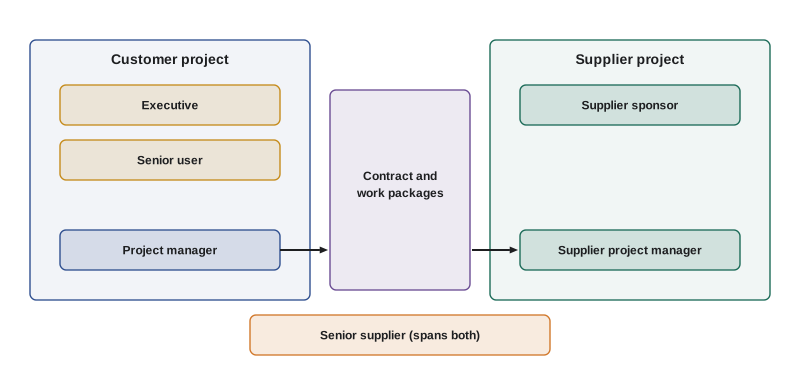
When the supplier is an external company, there are two organizations, two sets of management and two commercial interests. PRINCE2 assumes a customer-supplier environment. The customer's project is governed by the customer's board; the supplier may run its own project, using its own method, to deliver what the contract requires.
- Continued business justification: the customer and supplier each have their own business case. The supplier's case is about profit and reputation; the customer's is about benefits. The two can conflict, especially when changes are priced.
- Defined roles and relationships: the contract, the senior supplier role and the work packages define who decides what. Good relationships matter even more, because each side can see only part of the picture.
- Manage by exception: work package tolerances must be consistent with contract terms. A tolerance in the work package that contradicts the contract invites dispute.
- Focus on products: product descriptions and acceptance criteria often become contract schedules. Vague criteria are a frequent cause of disputes.
Worked problem
Aligning a work package tolerance with a contract
A fixed-price contract of 900,000 allows the customer to order variations, priced at agreed day rates, up to 10 % of the contract value without a formal amendment. The project manager wants to set a work package cost tolerance of +15 %. Is that consistent?
Show solution
- Contract variation limit: 900,000 × 0.10 = 90,000.
- Proposed work package tolerance: 900,000 × 0.15 = 135,000.
- Variations between 90,000 and 135,000 would need a contract amendment, which the work package tolerance cannot authorize.
Answer: No: the work package tolerance should not exceed the 10 % variation limit (90,000) unless the contract is amended.
Hybrid projects
Many projects mix predictive and agile work. A new transit station might have predictive construction work, with fixed designs and contracts, alongside an agile team building the passenger information app. PRINCE2 handles this naturally: management stages and tolerances apply to the whole project, while each work package can use the delivery approach that suits it. The construction work package may have tight scope tolerance and looser time tolerance; the app work package may have fixed time and cost with flexible scope. The project manager integrates the two through the stage plan and highlight reports.
Worked problem
Combining tolerances across work packages
A stage has two work packages. Construction: budget 1,200,000, tolerance ±5 %. App development: budget 300,000, fixed cost (zero cost tolerance) with flexible scope. The stage tolerance set by the board is ±4 % of the 1,500,000 stage budget. Construction is now forecast at 1,250,000; the app is on budget. Is the stage within tolerance?
Show solution
- Construction tolerance limit: 1,200,000 × 1.05 = 1,260,000. Forecast 1,250,000 is within its work package tolerance.
- Stage forecast: 1,250,000 + 300,000 = 1,550,000.
- Stage limit: 1,500,000 × 1.04 = 1,560,000. Forecast 1,550,000 is within stage tolerance.
Answer: Yes: both the construction work package and the stage are within their tolerances, though the margin at stage level is only 10,000, so the project manager should watch it closely.
Projects in very small organizations
In a small business or charity, one person may be the whole board and another the whole team. The principles still apply, but in a very compressed form. The owner acting as executive should still write down why the project is worthwhile and check it before each major spend. They should still ask someone with relevant experience what went wrong last time. Even if one person holds several roles, it helps to name whose interest each decision serves: the business, the users or the supplier. Stage boundaries may be a single conversation; tolerances may be a simple rule such as "tell me if we will be more than a week late or 10 % over". The method shrinks, but the questions remain.
Regulated and safety-critical projects
In regulated sectors such as health care, energy, aviation or rail, the principles interact with external rules. Quality criteria may be set partly by regulators. Stage boundaries may coincide with regulatory approvals, and a project may not proceed until a safety case or license is accepted. Tolerances on quality and risk may be very tight or zero. Tailoring in these contexts tends to add formality: more assurance, more detailed product descriptions and stronger configuration management. The principles help by making the decision points and authorities explicit, which regulators often expect to see.
Whatever the context, the test is the same. For each principle, ask what it would look like here, who is responsible for it and what evidence would show it is being applied. If you can answer those three questions for all seven, the project is applying PRINCE2, however unusual its setting.
A useful habit for any context is to write a one-line statement for each principle at initiation, describing how it will be applied on this project, and to revisit those seven lines at each stage boundary. The statements become a compact charter for the project's governance and a quick reference for new team members and assurance reviewers.
Common mistakes
MistakeLetting agile ceremonies replace project governance.
InsteadKeep justification, stages and tolerances at board level while teams work in sprints.
MistakeDropping principles on small projects as bureaucracy.
InsteadKeep each principle as a short, answered question.
MistakeIgnoring government gating frameworks.
InsteadAlign stage boundaries and tolerances with the required approvals.
MistakeDuplicating program documents in every project.
InsteadTailor to inherit what the program already provides.
MistakeSetting work package tolerances that contradict the contract.
InsteadAlign tolerances with contract terms.
Summary and key terms
- The principles apply in every context, but their application changes.
- In agile delivery, scope is often the main tolerance and retrospectives feed lessons.
- On small projects, each principle survives in a light form.
- In the public sector, stage boundaries align with government gates and create an audit trail.
- Within a program, tolerances, benefits and assurance may come from the program.
- In commercial relationships, there are two business cases and contracts shape roles and tolerances.
- Tailoring makes clear what each project inherits and what it does itself.
- Agile delivery
- Delivering in short timeboxes with frequent increments and adaptive priorities.
- Velocity
- The amount of work an agile team completes per timebox.
- Release
- A set of increments delivered together to users.
- Program
- A group of related projects and activities delivering a strategic change.
- Program board
- The governing body of a program.
- Customer-supplier environment
- A setting where one party commissions work and another delivers it.
- Work package
- A set of information about work to be done, authorized by the project manager.
- Variation
- A change to the scope of a contract, usually priced.
- Gating framework
- An organization's set of formal approval points.
- Audit trail
- A record of decisions and the information they were based on.
Practice problems
Work each problem on paper first, then reveal the answer to check.
Does PRINCE2 conflict with agile delivery?
Show answer
No; PRINCE2 governs the project, agile methods govern delivery.
Velocity 20, 5 sprints. Capacity?
Show answer
100 points.
What feeds the lessons log in agile delivery?
Show answer
Retrospectives.
What is the minimum stage structure on a small project?
Show answer
Initiation plus one delivery stage.
Why are principles valuable for public audit?
Show answer
They create a documented trail of decisions.
In a program, who usually sets project tolerances?
Show answer
The program.
How many business cases exist in a customer-supplier project?
Show answer
At least two: customer and supplier.
Contract 500,000, variation limit 8 %. Maximum variation without amendment?
Show answer
40,000.
What is a common pitfall for projects inside programs?
Show answer
Duplicating program documents.
What often becomes a contract schedule?
Show answer
Product descriptions and acceptance criteria.
Lesson quiz · 5 questions
Score 60% or more to complete this lesson.
Create a free account to save your progress, take quizzes and earn a certificate.