
PRIN-110 · Lesson 11 of 12 · 24 min
The principles compared with other approaches
PRINCE2 is not the only body of guidance built on principles. The PMBOK Guide from the Project Management Institute, the Agile Manifesto, Scrum, ISO 21502 and many organizations' own methods all state principles or values. Comparing them is useful for two reasons. In practice, many organizations blend approaches, and project professionals often hold more than one credential. And seeing what PRINCE2's principles have in common with others, and where they differ, deepens understanding of why PRINCE2 phrases its principles as it does. This lesson keeps the comparisons brief and practical; PMP-110 covers the PMBOK Guide in depth.
PRINCE2 and the PMBOK Guide
The PMBOK Guide, eighth edition, released in late 2025, sets out six principles: adopt a holistic view, focus on value, embed quality, be an accountable leader, integrate sustainability and build an empowered culture. The seventh edition had twelve broader principles. The two sets of principles do different jobs. PRINCE2's principles are obligations that define whether a project is being run using the method; they are closely tied to specific practices and processes. The PMBOK principles describe behaviors and mindsets for good project management in any approach; they are not tied to a specific governance structure.
| PRINCE2 principle | Closest PMBOK 8 principle | Main difference |
|---|---|---|
| Ensure continued business justification | Focus on value | PRINCE2 requires a business case reviewed at defined points |
| Learn from experience | Build an empowered culture; adopt a holistic view | PRINCE2 names specific lessons products |
| Define roles, responsibilities and relationships | Be an accountable leader | PRINCE2 prescribes the board structure and three interests |
| Manage by stages | Adopt a holistic view | PMBOK has no mandatory stage structure |
| Manage by exception | Be an accountable leader | PRINCE2 defines tolerance levels and escalation formally |
| Focus on products | Embed quality; focus on value | PRINCE2 uses product-based planning and product descriptions |
| Tailor to suit the project | Tailoring is built into PMBOK processes | Both stress tailoring; PRINCE2 forbids dropping principles |
The mapping is worth a closer look: it is many-to-many and approximate. PMBOK's "integrate sustainability" has no single PRINCE2 principle counterpart, though PRINCE2 7 addresses sustainability through the sustainability performance target and its tolerances. PRINCE2's manage by stages and manage by exception have no exact PMBOK equivalents, because PMBOK does not prescribe a governance structure.
For practitioners who hold both PMP and PRINCE2 credentials, a common way to combine them is to use PRINCE2 for project governance, roles and decision points, and the PMBOK Guide's broad toolkit for planning techniques, estimating and stakeholder engagement. The two fit together because PRINCE2 deliberately does not cover specialist techniques in depth.
PRINCE2 and the Agile Manifesto
The Agile Manifesto of 2001 states four values: individuals and interactions over processes and tools; working software over comprehensive documentation; customer collaboration over contract negotiation; and responding to change over following a plan. It also lists twelve supporting principles. At first sight PRINCE2 seems to sit on the right-hand side of each value, with its processes, management products, contracts and plans. A closer look shows more agreement than conflict.
| Agile value | How PRINCE2 principles relate |
|---|---|
| Individuals and interactions over processes and tools | PRINCE2 7 added relationships to the roles principle and made people an integrated element |
| Working software over comprehensive documentation | Focus on products judges progress by delivered products, not documents; tailoring cuts unnecessary documents |
| Customer collaboration over contract negotiation | The senior user sits on the board; the three interests decide together |
| Responding to change over following a plan | Manage by stages re-plans each stage; scope tolerance absorbs change |
The real difference is about where control sits. Agile approaches push decisions to self-organizing teams and rely on short feedback loops. PRINCE2 provides a governance layer above delivery that decides whether to invest, sets limits and handles exceptions. The two are complementary when PRINCE2 governs and agile delivers, and they conflict only when one tries to do the other's job.
PRINCE2 and Scrum
Scrum is a delivery framework with roles (product owner, scrum master, developers), events (sprint, sprint planning, daily scrum, sprint review, retrospective) and artifacts (product backlog, sprint backlog, increment). It also states values: commitment, focus, openness, respect and courage. Scrum does not address whether a project should be funded or continue, how a multi-team project is governed, or how supplier contracts are managed. PRINCE2 does. In a combined approach, the product owner often works closely with, or acts on behalf of, the senior user, and a sprint review gives evidence for highlight reports and stage boundary decisions.
PRINCE2 and ISO 21502
ISO 21502:2020, Project, program and portfolio management: guidance on project management, is an international standard describing practices for project management. It does not define a method, but it describes governance, roles, practices and the project life cycle in terms that are broadly consistent with PRINCE2. Organizations that need to show alignment with an international standard often map their PRINCE2-based method to ISO 21502. Like PMBOK, ISO 21502 emphasizes tailoring and business justification but does not prescribe PRINCE2's specific tolerance levels or product-based planning.
Common ground across approaches
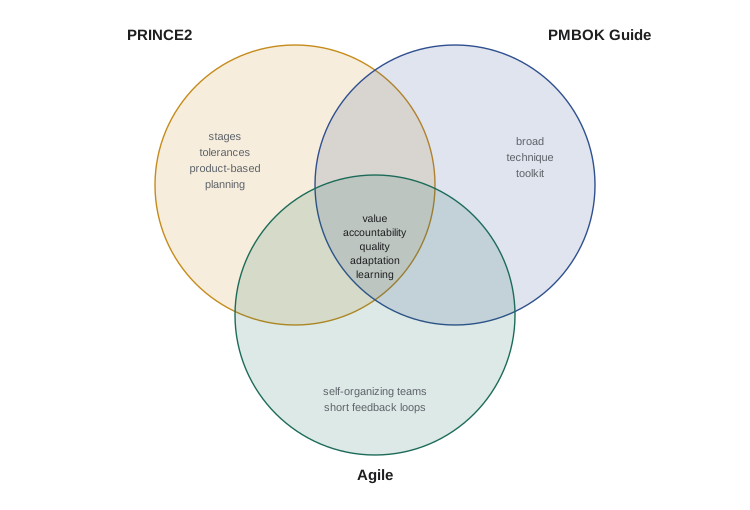
Across all of these approaches, a few ideas recur. Projects should deliver value and stop when they no longer can. Accountability must be clear. Quality must be defined and built in. Plans should be adapted as more is known. Learning should be continuous. Methods must be tailored to fit. PRINCE2's distinctive contribution is to turn these ideas into specific, checkable obligations, backed by defined roles, decision points, tolerances and management products. That is why PRINCE2 can say clearly whether a project is, or is not, being run using the method.
Choosing and combining
Organizations rarely choose one approach exclusively. A typical pattern in both Canada and the US is a corporate method based on PRINCE2 or PMBOK for governance, with agile delivery for software and product work and traditional planning for construction or infrastructure. The PRINCE2 principles can act as a common governance standard across those delivery styles, because they say what must be true rather than how the work is done.
Worked problem
Scoring approaches for a blended method
An organization wants a governance approach for a mix of construction and software projects. It scores three options from 1 to 5 on four weighted criteria: clear decision points (35 %), flexibility for agile teams (25 %), recognized certification for staff (20 %) and depth of planning techniques (20 %). PRINCE2-based: 5, 4, 4, 3. PMBOK-based: 3, 4, 5, 5. Pure agile framework: 2, 5, 3, 2. Which scores highest?
Show solution
- PRINCE2-based: 5 × 0.35 + 4 × 0.25 + 4 × 0.20 + 3 × 0.20 = 1.75 + 1.00 + 0.80 + 0.60 = 4.15.
- PMBOK-based: 3 × 0.35 + 4 × 0.25 + 5 × 0.20 + 5 × 0.20 = 1.05 + 1.00 + 1.00 + 1.00 = 4.05.
- Pure agile: 2 × 0.35 + 5 × 0.25 + 3 × 0.20 + 2 × 0.20 = 0.70 + 1.25 + 0.60 + 0.40 = 2.95.
Answer: The PRINCE2-based option scores 4.15, narrowly ahead of PMBOK-based at 4.05. With scores this close, a blend, PRINCE2 governance with PMBOK techniques, may be the practical answer.
People and behavior behind the principles
Every approach in this lesson recognizes that principles depend on behavior. A business case cannot be honestly reviewed if people fear delivering bad news. Exceptions will be hidden if escalation is punished. Lessons will not be recorded if mistakes lead to blame. PRINCE2 7's people element addresses this directly, with guidance on leadership, communication, culture and managing change. In practice, the most important behavior for applying the principles is honest, early communication about problems, combined with leaders who respond to bad news by solving problems rather than punishing messengers.
Common misconceptions when comparing approaches
A few misconceptions come up repeatedly when practitioners compare PRINCE2 with other approaches. The first is that PRINCE2 is only for large government IT projects. Its origins were in UK government IT, but the principles are written to apply to any project, and the method is used in construction, health care, finance, charities and small businesses around the world. The second is that PRINCE2 requires a long, fixed plan. In fact manage by stages exists precisely to avoid detailed long-range plans. The third is that PRINCE2 is document-heavy by design. The tailoring principle requires documents to be scaled to the project, and PRINCE2 7 explicitly emphasizes using management products as tools rather than as compliance artifacts.
There are misconceptions about agile too. Agile does not mean no planning, no documentation or no governance. Agile teams plan continuously, document what is useful and work within constraints set by their organizations. When a PRINCE2 board sets time and cost tolerances and lets an agile team manage scope within them, both approaches are being used as intended.
| Misconception | Reality |
|---|---|
| PRINCE2 is only for large IT projects | The principles apply to any project in any sector |
| PRINCE2 requires a detailed plan for the whole project | Manage by stages keeps the project plan high level and details each stage |
| PRINCE2 means lots of documents | Tailoring scales management products to the project |
| Agile means no governance | Agile delivery works within governance such as tolerances and stage boundaries |
| You must choose one framework | Many organizations blend PRINCE2 governance with agile or PMBOK techniques |
Credentials and careers
In the US, the PMP is the most widely referenced project management credential, and PRINCE2 is less common but valued by employers with international operations, UK or European links, or a focus on governance. Holding a PMP, CAPM or IPMA certificate can satisfy the prerequisite for PRINCE2 7 Practitioner, as PRIN-101 explained, so practitioners often add PRINCE2 to an existing PMI credential. Understanding how the principles map to other frameworks makes that transition easier.
Whichever credentials you hold, the most valuable skill is the one this course builds: looking at a real project and judging whether it is being managed well. Principles, from any framework, are the lens for that judgment.
Why PRINCE2 phrases principles as obligations
Comparing frameworks also shows why PRINCE2 chose to phrase its principles as obligations rather than aspirations. An aspiration such as "focus on value" is hard to audit: almost any project can claim to be doing it. An obligation such as "ensure continued business justification", backed by a business case that must be reviewed at each stage boundary, can be checked against evidence. This makes PRINCE2 particularly useful for organizations that need clear accountability and auditable decisions, such as public bodies and regulated firms. The trade-off is that PRINCE2 can feel more structured than approaches built on values alone, which is why the tailoring principle is so important.
In practice, the best project professionals use both kinds of principle. They apply PRINCE2's obligations to make governance clear and checkable, and they draw on broader principles, such as building an empowered culture or embedding quality, to shape how they lead teams day to day.
Common mistakes
MistakeTreating PRINCE2 and agile as opposites.
InsteadUse PRINCE2 for governance and agile methods for delivery where it suits.
MistakeAssuming PMBOK principles and PRINCE2 principles are interchangeable.
InsteadRecognize that PRINCE2 principles are method obligations tied to specific controls.
MistakePresenting a course-made mapping as an official crosswalk.
InsteadLabel informal mappings as approximate.
MistakeExpecting Scrum to answer funding and governance questions.
InsteadUse a governance layer such as PRINCE2 for those decisions.
MistakeIgnoring culture when applying principles.
InsteadBuild a climate in which bad news and lessons are raised early.
Summary and key terms
- Many approaches state principles or values; PRINCE2's are obligations that define the method.
- PMBOK 8 has six principles describing behaviors across any approach.
- Mappings between PRINCE2 and PMBOK principles are approximate and many-to-many.
- The Agile Manifesto values align with PRINCE2 7's people focus, product focus and stage re-planning.
- Scrum governs delivery; PRINCE2 governs investment decisions and escalation.
- ISO 21502 is broadly consistent with PRINCE2 but does not prescribe its controls.
- All approaches depend on honest communication and a culture that welcomes bad news early.
- PMBOK Guide
- PMI's guide to the project management body of knowledge; the eighth edition appeared in 2025.
- Agile Manifesto
- A 2001 statement of four values and twelve principles for agile software development.
- Scrum
- A delivery framework of roles, events and artifacts for complex work.
- Product owner
- The Scrum role responsible for maximizing the value of the product and ordering the backlog.
- ISO 21502
- An international standard giving guidance on project management.
- Crosswalk
- A formal mapping between two frameworks.
- Governance layer
- The level that decides on investment, limits and escalation.
- Self-organizing team
- A team that decides for itself how to do its work.
- Blended method
- An organization's approach combining elements of several frameworks.
- People element
- The PRINCE2 7 integrated element covering leadership, communication, culture and change.
Practice problems
Work each problem on paper first, then reveal the answer to check.
How many principles does PMBOK 8 state?
Show answer
Six.
Name the four Agile Manifesto values.
Show answer
Individuals and interactions, working software, customer collaboration, responding to change.
Which PRINCE2 principle relates most to "responding to change"?
Show answer
Manage by stages, with re-planning and scope tolerance.
Does Scrum decide whether a project should continue to be funded?
Show answer
No; that is a governance question.
What standard gives international guidance on project management?
Show answer
ISO 21502.
Scores 4, 4, 3, 3 with weights 35, 25, 20, 20 %. Total?
Show answer
1.4 + 1.0 + 0.6 + 0.6 = 3.6.
Which PMBOK principle has no single PRINCE2 counterpart?
Show answer
Integrate sustainability.
What did PRINCE2 7 add that echoes the first agile value?
Show answer
The people element and relationships.
What is a typical blended pattern?
Show answer
PRINCE2 governance with agile or PMBOK techniques for delivery.
What behavior matters most for applying principles?
Show answer
Honest, early communication about problems.
Lesson quiz · 5 questions
Score 60% or more to complete this lesson.
Create a free account to save your progress, take quizzes and earn a certificate.