
PMP-130 · Lesson 3 of 12 · 25 min
Defining scope and acceptance
Requirements describe what stakeholders need. Scope describes what the project will actually deliver to meet those needs, and just as importantly what it will not deliver. This lesson covers the project scope statement and its parts, product analysis and alternatives, acceptance criteria and the definition of done, the difference between validating and controlling scope, and the twin problems of scope creep and gold plating. It also shows how scope is handled in adaptive work, where the backlog is the scope and the question is how to keep it under control without freezing it.
Product scope and project scope
Product scope is the set of features and functions that characterize the product, service or result. Project scope is the work performed to deliver it, including management, training and transition work. Completion of product scope is measured against requirements; completion of project scope is measured against the project management plan. For Project Compass, product scope includes the fitted-out branch, the working kiosks and gates, and the app's features. Project scope also includes the project management, the tendering of the construction contract, staff training and the collection move.
The project scope statement
In a predictive project, the scope statement is the detailed description of the project's deliverables and the work needed to create them. It builds on the high-level description in the charter and on the requirements documentation. A good scope statement gives everyone a common understanding and becomes the basis for the WBS, estimates and later decisions about whether a request is in or out of scope.
| Element | Purpose | Project Compass example |
|---|---|---|
| Product scope description | Progressively elaborated characteristics of the product | A 12,400 square foot branch with collections, study space, children's area and community room; self-service lending; mobile app |
| Deliverables | Unique, verifiable products, results or capabilities | Fitted-out space with occupancy permit; 6 kiosks and 2 gate sets installed; app release 1 in app stores; 38,000 items tagged |
| Acceptance criteria | Conditions that must be met before deliverables are accepted | Occupancy permit issued; kiosk acceptance test passed; app meets accessibility audit |
| Project exclusions | What is explicitly out of scope | Exterior signage on the mall pylon; a book return drive-up chute; app integration with the city's parks booking system |
| Constraints | Limits on options | Lease handover date; fixed board-approved budget; landlord approval of structural changes |
| Assumptions | Factors treated as true for planning, to be validated | No hazardous materials in the ceiling; permit within 20 working days; existing electrical service is adequate |
Exclusions deserve special attention. Stakeholders tend to assume that anything related to the project is included. Writing down what is not included, and getting the sponsor to agree, prevents later disputes. Assumptions also matter because each is a potential risk: if the ceiling does contain hazardous materials, the project faces cost and delay. Assumptions and constraints are recorded in an assumption log and reviewed as the project progresses.
In the United States, the building assumptions would be checked against the locally adopted building code and the city's permit process, and the accessibility requirements against the ADA Standards for Accessible Design and the library's own design standards.
Product analysis and alternatives
Product analysis translates high-level product descriptions into tangible deliverables. Techniques include product breakdown, systems analysis, value engineering and value analysis. Alternatives analysis looks at different ways to deliver the scope. For Project Compass, the team compared tagging the collection with RFID versus keeping barcodes with self-checkout scanners. RFID costs more but allows faster checkout, security gates and quicker inventory; barcodes are cheaper but slower. The board chose RFID because staff time saved on inventory and holds supported the branch's staffing model. Recording the alternatives considered and why one was chosen helps later when someone asks why the project is not doing the cheaper option.
Value engineering looks for ways to deliver the required function at lower life-cycle cost. For example, the design team proposed polished concrete floors in the main collection area instead of carpet tiles. Initial cost was similar, but maintenance and replacement costs over 20 years were much lower. Value engineering is not simply cutting scope; it keeps the function while changing the means.
Acceptance criteria and the definition of done
Acceptance criteria state the conditions a deliverable must satisfy for the customer or sponsor to accept it. They should be agreed before the work is done, not argued about afterwards. In predictive projects, they appear in the scope statement and are detailed in the WBS dictionary and test plans. In adaptive projects, each backlog item has acceptance criteria, and the team also works to a definition of done that applies to every item, such as code reviewed, automated tests passing, accessibility checked and documentation updated.
| Concept | Applies to | Example |
|---|---|---|
| Acceptance criteria | A specific deliverable or backlog item | The hold-placement feature lets a signed-in patron place a hold in three taps and confirms by notification |
| Definition of done | Every increment the team completes | Code reviewed; unit and integration tests pass; WCAG 2.1 AA checks pass; release notes updated |
| Definition of ready | Items before they enter an iteration | Story has acceptance criteria, is estimated and has no unresolved dependencies |
Acceptance criteria connect directly to quality. A deliverable can be built exactly as designed and still fail acceptance if the criteria were never agreed. Conversely, criteria that are too vague invite disputes. PMP-131 covers quality planning and control in detail; for scope, the key point is that each deliverable should have criteria that are objective and agreed in advance.
Validating scope versus controlling scope
These two are often confused. Validating scope is the formal acceptance of completed deliverables by the customer or sponsor. It is mainly about acceptance. Controlling quality, which usually comes first, is about correctness: checking that the deliverable meets the quality requirements. A typical sequence is that the team builds a deliverable, quality control verifies it against specifications, and then the customer reviews it and formally accepts it in validate scope. In adaptive projects, the sprint review plays a similar role, with the product owner accepting or rejecting completed items.
Controlling scope is monitoring the status of scope and managing changes to the scope baseline. It involves comparing work performed with the baseline, identifying variances, and making sure that requested changes go through integrated change control. The aim is not to prevent all change, but to make sure that changes are deliberate, assessed and approved.
Scope creep and gold plating
Scope creep is uncontrolled expansion of scope without adjustments to time, cost and resources. It usually arrives in small increments: an extra report here, a slightly larger room there, each too small to seem worth a change request. Gold plating is the team adding features or quality the customer did not request, often with good intentions. Both consume resources and introduce risk. The cure is the same: clear scope documents, a known path for changes, and a team culture that delivers what was agreed and raises new ideas as proposals rather than quietly building them.
Worked problem
An informal request
During a site walk, the branch manager asks the construction superintendent to add two extra power outlets in the community room "while the walls are open". The superintendent mentions it to the project manager. The cost is small. What should the project manager do?
Show solution
- Recognize that even small additions change scope and may affect cost, schedule or other requirements.
- Clarify the need with the branch manager: what will the outlets be used for?
- Assess the impact with the contractor: cost, any permit implications and schedule effect.
- Submit the request through the agreed change process; if it falls within a delegated threshold, approve it at that level and record it.
- Update the scope documents and drawings once approved.
Answer: Handle it as a change request, even if small, so that scope, cost and drawings stay accurate. Many organizations allow small changes under a delegated threshold, which keeps the process quick.
Scope in adaptive work
In adaptive projects, the product backlog is the scope. It is expected to change as the team and stakeholders learn. Control comes from ordering the backlog by value, keeping a clear product goal, protecting each iteration from mid-iteration changes and measuring both delivery and scope change. A burn-up chart shows completed work and total scope on the same chart, so stakeholders can see whether scope growth is pushing the finish further away.
# Mobile app backlog for Project Compass: is scope growing faster than delivery?
# (invented sprint data, story points)
sprints = [  # (sprint, points completed, total backlog size at end of sprint)
    (1, 18, 220), (2, 21, 226), (3, 20, 238), (4, 23, 241), (5, 22, 255), (6, 24, 262)]

done = 0
prev_total = 220
print("Sprint  Done  Cum done  Backlog  Added  Remaining")
for s, pts, total in sprints:
    done += pts
    added = total - prev_total
    prev_total = total
    print(f"{s:6d} {pts:5d} {done:9d} {total:8d} {added:6d} {total - done:10d}")

velocity = done / len(sprints)
growth = (sprints[-1][2] - 220) / len(sprints)
remaining = sprints[-1][2] - done
print(f"\nAverage velocity: {velocity:.1f} points per sprint")
print(f"Average scope growth: {growth:.1f} points per sprint")
print(f"Net burn: {velocity - growth:.1f} points per sprint")
print(f"Sprints to finish at current rates: {remaining / (velocity - growth):.1f}")
print(f"Sprints to finish if scope froze now: {remaining / velocity:.1f}")Sprint Done Cum done Backlog Added Remaining
1 18 18 220 0 202
2 21 39 226 6 187
3 20 59 238 12 179
4 23 82 241 3 159
5 22 104 255 14 151
6 24 128 262 7 134
Average velocity: 21.3 points per sprint
Average scope growth: 7.0 points per sprint
Net burn: 14.3 points per sprint
Sprints to finish at current rates: 9.3
Sprints to finish if scope froze now: 6.3After six sprints, the team has completed 128 points at an average of 21.3 points per sprint, but the backlog has grown by an average of 7 points per sprint. The net burn is only 14.3 points per sprint, so finishing the current backlog would take about 9.3 more sprints, against 6.3 if scope stopped growing. This is not automatically bad: some additions may be high-value features discovered through user testing. But the product owner needs to make a deliberate choice: accept a later release, drop lower-value items, or fix the release 1 scope and move new ideas to release 2. Making this visible is the point.
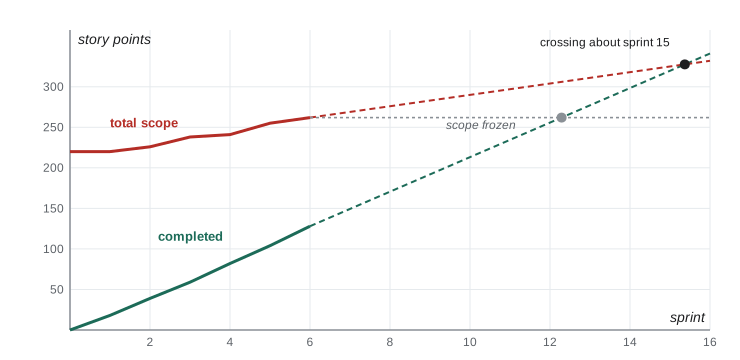
Minimum viable product (MVP) thinking helps keep adaptive scope in check. Release 1 of the app might include only availability search, holds and account management; room booking and event registration follow in release 2. Each release should be valuable on its own, and the team learns from real use before building more.
Who decides scope
In a predictive project, the sponsor and key stakeholders approve the scope baseline, and a change control board or delegated authority approves changes. In an adaptive project, the product owner decides the order of the backlog within the product goal and budget agreed with the sponsor. The project manager or team facilitates, assesses impact and keeps records, but does not unilaterally add or remove scope. An exam answer in which the project manager simply agrees to a stakeholder's request, or refuses it outright, is usually wrong; the right answer routes it to the appropriate decision-maker with impact information.
Common mistakes
MistakeLeaving exclusions out of the scope statement.
InsteadList what is out of scope and have the sponsor agree.
MistakeTreating validate scope and control quality as the same thing.
InsteadControl quality checks correctness; validate scope obtains formal acceptance.
MistakeApproving small requests informally.
InsteadRoute all changes through change control, using delegated thresholds for small items.
MistakeAdding unrequested features to impress the customer.
InsteadDeliver what was agreed and propose extra ideas as change requests.
MistakeFreezing the backlog to stop adaptive scope change.
InsteadMake scope change visible with burn-up charts and let the product owner trade value and time deliberately.
Summary and key terms
- Product scope is the product's features; project scope is the work to deliver it.
- The scope statement includes product description, deliverables, acceptance criteria, exclusions, constraints and assumptions.
- Product analysis, alternatives analysis and value engineering shape what will be delivered.
- Acceptance criteria apply to specific items; the definition of done applies to every increment.
- Control quality checks correctness; validate scope obtains formal acceptance; control scope manages the baseline.
- Scope creep is uncontrolled growth; gold plating is unrequested additions by the team.
- In adaptive work the backlog is the scope; burn-up charts reveal scope growth.
- Product scope
- The features and functions that characterize a product, service or result.
- Project scope
- The work performed to deliver a product, service or result with the specified features.
- Project scope statement
- A description of project scope, major deliverables, acceptance criteria, exclusions, constraints and assumptions.
- Acceptance criteria
- Conditions that must be met before deliverables are accepted.
- Definition of done
- A team checklist that every increment must meet to be considered complete.
- Validate scope
- Formalizing acceptance of completed deliverables.
- Control scope
- Monitoring scope status and managing changes to the scope baseline.
- Scope creep
- Uncontrolled expansion of scope without adjusting time, cost and resources.
- Gold plating
- Adding features or quality beyond what was requested.
- Value engineering
- Finding ways to deliver required functions at lower life-cycle cost.
Practice problems
Work each problem on paper first, then reveal the answer to check.
Is staff training part of product scope or project scope?
Show answer
Project scope; it is work needed to deliver the result, not a feature of the product.
Why record exclusions?
Show answer
To prevent stakeholders assuming related items are included and to support later scope decisions.
What should happen to an assumption that turns out false?
Show answer
It becomes an issue or risk to manage, possibly through a change request.
Which comes first, control quality or validate scope?
Show answer
Usually control quality, then validate scope.
A developer adds an animated welcome screen nobody asked for. What is this?
Show answer
Gold plating.
Velocity 20, scope growth 5 points per sprint, 150 points left. Sprints to finish?
Show answer
150 / (20 − 5) = 10 sprints.
Same backlog with scope frozen?
Show answer
150 / 20 = 7.5, so 8 sprints.
Who orders the backlog in an adaptive project?
Show answer
The product owner.
Give an example of value engineering.
Show answer
Choosing polished concrete floors with lower life-cycle cost while meeting the same function.
What is the difference between acceptance criteria and the definition of done?
Show answer
Acceptance criteria are specific to an item; the definition of done applies to all items.
Lesson quiz · 5 questions
Score 60% or more to complete this lesson.
Create a free account to save your progress, take quizzes and earn a certificate.