
PMP-110 · Lesson 7 of 12 · 29 min
Organizational structures, PMOs and governance
Projects do not happen in a vacuum. The way an organization is structured determines how much authority a project manager has, where team members come from, who controls the budget and how decisions are escalated. Project management offices (PMOs) add standards, support and sometimes direct control. Governance frameworks set out who decides what, and when. The 2026 exam content outline opens its Business Environment domain with the task "define and establish project governance", and the PMBOK Guide 8th edition makes governance a performance domain and gives PMOs expanded coverage. This lesson explains the main structures, PMO types and governance arrangements you will meet in scenarios.
Organizational structures
PMI describes a range of organizational structures. Most real organizations are hybrids, but the classic types are useful for reasoning about authority and resources.
| Structure | Description | Project manager authority | Resource availability | Who controls the budget | Project manager role |
|---|---|---|---|---|---|
| Functional | Organized by departments such as engineering or finance | Little or none | Little or none | Functional manager | Part-time; often a coordinator or expediter |
| Weak matrix | Functional, with some cross-department project work | Low | Low | Functional manager | Part-time coordinator |
| Balanced matrix | Shared authority between functional and project managers | Low to moderate | Low to moderate | Mixed | Full-time |
| Strong matrix | Project managers have significant authority; staff report to functions | Moderate to high | Moderate to high | Project manager | Full-time, often in a PMO |
| Projectized | Organized around projects; teams report to the project manager | High to almost total | High | Project manager | Full-time |
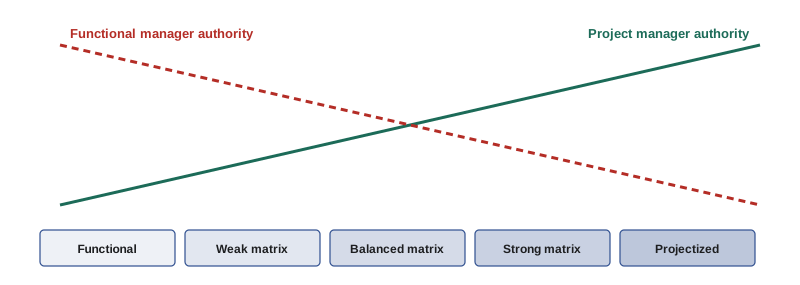
In a functional organization, a project manager, if one exists, often acts as a project expediter, who coordinates and communicates but cannot make or enforce decisions, or a project coordinator, who has a little more authority and may report to a senior manager. In a matrix, team members have two bosses: their functional manager, who oversees their professional work and career, and the project manager, who directs their project work. This dual reporting can cause conflict over priorities, which is why matrix scenarios often ask how to negotiate for resources or resolve competing demands.
Other forms appear in modern organizations. Virtual or networked organizations rely on partners and remote teams. Multidivisional organizations replicate functions within divisions by product or region. Product-oriented organizations, common in software and digital services, keep long-lived teams aligned to a product rather than assembling temporary project teams, and fund products continuously rather than project by project. The exam may describe such settings without naming the structure, so reason from who holds authority and resources.
Worked problem
Reading authority from the scenario
You lead a project in an organization where team members report to their department heads, who set their priorities and approve their time. You control no budget and spend half your week on other duties. What structure is this, and what is your main lever for getting work done?
Show solution
- Little authority, no budget control and a part-time role point to a functional or weak matrix structure.
- Your levers are influence, negotiation and escalation through the sponsor, not formal authority.
Answer: A functional or weak matrix structure. Build relationships with department heads, agree priorities through the sponsor and make the project's value clear.
Project management offices
A PMO is an organizational structure that standardizes project-related governance processes and facilitates the sharing of resources, methods, tools and techniques. PMOs vary widely in their degree of control.
| PMO type | Degree of control | Typical role |
|---|---|---|
| Supportive | Low | Provides templates, best practices, training and lessons learned; acts as a project repository |
| Controlling | Moderate | Requires compliance with frameworks, templates and governance; audits and reviews |
| Directive | High | Directly manages projects; project managers report to the PMO |
Beyond these classic types, organizations create enterprise PMOs that oversee portfolios across the organization, program management offices that support a single large program, and value management offices or agile PMOs that focus on enabling adaptive teams, coaching and measuring value rather than enforcing templates. The PMBOK Guide 8th edition gives PMOs fuller treatment than earlier editions, covering their value, types and structures.
A PMO can help a project manager in many ways: providing templates and tools, coaching, resource coordination, independent assurance, portfolio data and access to lessons from other projects. It can also be experienced as bureaucracy if it imposes standards without regard to project needs. In exam scenarios, a good project manager works with the PMO, tailoring within its requirements and raising concerns constructively, rather than ignoring it.
Worked problem
A simple PMO cost-benefit estimate
An organization runs 40 projects a year with an average budget of $1.5 million. A new PMO would cost $900,000 a year. Leaders estimate it would reduce average cost overruns from 12 % to 8 % of budget. Does the PMO pay for itself on that benefit alone?
Show solution
- Total annual project spending: 40 × 1.5 million = $60 million.
- Overrun reduction: 12 % − 8 % = 4 percentage points.
- Savings: 0.04 × 60 million = $2.4 million.
- Net benefit: 2.4 million − 0.9 million = $1.5 million; benefit-cost ratio about 2.7.
Answer: Yes, if the estimate holds, savings of about $2.4 million exceed the $900,000 cost. The assumption about overruns is the key risk to check.
Governance
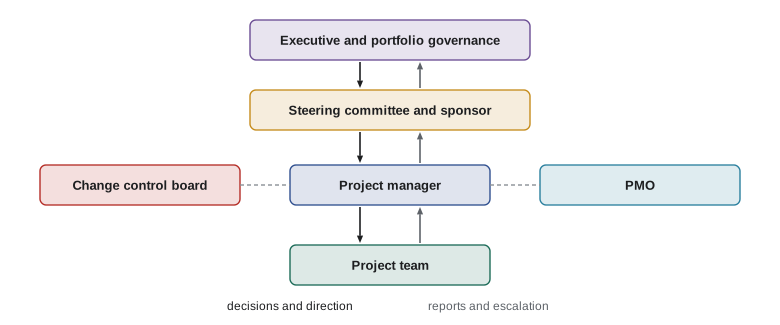
Project governance is the framework, functions and processes that guide project management activities in order to create a unique product, service or result to meet organizational, strategic and operational goals. Put simply, governance answers: who has the authority to make which decisions, how decisions are escalated, how performance is overseen, and how the project complies with policy and law. Governance sits above project management: the project manager manages within the framework that governance sets.
Common elements of project governance include a sponsor, who champions the project, provides funding and resolves issues beyond the project manager's authority; a steering committee or project board that makes major decisions and oversees performance; a change control board for approving significant changes; phase gates or stage reviews; escalation thresholds; policies on procurement, risk, quality, security and data; and reporting requirements. In adaptive settings, governance often relies more on frequent demonstrations, product roadmaps and lean portfolio funding than on detailed documents, but decision rights still need to be clear.
Worked problem
Escalation thresholds
A governance plan says: the project manager may approve changes up to $25,000 or 5 working days; the sponsor up to $150,000 or 20 days; anything larger goes to the steering committee. A change would add $60,000 and 8 days. Who approves it?
Show solution
- Cost: $60,000 exceeds the project manager's $25,000 limit but is within the sponsor's $150,000.
- Schedule: 8 days exceeds 5 but is within 20.
- The higher of the two thresholds crossed determines the approver: the sponsor.
Answer: The sponsor approves it. If either dimension had exceeded the sponsor's limit, it would go to the steering committee.
Governance questions on the exam often test whether the project manager respects decision rights. If a change is beyond your authority, you analyze its impact and take it to the appropriate body; you do not approve it yourself, and you do not simply refuse it. If a stakeholder bypasses governance by asking the team directly for changes, you redirect the request into the change process. If the governance framework itself is missing or unclear, defining it early, with the sponsor, is part of your job.
In the US federal government, the Program Management Improvement and Accountability Act of 2016 requires agencies to designate a Program Management Improvement Officer, and OMB oversees implementation, including portfolio reviews of high-risk programs. Capital programming guidance under OMB Circular A-11 and IT management policy under Circular A-130 set governance expectations for investments, and the Federal Acquisition Certification for Program and Project Managers (FAC-P/PM) sets competency levels for those who manage major acquisitions.
Organizational culture and style
Structure is only part of the picture. Culture, the shared values, beliefs and expectations of an organization, strongly affects how projects run. Relevant aspects include attitudes to risk, tolerance for failure, how hierarchical decision-making is, whether information is shared openly, and expectations about working hours and communication. A project manager moving from a start-up to a government department, or between countries, must read the culture and adapt. Culture is also one of the enterprise environmental factors covered in lesson 8.
Working with a sponsor
The sponsor is the governance role a project manager works with most closely. A good sponsor provides funding and direction, champions the project with senior leaders, makes or secures decisions beyond the project manager's authority, removes organizational obstacles and holds the project to its business case. A weak or absent sponsor is one of the most frequently cited causes of project failure. Project managers can help sponsors succeed by agreeing early how and how often they will meet, what decisions the sponsor will make, what information the sponsor needs and in what form, and how escalations will be handled.
When a sponsor becomes disengaged, the exam generally expects the project manager to address it directly: request a meeting, explain the decisions and risks that need attention, and, if necessary, raise the concern through governance channels. Proceeding without sponsorship on major decisions, or bypassing the sponsor to go straight to executives, are usually poor choices.
Governance in adaptive and hybrid settings
Adaptive teams still need governance, but it often looks different. Instead of approving a detailed scope up front, leaders may fund a product team for a period and review progress through frequent demonstrations of working increments. Lean portfolio management allocates budgets to value streams and lets teams decide how to deliver within guardrails such as spending limits, architectural standards and compliance requirements. Decision rights still matter: the product owner decides backlog order, the team decides how to build, and leaders decide funding and strategic direction.
Hybrid projects often keep phase gates for funding and regulatory decisions while letting teams work in iterations between gates. The project manager's task is to make the two fit together, for example by aligning gate reviews with release demonstrations so that governance sees real progress rather than documents alone.
| Governance element | Predictive form | Adaptive form |
|---|---|---|
| Funding | Approved per project and phase | Allocated to a product or value stream for a period |
| Scope approval | Detailed baseline approved early | Vision and roadmap; backlog evolves |
| Progress review | Status reports against baselines | Demonstrations of working increments |
| Change control | Change control board for baseline changes | Product owner reorders backlog within guardrails |
Governance also covers compliance. Projects must follow laws, regulations, contracts and internal policies, and the 2026 outline includes a task to plan and manage project compliance. In practice this means identifying applicable requirements early, assigning owners, building checks into the plan and keeping evidence that requirements were met, so that audits find a clear trail rather than a scramble.
Evidence matters: minutes of decisions, approved change requests and sign-offs show that governance worked as intended.
Common mistakes
MistakeAssuming the project manager has full authority everywhere.
InsteadAuthority depends on the structure and the charter.
MistakeConfusing a supportive PMO with a directive one.
InsteadOnly a directive PMO directly manages projects.
MistakeApproving changes beyond your delegated authority.
InsteadAnalyze them and route them to the right decision-maker.
MistakeTreating governance as something only executives care about.
InsteadProject managers help define and operate it.
MistakeIgnoring culture.
InsteadThe same plan can succeed in one culture and fail in another.
Summary and key terms
- Structures range from functional through weak, balanced and strong matrix to projectized.
- Project manager authority and resource control rise toward the projectized end.
- Matrix structures create dual reporting and require negotiation.
- PMOs may be supportive, controlling or directive, with enterprise and agile variants.
- Governance defines decision rights, escalation, oversight and compliance.
- Escalation thresholds route decisions to the right level.
- Culture affects how projects run as much as formal structure does.
- Functional organization
- A structure grouped by specialty departments.
- Matrix organization
- A structure in which staff report to both functional and project managers.
- Projectized organization
- A structure organized around projects, with high project manager authority.
- Project expediter
- A coordinator with no decision authority who communicates and tracks.
- PMO
- An organizational structure that standardizes project governance and shares resources and methods.
- Directive PMO
- A PMO that directly manages projects.
- Project governance
- The framework, functions and processes that guide project management activities.
- Sponsor
- The person or group who provides resources and support and is accountable for enabling success.
- Steering committee
- A senior group that provides direction and makes major decisions.
- Escalation threshold
- A limit beyond which a decision moves to a higher authority.
Practice problems
Work each problem on paper first, then reveal the answer to check.
In which structure does the project manager have the most authority?
Show answer
Projectized.
Who controls the budget in a weak matrix?
Show answer
The functional manager.
Name the three classic PMO types.
Show answer
Supportive, controlling and directive.
Which PMO type provides templates but little enforcement?
Show answer
Supportive.
A stakeholder asks a developer directly for a new feature. What should the project manager do?
Show answer
Redirect the request into the change process.
PM limit $20,000; change costs $35,000. Can the PM approve it?
Show answer
No; route it to the next authority level.
20 projects × $2 million; overruns cut by 3 points. Savings?
Show answer
$1.2 million.
What is a project expediter?
Show answer
A coordinator without decision authority.
Name two elements of project governance.
Show answer
Sponsor, steering committee, change control board, phase gates, escalation thresholds, policies.
Why can matrix structures cause conflict?
Show answer
Team members have two managers with competing priorities.
Lesson quiz · 5 questions
Score 60% or more to complete this lesson.
Create a free account to save your progress, take quizzes and earn a certificate.