
PMP-110 · Lesson 1 of 12 · 27 min
Projects, operations, programs and portfolios
Before you can manage a project well, or answer exam questions about one, you need a precise idea of what a project is and how it differs from the rest of the work an organization does. This lesson sets out the vocabulary that the PMBOK Guide and the PMP exam take for granted: projects and operations, programs and portfolios, outputs, outcomes and benefits, and the reasons organizations start projects in the first place. It also explains where this course sits in the HSM University PMP preparation path. PMP-101 covered how the certification and exam work; this course builds the conceptual foundation on which the later People, Process and Business Environment courses rest.
PMP, PMBOK and the PMI Talent Triangle are marks of PMI. This course is an independent study aid. The quiz and exam questions here are original practice items, not real exam questions.
What makes something a project
PMI defines a project as a temporary endeavor undertaken to create a unique product, service or result. Each part of that definition does work. Temporary means the project has a definite beginning and an end, even if the end date is uncertain at the start; it does not mean short, and some projects run for years. The end comes when the objectives are achieved, when it becomes clear they cannot be achieved, when the need no longer exists, or when funding or resources run out. Unique means the output is not identical to anything the organization has produced before, even if it resembles earlier work: a builder may construct hundreds of houses, but each has its own site, client, permits and team. Product, service or result covers the range of things a project can deliver: a physical item, a capability such as a new support service, or a result such as a research finding or a completed audit.
Projects drive change. An organization moves from a current state to a desired future state, and the project is the vehicle for that move. That is why the PMBOK Guide talks about projects in terms of value: the reason to invest in temporary, uncertain work is that it creates something the organization or its stakeholders value more than the cost and risk of creating it.
Projects and operations
Operations are the ongoing, repetitive work that sustains the organization: running a payroll every two weeks, processing insurance claims, staffing a call center, maintaining a fleet. Operations are not temporary and their outputs are largely the same each cycle. The distinction matters because the two kinds of work are managed differently. Operations are optimized for efficiency and consistency, using standard procedures and performance metrics. Projects are optimized for delivering something new within constraints, which means dealing with uncertainty, building temporary teams and making many first-time decisions.
The two meet at several points. A project often creates something that operations will then run, so handover to operations is a key part of closing. Operations staff are frequently stakeholders, subject matter experts or team members. And a change to operations, such as moving to a new system, is often delivered as a project. In the exam, watch for scenarios where a project manager forgets the people who will live with the result: planning for transition, training and support is part of delivering value, not an afterthought.
| Feature | Project | Operations |
|---|---|---|
| Duration | Temporary, with a defined end | Ongoing |
| Output | Unique product, service or result | Repetitive, standardized outputs |
| Team | Often assembled for the project | Stable functional teams |
| Main aim | Deliver change and value within constraints | Sustain the business efficiently |
| Typical controls | Plans, baselines, change control | Procedures, service levels, KPIs |
| Uncertainty | Higher, especially early | Lower and well understood |
Programs and portfolios
Projects rarely stand alone. A program is a group of related projects, subsidiary programs and program activities managed in a coordinated way to obtain benefits not available from managing them individually. A city that wants to cut commute times might run a program containing a rapid transit line, new bus routes, a fare system upgrade and a communications campaign. Each is a project, but the benefit, shorter commutes, comes only when they work together. The program manager focuses on interdependencies and benefits rather than on the detailed delivery of each project.
A portfolio is a collection of projects, programs, subsidiary portfolios and operations managed as a group to achieve strategic objectives. The components of a portfolio need not be related to one another. A hospital system's capital portfolio might include a new wing, an electronic health record upgrade, a parking structure and an energy retrofit. Portfolio management is about selecting and prioritizing the right work, balancing risk and capacity, and stopping work that no longer fits strategy. Its central question is "are we doing the right things?", while project management asks "are we doing things right?".
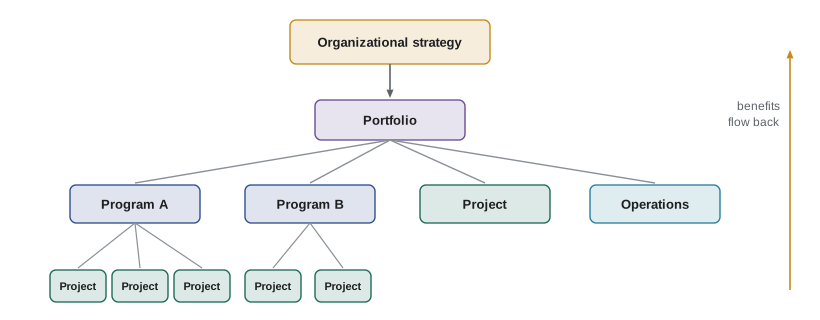
| Level | Scope | Success measured by | Typical manager focus |
|---|---|---|---|
| Project | Defined objectives and deliverables | Deliverables accepted; contribution to outcomes and value | Delivery within constraints |
| Program | Related components sharing benefits | Benefits realized and capabilities delivered | Interdependencies, benefits, governance |
| Portfolio | Organizational scope, changing with strategy | Aggregate performance and strategic contribution | Selection, prioritization, capacity, balance |
Organizational project management (OPM) is the term PMI uses for the framework that integrates portfolio, program and project management with organizational enablers such as governance, methods and culture, so that the organization consistently delivers its strategy. You do not need to memorize OPM models for the exam, but you should recognize that a project manager works inside this larger system and that many constraints, such as funding rules or approval gates, come from it.
Why organizations start projects
Projects are initiated in response to factors that affect the organization. PMI groups these drivers into a few broad categories, which are useful for reading scenario questions about why a project exists and what success looks like.
- Meeting regulatory, legal or social requirements, such as a new privacy law or accessibility standard.
- Satisfying stakeholder requests or needs, such as a community asking for a safer intersection.
- Implementing or changing business or technological strategies, such as moving services online.
- Creating, improving or fixing products, processes or services, such as redesigning a slow approval process.
Behind these sit specific triggers: market demand, a strategic opportunity, a customer request, a technological advance, a legal requirement, an environmental consideration or a social need. Knowing the driver helps you judge priorities. A project driven by a legal deadline has a hard constraint on time and little room to cut scope, while a project chasing a market opportunity may value speed over completeness and suit an adaptive approach.
Worked problem
Project or operations?
Classify each piece of work: (a) monthly patching of 400 laptops; (b) migrating those laptops to a new operating system over six months; (c) a quarterly customer satisfaction survey; (d) designing a new survey method that will replace it.
Show solution
- Ask whether the work is temporary and produces something unique.
- (a) Repeats every month with the same procedure: operations.
- (b) Has a start and end and changes the environment: a project, which will hand over to operations.
- (c) Repeats each quarter: operations.
- (d) Creates a new method once: a project.
Answer: (a) and (c) are operations; (b) and (d) are projects. Note that each project produces something operations will then run.
Outputs, outcomes and benefits
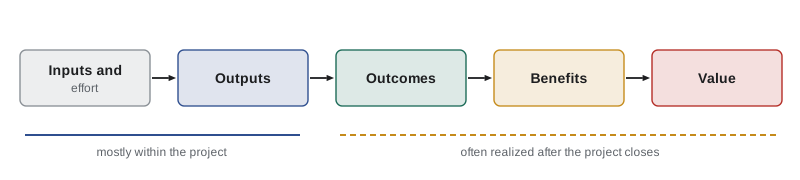
A recurring theme in the PMBOK Guide, and in the 2026 exam content outline, is that delivering outputs is not the same as delivering value. Outputs, or deliverables, are what the project produces: a building, a software release, a training course. Outcomes are the changes that result when people use the outputs: staff process claims faster, customers find information without calling. Benefits are the measurable gains the organization or its stakeholders experience as a result: lower cost per claim, higher satisfaction, reduced emissions. Value is the overall worth of those benefits relative to the cost, risk and effort of obtaining them, and it can be financial, social, environmental or strategic.
A project manager who focuses only on outputs might deliver a perfect system that nobody uses. One who keeps outcomes and benefits in view will ask, early, who needs to change their behavior, what support they need and how success will be measured after go-live. Lesson 2 develops these ideas into the value delivery system and benefits management.
Worked problem
Communication channels as the organization grows
A project team grows from 6 to 15 people. Using the formula \( n(n-1)/2 \) for the number of potential communication channels, how many channels are added?
Show solution
- At 6 people: \( 6 \times 5 / 2 = 15 \) channels.
- At 15 people: \( 15 \times 14 / 2 = 105 \) channels.
- Added channels: \( 105 - 15 = 90 \).
Answer: 90 channels are added, a sevenfold increase for a team that only grew two and a half times. This is one reason programs and larger projects need deliberate communication structures.
The project manager in the larger system
The project manager is the person assigned by the performing organization to lead the team responsible for achieving the project objectives. Program and portfolio managers have different responsibilities, and functional managers and operations managers run ongoing parts of the business. In practice the project manager must work with all of them: negotiating for resources with functional managers, aligning with program priorities, reporting to governance bodies and handing over to operations. Lesson 3 looks at the role in detail.
In US federal work, these levels are visible in law and policy. The Program Management Improvement and Accountability Act of 2016 (PMIAA) requires agencies to designate Program Management Improvement Officers and to strengthen program and project management, and OMB guidance, including Circular A-11 on capital programming, shapes how investments are selected and governed. You do not need these for the PMP exam, but recognizing them helps you see the exam's generic governance language in real settings.
Throughout this course, examples come from many industries: construction, health care, software, government, manufacturing and non-profits. The PMP is deliberately industry-neutral, and its questions describe situations in plain terms. Your task is to recognize the underlying concept, whether that is a portfolio priority decision, an operations handover or a confusion between outputs and benefits, and choose the response a well-informed project professional would make.
One more distinction is worth making early: managing a project is not the same as doing the project's technical work. A skilled engineer, developer or nurse may be an excellent team member and still need new skills to lead a project. The project manager coordinates, integrates, facilitates decisions and keeps the work aligned with its purpose. On small projects one person may do both, but the exam usually assumes the project manager is leading and enabling the team rather than personally completing tasks.
Common mistakes
MistakeThinking temporary means short.
InsteadA project can last years; temporary means it has a defined end.
MistakeCalling repetitive work a project because it is important.
InsteadImportance does not make work temporary or unique.
MistakeConfusing programs with large projects.
InsteadA program coordinates related components to obtain shared benefits.
MistakeTreating a portfolio as a list of related projects.
InsteadPortfolio components need not be related; they share strategic alignment.
MistakeEquating outputs with value.
InsteadValue depends on outcomes and benefits, which often arrive after the project closes.
Summary and key terms
- A project is a temporary endeavor undertaken to create a unique product, service or result.
- Operations are ongoing and repetitive; projects often create what operations will run.
- A program coordinates related projects and activities to obtain benefits not available separately.
- A portfolio groups projects, programs and operations to achieve strategic objectives.
- Projects start because of regulatory, stakeholder, strategic or improvement drivers.
- Outputs lead to outcomes, outcomes to benefits, and benefits relative to cost and risk define value.
- The project manager leads the team that achieves the project objectives, working within a wider organizational system.
- Project
- A temporary endeavor undertaken to create a unique product, service or result.
- Operations
- Ongoing, repetitive work that sustains the organization.
- Program
- Related projects and activities managed together to obtain shared benefits.
- Portfolio
- Projects, programs and operations managed as a group to achieve strategic objectives.
- Organizational project management
- A framework integrating portfolio, program and project management with enablers to deliver strategy.
- Output
- A deliverable produced by the project.
- Outcome
- A change that results from using outputs.
- Benefit
- A measurable gain realized by the organization or stakeholders.
- Value
- The worth of something to stakeholders relative to its cost and risk.
- Communication channels
- Potential lines of communication in a group, n(n − 1)/2.
Practice problems
Work each problem on paper first, then reveal the answer to check.
Give the three key parts of the PMI definition of a project.
Show answer
Temporary, unique, and creating a product, service or result.
Is a recurring monthly report a project?
Show answer
No; it is repetitive operations work.
What distinguishes a program from a large project?
Show answer
A program coordinates related components to obtain benefits not available by managing them separately.
Must portfolio components be related to each other?
Show answer
No; they are grouped to achieve strategic objectives.
Name two reasons a project might end other than success.
Show answer
Objectives cannot be met, the need no longer exists, or funding runs out.
How many communication channels does a team of 10 have?
Show answer
45.
Distinguish an outcome from a benefit.
Show answer
An outcome is a change from using outputs; a benefit is a measurable gain from that change.
Which question does portfolio management ask?
Show answer
Are we doing the right things?
Name one of the four broad categories of project drivers.
Show answer
Regulatory or legal requirements, stakeholder needs, strategy or technology changes, or improving products and processes.
Why must project managers plan for transition to operations?
Show answer
Because value comes from people using the outputs after handover.
Lesson quiz · 5 questions
Score 60% or more to complete this lesson.
Create a free account to save your progress, take quizzes and earn a certificate.