
PMP-110 · Lesson 6 of 12 · 29 min
Development approaches, life cycles and tailoring
Every project must decide how it will produce its deliverables: plan everything up front and build to the plan, discover and deliver in short cycles, or combine the two. That decision, the development approach, shapes the life cycle, the cadence of delivery, the roles on the team and the documents produced. Because about 60 % of 2026 PMP exam items reflect adaptive or hybrid approaches, and the rest predictive, you must be comfortable with all three and able to recognize which suits a situation. This lesson defines the approaches and life cycles, explains the factors that drive the choice, and introduces tailoring, the deliberate adaptation of approach, processes and artifacts to fit the project.
Development approaches
A development approach is the method used to create and evolve the product, service or result during the project. PMI describes a spectrum rather than separate boxes.
| Approach | How it works | Suits projects where | Example |
|---|---|---|---|
| Predictive | Scope, schedule and cost are defined early; work follows a plan through sequential phases | Requirements are clear and stable, change is costly, and regulation or contracts demand detail up front | A bridge, a plant shutdown, a regulated device built to a fixed specification |
| Iterative | The team develops the product through repeated cycles, refining it with feedback | The solution needs exploration and refinement before it is right | A prototype refined over several design rounds |
| Incremental | The team delivers usable pieces in stages, each adding capability | Early partial delivery has value | A new office opened floor by floor |
| Adaptive (agile) | Iterative and incremental with short cycles, frequent feedback and evolving requirements | Requirements are uncertain or changing and early feedback is valuable | A customer app released every two weeks |
| Hybrid | A combination, such as predictive for infrastructure and adaptive for software | Parts of the project differ in certainty or constraints | A hospital wing with adaptive development of its scheduling software |
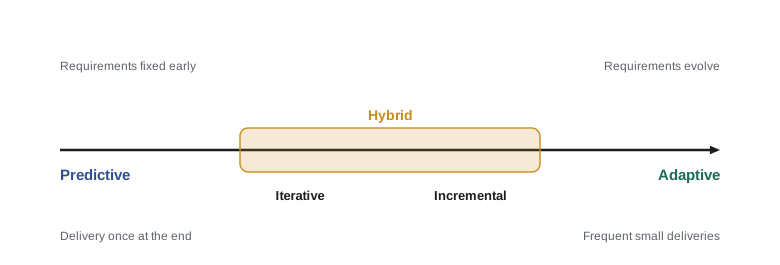
Iterative and incremental are different ideas that are often combined. Iterative is about refining: getting something better through repetition and feedback. Incremental is about adding: delivering more capability over time. Agile approaches use both: each iteration produces a working increment that is then refined in later iterations.
Life cycles and phases
A project life cycle is the series of phases a project passes through from start to completion. A phase is a collection of logically related activities that ends with one or more deliverables. Predictive life cycles often use phases such as feasibility, design, build, test, deploy and close, each ending with a phase gate, a review where governance decides whether to continue, change direction or stop. Adaptive life cycles repeat short cycles, often called iterations or sprints, typically one to four weeks long, each producing a potentially usable increment. Flow-based approaches such as Kanban have no fixed iterations; work items move through the system continuously, limited by work-in-progress limits.
The product life cycle is broader than the project life cycle. A product may be conceived, developed, launched, grown, matured and retired over many years, and several projects may occur along the way: the original development, later enhancements and eventually decommissioning. Keeping the product life cycle in mind helps a project manager plan for operations, support and eventual disposal, which connects to the sustainability principle.
Cadence
Delivery cadence describes the timing and frequency of deliveries. A predictive project may have a single delivery at the end. Multiple deliveries occur when parts of the scope are delivered at different times, as with phased go-lives. Periodic deliveries follow a fixed schedule, such as monthly releases. Continuous delivery releases increments as soon as they are ready, which in software can mean many times a day. Cadence should match how quickly stakeholders can absorb change and how valuable early delivery is.
Choosing an approach
There is no universally best approach. The choice depends on characteristics of the product, the project and the organization. PMI identifies factors such as these.
- Product, service or result: degree of innovation, requirements certainty, scope stability, ease of change, delivery options, risk and safety requirements, and regulation.
- Project: stakeholder availability and needs, schedule constraints, funding availability and structure.
- Organization: structure, culture, capability, team size and location, and experience with the approach.
Worked problem
Scoring suitability for an adaptive approach
A team rates three factors from 1 (favors predictive) to 5 (favors adaptive): requirements uncertainty 5, ease of incremental delivery 4, customer availability for frequent feedback 2. Regulatory documentation needs rate 2 and team experience with agile rates 3. What is the average, and what does it suggest?
Show solution
- Sum: 5 + 4 + 2 + 2 + 3 = 16.
- Average: 16 / 5 = 3.2.
- Look at the spread, not just the average: high uncertainty and easy increments favor adaptive; low customer availability and documentation needs pull toward predictive.
Answer: An average of 3.2 sits in the middle, suggesting a hybrid approach: adaptive delivery with deliberate steps to secure customer feedback and produce required documentation.
PMI's Agile Practice Guide, developed with the Agile Alliance, offers a similar suitability filter that rates culture, team and project attributes. Whatever tool is used, the scoring is a conversation starter. The exam expects you to recognize signals: high uncertainty and the ability to deliver in pieces point toward adaptive; fixed regulatory specifications and costly change point toward predictive; a mix points toward hybrid.
| Signal in a scenario | Points toward |
|---|---|
| Requirements are unclear or likely to change | Adaptive |
| Customer can review work every two weeks | Adaptive |
| Change after construction is extremely expensive | Predictive |
| Regulator requires approved design before building | Predictive (at least for that part) |
| Hardware is fixed but software needs discovery | Hybrid |
| Organization is new to agile but wants faster feedback | Hybrid, with coaching |
Hybrid in practice
Hybrid approaches are common and are prominent on the exam. They take several forms: running some deliverables predictively and others adaptively; using an adaptive approach inside a predictive governance framework of phase gates and funding approvals; starting with an adaptive discovery phase and then building predictively once requirements are clear; or the reverse, using predictive planning for a fixed platform and adaptive cycles for features. The key is that the combination is chosen deliberately to fit the work, not drifted into because nobody decided.
Worked problem
Designing a hybrid life cycle
A utility is replacing meters in 200,000 homes and building a customer portal to show usage. The hardware specification is fixed and installation crews work to a route plan; the portal's features are uncertain and customers have strong opinions. Propose an approach.
Show solution
- Meter installation: predictive, with a detailed route schedule, procurement plan and safety procedures.
- Portal: adaptive, with two-week iterations, a product owner and regular customer testing.
- Integration: align the portal's release plan with installation milestones so features appear as meters go live.
- Governance: phase gates for funding and regulatory approvals over both streams.
Answer: A hybrid with a predictive installation stream and an adaptive portal stream under common governance.
Tailoring
Tailoring is the deliberate adaptation of the approach, governance and processes to make them more suitable for the given environment and the work at hand. The PMBOK Guide says plainly that projects should not apply every process, artifact or practice; they should select and adapt what adds value. Over-processing wastes effort and frustrates teams; under-processing exposes the project to avoidable risk. In the 8th edition, tailoring guidance appears within each performance domain.
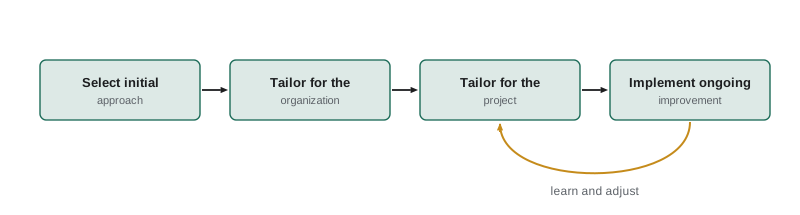
Tailoring typically follows four steps. First, select the initial development approach. Second, tailor for the organization: organizational policies, PMO standards and governance may require certain processes or documents. Third, tailor for the project: consider size, complexity, criticality, team and stakeholders. Fourth, implement ongoing improvement: review in retrospectives or lessons-learned sessions and adjust as the project proceeds.
Worked problem
A simple tailoring matrix
For a 3-month, 5-person internal project with low risk, rate each artifact as full, light or omit: detailed risk register, change control board, weekly status report, formal stakeholder register, lessons learned.
Show solution
- Risk register: light, a short list reviewed weekly is enough.
- Change control board: omit as a separate body; the sponsor approves changes.
- Weekly status report: light, a one-page or dashboard update.
- Stakeholder register: light, a simple list with interests and influence.
- Lessons learned: light, a short retrospective at the end and midway.
Answer: Mostly light, with a separate change control board omitted. A large, high-risk project would choose differently.
In the US federal context, agency capital planning policies and acquisition rules often set minimum documentation and review requirements by investment size and risk, which is a form of organizational tailoring that project teams must respect.
Approaches beyond software
Adaptive approaches began in software but now appear in many fields. Marketing teams run campaigns in short cycles, testing messages and adjusting based on results. Construction teams use pull planning and short-interval scheduling from lean construction, where the people doing the work plan the next few weeks together. Product hardware teams build rapid prototypes and test them with users before committing to tooling. Policy teams pilot a new service in one region before national rollout. In each case the principle is the same: when uncertainty is high, learn through short cycles of delivery and feedback rather than betting everything on an up-front plan.
Conversely, predictive approaches remain essential where change is expensive or dangerous. You cannot iterate on the foundation of a high-rise once concrete has cured, and you cannot release an untested change to a nuclear safety system. Even agile organizations use predictive planning for long-lead procurement, regulatory submissions and infrastructure. The skill the exam tests is matching the approach to the work, not loyalty to a method.
Life cycle examples
| Project | Likely life cycle | Why |
|---|---|---|
| Office relocation with fixed lease date | Predictive with phases and gates | Clear scope, hard deadline, costly late change |
| New mobile banking feature | Adaptive with two-week iterations | Uncertain user needs, easy to release increments |
| ERP system replacement | Hybrid | Fixed core configuration and data migration; adaptive reports and integrations |
| Research study | Iterative | Methods refined as early results arrive |
| Support ticket backlog reduction | Flow-based (Kanban) | Continuous stream of small, varied work items |
Note that a flow-based approach suits work that arrives continuously rather than as a defined project scope. Many teams use Kanban boards with explicit work-in-progress limits so that they finish work before starting more, which shortens the time each item takes from request to delivery.
Whatever the approach, write down the reasons for the choice in the project management plan or equivalent. If the context changes, for example requirements stabilize or a regulator imposes new documentation rules, the team can revisit the decision knowingly rather than drifting into a different way of working. Changing approach mid-project is legitimate when it is deliberate and agreed with governance.
A useful exam heuristic: when a scenario describes an organization new to agile, the best answer usually involves coaching, a pilot team or a hybrid step rather than an overnight switch. Lasting changes in approach need training, leadership support and time for teams to learn new habits.
Common mistakes
MistakeAssuming agile means no planning.
InsteadAdaptive teams plan continuously at several levels.
MistakeConfusing iterative with incremental.
InsteadIterative refines; incremental adds capability.
MistakeChoosing an approach by habit.
InsteadThe choice should follow product, project and organizational factors.
MistakeTreating hybrid as a compromise nobody chose.
InsteadGood hybrids are deliberate designs.
MistakeApplying every process to every project.
InsteadTailoring is expected, not optional.
Summary and key terms
- Development approaches range from predictive through iterative and incremental to adaptive, with hybrids in between.
- A life cycle is the series of phases a project passes through; predictive phases often end with gates.
- Adaptive life cycles repeat short iterations; flow-based approaches move work continuously.
- Cadence can be single, multiple, periodic or continuous delivery.
- Product, project and organizational factors guide the choice of approach.
- Hybrid approaches combine predictive and adaptive elements deliberately.
- Tailoring adapts approach, governance and processes, and continues through the project.
- Development approach
- The method used to create and evolve the product during the project.
- Predictive approach
- An approach that defines scope, schedule and cost early and follows a plan.
- Adaptive approach
- An iterative and incremental approach with evolving requirements and frequent feedback.
- Hybrid approach
- A deliberate combination of predictive and adaptive elements.
- Project life cycle
- The series of phases a project passes through.
- Phase gate
- A review at the end of a phase to decide whether to continue.
- Iteration
- A short, time-boxed cycle of work producing an increment.
- Increment
- A usable addition to the product.
- Cadence
- The timing and frequency of deliveries.
- Tailoring
- Deliberate adaptation of approach, governance and processes to the context.
Practice problems
Work each problem on paper first, then reveal the answer to check.
Requirements are unclear and the customer can review work weekly. Which approach?
Show answer
Adaptive.
What is the difference between iterative and incremental?
Show answer
Iterative refines through repetition; incremental adds capability in pieces.
What happens at a phase gate?
Show answer
Governance decides whether to continue, change direction or stop.
Name the four kinds of delivery cadence.
Show answer
Single, multiple, periodic and continuous.
Ratings 4, 5, 3, 2: average suitability for adaptive?
Show answer
3.5.
Name the four steps of tailoring.
Show answer
Select approach, tailor for the organization, tailor for the project, implement ongoing improvement.
What is a hybrid approach?
Show answer
A deliberate mix of predictive and adaptive elements.
Which approach suits a structure where change after building is very costly?
Show answer
Predictive.
What limits work in a flow-based approach?
Show answer
Work-in-progress limits.
Why tailor?
Show answer
To add value without wasting effort or exposing the project to avoidable risk.
Lesson quiz · 5 questions
Score 60% or more to complete this lesson.
Create a free account to save your progress, take quizzes and earn a certificate.