
PHYS-450 · Lesson 8 of 12 · 24 min
Black holes: horizons, Kerr spin and Hawking radiation
A black hole is a region of spacetime from which nothing, not even light, can escape. The idea has a Newtonian ancestor: in 1783 John Michell and later Pierre-Simon Laplace noted that a star dense enough would have an escape speed greater than the speed of light. But the general-relativistic black hole is something far stranger than a very dark star. It has a boundary, the event horizon, that is not a surface of matter but a surface in spacetime; inside it, every future-directed path leads inward, as inevitably as tomorrow follows today. For decades after Schwarzschild, most physicists, Einstein among them, believed nature would prevent such objects from forming. Today black holes are routinely observed: stellar-mass ones in X-ray binaries and gravitational-wave mergers, and supermassive ones at the hearts of galaxies, two of which have been imaged directly. This lesson explores their geometry, their rotation and the quantum glow that Stephen Hawking predicted in 1974.
What happens at the Schwarzschild radius
Lesson 6 found that a falling body reaches \(r = r_s\) in finite proper time while the far-away coordinate time diverges. Is anything physically singular at \(r_s\)? The test is a curvature invariant, a scalar built from the Riemann tensor that every observer agrees on. For Schwarzschild the simplest nonzero one is the Kretschmann scalar
which is perfectly finite at \(r = r_s\) and diverges only at \(r = 0\). The trouble at \(r_s\) is a failure of the coordinates, like the failure of longitude at the North Pole. New coordinates remove it. Define the ingoing Eddington–Finkelstein time \(v = t + r^*/c\), where the tortoise coordinate \(r^* = r + r_s\ln|r/r_s - 1|\) diverges logarithmically at \(r_s\). The metric becomes
which is regular at \(r = r_s\). In these coordinates ingoing light rays are simply lines of constant \(v\), and they pass smoothly through the horizon. Outgoing light rays are more revealing. Outside \(r_s\) they move outward; exactly at \(r_s\) they stay at constant \(r\), hovering; inside \(r_s\) even outgoing light moves to smaller \(r\). The light cones tip over as \(r_s\) is approached until, inside, the entire future cone points inward. The surface \(r = r_s\) is the event horizon: the boundary of the region from which signals can reach the distant universe.
Inside the horizon the roles of \(t\) and \(r\) exchange in the original Schwarzschild metric: \(g_{tt}\) becomes positive and \(g_{rr}\) negative, so \(r\) is a time coordinate. Decreasing \(r\) is the direction of the future, and the singularity at \(r = 0\) is not a place at the middle of the hole but a moment in the future of everything inside. A falling observer cannot avoid it any more than we can avoid next Tuesday. The maximum proper time from horizon to singularity, achieved by not firing any rockets, is \(\pi GM/c^3\): about 15 microseconds for a stellar black hole of three solar masses and about 66 seconds for Sgr A*.
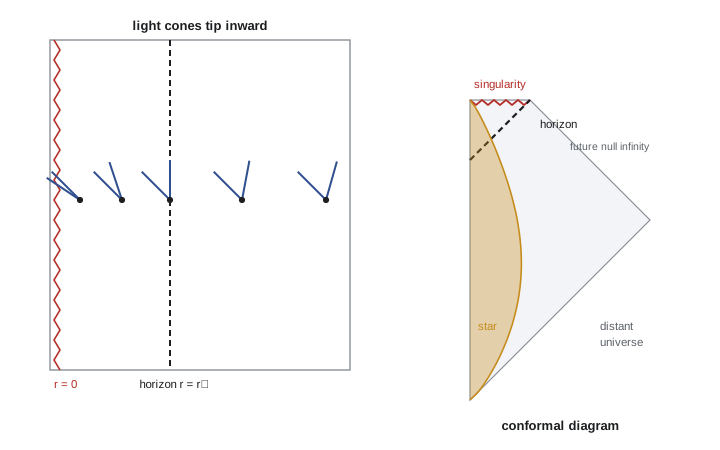
A conformal or Penrose diagram, named after Roger Penrose, compresses all of spacetime onto a finite page while keeping light rays at 45 degrees, so the causal structure can be read at a glance. For a black hole formed by the collapse of a star, the diagram shows the star's surface falling through the horizon, the horizon as a light-like line, and the singularity as a spacelike line at the top. Penrose proved in 1965 that once a trapped surface forms, a surface from which even outgoing light converges, a singularity is inevitable under reasonable conditions on matter; this work earned him half of the 2020 Nobel Prize in Physics. The other half went to Reinhard Genzel and Andrea Ghez for the discovery, from the orbits of stars like S2, of a supermassive compact object at the middle of the Milky Way.
Do black holes form?
Stars are held up by pressure: thermal pressure while they burn nuclear fuel, then electron degeneracy pressure in white dwarfs up to the Chandrasekhar mass of about 1.4 solar masses, then neutron degeneracy and nuclear forces in neutron stars up to a maximum of about 2 to 2.3 solar masses. In 1939 J. Robert Oppenheimer and Hartland Snyder showed that a pressureless sphere collapsing under its own gravity crosses its own Schwarzschild radius in finite proper time and forms a black hole. A massive star whose core exceeds the neutron-star limit, or two neutron stars that merge into an object too heavy to support itself, has no known way to avoid the same fate.
The observational case is now overwhelming. Cygnus X-1, discovered in X-rays in 1964, contains a compact object of about 21 solar masses orbiting a blue supergiant, far above any neutron-star limit. About twenty such X-ray binaries are known in the Milky Way. LIGO, Virgo and KAGRA have detected hundreds of mergers of compact objects since 2015, most of them pairs of black holes of tens of solar masses. The Event Horizon Telescope, an Earth-sized network of radio telescopes, imaged the shadow of the 6.5 billion solar mass black hole M87* in 2019 and of Sgr A* in 2022, each a dark region surrounded by a bright ring of the size general relativity predicts.
Rotating black holes: the Kerr solution
Real stars rotate, and angular momentum is conserved in collapse, so most black holes should spin. In 1963 the New Zealand mathematician Roy Kerr found the exact solution for a rotating black hole. It depends on two numbers: the mass \(M\) and the angular momentum \(J\), conveniently written as the spin parameter \(a = J/(Mc)\), a length, or in geometrized units the dimensionless \(\chi = a/M\) between 0 and 1. The uniqueness theorems of Werner Israel, Brandon Carter, Stephen Hawking and David Robinson, proved between 1967 and 1975, show that every stationary black hole in vacuum is a Kerr black hole. Black holes have no hair, in Wheeler's phrase: whatever collapsed to form them, mass, spin and electric charge are all that remain, and astrophysical black holes have negligible charge.
The Kerr geometry has two remarkable surfaces. The event horizon is at \(r_+ = M + \sqrt{M^2 - a^2}\) in geometrized units, which shrinks from \(2M\) for no spin to \(M\) for maximal spin. Outside it lies the ergosphere, bounded at the equator by \(r = 2M\). Inside the ergosphere, spacetime itself is dragged around with the hole so strongly that nothing can remain at rest relative to the distant stars; every observer, even one firing rockets as hard as possible, must co-rotate. This frame dragging, a gravitational analog of magnetism, also exists, much more weakly, around the rotating Earth. Gravity Probe B, a satellite carrying four ultra-precise gyroscopes in polar orbit, measured the Earth's frame dragging in 2011 as a drift of the gyroscopes' axes of 37 milliarcseconds per year, in agreement with general relativity within about twenty parts in a hundred, alongside the much larger geodetic effect of 6.6 arcseconds per year.
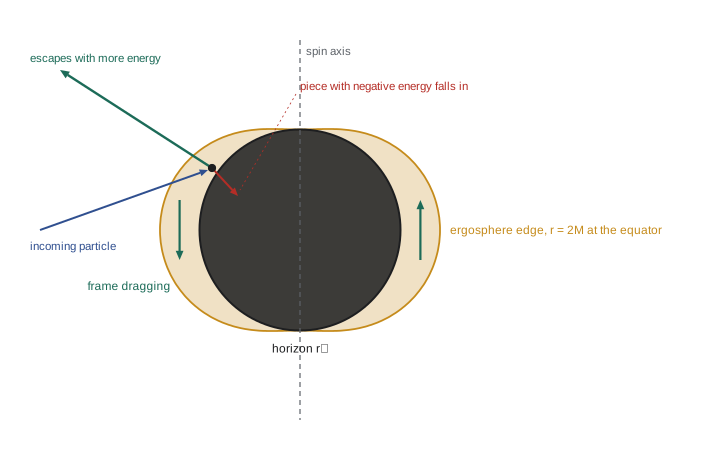
Penrose showed in 1969 that rotational energy can be extracted from the ergosphere. A particle that enters it and splits in two can send one piece onto an orbit with negative energy as measured from infinity, which falls into the hole and reduces its spin, while the other escapes with more energy than the original particle had. Up to 29 parts in a hundred of a maximally spinning hole's mass is rotational energy that can in principle be extracted. Magnetic fields threading the ergosphere can do the same thing on a grand scale, a mechanism proposed by Roger Blandford and Roman Znajek in 1977 and thought to power the relativistic jets of quasars, including the one emerging from M87*.
Spin also moves the innermost stable circular orbit. For orbits rotating with the hole, the ISCO moves inward from \(6M\) at zero spin to \(M\) at maximal spin, and the binding energy released by matter spiralling down to it grows from 5.7 to 42 parts in a hundred of its rest mass. For orbits against the spin, the ISCO moves out to \(9M\). Astronomers measure black-hole spins from the shapes of X-ray emission lines produced near the ISCO and from gravitational waveforms; many measured spins are high.
import math
def isco(chi, prograde=True):
    """Bardeen-Press-Teukolsky ISCO radius in units of M for spin chi in [0, 1]."""
    z1 = 1 + (1 - chi**2)**(1/3) * ((1 + chi)**(1/3) + (1 - chi)**(1/3))
    z2 = math.sqrt(3 * chi**2 + z1**2)
    s = -1 if prograde else 1
    return 3 + z2 + s * math.sqrt((3 - z1) * (3 + z1 + 2 * z2))
def efficiency(r):
    """Binding energy at the ISCO, 1 - E, using E = sqrt(1 - 2/(3 r)) (valid for Kerr ISCO in units of M)."""
    return 1 - math.sqrt(1 - 2 / (3 * r))
print(" spin   r_+ (M)   ISCO pro (M)  ISCO retro (M)  efficiency pro")
for chi in (0.0, 0.5, 0.9, 0.99, 0.998, 1.0):
    rp = 1 + math.sqrt(1 - chi**2)
    r1, r2 = isco(chi), isco(chi, prograde=False)
    print(f"{chi:5.3f}   {rp:6.3f}     {r1:7.3f}       {r2:7.3f}         {efficiency(r1):6.3f}")
print("extractable rotational energy of a maximal hole:", round(1 - 1/math.sqrt(2), 3), "of its mass")spin r_+ (M) ISCO pro (M) ISCO retro (M) efficiency pro 0.000 2.000 6.000 6.000 0.057 0.500 1.866 4.233 7.555 0.082 0.900 1.436 2.321 8.717 0.156 0.990 1.141 1.454 8.972 0.264 0.998 1.063 1.237 8.994 0.321 1.000 1.000 1.000 9.000 0.423 extractable rotational energy of a maximal hole: 0.293 of its mass
The area theorem and black-hole thermodynamics
In 1971 Hawking proved that, classically, the area of a black hole's event horizon can never decrease. When two black holes merge, the final horizon area is at least the sum of the initial areas. This sounds like the second law of thermodynamics, and Jacob Bekenstein, a graduate student of Wheeler's, proposed in 1972 that it is: a black hole has an entropy proportional to its horizon area. The analogy extends to all four laws of thermodynamics, with the surface gravity \(\kappa\) of the horizon playing the role of temperature. For Schwarzschild, \(\kappa = c^4/(4GM)\). LIGO tested the area theorem with the first detected merger, GW150914, comparing the total area before and after; a 2021 analysis found that the area increased, consistent with the theorem at high confidence.
Hawking radiation
At first most physicists, Hawking included, regarded the thermodynamic analogy as purely formal: a black hole absorbs everything and emits nothing, so its temperature must be zero. In 1974 Hawking applied quantum field theory to the curved spacetime outside a horizon and found that a black hole does emit, with a perfectly thermal spectrum at temperature
The temperature can be estimated by a dimensional argument: the only temperature that can be built from the black hole's mass and the constants \(\hbar\), \(c\), \(G\) and \(k_B\) is proportional to \(\hbar c^3/(GMk_B)\). The characteristic wavelength of the emitted radiation is about the size of the hole. A heuristic picture is that quantum fluctuations near the horizon create pairs of particles; occasionally one falls in with negative energy and the other escapes, carrying energy away. With the temperature fixed, the first law \(dM c^2 = T\,dS\) gives the Bekenstein–Hawking entropy
where \(\ell_P = \sqrt{G\hbar/c^3} = 1.6 \times 10^{-35}\) m is the Planck length. A solar-mass black hole has an entropy of about \(10^{77}\,k_B\), some \(10^{19}\) times the entropy of the Sun. Hawking radiation is unimaginably weak for astrophysical black holes: a solar-mass hole is at 62 nanokelvins, far colder than the 2.7 K microwave background, so it absorbs more than it emits and grows. But a black hole evaporating in empty space loses mass at a rate proportional to \(1/M^2\), getting hotter as it shrinks, and the lifetime is proportional to \(M^3\). Only primordial black holes, which might have formed in the early universe, could be evaporating today. The simple photon-only estimate in the code gives a lifetime of a few trillion years for \(10^{12}\) kg; emission of other particles speeds the process, so holes born with about \(5 \times 10^{11}\) kg would be finishing their lives now in a final burst of gamma rays. None has been detected.
import math
hbar, c, G, kB = 1.0546e-34, 2.998e8, 6.674e-11, 1.3807e-23
Msun = 1.989e30
yr = 3.156e7
def T_H(M): return hbar * c**3 / (8 * math.pi * G * M * kB)
def entropy_kB(M):
    rs = 2 * G * M / c**2
    A = 4 * math.pi * rs**2
    return c**3 * A / (4 * G * hbar)
def lifetime(M):          # photon-only estimate: t = 5120 pi G^2 M^3 / (hbar c^4)
    return 5120 * math.pi * G**2 * M**3 / (hbar * c**4)
print(" mass               T_H (K)        entropy (k_B)   lifetime (yr)")
for name, M in (("1e12 kg", 1e12), ("Moon", 7.35e22), ("1 solar mass", Msun), ("Sgr A*", 4.3e6*Msun), ("M87*", 6.5e9*Msun)):
    print(f"{name:14s}  {T_H(M):12.3e}   {entropy_kB(M):12.3e}   {lifetime(M)/yr:12.3e}")
# which mass has a Hawking temperature equal to the microwave background today?
print(f"T_H = 2.725 K for M = {hbar*c**3/(8*math.pi*G*kB*2.725):.2e} kg (about six tenths of the Moon's mass)")
# shadow (photon ring) angular diameter: 2 sqrt(27) GM / (c^2 D)
for name, M, D in (("M87*", 6.5e9*Msun, 16.8e6*3.086e16), ("Sgr A*", 4.3e6*Msun, 8.28e3*3.086e16)):
    theta = 2 * math.sqrt(27) * G * M / (c**2 * D) * 206265e6
print(f"{name}: predicted ring diameter {theta:.0f} microarcseconds")mass T_H (K) entropy (k_B) lifetime (yr) 1e12 kg 1.227e+11 2.653e+40 2.665e+12 Moon 1.669e+00 1.433e+62 1.058e+45 1 solar mass 6.169e-08 1.049e+77 2.097e+67 Sgr A* 1.435e-14 1.940e+90 1.667e+87 M87* 9.491e-18 4.434e+96 5.758e+96 T_H = 2.725 K for M = 4.50e+22 kg (about six tenths of the Moon's mass) M87*: predicted ring diameter 40 microarcseconds Sgr A*: predicted ring diameter 53 microarcseconds
The predicted ring diameters, about 40 microarcseconds for M87* and 53 for Sgr A*, match the 42 and 52 microarcseconds the Event Horizon Telescope measured. A black hole of about six tenths of the Moon's mass would have a Hawking temperature equal to that of today's microwave background; anything heavier is colder than the sky and grows by absorbing it.
Hawking radiation raises the deepest puzzle in theoretical physics. If a black hole formed from matter in a definite quantum state evaporates into perfectly thermal radiation, the information about that state appears to be destroyed, in conflict with the unitarity of quantum mechanics. This black-hole information paradox has driven half a century of research, including the holographic principle, the idea that the information in a region is encoded on its boundary, with entropy proportional to area. Calculations since 2019 suggest that information does escape, in subtle correlations in the radiation, but no complete account exists, and the paradox remains a guide toward a theory of quantum gravity.
Worked problem
Falling into Sgr A*
An astronaut falls freely from rest just outside the horizon of Sgr A* (\(M = 4.3 \times 10^6 M_\odot\)). What is the longest proper time they can survive after crossing the horizon, and what tidal stretch do they feel at the horizon across 2 m?
Show solution
- \(GM/c^3 = 4.3 \times 10^6 \times 4.93 \times 10^{-6}\) s \(= 21.2\) s.
- Maximum proper time from horizon to singularity: \(\pi GM/c^3 = 66.6\) s.
- Horizon radius \(r_s = 2GM/c^2 = 1.27 \times 10^{10}\) m.
- Tidal stretch: \(2GM \times 2/r_s^3 = 2c^2 \times 2/(2r_s^2) \approx 1.1 \times 10^{-3}\) m/s².
Answer: About a minute of proper time, and a tidal stretch of about \(10^{-3}\) m/s² at the horizon, far too small to feel; the tides become lethal only in the last fraction of a second before the singularity.
Common mistakes
MistakePicturing the singularity as a point at the middle of the hole.
InsteadInside the horizon r is a time coordinate; the singularity is a moment in every infalling observer's future.
MistakeSaying black holes suck in everything around them.
InsteadFar from the hole its gravity is that of any mass \(M\); orbits outside the ISCO are stable.
MistakeThinking Hawking radiation makes astrophysical black holes shrink today.
InsteadStellar and supermassive holes are colder than the microwave background and grow by absorbing it.
MistakeAssuming the Event Horizon Telescope images the horizon directly.
InsteadIt images the shadow bounded by the photon ring, about \(\sqrt{27}GM/c^2\) in radius.
Summary and key terms
- Curvature invariants are finite at \(r_s\); Eddington–Finkelstein coordinates show light cones tipping inward and the horizon as a one-way surface.
- Inside, the singularity lies in the future; the longest proper time from horizon to singularity is \(\pi GM/c^3\).
- Kerr black holes have mass and spin only (no hair); frame dragging creates an ergosphere from which energy can be extracted.
- Spin moves the prograde ISCO from 6M to M and raises accretion efficiency from 5.7 to 42 parts in a hundred.
- Horizon area never decreases classically; black holes have entropy proportional to area.
- Hawking temperature \(T_H = \hbar c^3/(8\pi GMk_B)\), 62 nK for one solar mass; evaporation time grows as \(M^3\).
- Event horizon
- The boundary of the region from which no signal can reach the distant universe.
- Kretschmann scalar
- A curvature invariant; for Schwarzschild it is finite at the horizon and infinite at r = 0.
- Kerr solution
- The exact metric of a rotating black hole, determined by mass and spin.
- Ergosphere
- The region outside a rotating horizon where nothing can stay at rest relative to distant stars.
- Frame dragging
- The rotation of local inertial frames by a rotating mass.
- Hawking radiation
- Thermal emission from a black hole predicted by quantum field theory in curved spacetime.
Practice problems
Work each problem on paper first, then reveal the answer to check.
What is the Kretschmann scalar at the horizon of a 10 solar-mass black hole?
Show answer
\(12r_s^2/r_s^6 = 12/r_s^4 = 12/(2.95 \times 10^4)^4 \approx 1.6 \times 10^{-17}\) m⁻⁴, finite.
A black hole has spin parameter 0.9. Where are its horizon and its prograde ISCO, in units of GM/c²?
Show answer
\(r_+ = 1 + \sqrt{1 - 0.81} = 1.44\); ISCO about 2.32.
Two non-spinning black holes of 30 solar masses merge into one of 57 solar masses (spin neglected). Is the area theorem satisfied?
Show answer
Area scales as \(M^2\): \(2 \times 30^2 = 1800 < 57^2 = 3249\); yes.
What is the Hawking temperature of a black hole of 10 solar masses?
Show answer
\(6.2 \times 10^{-9}\) K.
Why can no one inside the horizon send a signal out?
Show answer
Every future-directed light cone inside points to smaller r; even outgoing light moves inward.
Lesson quiz · 5 questions
Score 60% or more to complete this lesson.
Create a free account to save your progress, take quizzes and earn a certificate.