
PHYS-450 · Lesson 2 of 12 · 22 min
Special relativity review: four-vectors, the metric and spacetime diagrams
General relativity is built on special relativity in the same way that the geometry of a curved surface is built on the flat geometry of its tangent planes. Over any small enough region, spacetime looks like the flat spacetime of special relativity, and the laws of physics take their special-relativistic form there. Before curving spacetime, therefore, we need special relativity in the language that generalizes: events as points, intervals as distances, four-vectors as arrows and the metric as the rule that turns arrows into numbers. PHYS-271 introduced time dilation, length contraction and \(E = \gamma m c^2\) from Einstein's two postulates; this lesson repackages those results geometrically, the way Hermann Minkowski did in 1908.
Events, worldlines and the interval
An event is something that happens at a particular place at a particular time: a flash of light, a collision, the tick of a clock. An inertial observer labels events with coordinates \((t, x, y, z)\). The history of a particle is a continuous sequence of events, a curve in spacetime called its worldline. A spacetime diagram plots worldlines with time running upward and one space direction horizontally. It is conventional to measure time in units of length by plotting \(ct\), or equivalently to set \(c = 1\), so that light rays travel along lines at 45 degrees.
Different inertial observers assign different coordinates to the same events. The time between two events depends on the observer, and so does their spatial separation. One combination does not. For two events separated by \(\Delta t, \Delta x, \Delta y, \Delta z\), the spacetime interval
has the same value for every inertial observer. This invariance is the content of special relativity, just as the invariance of \(\Delta x^2 + \Delta y^2\) under rotations is the content of Euclidean geometry. The sign convention used here, with a minus sign on the time part, is the one used in most general relativity texts; particle physicists often use the opposite overall sign. Nothing physical depends on the choice, but it must be used consistently.
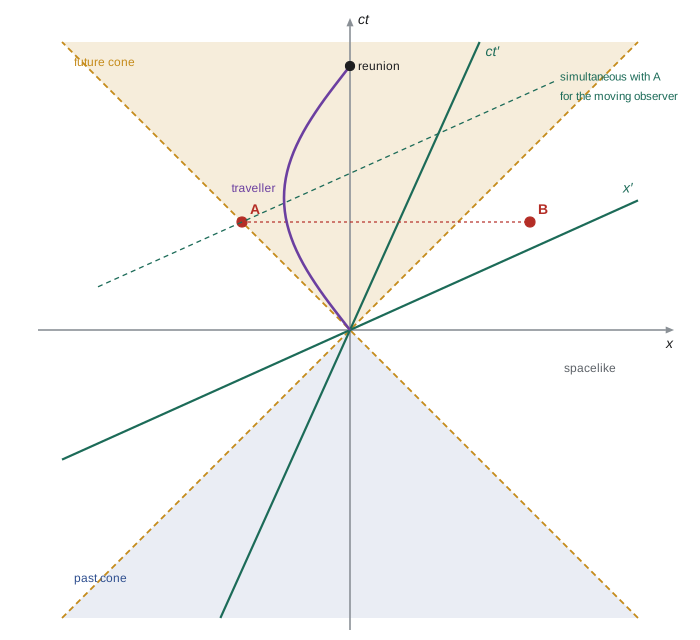
The sign of the interval classifies pairs of events. If \(\Delta s^2 < 0\) the separation is timelike: a massive particle could travel from one event to the other, and every observer agrees on their time order. If \(\Delta s^2 = 0\) the separation is null or lightlike: only a light signal connects them. If \(\Delta s^2 > 0\) the separation is spacelike: no signal can connect them, and different observers disagree about which happened first. The set of null directions from an event forms its light cone. The future cone contains every event the event can influence; the past cone contains every event that could have influenced it. Spacelike-separated events lie outside both cones and are causally disconnected.
Proper time and the twin paradox
For a timelike worldline, the interval measures the time ticked by a clock carried along it. Along a short piece of worldline, the proper time is
This single formula contains time dilation: a moving clock accumulates less proper time than coordinate time by the factor \(1/\gamma = \sqrt{1 - v^2/c^2}\). It also resolves the twin paradox. One twin stays home on a straight worldline; the other travels out and back. The two worldlines join the same two events, departure and reunion. The interval is a kind of length, but with the minus sign in the metric the straight timelike worldline between two events has the greatest proper time, not the least. The traveling twin, whose worldline bends, is younger at the reunion. There is no paradox and no symmetry: the stay-at-home twin is inertial throughout, while the traveler must accelerate to turn around.
This maximal property of straight timelike worldlines is worth remembering. In lesson 4 it becomes the definition of a geodesic in curved spacetime: a freely falling body follows the worldline that maximizes its proper time between two events. Free fall is the path along which a clock ticks the most.
Four-vectors and the metric
A four-vector is a quantity with four components that transform between inertial frames the same way as the coordinate differences \((c\,dt, dx, dy, dz)\). Write the components as \(A^\mu\) with \(\mu = 0, 1, 2, 3\), where 0 is the time component. The Minkowski metric \(\eta_{\mu\nu}\) is the diagonal matrix with entries \((-1, 1, 1, 1)\), and the scalar product of two four-vectors is
Here we use the Einstein summation convention: a repeated index, once up and once down, is summed over its four values. The scalar product is the same in every inertial frame, which is what makes four-vectors useful. Writing a law of physics as an equation between four-vectors guarantees that it holds in every frame. The metric also lowers indices: \(A_\mu = \eta_{\mu\nu} A^\nu\), so \(A_0 = -A^0\) while the spatial components are unchanged. In curved spacetime the constant matrix \(\eta_{\mu\nu}\) will be replaced by a metric \(g_{\mu\nu}(x)\) that varies from point to point, but the rule for scalar products will be exactly the same.
The most important four-vectors describe a particle's motion. The four-velocity is \(u^\mu = dx^\mu/d\tau\), the rate of change of position with proper time. Its components are \(u^\mu = \gamma(c, v_x, v_y, v_z)\), and its scalar product with itself is \(u \cdot u = -c^2\) for every massive particle, a constant that reflects the fact that every clock ticks its own proper time at one second per second. The four-momentum is \(p^\mu = m u^\mu = (E/c, \vec{p})\) with \(E = \gamma m c^2\) and \(\vec{p} = \gamma m \vec{v}\). Its scalar product gives
The rest mass \(m\) is the invariant length of the four-momentum. For a photon \(m = 0\) and \(E = pc\). For a system of particles, the total four-momentum is the sum of the individual four-momenta, and its invariant length defines the invariant mass of the system. Two photons each of energy \(E\) moving in opposite directions have total momentum zero and total energy \(2E\), so the pair has invariant mass \(2E/c^2\) even though each photon is massless. Mass is not additive in relativity; energy and momentum are.
Lorentz transformations
The coordinates of an observer moving with speed \(v\) along \(x\) are related to ours by the Lorentz boost
Every four-vector transforms by the same matrix. A useful parametrization introduces the rapidity \(\phi\) with \(\beta = \tanh\phi\), so \(\gamma = \cosh\phi\) and \(\gamma\beta = \sinh\phi\). A boost is then a hyperbolic rotation, and successive boosts along the same line simply add their rapidities. This is the geometric reason that velocities do not add linearly: \(\tanh(\phi_1 + \phi_2)\) gives the familiar formula \((\beta_1 + \beta_2)/(1 + \beta_1 \beta_2)\), which never exceeds one.
import math
def boost(p, beta):                       # p = (E, px, py, pz) with c = 1
    g = 1 / math.sqrt(1 - beta**2)
    E, px, py, pz = p
    return (g * (E - beta * px), g * (px - beta * E), py, pz)
def mass2(p):                             # invariant: E^2 - |p|^2
    E, px, py, pz = p
    return E**2 - px**2 - py**2 - pz**2
# a proton (m = 0.938 GeV) with momentum 3 GeV along x
m = 0.938
p = (math.sqrt(3.0**2 + m**2), 3.0, 0.0, 0.0)
for beta in (0.0, 0.5, 0.9, 0.954):
    q = boost(p, beta)
    print(f"beta = {beta:5.3f}: E = {q[0]:7.4f} GeV, px = {q[1]:7.4f} GeV, m^2 = {mass2(q):.6f}")
# two photons back to back: each massless, the pair is not
g1, g2 = (1.0, 1.0, 0, 0), (1.0, -1.0, 0, 0)
tot = tuple(a + b for a, b in zip(g1, g2))
print("photon m^2:", mass2(g1), " pair m^2:", mass2(tot), " pair mass:", math.sqrt(mass2(tot)), "GeV")
# rapidities add
b1, b2 = 0.6, 0.8
print("0.6 + 0.8 via rapidity:", round(math.tanh(math.atanh(b1) + math.atanh(b2)), 6),
" formula:", round((b1 + b2) / (1 + b1 * b2), 6))beta = 0.000: E = 3.1432 GeV, px = 3.0000 GeV, m^2 = 0.879844 beta = 0.500: E = 1.8974 GeV, px = 1.6494 GeV, m^2 = 0.879844 beta = 0.900: E = 1.0168 GeV, px = 0.3925 GeV, m^2 = 0.879844 beta = 0.954: E = 0.9380 GeV, px = 0.0046 GeV, m^2 = 0.879844 photon m^2: 0.0 pair m^2: 4.0 pair mass: 2.0 GeV 0.6 + 0.8 via rapidity: 0.945946 formula: 0.945946
Boosting into the frame moving at \(\beta = p c/E = 0.954\) brings the proton to rest, where its energy is just its rest energy of 0.938 GeV. In every frame the invariant mass squared is the same, to the rounding of the printout. Particle physicists use exactly this invariance to discover new particles: the invariant mass of the decay products of a short-lived particle, computed from measured energies and momenta, clusters at the parent's mass. The Higgs boson was found in 2012 as a bump at 125 GeV in the invariant mass of photon pairs.
Relativity of simultaneity in pictures
In a spacetime diagram, the moving observer's time axis is their worldline, the line \(x = v t\), tilted toward the light cone. Their space axis, the set of events they call simultaneous with the origin, is the line \(c t = \beta x\), tilted up from the \(x\) axis by the same angle. The two primed axes are symmetric about the light line, and they close up like scissors as \(\beta \to 1\). Events on a horizontal line are simultaneous for us but not for the moving observer, who sees the event further along \(x\) happening earlier. The causal order of timelike-separated events is preserved because the light cones, the 45 degree lines, are the same for everyone.
Accelerated observers in flat spacetime
Special relativity can describe accelerated motion perfectly well; it is gravity, not acceleration, that requires general relativity. A rocket with constant proper acceleration \(a\), the acceleration felt by its passengers, follows a hyperbola in a spacetime diagram:
At \(a = 9.8\) m/s², a comfortable acceleration of one Earth gravity, \(c^2/a\) is about 0.97 light-years and \(c/a\) about 0.97 years. A crew accelerating at one gravity for half the trip and decelerating for the other half would reach the middle of the Milky Way, 26,000 light-years away, in about 20 years of their own time, while 26,000 years pass on Earth. Even more striking, the hyperbolic worldline approaches a light line asymptotically: light sent from behind the rocket after a certain moment never catches it. The accelerating crew has a horizon, a surface beyond which events are hidden from them. This Rindler horizon of flat spacetime will reappear in lesson 3 as a model for the horizon of a black hole.
import math
c, yr, ly = 2.998e8, 3.156e7, 9.461e15
a = 9.81
def trip(D_ly):
    """Accelerate at a for half the distance, then decelerate. Return ship time and Earth time in years."""
    half = D_ly * ly / 2
    # x = (c^2/a)(cosh(a tau/c) - 1)  ->  tau for the half distance
    tau_half = (c / a) * math.acosh(1 + a * half / c**2)
    t_half = (c / a) * math.sinh(a * tau_half / c)
    return 2 * tau_half / yr, 2 * t_half / yr
for name, D in (("Proxima Centauri", 4.24), ("Vega", 25.0), ("Galactic middle", 26000.0), ("Andromeda", 2.5e6)):
    ship, earth = trip(D)
    print(f"{name:17s} {D:10.4g} ly: ship {ship:6.2f} yr, Earth {earth:12.1f} yr")
# proper time along a twin's out-and-back trip at 0.8 c for 10 years of Earth time
v = 0.8
print("travelling twin ages", round(10 * math.sqrt(1 - v**2), 2), "years while Earth ages 10")Proxima Centauri 4.24 ly: ship 3.54 yr, Earth 5.9 yr Vega 25 ly: ship 6.44 yr, Earth 26.9 yr Galactic middle 2.6e+04 ly: ship 19.75 yr, Earth 26000.0 yr Andromeda 2.5e+06 ly: ship 28.59 yr, Earth 2499820.2 yr traveling twin ages 6.0 years while Earth ages 10
For Proxima Centauri the ship and Earth times differ modestly; for distant destinations the ship time grows only logarithmically with distance, because the ship spends most of the trip at enormous \(\gamma\). The energy required is another matter entirely: the rocket equation makes such trips impossible with any known propulsion. But the kinematics is pure special relativity, and it shows that acceleration alone does not need general relativity. Gravity is different because it cannot be removed globally by any choice of coordinates: tidal effects remain.
Worked problem
Invariant mass of a particle decay
A neutral pion decays into two photons. In the laboratory one photon has energy 100.0 MeV along \(+x\) and the other 91.1 MeV along \(+y\), at 90° to the first. Find the pion's mass.
Show solution
- Total energy \(E = 191.1\) MeV; total momentum \(\vec{p} = (100.0, 91.1, 0)\) MeV/\(c\).
- \(|\vec{p}|^2 c^2 = 100.0^2 + 91.1^2 = 10{,}000 + 8299 = 18{,}299\) MeV².
- \(E^2 = 191.1^2 = 36{,}519\) MeV², so \(m^2 c^4 = 36{,}519 - 18{,}299 = 18{,}220\) MeV².
- \(m c^2 = \sqrt{18{,}220} = 135.0\) MeV. For two photons this is the same as \(m^2c^4 = 2E_1E_2(1 - \cos\theta)\).
Answer: 135 MeV, the neutral pion's mass. The invariant mass needs no knowledge of the pion's velocity in the laboratory.
Common mistakes
MistakeThinking the interval is \(c^2\Delta t^2 + \Delta x^2\).
InsteadThe time part enters with the opposite sign: \(\Delta s^2 = -c^2\Delta t^2 + \Delta x^2 + \dots\) in the convention used here.
MistakeBelieving the straight worldline is the shortest in proper time.
InsteadWith the Minkowski sign, the straight timelike worldline between two events has the greatest proper time; bent worldlines age less.
MistakeAdding masses of particles to get the mass of a system.
InsteadEnergies and momenta add; the system's mass is the invariant length of the total four-momentum and can exceed the sum of the parts.
MistakeSaying that special relativity cannot handle acceleration.
InsteadAccelerated observers are described perfectly well in flat spacetime; general relativity is needed for gravity, which produces tidal effects.
Summary and key terms
- The interval \(\Delta s^2 = -c^2\Delta t^2 + \Delta x^2 + \Delta y^2 + \Delta z^2\) is the same for all inertial observers and classifies separations as timelike, null or spacelike.
- Proper time \(\tau = \int \sqrt{1 - v^2/c^2}\,dt\) is what a clock measures; straight timelike worldlines maximize it.
- Four-vectors transform like \((c\,dt, d\vec{x})\); the Minkowski metric \(\eta_{\mu\nu} = \mathrm{diag}(-1, 1, 1, 1)\) defines their invariant scalar product.
- The four-momentum \(p^\mu = (E/c, \vec{p})\) satisfies \(p \cdot p = -m^2c^2\); invariant mass is the length of the total four-momentum.
- Lorentz boosts are hyperbolic rotations; rapidities add along a line.
- Constant proper acceleration traces a hyperbola with a horizon, a preview of black-hole horizons.
- Event
- A point in spacetime, with a time and a place.
- Worldline
- The curve in spacetime traced by a particle's history.
- Light cone
- The null directions from an event, separating its causal future and past from spacelike-separated events.
- Proper time
- Time measured by a clock moving along a worldline.
- Four-vector
- A four-component quantity that transforms like \((c\,dt, d\vec{x})\) under Lorentz transformations.
- Rapidity
- The parameter \(\phi\) with \(\beta = \tanh\phi\); rapidities of collinear boosts add.
Practice problems
Work each problem on paper first, then reveal the answer to check.
Event A is at \((ct, x) = (0, 0)\) and event B at \((3, 5)\) m. Is the separation timelike or spacelike? Can A cause B?
Show answer
\(\Delta s^2 = -9 + 25 = 16\) m², spacelike; no.
A muon moving at 0.995 c lives 2.2 microseconds in its rest frame. How far does it travel in the lab on average?
Show answer
\(\gamma = 10.0\); lab lifetime 22 microseconds; distance \(0.995 \times 3 \times 10^8 \times 2.2 \times 10^{-5} \approx 6.6\) km.
What is \(u \cdot u\) for a particle moving at 0.6 c?
Show answer
\(-c^2\), as for every massive particle.
Combine boosts of 0.9 c and 0.9 c along the same line.
Show answer
\((0.9 + 0.9)/(1 + 0.81) = 0.9945\,c\).
An electron (0.511 MeV) and a positron collide head on, each with energy 5 GeV. What is the invariant mass of the pair?
Show answer
10 GeV/c²: total momentum is zero and total energy 10 GeV.
Lesson quiz · 5 questions
Score 60% or more to complete this lesson.
Create a free account to save your progress, take quizzes and earn a certificate.