
PHYS-261 · Lesson 7 of 12 · 22 min
The second law: heat engines, refrigerators and Carnot
The first law says that energy is conserved, so an engine cannot produce more work than the heat it takes in. It does not say that an engine cannot turn all of that heat into work. Yet every engine ever built has rejected some heat to its surroundings: a car's radiator and exhaust, a power station's cooling towers, the condenser of Watt's steam engine. The second law of thermodynamics makes this observation into a principle. This lesson states the second law in the two classical forms due to Kelvin and Clausius, shows that they are equivalent, proves Carnot's theorem that no engine can beat a reversible one, derives the Carnot efficiency, and applies it to engines, refrigerators and the heat pumps that are increasingly used to heat homes in cold climates.
Heat engines
A heat engine is a device that works in a cycle, taking in heat \(Q_h\) from a hot reservoir at temperature \(T_h\), doing work \(W\), and rejecting heat \(Q_c\) to a cold reservoir at \(T_c\). A reservoir is a body so large that its temperature does not change when heat flows in or out: a furnace, the atmosphere, a lake. Because the engine returns to its initial state after each cycle, its internal energy is unchanged, and the first law gives \(W = Q_h - Q_c\). The efficiency is the fraction of the heat input that becomes work,
Here \(Q_h\) and \(Q_c\) denote magnitudes. A refrigerator or heat pump runs the cycle backwards: work \(W\) is used to extract heat \(Q_c\) from the cold reservoir and deliver \(Q_h = Q_c + W\) to the hot one. A refrigerator is rated by its coefficient of performance \(\text{COP}_R = Q_c/W\); a heat pump, whose purpose is to warm the hot side, by \(\text{COP}_{HP} = Q_h/W = 1 + \text{COP}_R\).
Two statements of the second law
Kelvin, in 1851, and Max Planck later, stated the second law as an impossibility for engines:
Kelvin–Planck statement: no device operating in a cycle can take in heat from a single reservoir and convert it entirely into work.
Clausius, in 1854, stated it as an impossibility for refrigerators:
Clausius statement: no device operating in a cycle can transfer heat from a colder body to a hotter body with no other effect.
The two statements are equivalent: if either were false, the other would be too. Suppose a perfect engine existed that turned heat \(Q\) from a hot reservoir entirely into work \(W = Q\). Use that work to drive an ordinary refrigerator that takes \(Q_c\) from a cold reservoir and delivers \(Q_c + W\) to the hot one. The combination takes \(Q_c\) from the cold reservoir and delivers a net \(Q_c\) to the hot one, with no other effect, violating Clausius. Conversely, suppose a perfect refrigerator existed that moved heat \(Q_c\) from cold to hot with no work. Combine it with an ordinary engine that takes \(Q_h\) from the hot reservoir, rejects exactly \(Q_c\) to the cold one and does work \(Q_h - Q_c\). The cold reservoir is unchanged, and the combination turns the net heat \(Q_h - Q_c\) from the hot reservoir entirely into work, violating Kelvin–Planck. The second law is therefore one law, and the two forms are two of its faces.
The Carnot cycle
Carnot imagined an engine that uses only reversible processes. Its cycle has four steps, which for an ideal gas are: an isothermal expansion at \(T_h\), during which the gas absorbs \(Q_h\); an adiabatic expansion that cools the gas to \(T_c\); an isothermal compression at \(T_c\), rejecting \(Q_c\); and an adiabatic compression that returns it to \(T_h\). Heat flows only across vanishingly small temperature differences, and every step can be run backwards, so the same cycle run in reverse is a reversible refrigerator.
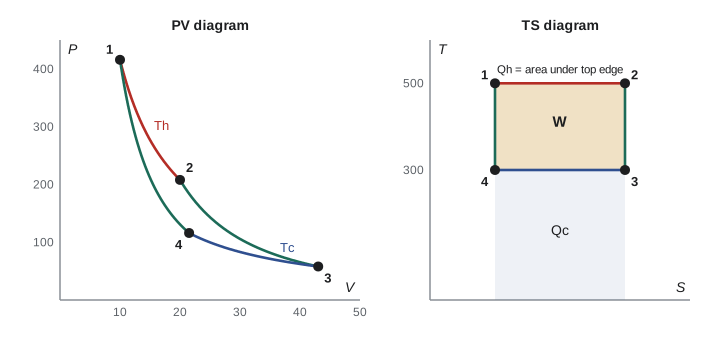
For an ideal gas the efficiency can be computed directly. On the isotherms, \(Q_h = nRT_h \ln(V_2/V_1)\) and \(Q_c = nRT_c \ln(V_3/V_4)\). On the adiabats, \(T_hV_2^{\gamma-1} = T_cV_3^{\gamma-1}\) and \(T_hV_1^{\gamma-1} = T_cV_4^{\gamma-1}\). Dividing these gives \(V_2/V_1 = V_3/V_4\), so the logarithms are equal and
Carnot's theorem
Carnot's theorem states that no engine operating between two reservoirs can be more efficient than a reversible engine operating between the same reservoirs, and that all reversible engines between them have the same efficiency. The proof is another combination argument. Suppose some engine X had efficiency greater than a reversible engine C. Run C backwards as a refrigerator, driven by the work of X, and adjust the sizes so that X takes in the same heat \(Q_h\) from the hot reservoir that C returns to it. Since X is more efficient, it produces more work than C needs; the hot reservoir is unchanged, and the surplus work has been extracted from the cold reservoir alone, violating Kelvin–Planck. If two reversible engines had different efficiencies, the same argument run with either one backwards would give a contradiction, so they must be equal.
The theorem has a striking consequence. Because every reversible engine between two reservoirs has the same efficiency, whatever its working substance, the ratio \(Q_c/Q_h\) for a reversible engine depends only on the two reservoirs and can be used to define a temperature scale independent of any substance. Kelvin proposed exactly this: define the ratio of two thermodynamic temperatures by \(T_c/T_h = Q_c/Q_h\) for a reversible engine between them. Our ideal gas calculation shows that this thermodynamic temperature coincides with the ideal-gas temperature of lesson 2, so the kelvin scale is both practical and fundamental. Absolute zero is the temperature of a cold reservoir to which a reversible engine would reject no heat at all.
Real engines
Real engines are less efficient than Carnot's, for two kinds of reasons. First, their cycles are not Carnot cycles: heat is absorbed over a range of temperatures, not all at the hottest. Second, they are irreversible: friction, turbulence and heat flow across finite temperature differences all waste some of the potential work. Engineers model them with idealized air-standard cycles. In the Otto cycle of a spark-ignition engine, heat is added and removed at constant volume, and the efficiency depends only on the compression ratio \(r\),
which is about 60% for \(r = 10\) and \(\gamma = 1.4\); real gasoline engines achieve 25% to 35% at their best operating point. The diesel cycle adds heat at constant pressure and uses higher compression ratios, typically 15 to 20; large marine diesels reach about 50%. A modern combined-cycle gas power plant, which uses the hot exhaust of a gas turbine to raise steam for a second turbine, reaches about 60%, close to the Carnot limit for its temperatures times a realistic factor. The Stirling cycle, invented by Robert Stirling in 1816, exchanges heat at constant temperature and stores the heat released in one constant-volume step in a regenerator, returning it in the other; with a perfect regenerator its efficiency equals Carnot's.
Refrigerators and heat pumps
For a reversible refrigerator, \(Q_c/Q_h = T_c/T_h\) as before, so
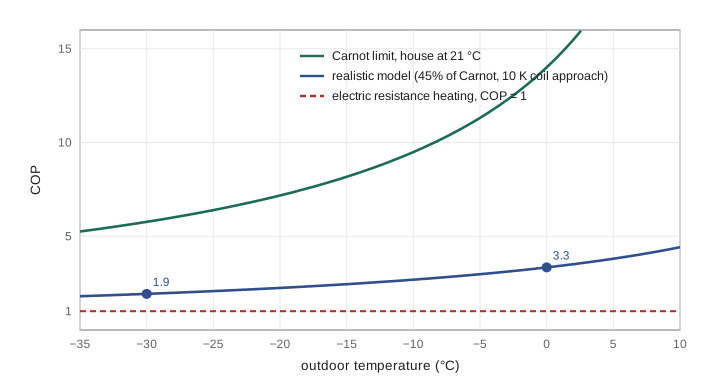
Both grow without limit as the temperature difference shrinks. This is the great advantage of heat pumps: moving heat across a small temperature difference costs much less work than creating it from electricity in a resistance heater, which has a COP of exactly 1. A heat pump warming a house from mild outdoor air can deliver three or four units of heat per unit of electricity. As the outdoor temperature falls, the COP falls too, both because the temperature lift grows and because the outdoor coil must be colder than the air in order to absorb heat from it. Cold-climate heat pumps, designed with variable-speed compressors and refrigerants suited to low temperatures, are now commonly rated to keep working down to about \(-25\) to \(-30\) °C, and they are being installed widely across the Prairies and the northern United States.
import math
gamma = 1.4

def carnot(Th, Tc): return 1 - Tc / Th
def otto(r): return 1 - r**(1 - gamma)
def diesel(r, rc): return 1 - r**(1 - gamma) * (rc**gamma - 1) / (gamma * (rc - 1))

print("engine efficiencies")
print(f"  Carnot between 900 K and 300 K:        {carnot(900, 300):.3f}")
for r in (8, 10, 12):
    print(f"  ideal Otto, compression ratio {r:2d}:      {otto(r):.3f}")
print(f"  ideal Diesel, r = 18, cutoff ratio 2:  {diesel(18, 2):.3f}")
print(f"  ideal Stirling with perfect regenerator = Carnot between its two temperatures")

# Heat pump heating a house to 21 C as the outdoor temperature falls
T_in = 294.15
print("\noutdoor (C)  Carnot COP  realistic COP (45 % of Carnot, 10 K approach)")
for t_out in (10, 0, -10, -20, -25, -30, -35):
    Tc = t_out + 273.15
    cop_carnot = T_in / (T_in - Tc)
    Th_coil, Tc_coil = T_in + 10, Tc - 10              # coil temperatures differ from the air
    cop_real = 0.45 * Th_coil / (Th_coil - Tc_coil)
    print(f"   {t_out:5d}       {cop_carnot:6.2f}        {cop_real:5.2f}")

# A refrigerator: kitchen at 22 C, freezer at -18 C, 1 kW of electrical input
Th, Tc = 295.15, 255.15
cop_ref = Tc / (Th - Tc)
print(f"\nfreezer: Carnot COP = {cop_ref:.2f}; with 1.0 kW input it could remove at most "
f"{cop_ref:.1f} kW and dump {cop_ref + 1:.1f} kW into the kitchen")engine efficiencies
Carnot between 900 K and 300 K: 0.667
ideal Otto, compression ratio 8: 0.565
ideal Otto, compression ratio 10: 0.602
ideal Otto, compression ratio 12: 0.630
ideal Diesel, r = 18, cutoff ratio 2: 0.632
ideal Stirling with perfect regenerator = Carnot between its two temperatures
outdoor (C) Carnot COP realistic COP (45 % of Carnot, 10 K approach)
10 26.74 4.42
0 14.01 3.34
-10 9.49 2.68
-20 7.17 2.24
-25 6.39 2.07
-30 5.77 1.93
-35 5.25 1.80
freezer: Carnot COP = 6.38; with 1.0 kW input it could remove at most 6.4 kW and dump 7.4 kW into the kitchenEven a Carnot heat pump loses ground in the cold, falling from a COP of about 27 at 10 °C to 5.8 at \(-30\) °C. The realistic model, which takes 45% of the Carnot value between coil temperatures 10 K beyond the indoor and outdoor air, gives COPs from 4.4 down to 1.9, close to what manufacturers report for good cold-climate units. At −30 °C (−22 °F), a very cold Minneapolis night, the heat pump still delivers almost twice as much heat per kilowatt-hour as a baseboard heater, though many installations keep a backup heater for the coldest hours, when the house also needs the most heat. The freezer calculation shows the other side of the coin: a refrigerator with 1 kW of input can remove at most about 6.4 kW from the freezer, and every joule of work it uses ends up as heat in the kitchen.
Worked problem
A power station
A steam power station produces 500 MW of electricity with steam at 560 °C and a condenser at 30 °C. Its actual efficiency is 38%. Find the Carnot limit, the heat rejected to the cooling water, and how much the river or lake water warms if it flows through the condenser at 20 m³/s.
Show solution
- Carnot: \(\eta = 1 - 303/833 = 0.636\).
- Heat input: \(Q_h = 500/0.38 = 1316\) MW; heat rejected: \(1316 - 500 = 816\) MW.
- 20 m³/s of water is 20 000 kg/s. Its temperature rise is \(816 \times 10^6/(20\,000 \times 4186) = 9.7\) K.
- So about 62% of the fuel's energy is rejected, and the actual efficiency is 60% of the Carnot limit.
Answer: The Carnot limit is 64%; the station rejects 816 MW and warms the cooling water by about 10 K.
Common mistakes
MistakeUsing Celsius temperatures in \(1 - T_c/T_h\).
InsteadCarnot formulas need absolute temperatures.
MistakeThinking that a COP greater than 1 violates energy conservation.
InsteadA heat pump moves heat rather than creating it; the delivered heat is the work plus the heat taken from outside.
MistakeBelieving that better engineering could reach 100% efficiency.
InsteadThe Carnot limit is a consequence of the second law, not of poor design.
MistakeAssuming a reversible engine is fast and powerful.
InsteadReversible processes are infinitely slow; real engines trade efficiency for power.
MistakeForgetting that a refrigerator heats the room it stands in.
InsteadIt rejects \(Q_c + W\) to the room, more than it removes from the cold space.
Summary and key terms
- A heat engine has efficiency \(\eta = W/Q_h = 1 - Q_c/Q_h\); refrigerators and heat pumps are rated by COP.
- Kelvin–Planck: no cyclic device can turn heat from one reservoir entirely into work. Clausius: heat does not flow from cold to hot by itself. They are equivalent.
- Carnot's theorem: no engine between two reservoirs beats a reversible one, and all reversible ones are equal.
- \(\eta_{\text{Carnot}} = 1 - T_c/T_h\), \(\text{COP}_R = T_c/(T_h - T_c)\), \(\text{COP}_{HP} = T_h/(T_h - T_c)\).
- Kelvin's thermodynamic temperature is defined by \(T_c/T_h = Q_c/Q_h\) for reversible engines and equals the ideal-gas temperature.
- Real engines and heat pumps reach a fraction of the Carnot value; heat pumps lose performance as the outdoor temperature falls.
- heat engine
- A cyclic device that converts part of the heat it absorbs into work.
- reservoir
- A body large enough that its temperature does not change when heat is exchanged.
- Carnot cycle
- A reversible cycle of two isothermal and two adiabatic processes.
- coefficient of performance
- Heat moved or delivered per unit work for a refrigerator or heat pump.
- thermodynamic temperature
- Kelvin's scale, defined by the heat ratios of reversible engines.
- regenerator
- A heat store that returns heat within a cycle, used in Stirling engines.
Practice problems
Work each problem on paper first, then reveal the answer to check.
Find the Carnot efficiency of an engine between 500 °C and 20 °C.
Show answer
\(1 - 293/773 = 0.621\).
An engine absorbs 2000 J and rejects 1400 J per cycle. Find its efficiency and the work per cycle.
Show answer
\(W = 600\) J, \(\eta = 0.30\).
A heat pump has COP 3.2 and delivers 9.6 kW of heat. How much electric power does it use and how much heat does it take from outdoors?
Show answer
\(W = 9.6/3.2 = 3.0\) kW; heat from outside \(= 9.6 - 3.0 = 6.6\) kW.
Find the ideal Otto efficiency for a compression ratio of 9.
Show answer
\(1 - 9^{-0.4} = 1 - 0.415 = 0.585\).
What is the Carnot COP of a refrigerator that keeps its interior at 4 °C in a 22 °C kitchen?
Show answer
\(277.15/18 = 15.4\).
Explain why a power station near a cold lake can be slightly more efficient in winter.
Show answer
A colder condenser lowers \(T_c\), raising the Carnot limit \(1 - T_c/T_h\) and usually the real efficiency.
Lesson quiz · 5 questions
Score 60% or more to complete this lesson.
Create a free account to save your progress, take quizzes and earn a certificate.