
PHYS-261 · Lesson 6 of 12 · 22 min
Heat transfer: conduction, convection and radiation
Thermodynamics tells us where energy will end up; heat transfer tells us how fast it gets there. Heat flows from hot to cold by three mechanisms. In conduction, energy passes through a material by molecular collisions, lattice vibrations and, in metals, free electrons, without any bulk motion. In convection, a moving fluid carries energy with it. In radiation, energy travels as electromagnetic waves, and needs no medium at all. This lesson develops the basic law for each, applies them to the heat loss through the wall of a house on a cold night and to a cooling cup of coffee, and introduces the blackbody spectrum, which will be central to the capstone on the Earth and the Sun.
Conduction and Fourier's law
Joseph Fourier, in his Analytical Theory of Heat of 1822, proposed that the heat flux through a material, the energy per unit time per unit area, is proportional to the temperature gradient:
The thermal conductivity \(\kappa\), in W/(m K), varies enormously between materials: about 400 for copper, 237 for aluminum, 50 for steel, 2 to 3 for rock, 1.0 for glass, 0.6 for water, 0.12 for wood, 0.04 for glass wool or mineral wool insulation and 0.026 for still air. Good insulators work by trapping air in small cells so that it cannot convect; their conductivity is close to that of still air. Metals conduct heat well for the same reason that they conduct electricity well: their free electrons carry energy, and the Wiedemann–Franz law of 1853 states that the ratio of thermal to electrical conductivity is proportional to temperature with nearly the same constant for all metals.
For steady conduction through a slab of thickness \(d\) and area \(A\), with faces held at \(T_1\) and \(T_2\), the gradient is uniform and the heat current is
The thermal resistance \(R_{\text{th}}\) behaves like an electrical resistance, with temperature difference playing the role of voltage and heat current the role of electric current. Layers in series add their resistances; parallel paths, such as studs and insulation side by side in a wall, add their conductances. Building codes and product labels quote the resistance of a unit area, \(R = d/\kappa\). In Canada this is the RSI value in m² K/W; in the United States it is the R-value in ft² °F h/Btu, and one RSI equals 5.678 US R. A typical 140 mm batt of mineral wool, RSI 3.87, is labeled R-22.
The heat equation
When temperatures change with time, energy conservation adds a second ingredient. Heat flowing into a small volume raises its temperature at a rate set by the heat capacity per unit volume, \(\rho c\). Combining this with Fourier's law gives the heat, or diffusion, equation
where \(D\) is the thermal diffusivity, in m²/s. A temperature disturbance spreads a distance of about \(\sqrt{Dt}\) in time \(t\). For soil, \(D \approx 5 \times 10^{-7}\) m²/s, so the daily temperature cycle penetrates only about 10 cm and the yearly cycle about 2 to 3 m. That is why frost depth matters for foundations and water pipes on the prairies, and why the ground a few meters down stays near the annual mean temperature all year round, the basis of ground-source heat pumps. The computational physics course solves this equation numerically; here we use its steady-state and scaling consequences.
Convection
When a fluid moves, it carries its internal energy with it. In natural convection the motion is driven by buoyancy: air warmed by a radiator expands, rises and is replaced by cooler air. In forced convection a fan, a pump or the wind drives the flow. The detailed physics involves fluid dynamics, but engineers summarize the transfer between a surface and a fluid by Newton's law of cooling,
in which the convective heat transfer coefficient \(h\) depends on the geometry, the fluid and its speed. Typical values are 5 to 10 W/(m² K) for natural convection in air, 10 to 100 for forced convection in air, and hundreds to thousands for water. Isaac Newton stated the cooling law, in a different form, in 1701. A thin layer of fluid next to any surface, the boundary layer, moves slowly and dominates the resistance to heat flow; the air films on the inner and outer surfaces of a wall are treated as small thermal resistances in series with the wall itself. Wind thins the outer film, which is one reason the wind chill index, adopted jointly by Canada and the United States in 2001, makes still, cold air feel milder than windy air at the same temperature.
Radiation and the Stefan–Boltzmann law
Every object emits electromagnetic radiation because of the thermal motion of its charged particles. An ideal absorber, which absorbs all radiation falling on it, is called a blackbody; Gustav Kirchhoff showed in 1860 that a good absorber at a given wavelength is also a good emitter at that wavelength, so a blackbody is also the best possible emitter. Josef Stefan found experimentally in 1879, and Boltzmann derived from thermodynamics in 1884, that the total power radiated per unit area by a blackbody is
A real surface emits \(\varepsilon\sigma T^4\), where the emissivity \(\varepsilon\) lies between 0 and 1: about 0.9 to 0.98 for skin, paint, water, snow and most non-metals in the infrared, but only 0.02 to 0.1 for polished metals. Two surfaces exchange radiation in both directions, and the net flux from a small surface at \(T_1\) to large surroundings at \(T_2\) is \(\varepsilon\sigma(T_1^4 - T_2^4)\). When the temperatures are close this is approximately \(4\varepsilon\sigma \bar T^3 (T_1 - T_2)\), a linear law with an effective coefficient of about 5 W/(m² K) at room temperature, comparable to natural convection. That is why radiation is never negligible indoors, and why you feel cold standing next to a large window on a winter night even when the air is warm.
The blackbody spectrum
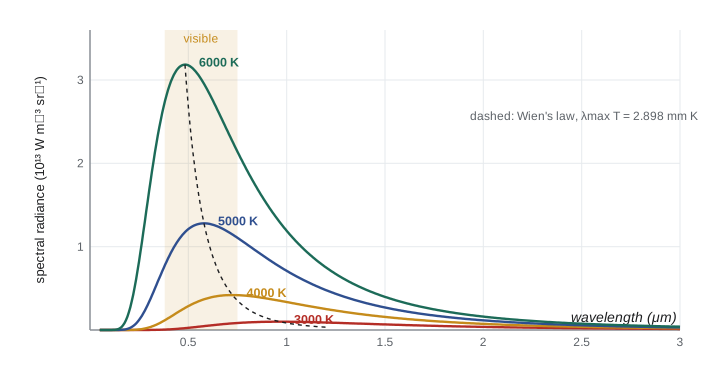
The radiation from a blackbody has a continuous spectrum that depends only on its temperature. Wilhelm Wien showed in 1893 that the peak wavelength is inversely proportional to temperature,
so the Sun, at 5772 K, peaks at about 500 nm in the green, a red-hot stove element at 1000 K near 2.9 μm in the infrared, and a human body at 310 K near 9.3 μm. Classical physics predicted that the spectral intensity should grow without limit at short wavelengths, the ultraviolet catastrophe. Max Planck found the correct formula in 1900 by assuming that energy is exchanged with the radiation in quanta of size \(h\nu\). In terms of wavelength the spectral radiance is
Integrating over all wavelengths and directions reproduces the Stefan–Boltzmann law and gives \(\sigma = 2\pi^5 k^4/(15 c^2 h^3)\), so Planck's constant and Boltzmann's constant together fix the value of \(\sigma\). Lesson 12 uses Planck's law to compare the spectrum of sunlight with the infrared glow of the Earth.
A wall on a cold night and a cooling cup
The program applies all three mechanisms. First it adds the thermal resistances of the layers of a typical wood-frame wall, from the inside air film to the outside air film, on a night when the outdoor temperature is \(-30\) °C, a hard January night in Minneapolis, when the thermometer falls to −22 °F; the room is at 21 °C. Since the same heat flux crosses every layer, the temperature drop across each layer is proportional to its resistance. Next it computes the radiative loss of a roof under a clear night sky, which radiates like a blackbody near \(-40\) °C. Finally it follows a 300 g cup of coffee cooling from 80 °C by convection and radiation, with time steps of one second.
import math
sigma = 5.670374419e-8

# Conduction through a wood-frame wall: layers in series (thermal resistance per m^2)
layers = [("inside air film", 0.12), ("gypsum board 13 mm", 0.08), ("mineral wool 140 mm", 3.87),
          ("plywood sheathing 11 mm", 0.10), ("vinyl siding", 0.11), ("outside air film", 0.03)]
R_total = sum(r for _, r in layers)
T_in, T_out = 21.0, -30.0
q = (T_in - T_out) / R_total
print(f"total resistance {R_total:.2f} m^2 K/W, U = {1 / R_total:.3f} W/(m^2 K), heat flux {q:.1f} W/m^2")
T = T_in
print(f"  {'inside':30s} {T:7.2f} C")
for name, r in layers:
    T -= q * r
    print(f"  after {name:24s} {T:7.2f} C")

# Radiation: a clear night sky behaves like a blackbody near -40 C
eps, T_roof, T_sky = 0.90, 263.15, 233.15
q_rad = eps * sigma * (T_roof**4 - T_sky**4)
h_rad = 4 * eps * sigma * ((T_roof + T_sky) / 2)**3
print(f"\nroof at -10 C under a -40 C sky: net radiation loss {q_rad:.1f} W/m^2 "
      f"(linearized coefficient {h_rad:.2f} W/(m^2 K))")

# Cooling of a mug of coffee: convection plus radiation, Euler time steps of 1 s
m, c = 0.30, 4186.0                   # kg, J/(kg K)
A, h_conv, eps_mug = 0.030, 10.0, 0.95
T_room = 293.15
Tc = 353.15                           # 80 C
t = 0
print("\n minute   coffee (C)   convection (W)   radiation (W)")
while t <= 3600:
    Pconv = h_conv * A * (Tc - T_room)
    Prad = eps_mug * sigma * A * (Tc**4 - T_room**4)
    if t % 600 == 0:
        print(f"  {t // 60:4d}     {Tc - 273.15:7.2f}       {Pconv:8.2f}         {Prad:8.2f}")
    Tc -= (Pconv + Prad) / (m * c)
t += 1total resistance 4.31 m^2 K/W, U = 0.232 W/(m^2 K), heat flux 11.8 W/m^2
inside 21.00 C
after inside air film 19.58 C
after gypsum board 13 mm 18.63 C
after mineral wool 140 mm -27.16 C
after plywood sheathing 11 mm -28.34 C
after vinyl siding -29.65 C
after outside air film -30.00 C
roof at -10 C under a -40 C sky: net radiation loss 93.9 W/m^2 (linearized coefficient 3.12 W/(m^2 K))
minute coffee (C) convection (W) radiation (W)
0 80.00 18.00 13.20
10 66.96 14.09 9.69
20 56.96 11.09 7.26
30 49.21 8.76 5.52
40 43.16 6.95 4.24
50 38.40 5.52 3.29
60 34.65 4.40 2.57The wall's total resistance is 4.31 m² K/W, so on that night each square meter loses 11.8 W. Almost the entire 51 K temperature drop, 46 K of it, occurs across the mineral wool, which has 90% of the resistance; the drywall and sheathing barely matter. The plywood sheathing sits at about \(-28\) °C, which is why vapor from inside must be stopped by a vapor retarder on the warm side: if moist indoor air reached the cold sheathing, it would condense and freeze there. A real wall loses more than this calculation suggests, because wood studs, about 0.12 W/(m K), form parallel paths that bypass the insulation. The roof loses 94 W/m² to the clear sky by radiation alone, which is why frost forms on car windshields and roofs on clear nights even when the air stays above freezing. The coffee loses heat at 31 W at first, with radiation responsible for about 40%; after an hour it has cooled to about 35 °C. Because the losses are proportional to the temperature difference, the cooling is roughly exponential, with a time constant of about 40 minutes for this cup.
Worked problem
Heat loss through a window
A double-glazed window of area 1.5 m² has an overall heat transfer coefficient \(U = 2.8\) W/(m² K), including its air films. Compare its heat loss with that of 1.5 m² of the wall above, on a night with 21 °C inside and \(-30\) °C outside. What does it cost to run for a month of such nights if electricity costs 0.10 dollars per kWh?
Show solution
- Window: \(P = UA\Delta T = 2.8 \times 1.5 \times 51 = 214\) W.
- Wall: \(U = 0.232\) W/(m² K) from the program, so \(P = 0.232 \times 1.5 \times 51 = 17.7\) W, about one-twelfth.
- Energy in 30 days: \(214\ \text{W} \times 720\ \text{h} = 154\) kWh for the window, 12.8 kWh for the wall.
- Cost: about 15.40 dollars for the window and 1.28 dollars for the wall, if heated with electric resistance.
Answer: The window loses about twelve times as much heat as the same area of insulated wall, around 214 W.
Common mistakes
MistakeAdding thermal conductivities of layers in series.
InsteadAdd resistances \(d/\kappa\) in series and conductances in parallel.
MistakeConfusing RSI with US R-values.
Instead1 RSI (m² K/W) equals 5.678 US R (ft² °F h/Btu).
MistakeUsing Celsius temperatures in \(\sigma T^4\).
InsteadRadiation laws need absolute temperatures; \(T^4\) of a Celsius value is meaningless.
MistakeNeglecting radiation at room temperature.
InsteadIts linearized coefficient is about 5 W/(m² K), comparable to natural convection.
MistakeAssuming shiny surfaces radiate like black ones.
InsteadPolished metals have emissivities of a few hundredths; that is why foil-faced insulation and thermos flasks work.
Summary and key terms
- Fourier's law \(q = -\kappa\,dT/dx\) governs conduction; resistances \(d/(\kappa A)\) add in series.
- The heat equation \(\partial T/\partial t = D\nabla^2 T\) spreads disturbances a distance \(\sqrt{Dt}\).
- Convection is summarized by Newton's law of cooling, \(P = hA\Delta T\), with \(h\) set by the flow.
- A blackbody radiates \(\sigma T^4\); real surfaces radiate \(\varepsilon\sigma T^4\), and good absorbers are good emitters.
- Wien's law \(\lambda_{\max}T = 2.898 \times 10^{-3}\) m K locates the peak of the Planck spectrum.
- In an insulated wall nearly all the temperature drop occurs across the insulation.
- thermal conductivity
- The constant in Fourier's law, in W/(m K).
- thermal resistance
- Temperature difference divided by heat current; d/(kA) for a slab.
- thermal diffusivity
- k/(rho c), which sets how fast temperature changes spread.
- convection coefficient
- The h in Newton's law of cooling, in W/(m^2 K).
- emissivity
- The ratio of a surface's thermal emission to that of a blackbody at the same temperature.
- blackbody
- An ideal absorber and emitter of radiation whose spectrum depends only on temperature.
Practice problems
Work each problem on paper first, then reveal the answer to check.
Find the heat current through a 2.0 m² glass pane 4.0 mm thick (\(\kappa = 1.0\) W/(m K)) with surfaces at 15 °C and 5 °C.
Show answer
\(P = 1.0 \times 2.0 \times 10/0.004 = 5000\) W. In practice the air films limit the loss far more than the glass does.
Convert RSI 5.3 to a US R-value.
Show answer
\(5.3 \times 5.678 = 30.1\), about R-30.
By what factor does the power radiated by a blackbody increase if its absolute temperature doubles?
Show answer
\(2^4 = 16\).
Find the peak wavelength of the radiation from a person with skin at 33 °C.
Show answer
\(\lambda = 2.898 \times 10^{-3}/306 = 9.5\) μm, in the thermal infrared.
How deep does a temperature change at the surface penetrate into soil (\(D = 5 \times 10^{-7}\) m²/s) in 30 days?
Show answer
\(\sqrt{Dt} = \sqrt{5 \times 10^{-7} \times 2.6 \times 10^6} = 1.1\) m.
A person with 1.8 m² of skin at 33 °C, emissivity 0.97, stands in a room whose walls are at 20 °C. Estimate the net radiative loss.
Show answer
\(0.97 \times 5.67 \times 10^{-8} \times 1.8 \times (306^4 - 293^4) = 0.97 \times 5.67 \times 10^{-8} \times 1.8 \times 1.40 \times 10^9 = 139\) W.
Lesson quiz · 5 questions
Score 60% or more to complete this lesson.
Create a free account to save your progress, take quizzes and earn a certificate.