
PHOT-499 · Lesson 8 of 12 · 28 min
Writing about the work
A capstone needs more writing than most students expect. The exhibition needs a title, a project text and labels; the book needs a text and captions; the portfolio and website need a statement and a short biography; every image needs a caption and alt text; and the defense, grant applications and press outreach all draw on the same material. Writing is assessed separately in this course because it is how most people first meet your work: a jury reads the statement before looking, a visitor reads the wall text before walking in, and a screen-reader user meets the image through its description. PHOT-401 lesson 11 covered writing artist statements and PHOT-230 lesson 11 and PHOT-320 lesson 8 covered captions and accuracy; this lesson assembles the full set of texts a capstone needs and the process for writing them well.
The texts a capstone needs
Different texts serve different readers and lengths. Writing them as a set, from the same core description, keeps them consistent; writing each from scratch at the last minute produces contradictions that reviewers notice.
| Text | Reader | Typical length |
|---|---|---|
| Title and subtitle | Everyone | A few words |
| Core description | You; the source for all other texts | 50 words |
| Artist statement | Juries, curators, portfolio reviewers | 150 to 300 words |
| Project or wall text | Exhibition visitors, book readers | 200 to 400 words |
| Biography | Programs, websites, press | 50 to 100 words, third person |
| Captions and labels | Visitors, readers | 1 to 3 lines each, plus optional quotes |
| Alt text | People using screen readers | One or two sentences per image |
| Social and press copy | Public, journalists | 30 to 150 words |
| Post-production statement | Juries, supervisors | 50 to 150 words |
Start with a core description
Before drafting any public text, write a 50-word core description in plain language that says what the work is, where and when it was made, how, and why. Test it by reading it aloud to someone who does not know the project and asking them to tell it back. If they cannot, simplify. Every other text expands, shortens or adapts this description; when you change the project's emphasis, change the core first.
Amara's core description read: "Night Shift is a series of portraits and empty workplaces made between midnight and dawn with bakers, cleaners, transit mechanics, a radio host and taxi drivers in one city in 2026. Each worker chose where to stand. The empty rooms show the traces of work that most of the city never sees."
Worked problem
Expanding a core description to a word budget
Amara's wall text has a limit of 300 words. She plans a paragraph on what and where (60 words), a paragraph on how she worked with the subjects (80 words), a paragraph on why night work matters (90 words), a quote from a subject (30 words) and a closing note on the pairs and how to read the wall (40 words). Does the plan fit, and what reading time does it imply?
Show solution
- Total: \( 60 + 80 + 90 + 30 + 40 = 300 \) words, exactly the limit.
- At a typical silent reading speed of about 200 to 250 words per minute for general audiences, 300 words take about \( 300/250 = 1.2 \) to \( 300/200 = 1.5 \) minutes.
- Visitors standing at a wall often read less than they would sitting, so a text near the upper limit benefits from short paragraphs and a strong first sentence.
Answer: The plan fits at 300 words and takes about 70 to 90 seconds to read. Amara keeps the first paragraph self-sufficient, so a visitor who reads only it still understands the project.
The artist statement
The artist statement explains the work to professional readers: juries, curators, editors and reviewers. It should say what the work is, how it was made, what questions it pursues and how it relates to your wider practice. Use the first person and the present tense, plain language and specific details. Avoid both modesty that undersells ("I just like taking pictures of people") and inflated theory that the images do not support. A good test is whether every sentence could only be about this project; a sentence that could describe any project should go.
| Draft sentence | Problem | Revision |
|---|---|---|
| This series explores the human condition in the urban nocturnal environment. | Abstract; could describe any project | I photographed people who keep the city running between midnight and dawn. |
| I wanted to capture their stories. | Vague verb; the images do not tell stories in sequence | Each worker chose where to stand and what to hold. |
| The images interrogate notions of visibility. | Inflated vocabulary | The empty rooms show traces of work that most people never see. |
| I hope viewers will think about it. | Weak ending | When the morning shift arrives, the night's work has already disappeared. |
Captions and labels
Captions in a documentary capstone carry facts: who, what, where and when. They should be accurate, checked against field notes and, where possible, approved by the people in them. Use names only with permission and spell them correctly; describe people as they would describe themselves; and avoid adjectives that tell the viewer what to feel. Extended captions can include a short quotation from the subject, which adds a second voice to the work. Amara asked each subject to read their caption before the exhibition, and two of them asked for changes to job titles, which she made.
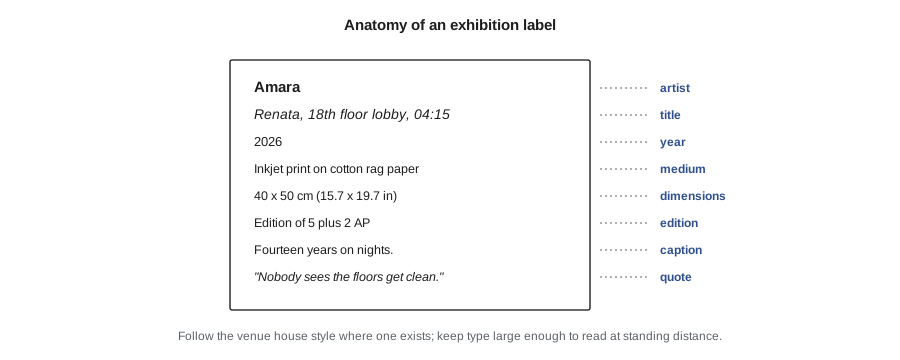
Exhibition labels follow a standard pattern in galleries: title, date, medium and dimensions, sometimes followed by an edition statement and a short caption. Exact formats vary by institution, so follow the gallery's house style if it has one. PHOT-430 lesson 11 discusses label legibility, type size and placement.
| Weak | Why | Strong |
|---|---|---|
| Tired worker at night. | No name, no place, tells viewer what to feel | Renata, 52, cleaning supervisor, 18th floor lobby, 04:15. Fourteen years on nights. |
| A baker. | Missing context | Luis, apprentice baker, shapes the first loaves at 02:40. "By four the street belongs to the delivery vans." |
| Empty garage. | Says what the viewer can see | Transit maintenance yard, bay 3, after the last bus returns at 01:30. |
Alt text and accessibility
Alt text is a short text alternative to an image, read aloud by screen readers to people who are blind or have low vision and shown when an image fails to load. Web accessibility standards, the Web Content Accessibility Guidelines (WCAG), require a text alternative for meaningful images. Good alt text describes what is important in the image in its context, in one or two sentences, without starting with "image of"; it does not repeat the caption word for word. For complex images, or where the visual content is the point, a longer image description can sit in the page text or behind a link. Many organizations recommend keeping alt text concise, often under about 150 characters, with longer descriptions elsewhere.
In the United States, the Department of Justice's ADA Title II rule requires state and local government web content, including public universities, to meet WCAG 2.1 Level AA, with compliance dates extended in 2026 to April 2027 for larger entities and April 2028 for smaller ones. Your portfolio site may not be legally required to comply, but your school's site and many public galleries will be, and juries increasingly expect accessible submissions.
Worked problem
Writing alt text for a portrait
Amara's caption reads: "Renata, 52, cleaning supervisor, 18th floor lobby, 04:15. Fourteen years on nights." Write alt text of no more than about 150 characters that adds what the caption does not say.
Show solution
- The caption gives name, age, role, place and time; the alt text should describe what a sighted viewer sees.
- Draft: "A woman in a blue uniform stands with folded arms beside a cleaning cart in a dark marble lobby, lit from one side, city lights behind glass." Count: about 140 characters.
- Check: it describes the person, pose, setting and light without repeating the caption or interpreting her mood.
Answer: "A woman in a blue uniform stands with folded arms beside a cleaning cart in a dark marble lobby, lit from one side, city lights behind glass." It fits the limit and complements the caption.
Readability and plain language
Public texts should be readable by a general adult audience. Plain language guidelines recommend short sentences, common words, active verbs and one idea per paragraph. Readability formulas, such as the Flesch reading ease score, estimate difficulty from sentence length and syllables per word. They are crude and ignore meaning, but they flag texts that are likely to be hard going. BUS-120 lesson 2 discusses plain language in professional writing more generally.
import re
def syllables(word):
    w = word.lower().strip('.,;:!?"')
    groups = re.findall(r'[aeiouy]+', w)
    n = len(groups) - (1 if w.endswith('e') and len(groups) > 1 else 0)
    return max(1, n)
def flesch(text):
    sentences = max(1, len(re.findall(r'[.!?]', text)))
    words = text.split()
    syl = sum(syllables(w) for w in words)
    return 206.835 - 1.015 * len(words) / sentences - 84.6 * syl / len(words), len(words) / sentences
draft = ('This series interrogates the invisibility of nocturnal work through a dialectical '
         'juxtaposition of portraiture and architectural emptiness, foregrounding precarity.')
plain = ('I photographed people who work at night. Each worker chose where to stand. '
         'The empty rooms show the traces of work that most of the city never sees.')
for name, t in [('draft', draft), ('plain', plain)]:
    score, wps = flesch(t)
print(f'{name}: reading ease {score:.0f}, words per sentence {wps:.1f}')draft: reading ease -44, words per sentence 19.0 plain: reading ease 89, words per sentence 9.3
The inflated draft scores far below zero, which signals text that general readers will struggle with; the plain version scores in the easy range. Use a score like this as a prompt to reread, not as a target in itself: a text can score well and still say nothing.
Language and translation
Consider which languages your audience reads. A bilingual or multilingual community may expect texts in more than one language, and some venues have legal or policy requirements.
In the United States there is no general legal requirement for exhibition texts in particular languages, but venues serving communities that speak Spanish or other languages often provide translations, and public institutions may have language access policies. Have translations made or checked by a fluent speaker; machine translation of artistic texts often misses tone and specialist terms.
Writing with and about the people in the work
Representation does not end at the shutter. The words around an image shape how viewers see the people in it. Use people's own words where you can, ask how they want to be named and described, avoid terms they would find demeaning, and do not speak for them about experiences you did not share. Where subjects reviewed images under an agreement, let them review captions too. If someone asks not to be named, use a role or no name, and check that other details do not identify them indirectly.
The biography and professional copy
The biography is a short third-person text for programs, websites and press: name, where you are based, what you do, key education and exhibitions, and one sentence on your current work. Keep a 50-word and a 100-word version. Social and press copy adapts the core description to its medium: a hook in the first line, the essential facts (what, where, when, opening hours), a credit and accessibility information. Write these in week 11 or 12 so they are ready for launch; lesson 9 covers the output and lesson 10 the online presence that uses them.
A writing schedule
Draft the core description in week 2 with the proposal, the artist statement at mid-term, captions from week 8 as the edit settles, and the wall text, biography, alt text and press copy in weeks 10 to 12. Leave time for others to read and for subjects to approve captions. The writing deliverable is due in week 12 so that labels can be printed and installed in time.
| Week | Text | Reviewer |
|---|---|---|
| 2 | Core description | Supervisor |
| 7 | Artist statement draft | Mid-term panel |
| 8 to 10 | Captions and quotes | Subjects, site partners |
| 10 | Wall text and book text | Supervisor, one outside reader |
| 11 | Alt text, biography, press and social copy | Classmate, accessibility check |
| 12 | Final set and labels to print | Gallery coordinator |
Common mistakes
MistakeWriting each text from scratch at the last minute
InsteadWrite a core description first and derive every text from it on a schedule.
MistakeFilling statements with abstract or inflated vocabulary
InsteadUse plain, specific sentences that could only describe this project.
MistakeCaptions that tell viewers what to feel
InsteadGive accurate facts and, where possible, the subject's own words.
MistakeAlt text that repeats the caption or begins with "image of"
InsteadDescribe what matters visually in one or two sentences that complement the caption.
MistakePublishing names and descriptions without the subjects' agreement
InsteadAsk how people want to be named and described, and let them review captions.
Summary and key terms
- A capstone needs a family of texts for different readers and lengths.
- Start with a 50-word core description and derive every other text from it.
- Artist statements use plain, specific, first-person language.
- Captions carry accurate facts and can add the subject's own voice.
- Alt text describes what matters visually and complements the caption; public institutions must meet WCAG under the ADA Title II rule.
- Readability formulas flag hard texts but do not measure meaning.
- Plan languages, subject review and a writing schedule ending in week 12.
- Core description
- A short plain-language description from which all project texts derive.
- Artist statement
- A first-person text explaining the work to professional readers.
- Wall text
- An introductory text displayed in an exhibition.
- Caption
- Text accompanying an image with facts about it.
- Exhibition label
- A small panel giving title, date, medium, dimensions and other details for a work.
- Alt text
- A short text alternative for an image read by screen readers.
- Image description
- A longer text describing the visual content of an image.
- WCAG
- The Web Content Accessibility Guidelines, the main standard for accessible web content.
- Plain language
- Writing that the intended audience can understand the first time they read it.
- Biography
- A short third-person text about a photographer's background and work.
Practice problems
Work each problem on paper first, then reveal the answer to check.
How long is a typical artist statement?
Show answer
About 150 to 300 words.
At 220 words per minute, how long does a 330-word wall text take to read?
Show answer
1.5 minutes.
What four facts should a documentary caption carry?
Show answer
Who, what, where and when.
Give two rules for good alt text.
Show answer
Describe what matters visually; do not repeat the caption or start with "image of".
What is a core description and how long is it?
Show answer
A plain-language description of about 50 words from which other texts derive.
What does a low Flesch reading ease score suggest?
Show answer
The text is likely to be hard for general readers.
What standard pattern do gallery labels follow?
Show answer
Title, date, medium and dimensions, often with an edition and caption.
Why let subjects review captions?
Show answer
To check accuracy and how they are named and described.
Which accessibility standard sets text alternative requirements?
Show answer
WCAG.
In which person is a biography usually written?
Show answer
The third person.
Lesson quiz · 5 questions
Score 60% or more to complete this lesson.
Create a free account to save your progress, take quizzes and earn a certificate.