
PHOT-499 · Lesson 3 of 12 · 33 min
Planning, permissions and pre-production
An approved proposal says what you will make; the production plan says how, when, at what cost and with whose permission. It is the second assessed deliverable, due in week 3, and it has four parts: a schedule, a budget, a permissions and ethics plan, and a risk register. Planning feels like a delay when you want to start shooting, but every hour spent here saves several later. The business methods behind estimates and contracts were covered in PHOT-410 lessons 3 and 5, consent and representation in PHOT-401 lesson 5, and the law of photographing in public in PHOT-230 lesson 7; this lesson applies them to the specific shape of a term-long project and adds the scheduling and risk tools a capstone needs.
Building the schedule
A schedule lists tasks, how long each takes, which tasks must finish before others can start, and who or what each task depends on. For a capstone, the most useful form is a simple network of tasks with dependencies, from which you can find the critical path: the longest chain of dependent tasks from start to finish. Any delay on the critical path delays the opening; delays on other tasks are absorbed by their float, the spare time before they would affect the end date. Knowing which tasks are critical tells you where to put your attention and your buffers.
Start from the output tasks identified in lesson 1, add production and pre-production tasks, and draw arrows for real dependencies only. "Edit" depends on "shoot", and "order prints" depends on "final edit", but "write captions" can run in parallel with post-production once the edit is fixed. External tasks such as framing and book proofs deserve their own lines because their durations are not under your control.
Worked problem
Finding the critical path
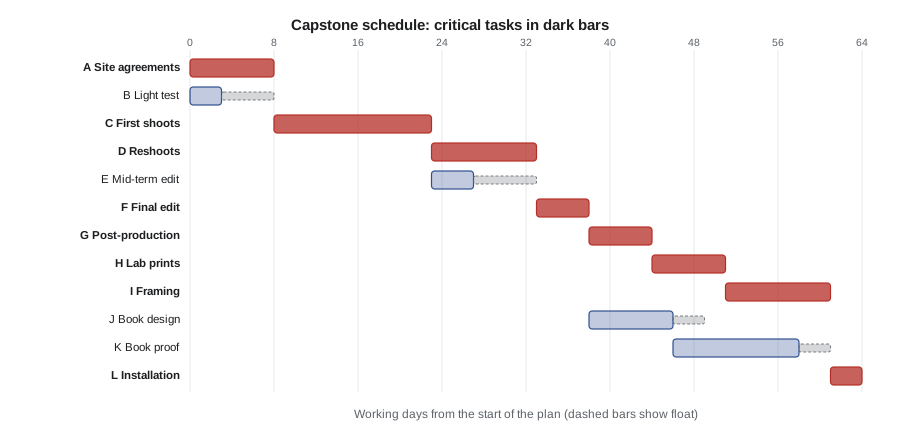
Amara's simplified plan has these tasks and durations in working days: A secure site agreements (8); B test lighting kit (3, after nothing); C first shoots (15, after A and B); D second shoots and reshoots (10, after C); E mid-term edit (4, after C); F final edit (5, after D and E); G post-production (6, after F); H prints at lab (7, after G); I framing (10, after H); J book dummy design (8, after F); K book proof (12, after J); L installation (3, after I and K). What is the shortest project duration and which tasks are critical?
Show solution
- Earliest finishes: A 8, B 3, C \( \max(8, 3) + 15 = 23 \), D \( 23 + 10 = 33 \), E \( 23 + 4 = 27 \), F \( \max(33, 27) + 5 = 38 \).
- Print branch: G \( 38 + 6 = 44 \), H \( 44 + 7 = 51 \), I \( 51 + 10 = 61 \). Book branch: J \( 38 + 8 = 46 \), K \( 46 + 12 = 58 \).
- L starts after \( \max(61, 58) = 61 \) and finishes at 64.
- Critical path: A, C, D, F, G, H, I, L. The book branch has \( 61 - 58 = 3 \) days of float; B has 5 days of float; E has 6.
Answer: The project needs 64 working days, about 13 weeks. Site agreements, shooting, editing, post-production, printing and framing are all critical, so a slow framer or a late agreement moves the opening; the book proof is nearly critical and should be ordered as early as the edit allows.
tasks = {  # name: (duration in working days, predecessors)
    'A agreements': (8, []), 'B light test': (3, []), 'C first shoots': (15, ['A agreements', 'B light test']),
    'D reshoots': (10, ['C first shoots']), 'E midterm edit': (4, ['C first shoots']),
    'F final edit': (5, ['D reshoots', 'E midterm edit']), 'G post': (6, ['F final edit']),
    'H prints': (7, ['G post']), 'I framing': (10, ['H prints']), 'J book design': (8, ['F final edit']),
    'K book proof': (12, ['J book design']), 'L install': (3, ['I framing', 'K book proof'])}
ef = {}
for t in tasks:  # tasks are listed in dependency order
    d, pre = tasks[t]
    ef[t] = max([ef[p] for p in pre], default=0) + d
end = max(ef.values())
lf = {t: end for t in tasks}
for t in reversed(list(tasks)):
    succ = [s for s in tasks if t in tasks[s][1]]
    if succ:
        lf[t] = min(lf[s] - tasks[s][0] for s in succ)
for t in tasks:
    fl = lf[t] - ef[t]
    print(f'{t:16s} finish day {ef[t]:3d}  float {fl:2d}' + ('  critical' if fl == 0 else ''))
print('project length', end, 'working days')A agreements finish day 8 float 0 critical B light test finish day 3 float 5 C first shoots finish day 23 float 0 critical D reshoots finish day 33 float 0 critical E midterm edit finish day 27 float 6 F final edit finish day 38 float 0 critical G post finish day 44 float 0 critical H prints finish day 51 float 0 critical I framing finish day 61 float 0 critical J book design finish day 46 float 3 K book proof finish day 58 float 3 L install finish day 64 float 0 critical project length 64 working days
Budgeting
The capstone budget should list every expected cost, with a source for each figure, and a contingency. Typical lines are travel, equipment rental or purchase, consumables, model or participant costs (refreshments, prints given as thanks, transport), location fees, printing and framing, book proofs, exhibition materials (signage, wall text, hardware), storage media, software subscriptions, insurance and any fees for assistants. Use quotes where possible and label estimates. A contingency of about 10 to 15 percent on uncertain lines is common; output costs and travel are the most likely to rise.
A budget is also a design tool. If framing twenty prints would cost more than you can afford, the decision to show fifteen framed prints and five unframed pinned prints, or to use a different presentation method from PHOT-430 lesson 10, is an artistic decision forced by money, and it is better made in week 3 than in week 11.
| Line | Basis | Amount |
|---|---|---|
| Travel to sites | 24 trips, transit and late-night taxis | 420 |
| Battery LED light and stand | Purchase, used | 260 |
| Storage | Two 4 TB drives plus cloud plan for term | 330 |
| Participant thanks | 30 small prints and coffee | 180 |
| Exhibition prints | 15 prints 40 x 50 cm, lab quote | 600 |
| Framing | 15 frames, educational discount quote | 900 |
| Book proof | Print-on-demand, 48 pages, two copies | 110 |
| Signage and wall text | Vinyl title and printed labels | 90 |
| Subtotal | 2,890 | |
| Contingency | 12 percent on travel, prints, framing and proof | 245 |
| Total | 3,135 |
Worked problem
Budgeting a shoot day with contingency
A night shoot at the transit yard needs: a taxi home after 3 a.m. (estimated 38), a transit fare in (3.35), coffee and snacks for the crew of six (30), a reflector rental (15) and a power bank (owned, no cost). Amara adds 15 percent contingency on taxi and rental only. What should she budget for the day?
Show solution
- Base: \( 38 + 3.35 + 30 + 15 = 86.35 \).
- Contingency: \( 0.15 \times (38 + 15) = 7.95 \).
- Total: \( 86.35 + 7.95 = 94.30 \).
Answer: About 94 for the day. Across eight such shoots, small items add up to about 750, which is why per-shoot costs belong in the budget rather than being treated as personal spending.
Permissions: access agreements
Access agreements with sites and organizations are often the first critical-path task. A short written agreement, even an email that both parties confirm, should state who you are, what you will photograph, when, the conditions the site sets (areas off limits, safety rules, supervision, review of images), how the images will be used (exhibition, book dummy, portfolio, website, possible publication), what the site will receive, and how either side can end the arrangement. Ask early, ask the person with authority to agree, and confirm in writing. Large organizations often route requests through communications or media relations departments, which can take weeks.
Some sites have legal duties that limit photography. Hospitals must protect patients' health information, so Amara's agreement with the hospital limited her to staff areas, required that no patient or patient information appear in any frame, and gave the hospital's communications office a right to review images for privacy issues before exhibition. That review was about privacy, not taste, and the agreement said so.
In the United States, the HIPAA Privacy Rule applies to covered entities such as hospitals. Hospitals generally need a patient's written authorization before allowing photography that could identify a patient for purposes outside treatment, which is why media policies set strict conditions and route requests through communications offices.
Releases and the right to one's image
A release is a signed permission from a person (a model release) or a property owner (a property release) for specified uses of images. Whether you legally need one depends on the jurisdiction, the setting and the use, which PHOT-230 lesson 7 and PHOT-410 lesson 5 discuss in detail. For a capstone, two practical rules apply. First, get releases from everyone who is the clear subject of a portrait, whatever the law, because releases document informed consent and keep options open for later publication, books and grants. Second, explain uses in plain language, including exhibition, book, website, social media, portfolio, competitions and possible sale of prints, and do not imply uses are narrower than they are.
In the United States, rights depend on state law. Statutes such as New York Civil Rights Law sections 50 and 51 and California Civil Code section 3344 restrict use of a person's name or likeness for advertising or trade without written consent, but courts have generally treated art, news and books as outside "advertising or trade". In Foster v. Svenson (2015), a New York appellate court held that an artist who photographed neighbors through their apartment windows had not violated the statute because the work was artistic expression, while describing the conduct as disturbing. Intrusion upon seclusion still protects people in private settings in most states, and selling prints or using images to promote a commercial service can change the analysis.
| Subject | Site | Release signed | Uses agreed | Review requested | Print given |
|---|---|---|---|---|---|
| Baker, owner | Bakery | Yes | All listed uses | Yes, before exhibition | Yes |
| Baker, apprentice | Bakery | Yes | All except social media | No | Yes |
| Cleaner 1 | Hospital | Yes | Exhibition, book, portfolio | Hospital privacy review | Yes |
| Cleaner 2 | Hospital | Declined | None; not photographed identifiably | Not applicable | Not applicable |
| Mechanic 1 | Transit yard | Yes | All listed uses | Employer review | Pending |
| Radio host | Radio station | Yes | All listed uses | No | Yes |
| Driver 1 | Taxi stand | Verbal only | Pending written release | No | Pending |
Worked problem
Checking release coverage before the edit
Amara's draft edit has 26 images: 14 portraits of named subjects, 8 empty interiors and 4 scenes with people at a distance who are not identifiable. Of the 14 portrait subjects, 11 have signed releases covering all uses, 2 have releases excluding social media and 1 has given only verbal consent. Which images are fully cleared for the exhibition, book and social media launch?
Show solution
- Exhibition and book: the 11 full releases plus the 2 that exclude only social media, giving 13 portraits; plus 8 interiors (site agreements cover these) and the 4 non-identifiable scenes: \( 13 + 8 + 4 = 25 \).
- Social media: the 11 full releases plus 12 non-portrait images, giving 23.
- The verbal-consent portrait is not yet cleared for any public use.
Answer: 25 of 26 images can go into the exhibition and book, and 23 into social media posts. Amara must obtain a written release from the driver or replace that image before the final edit in week 9.
Community consent and Indigenous protocols
When a project involves a community rather than only individuals, consent has a collective dimension. A neighborhood, a congregation, a workplace or a cultural community may have views on how it is represented, and individual releases do not settle those views. Talk with community organizations early, share work in progress, and be willing to change plans. Where work involves Indigenous peoples, places or cultural practices, additional protocols apply, set by the communities themselves.
In the United States, federally recognized tribes are sovereign nations that set their own rules for photography on tribal lands; some require permits for any photography, some prohibit photographing ceremonies or certain places, and some require approval from a tribal council or cultural office. The CARE principles for Indigenous data governance (collective benefit, authority to control, responsibility and ethics) are widely used guidance. If a project gathers interviews or data as research, a school's institutional review board may need to review it, and some tribes operate their own review boards.
Location permits and site rules
Photographing in publicly accessible places is generally lawful without a permit, but permits may be needed when a shoot occupies a street or sidewalk, uses stands, lights or crews in public places, needs parking, or takes place in a park or on transit property. Many cities run a film office that issues permits; requirements depend on the size of the crew and the equipment rather than on whether the work is commercial. Private property, including shopping centers and transit stations, is governed by the owner's rules.
On National Park Service lands, the EXPLORE Act, signed in January 2025, means that still photography and filming generally need no permit or fees when the group is eight people or fewer, only hand-carried equipment is used, the activity is in areas open to the public and does not need exclusive use of a site or harm resources, according to NPS guidance checked in October 2026; larger or more disruptive shoots still need a permit. City film offices set their own thresholds. Drone use falls under FAA rules, covered in PHOT-350.
Safety planning for fieldwork
Capstone shoots often happen in places and at times that carry risk: at night, in industrial sites, in traffic, in bad weather, or in emotionally difficult settings. Your school will have a fieldwork or off-campus activity policy; follow it, and write a short safety plan for each kind of shoot. For night work, Amara's plan included a check-in system (a text to a classmate at arrival and departure, with a call if no message by an agreed time), routes and late-night transport home, the site safety orientation and protective equipment the transit yard required, and a rule never to photograph alone at the taxi stand after 2 a.m. The hazard-identification and personal protective equipment methods in HSE-103 and HSE-104 apply to photographers as much as to workers.
| Risk | Likelihood (1 to 5) | Impact (1 to 5) | Score | Response |
|---|---|---|---|---|
| Hospital withdraws access | 2 | 4 | 8 | Second hospital contact; keep cleaning-company alternative |
| Framer delay | 3 | 4 | 12 | Order early; quote from second framer; buffer of 3 days |
| Drive failure loses raw files | 2 | 5 | 10 | 3-2-1 backup from first shoot (lesson 7) |
| Illness in production weeks | 3 | 3 | 9 | Two spare shoot nights in weeks 8 and 9 |
| Subject withdraws consent after shoot | 2 | 3 | 6 | Shoot more subjects than needed; remove images promptly |
| Unsafe situation at night | 2 | 5 | 10 | Check-in system; never alone at taxi stand after 2 a.m. |
Scores multiply likelihood by impact. Anything scoring 10 or more needs a specific response and an owner; lower scores can be monitored. Review the register at each supervision meeting and update the scores as conditions change.
Insurance and equipment
Check what your school's insurance covers. Many schools insure students for liability during approved coursework but not for personal equipment, and venues or sites sometimes ask for a certificate of insurance naming them as additional insured. Personal equipment insurance through a professional association or a specialist insurer, discussed in PHOT-410 lesson 10, is worth considering before taking gear into industrial sites or onto transit at night. Prepare equipment before production: test the full kit together, label batteries and cards, update firmware and keep a written checklist for each kind of shoot.
Common mistakes
MistakeStarting shoots before site agreements are confirmed in writing
InsteadMake access agreements the first critical-path task and confirm terms in writing.
MistakeRelying on verbal consent for portraits in the final edit
InsteadObtain written releases that describe all intended uses in plain language.
MistakeAssuming individual releases settle community consent
InsteadConsult community organizations and follow Indigenous and community protocols.
MistakeBudgeting only for prints and framing
InsteadInclude travel, participant thanks, storage, signage, insurance and a contingency.
MistakeWriting a risk register and never reviewing it
InsteadReview and update scores at every supervision meeting.
Summary and key terms
- The production plan has a schedule, a budget, a permissions and ethics plan and a risk register.
- The critical path is the longest chain of dependent tasks; delays on it move the opening.
- Budget every line with a source and add contingency to uncertain lines.
- Written access agreements state scope, conditions, uses, review and exit.
- Get written releases from portrait subjects describing all uses, whatever state law requires.
- Community and Indigenous protocols add collective consent to individual releases.
- Write a safety plan for fieldwork and score risks by likelihood and impact.
- Critical path
- The longest chain of dependent tasks, which sets the project duration.
- Float
- The time a task can slip without delaying the project end.
- Contingency
- Money or time set aside for uncertain costs or delays.
- Access agreement
- A written arrangement with a site or organization setting terms for photography.
- Model release
- A signed permission from a person for specified uses of their image.
- Property release
- A signed permission from a property owner for specified uses of images.
- Right to image
- A person's legal interest in how their likeness is captured and used.
- OCAP
- First Nations principles of ownership, control, access and possession of information.
- Risk register
- A table of risks scored by likelihood and impact with planned responses.
- Certificate of insurance
- A document showing insurance coverage, often naming a venue as additional insured.
Practice problems
Work each problem on paper first, then reveal the answer to check.
Tasks A (5 days) and B (3 days) both precede C (4 days). What is C's earliest finish?
Show answer
Day 9.
A task finishes on day 40 but could finish on day 46 without delaying the end. What is its float?
Show answer
6 days.
Base costs are 2,000, of which 1,200 is uncertain. What is a 12 percent contingency on the uncertain lines?
Show answer
144.
What six items should an access agreement cover?
Show answer
Who you are, what, when, conditions, uses and what the site receives, plus how to end it.
Score a risk with likelihood 4 and impact 3. Does it need a specific response at a threshold of 10?
Show answer
12, so yes.
Why get releases even where the law may not require them?
Show answer
They document informed consent and keep options open for books, grants and publication.
Which New York case concerned an artist photographing neighbors through windows?
Show answer
Foster v. Svenson (2015).
Who sets photography rules for Indigenous communities?
Show answer
The communities themselves, through their own protocols and governing bodies.
Give two parts of a night-shoot safety plan.
Show answer
A check-in system and planned late-night transport home.
Why should hospital image review be described in writing?
Show answer
To make clear it concerns patient privacy, not editorial taste.
Lesson quiz · 5 questions
Score 60% or more to complete this lesson.
Create a free account to save your progress, take quizzes and earn a certificate.