
PHOT-499 · Lesson 5 of 12 · 31 min
Production II: problem-solving, reshoots and the mid-term review
No capstone goes exactly to plan. A site withdraws access, a key subject moves away, a drive fails, a week is lost to illness, or the images simply do not say what the proposal hoped they would. What distinguishes successful projects is not the absence of problems but how quickly they are noticed and how well they are handled. This lesson covers problem-solving during production, managing changes to the plan, the mid-term review in week 7, and planning reshoots. It builds on the critique methods of PHOT-401 lessons 7 and 8 and the scheduling and risk tools from lesson 3.
Noticing problems early
Problems are cheapest to solve when they are small. The weekly review from lesson 4 and the risk register from lesson 3 are your early warning system. Watch for signals: a site contact who stops replying, a coverage gap that does not close, shoots that take longer than planned, a budget line that is running ahead, images that look competent but do not move you, or a growing reluctance to go out and shoot. Each of these is information. Write it in the log, decide whether it needs action, and if it does, act within the week.
Some signals are about you rather than the project. Night shoots, demanding subjects and a heavy course load can wear people down. Fatigue leads to mistakes with files and safety, and to poor judgment in the edit. Build rest into the schedule, especially after late shoots, and treat a persistent loss of energy or motivation as a real problem to raise with your supervisor or the school's support services, not as a personal failing to hide.
A method for solving production problems
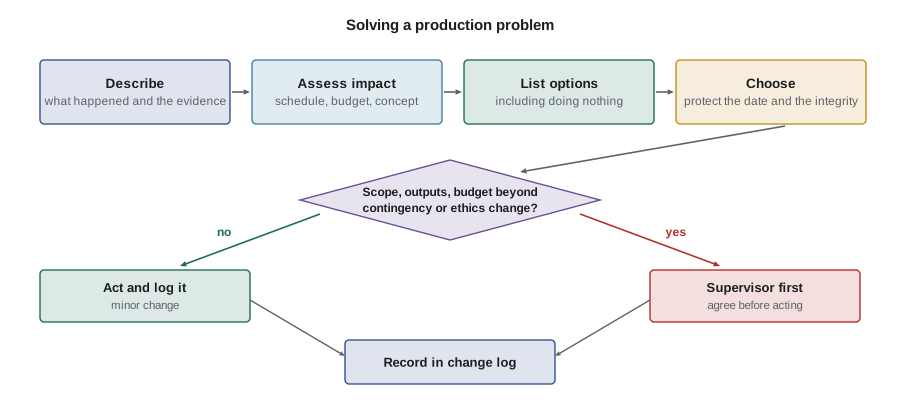
When a problem appears, work through four questions. What exactly has happened, and what is the evidence? What is the impact on the critical path, the budget, the coverage grid and the concept? What are the options, including doing nothing? Which option best protects the opening date and the integrity of the work at an acceptable cost? Write the answers in the log; if the decision changes the scope, outputs, budget by more than the contingency, or the ethical basis of the project, discuss it with your supervisor before acting.
| Problem | Typical responses |
|---|---|
| Site withdraws access | Use the alternative from the risk register; ask why and whether partial access is possible; adjust coverage |
| Subject withdraws consent | Delete or set aside their images promptly; thank them; do not argue; adjust the edit |
| Drive or card failure | Restore from backup; check the backup routine; reshoot only what was lost |
| Weather or season changes | Shift shoot types; use float on non-critical tasks |
| Illness | Use spare shoot nights; reduce scope if the critical path is hit |
| Images do not carry the concept | Review with supervisor; change approach deliberately; revisit the question |
| Budget running ahead | Compare with contingency; cut or change output costs early |
Managing changes to the plan
The approved proposal and production plan are the baseline. Changes are normal, but they should be deliberate and recorded. A simple change log lists the date, what changed, why, the impact on schedule, budget and outputs, and who approved it. Minor changes, such as swapping the order of two shoots, need only a log entry. Major changes, such as replacing a site, switching from a book to a screen-based output, or changing the question, need supervisor approval and may need updated permissions.
When the hospital's communications office paused Amara's access in week 6 during a busy period, she logged the problem, checked the critical path (hospital shoots were on it), and chose between waiting, switching to the cleaning company that serviced several office towers, or dropping the hospital strand. She proposed switching to the office towers while keeping the two hospital portraits already cleared, which preserved the theme of cleaning work at night, cost two extra travel nights and needed new access agreements and releases. Her supervisor approved the change on condition that the new agreements were in place before shooting.
| Date | Change | Reason | Impact | Approved |
|---|---|---|---|---|
| Week 5 | Interiors: lower camera, traces of work, longer exposures | Interiors looked like real estate images | None on schedule | Log only |
| Week 6 | Replace hospital strand with office tower cleaning | Hospital paused access | Two extra nights, new agreements | Supervisor, with condition |
| Week 7 | Drop audio slideshow; keep quotes as captions | Hours over plan after site change | Saves about 10 hours | Supervisor |
| Week 8 | Book from 48 to 40 pages | Edit tighter than planned | Saves proof cost | Log only |
Checking progress against the plan
Progress is easier to judge with numbers. Compare the work you planned to have done by now with the work actually done, and the money you planned to spend with the money actually spent. A simple way, borrowed from project management, is to estimate the percentage complete of each stage, multiply by the stage's planned hours to get the earned hours, and compare earned hours with the planned hours to date and the actual hours spent. If earned is below planned, you are behind schedule; if actual is above earned, the work is taking longer than estimated.
Worked problem
Schedule and effort variance at mid-term
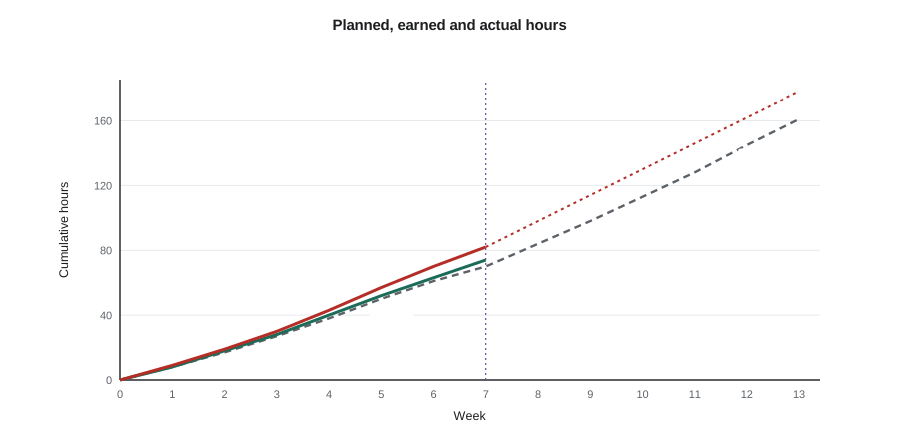
By the end of week 7 Amara planned to have completed 70 hours of work. She has actually spent 82 hours. Estimating percentage complete by stage against planned hours gives: research and proposal 14 of 14 hours, pre-production 18 of 18, shooting 75 percent of 45 hours, file management 60 percent of 10, editing 15 percent of 16. What are her earned hours, schedule variance and effort variance?
Show solution
- Earned hours: \( 14 + 18 + 0.75 \times 45 + 0.6 \times 10 + 0.15 \times 16 = 14 + 18 + 33.75 + 6 + 2.4 = 74.15 \).
- Schedule variance: earned minus planned, \( 74.15 - 70 = +4.15 \) hours, so she is slightly ahead of plan.
- Effort variance: earned minus actual, \( 74.15 - 82 = -7.85 \) hours, so the work has taken about 11 percent more effort than estimated (\( 82/74.15 \approx 1.11 \)).
Answer: Amara is a little ahead on output but working harder than planned. If the remaining work also runs 11 percent over, it will need more hours than she has, so the week 7 decision to drop the audio slideshow is justified by the numbers.
plan = {'research': 14, 'preproduction': 18, 'shooting': 45, 'files': 10, 'editing': 16, 'post': 12,
        'writing': 10, 'output': 14, 'install': 8, 'portfolio': 8, 'presentation': 6}
done = {'research': 1.0, 'preproduction': 1.0, 'shooting': 0.75, 'files': 0.6, 'editing': 0.15}
actual, capacity_left = 82, 6 * 12 * 0.9
earned = sum(plan[k] * done.get(k, 0) for k in plan)
remaining_plan = sum(plan.values()) - earned
factor = actual / earned
forecast = remaining_plan * factor
print(f'earned {earned:.2f} h, effort factor {factor:.2f}')
print(f'remaining at plan {remaining_plan:.1f} h, at current factor {forecast:.1f} h')
print(f'capacity left {capacity_left:.1f} h, gap {forecast - capacity_left:+.1f} h')earned 74.15 h, effort factor 1.11 remaining at plan 86.8 h, at current factor 96.0 h capacity left 64.8 h, gap +31.2 h
The forecast compares remaining work, adjusted for the effort factor so far, with the hours left in the term. A positive gap means something must give. Work through the options in the same order every time: use float and spare nights, trim tasks that do not affect assessed outputs, simplify outputs, and only then reduce the body of work itself.
Budget variance
Track spending against the budget weekly. A forecast at completion adds money already spent to a fresh estimate of what remains; comparing it with the budget shows whether the contingency will cover the difference. Output costs are often fixed by quotes in week 9 or 10, so a budget that is running ahead in week 7 is the last moment to change output decisions cheaply.
Worked problem
Forecasting the final cost
By week 7 Amara has spent 1,140 against a planned 980 for the same period, mainly on extra travel after the site change. Her remaining estimate is 2,010 for output and other costs. Her budget is 3,135 including a 245 contingency. What is her forecast at completion, and is the contingency enough?
Show solution
- Forecast at completion: \( 1140 + 2010 = 3150 \).
- Overrun against the total budget: \( 3150 - 3135 = 15 \), which means the contingency has been almost entirely used.
- The book reduction from 48 to 40 pages saves about 15 on the proof; switching four frames to float-mounted prints saves about 120.
Answer: The forecast is 3,150, about 15 over the total budget with no contingency left for output risks. With both savings the forecast falls to about 3,015, so Amara takes the framing change and restores about 120 of headroom before ordering.
Preparing for the mid-term review
The mid-term review is the third assessed deliverable and the single most useful meeting of the term. Its purpose is to test whether the body of work is cohering and whether the plan will deliver it, while there is still time to change course. Bring a rough edit of fifteen to twenty-five images, printed small (work prints) or laid out on screen in a draft order; the coverage grid; the schedule with progress marked; the budget with spending to date; the change log; the process log; and two or three questions you want answered.
| Bring | Shows |
|---|---|
| Rough edit of 15 to 25 work prints | Whether the series coheres |
| Contact sheets for the strongest shoots | Range and alternatives |
| Coverage grid | Gaps and balance |
| Schedule with progress | Whether the date is safe |
| Budget and forecast | Whether output is affordable |
| Change log and process log | How decisions were made |
| Two or three specific questions | Where you need help |
Reviews often include peers as well as the supervisor. Use the critique methods from PHOT-401 lesson 7: present briefly, then listen; let reviewers describe what they see before you explain what you intended; ask open questions such as "Which images feel like they belong to a different project?" and "Where does the sequence lose you?"; and write everything down. Gaps between what reviewers see and what you intended are the most valuable information you will get all term.
Acting on mid-term feedback
After the review, sort the feedback into three groups: act on now, test before deciding, and set aside with reasons. Feedback that several reviewers give independently, or that matches what you already suspected, usually belongs in the first group. Suggestions that would change the concept substantially belong in the second or third, because there may not be time to develop them properly. Write a short response document within two days that lists the main points and what you will do about each, and agree it with your supervisor.
Amara's reviewers said that the portraits were strong but similar, that the interiors were the more surprising images, and that the taxi strand felt thin. She decided to act on the first point by asking some subjects to choose a different working position for a second portrait, to test the second point by building a draft sequence that led with interiors, and to set aside a suggestion to add archival night photographs of the city because it would change the project's form and could not be researched properly in the time.
Planning and making reshoots
A reshoot replaces or improves an image that is close to working but has a fixable problem: soft focus, a distracting background, an unflattering moment, a consent issue, or a gap in the sequence. Reshoots should be planned like any shoot: a list of target images, why each is needed, what will be different, and how it will match the images it sits beside. Matching matters; a reshoot made with different light or a different lens will stand out in the sequence. Bring prints or a tablet showing the original to the reshoot to match framing, height and light.
Worked problem
Prioritizing reshoots
Amara has five reshoot candidates and time for three nights, each of which can cover one site. Each candidate is scored for importance to the sequence (1 to 5) and chance of success (as a probability): bakery owner second portrait 4, 0.7; taxi stand interior 5, 0.5; transit mechanic portrait with less clutter 3, 0.8; radio host at the desk 4, 0.6; office tower cleaner in the stairwell 5, 0.6. The bakery and radio candidates are at different sites; all others are at different sites too. Which three should she choose by expected value (importance times probability)?
Show solution
- Expected values: bakery \( 4 \times 0.7 = 2.8 \); taxi \( 5 \times 0.5 = 2.5 \); transit \( 3 \times 0.8 = 2.4 \); radio \( 4 \times 0.6 = 2.4 \); office tower \( 5 \times 0.6 = 3.0 \).
- Ranked: office tower 3.0, bakery 2.8, taxi 2.5, then transit and radio tied at 2.4.
Answer: The office tower stairwell, the bakery owner and the taxi stand interior. The taxi interior also closes the coverage gap from lesson 4, which is a tie-breaker beyond the expected value.
Knowing when to stop shooting
By the end of week 9 at the latest, production should stop except for a final reshoot or two that the edit specifically needs. Stopping is hard because there is always another picture to make. The edit, the writing and the output all need time and fresh eyes, and they are assessed with the same weight as the images. Treat the last shoot date as you would a client's delivery date: fixed unless something serious changes.
Common mistakes
MistakeWaiting for problems to solve themselves
InsteadLog signals as they appear and act within the week.
MistakeChanging scope or outputs without telling the supervisor
InsteadUse a change log and seek approval for major changes before acting.
MistakeJudging progress only by how busy you feel
InsteadCompare planned, earned and actual hours and forecast the remaining work.
MistakeTreating mid-term feedback as a list of orders or as an attack
InsteadSort feedback into act now, test, and set aside with reasons, and write a response.
MistakeReshooting without matching the original approach
InsteadPlan reshoots with target images and match light, lens, height and framing.
Summary and key terms
- Problems are cheapest to solve when small; the weekly review is the early warning system.
- Describe the problem, assess impact, list options and choose what protects the date and integrity.
- Record changes in a change log; major changes need supervisor approval.
- Earned hours compared with planned and actual hours show schedule and effort variance.
- Forecast final cost as money spent plus a fresh estimate of what remains.
- Prepare the mid-term review with a rough edit, plans, logs and questions, and respond in writing.
- Plan reshoots by expected value and match them to the series.
- Baseline
- The approved plan against which changes and progress are measured.
- Change log
- A record of changes to the plan with reasons, impacts and approvals.
- Earned hours
- Planned hours multiplied by the fraction of each task completed.
- Schedule variance
- Earned hours minus planned hours to date.
- Effort variance
- Earned hours minus actual hours spent.
- Forecast at completion
- Money spent so far plus an estimate of the remaining cost.
- Work print
- A small, inexpensive print used for review and sequencing.
- Mid-term review
- An assessed review of work in progress and the plan in about week 7.
- Reshoot
- A planned shoot to replace or improve specific images.
- Expected value
- Importance or payoff multiplied by probability of success.
Practice problems
Work each problem on paper first, then reveal the answer to check.
Planned 60 hours, earned 54, actual 66. What are the schedule and effort variances?
Show answer
Schedule −6 hours (behind); effort −12 hours (over effort).
Spent 900, remaining estimate 1,600, budget 2,400. What is the forecast overrun?
Show answer
100.
Name three signals that a project has a problem.
Show answer
Unanswered site contact, a persistent coverage gap, budget running ahead, or images that do not carry the concept.
Which changes need supervisor approval?
Show answer
Changes to scope, outputs, budget beyond contingency, or the ethical basis of the project.
How many images should a mid-term rough edit contain?
Show answer
About 15 to 25.
What three groups can feedback be sorted into?
Show answer
Act on now, test before deciding, set aside with reasons.
A reshoot is worth 4 with a 0.5 chance of success. What is its expected value?
Show answer
2.
Why bring the original image to a reshoot?
Show answer
To match framing, height, lens and light.
When should main production stop at the latest?
Show answer
By the end of week 9, apart from specific reshoots.
What should happen to a subject's images if they withdraw consent?
Show answer
Set them aside or delete them promptly and adjust the edit.
Lesson quiz · 5 questions
Score 60% or more to complete this lesson.
Create a free account to save your progress, take quizzes and earn a certificate.