
PHOT-410 · Lesson 8 of 12 · 28 min
Stock, licensing platforms and product income
Not all photography income comes from commissions. An archive of images can earn through stock agencies and licensing platforms, prints and products can sell to buyers who never commission a shoot, and knowledge can be sold through workshops and courses. These streams can be scalable, because one image or one course can sell many times, but they rarely produce large sums quickly, and the markets have changed sharply with online platforms and generative AI. This lesson looks at how stock photography works and pays, the economics of microstock and macrostock, licensing images for AI training, print and product sales, and education products, and it shows how to judge whether a passive income stream is worth the effort.
How stock photography works
Stock photography is the licensing of existing images to buyers who need pictures without commissioning a shoot: designers, publishers, advertisers, website owners and media. Photographers upload images to an agency or platform, which markets them, handles licenses and payments, and pays the photographer a royalty, a share of each sale.
Two broad license types exist. Royalty-free (RF) licenses let the buyer use an image in many ways for a one-time fee, usually without exclusivity; the price does not depend on the specific use, though extended licenses cost more for uses such as merchandise or very large print runs. Rights-managed (RM) licenses are priced according to the specific use, territory and duration, like the commercial usage licenses in Lesson 4, and can include exclusivity. Most stock sold today is royalty-free.
Microstock and macrostock
Microstock agencies sell royalty-free images at low prices, often through subscriptions that give buyers many downloads a month. Photographers earn small amounts per download, from cents to a few dollars, but can sell in volume. Macrostock or premium agencies sell fewer images at higher prices, often curated collections with stricter standards and sometimes rights-managed licenses, paying more per sale but selling less often.
| Feature | Microstock | Macrostock |
|---|---|---|
| Typical license | Royalty-free, often subscription | Royalty-free or rights-managed |
| Price to buyer | Low, from under a dollar to tens of dollars | Tens to thousands of dollars |
| Royalty share | Often 15 to 40% | Often 20 to 50% |
| Earnings per sale | Cents to a few dollars | Tens to hundreds of dollars |
| Acceptance | Technical standards, high volume | Curated, stricter standards |
| Exclusivity | Usually non-exclusive | Sometimes exclusive |
Royalty rates and policies change often, so check each agency's current contributor terms. Some agencies use tiers that raise the royalty share as lifetime sales grow; others have cut rates over time. Read terms on exclusivity carefully: an exclusive agreement may forbid selling the same image, or any of your images, elsewhere.
Return per image
Stock contributors often measure performance with return per image (RPI): total earnings over a period divided by the number of images in the portfolio. RPI makes it possible to estimate how large a portfolio must be to reach an income goal, and to compare agencies.
Worked problem
Stock revenue per download
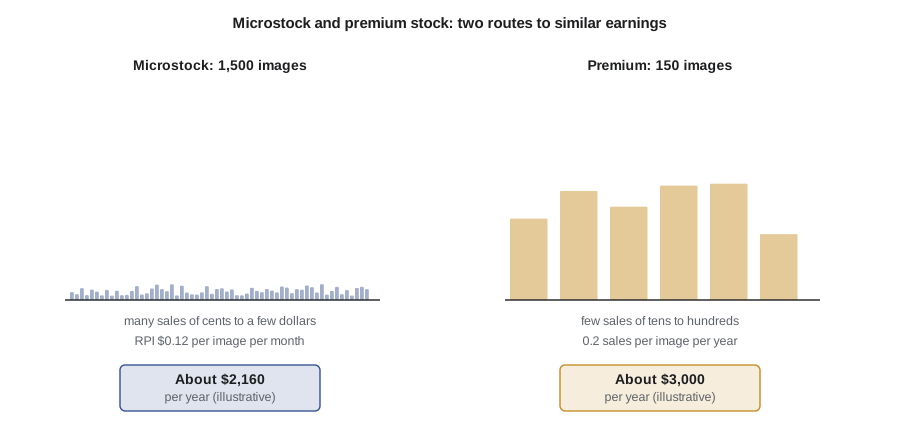
A photographer has 1,500 images on microstock agencies earning an average RPI of $0.12 per image per month, and 150 images with a premium agency where each image sells on average twice a year at an average license price of $250, with a 40% royalty. What does each portfolio earn in a year?
Show solution
- Microstock monthly: \( 1500 \times 0.12 = \$180 \); yearly: \( 180 \times 12 = \$2160 \).
- Premium sales per year: \( 150 \times 2 = 300 \) licenses.
- Premium earnings: \( 300 \times 250 \times 0.40 = \$30\,000 \).
- That premium figure would be exceptional; most premium portfolios sell far less often, perhaps 0.2 times per image per year, giving \( 150 \times 0.2 \times 250 \times 0.40 = \$3000 \).
Answer: About $2,160 from microstock and, at a realistic sales rate, about $3,000 from the premium portfolio. The illustration shows how strongly results depend on sales frequency, which is hard to predict and which differs greatly by subject.
What sells in stock
Stock buyers want images that solve communication problems: authentic people in everyday situations, diverse communities, workplaces, health, technology, sustainability, local places and seasonal themes. Commercial stock needs model and property releases and must avoid logos, trademarks and recognizable artworks; editorial stock covers newsworthy events and places without releases but cannot be used for advertising. Keywording and titles determine whether buyers find an image, so accurate, specific keywords are as important as the photograph.
Generic concepts, such as a handshake against a white background, have been hit hardest by AI image generators. Photographs whose value depends on being real, such as specific places, events, real communities and documentary scenes, are more resilient.
AI training licenses and opt-outs
Generative AI models are trained on very large collections of images. Some stock agencies and platforms have signed data licensing deals with AI developers, allowing their libraries to be used for training, and some share part of that revenue with contributors. Getty Images and Shutterstock, two of the largest agencies, announced a merger in 2025, and AI licensing was part of the strategic background. Some companies also offer stock contributors bonuses or payments for images used to train their own image generators.
Legal questions about training remain unsettled at the time of writing. In the United States, courts are weighing whether training on copyrighted works is fair use, with early decisions pointing in different directions depending on the facts. In Canada, there is no specific text and data mining exception in the Copyright Act, and the federal government has consulted on how copyright should apply to AI. Photographers who want to signal that their work should not be used for training can use robots.txt directives on their websites, platform settings where offered, and the IPTC data mining field in image metadata, though such signals are not respected by every developer. Before agreeing to agency terms, read whether they permit AI training use and whether you share in the revenue.
Prints and products
Prints, wall art, albums, books and other products turn images into physical goods. Pricing should cover the cost of production, your time, packaging and shipping, card fees, a share of overheads and a profit, and should be consistent with your positioning.
Worked problem
Pricing a framed print
A 16 by 20 inch framed print costs $140 for printing, framing and packaging, plus $25 shipping, which you pass on to the client. You want a 60% margin on the product. A gallery that offers to sell the print takes a 50% commission on the retail price. What retail price do you set, and what do you earn from a gallery sale?
Show solution
- Retail price for a 60% margin: \( 140 / (1 - 0.60) = 140 / 0.40 = \$350 \), plus shipping where applicable.
- Direct sale profit: \( 350 - 140 = \$210 \).
- Gallery sale: commission \( 0.50 \times 350 = \$175 \), leaving \( 175 - 140 = \$35 \) profit.
- To keep the same $210 profit after a 50% commission, the retail price would need to be \( (140 + 210) / 0.50 = \$700 \).
Answer: $350 for direct sales. A 50% gallery commission at that price leaves only $35, so many artists set one retail price for all channels high enough to absorb commission; selling direct for less than the gallery price can damage the relationship. PHOT-401 discusses editions and gallery pricing.
Print-on-demand services print and ship products when orders arrive, removing inventory risk but leaving lower margins. Limited editions can justify higher prices but require honest edition records. Product lines for portrait clients, such as albums and wall art, raise average sales and give clients something tangible to keep, as Lesson 7 showed.
Education and digital products
Experienced photographers can earn from teaching: workshops, one-to-one mentoring, online courses, presets and templates, e-books and paid newsletters. These products depend on an audience that trusts you, so they usually follow, rather than precede, an established reputation. They also take real work to create, market and support. Treat each product as a small business with its own costs and break-even point.
Worked problem
Break-even for a workshop
A one-day landscape workshop costs $900 in fixed costs for venue, insurance, transport and marketing, plus $45 per participant for lunch and handouts. Participants pay $295. How many participants are needed to break even, and what is the profit with 10?
Show solution
- Contribution per participant: \( 295 - 45 = \$250 \).
- Break-even: \( 900 / 250 = 3.6 \), so 4 participants.
- Profit with 10: \( 10 \times 250 - 900 = \$1600 \), before your own time.
Answer: Four participants break even; ten give $1,600 for a day of teaching plus preparation, comparable to a commercial day rate if planning time is modest.
Is passive income worth it?
Passive income is rarely passive at first. Stock requires shooting, editing, releasing, keywording and uploading, often hundreds of images before meaningful returns. Products need design, testing and marketing. Courses need recording, editing and support. Judge each stream by its expected earnings per hour of work over several years, compared with your day rate, and by how well it fits your brand. A stream that builds your reputation, such as teaching, may be worth more than its direct earnings; a stream that pulls you away from higher-value commissions may not be.
Licensing an archive directly
Besides agencies, photographers can license images directly from their own archive: to publishers, businesses, tourism organizations, designers and media who find the work through a website, search or personal contact. Direct licensing keeps the whole fee rather than a royalty share, but requires a searchable online archive, clear license terms and the time to negotiate and invoice. Specialist archives, such as a region, an industry or a long-running documentary subject, can command good fees because buyers cannot easily find comparable images elsewhere. A licensing page on your website, with sample terms and a simple request form, makes it easy for buyers to ask.
Diversifying without losing focus
Adding products and platforms can spread risk, but each new stream also needs attention. A sensible approach is to choose streams that reinforce your main business: a family photographer might add wall art and albums; a landscape photographer, prints and workshops; a commercial photographer, licensing of an archive to existing clients. Review each stream once a year and drop those that consume time without building income or reputation.
Common mistakes
MistakeExpecting stock to replace commissioned income quickly
InsteadBuild a stock portfolio gradually and measure return per image.
MistakeUploading commercial stock without releases
InsteadObtain model and property releases or submit as editorial only.
MistakeSigning exclusive agency terms without reading them
InsteadCheck exclusivity, royalty rates and AI training clauses before agreeing.
MistakePricing prints for direct sale only, then selling through galleries
InsteadSet a retail price that can absorb commission and keep it consistent across channels.
MistakeTreating courses and presets as effortless income
InsteadPlan their costs, marketing and support like any other product.
Summary and key terms
- Stock licenses existing images through agencies for royalties.
- Royalty-free licenses dominate; rights-managed licenses price specific uses.
- Microstock earns small amounts per sale; premium stock earns more from fewer sales.
- Return per image helps estimate earnings and compare agencies.
- AI training licenses and opt-outs are evolving, and the law is unsettled.
- Product prices should cover cost, overheads and profit, and allow for commissions.
- Education products depend on audience and reputation and need break-even analysis.
- Stock photography
- Licensing existing images to buyers through agencies or platforms.
- Royalty
- The share of each sale paid to the photographer.
- Royalty-free (RF)
- A license allowing broad use for a one-time fee.
- Rights-managed (RM)
- A license priced by specific use, territory and duration.
- Microstock
- Low-priced, high-volume royalty-free stock.
- Macrostock
- Higher-priced, curated stock with fewer sales.
- Return per image (RPI)
- Earnings divided by the number of images in a portfolio.
- Editorial stock
- Images licensed for news and commentary, not advertising.
- Print-on-demand
- Producing and shipping products only when ordered.
- Data mining opt-out
- A signal that a work should not be used for AI training or text and data mining.
Practice problems
Work each problem on paper first, then reveal the answer to check.
2,000 images earn $300 a month. What is the RPI?
Show answer
\( 300 / 2000 = \$0.15 \) per image per month.
How much would 3,000 images earn per year at an RPI of $0.10 per month?
Show answer
\( 3000 \times 0.10 \times 12 = \$3600 \).
A product costs $90 and the target margin is 55%. What is the retail price?
Show answer
\( 90 / 0.45 = \$200 \).
What is the difference between royalty-free and rights-managed licenses?
Show answer
RF is a one-time fee for broad use; RM is priced by specific use.
Why does commercial stock need releases?
Show answer
Advertising use of people or private property requires permission.
Name two ways to signal an AI training opt-out.
Show answer
robots.txt directives, platform settings, IPTC data mining metadata.
Fixed workshop costs are $1,200 and contribution per participant is $200. What is break-even?
Show answer
\( 1200 / 200 = 6 \) participants.
A print retails at $400 with a 50% gallery commission and costs $120. What is the profit from a gallery sale?
Show answer
\( 200 - 120 = \$80 \).
What kinds of stock images are more resilient to AI competition?
Show answer
Authentic images of real places, events and communities.
How should you judge a passive income stream?
Show answer
By expected earnings per hour over several years and fit with your brand.
Lesson quiz · 5 questions
Score 60% or more to complete this lesson.
Create a free account to save your progress, take quizzes and earn a certificate.