
PHOT-410 · Lesson 5 of 12 · 26 min
Estimates, contracts and terms
Most disputes between photographers and clients are not about bad faith; they come from different assumptions about what was agreed. How many images? When will they be delivered? Can the client use them in an advertisement? What happens if the shoot is canceled the day before? Estimates, contracts and standard terms answer these questions in writing before work begins. This lesson covers the paperwork that runs a photography business from first quote to final invoice: estimates, proposals and quotes, the essential clauses of a photography contract, deposits and cancellation schedules, kill fees, payment terms, releases and consumer protection. PHOT-310 showed how to build a detailed commercial estimate and PHOT-340 walked through event contracts; here we design a complete system of documents that works across markets. This is general information; have a lawyer review your standard contracts.
The document flow
A typical job moves through a sequence of documents, each confirming the previous step.
- Inquiry notes: what the client wants, budget, dates and how they intend to use the images.
- Estimate or proposal: the scope, fees, expenses, usage and terms you are offering. An estimate is a reasoned projection that may change if the scope changes; a quote is usually a fixed price.
- Contract or signed estimate: the client's acceptance of your terms, often with a deposit.
- Change orders: written confirmation of any change in scope, schedule or fees during the job.
- Delivery note and license: what was delivered and the rights granted.
- Invoice: the amount due, with payment terms and the license becoming effective on payment.
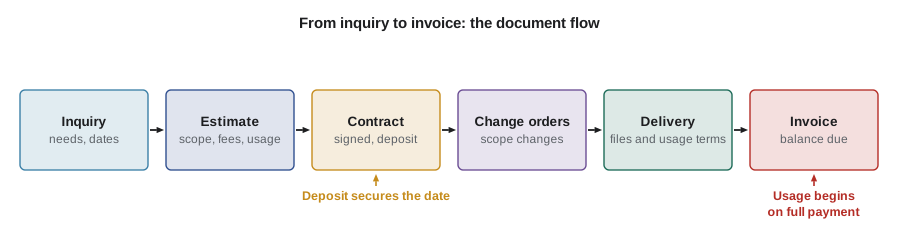
Keeping templates for each step saves time and makes your business look organized. Many photographers use studio management software that links inquiries, contracts, invoices and payments, so a client signs and pays a deposit online in one step.
Essential contract clauses
A photography contract does not need to be long, but it should cover the following points clearly.
- Parties and contact details: who is hiring whom, with legal names.
- Scope of work: date, time, location, hours of coverage, number and type of images, edits included and deliverables.
- Fees and expenses: the creative fee or package price, itemized expenses and how overages are charged.
- Payment terms: deposit, balance due dates, accepted methods and late payment interest.
- Usage and copyright: who owns copyright, what license the client receives, and any restrictions.
- Delivery: format, method and timeline for delivery, and how long you will keep the files.
- Cancellation and rescheduling: what happens if either side cancels or postpones.
- Limitation of liability: a cap on your liability, often the amount paid, and exclusions for events beyond your control.
- Releases and credit: who obtains model and property releases, and how you are credited.
- Portfolio use: whether you may use images in your own marketing, which private clients may want to restrict.
- Dispute resolution and governing law: how disagreements are handled and which jurisdiction's law applies.
Write in plain language. A contract a client understands is more likely to be respected and less likely to be found unfair if challenged.
Deposits, retainers and cancellation schedules
A deposit protects your calendar. When a client books a date, you turn away other work for that date, so a deposit compensates you if they cancel. Wedding and event photographers typically take 25 to 50% at booking; commercial photographers may take a percentage of the estimate before pre-production begins, especially with new clients. Be careful with the words: in some places, a deposit may be refundable if the date can be rebooked, while a retainer or booking fee described as non-refundable compensates for reserving the date. Courts generally enforce cancellation charges that are a genuine estimate of your loss, but may refuse to enforce charges that look like a penalty.
A cancellation schedule ties the charge to how close the cancellation is to the shoot, since a late cancellation leaves less time to rebook.
| Days of notice before shoot | Charge as share of creative fee | Expenses |
|---|---|---|
| More than 14 days | Deposit kept, 25% | Non-refundable expenses already incurred |
| 7 to 14 days | 50% | Non-refundable expenses already incurred |
| 2 to 6 days | 75% | All committed expenses |
| Less than 48 hours | 100% | All committed expenses |
Worked problem
Applying a cancellation schedule
A client cancels a shoot 5 days before the date. The creative fee was $3,200, and you had already paid a non-refundable studio deposit of $400 and booked an assistant who charges a $150 cancellation fee. Using the schedule above, what does the client owe?
Show solution
- 5 days falls in the 2 to 6 day band: \( 0.75 \times 3200 = \$2400 \).
- Committed expenses: \( 400 + 150 = \$550 \).
- Total: \( 2400 + 550 = \$2950 \), less any deposit already paid.
Answer: $2,950 in total. If the client paid a 25% deposit of $800, the balance owed is \( 2950 - 800 = \$2150 \).
Kill fees and postponements
A kill fee is a payment due when a client stops a project after work has begun, often used in editorial and commercial work. A typical clause sets a kill fee of 50% of the creative fee if the project is canceled after the shoot but before delivery, plus all expenses. Postponements are different from cancellations: many photographers allow one postponement without penalty if notice is given early and a new date is set within a defined period, with weather days priced separately for outdoor shoots.
Payment terms and late payment
Set payment terms that protect cash flow. For consumers, require full payment before the event or before delivery. For businesses, 30-day terms are common, though large companies may insist on 45, 60 or more days, which you should price in. State that the license to use images takes effect only on full payment; this gives you leverage if a client delays.
If you charge interest on late payments in the United States, check your state's laws, which set maximum interest rates (usury limits) and sometimes specific rules for late fees in consumer contracts. State the rate clearly, for example "1.5% per month (18% per year)", and apply it consistently. Some states also set prompt-payment protections for freelancers, such as New York City's Freelance Isn't Free Act and New York State's similar law, which require written contracts and timely payment for many freelance jobs.
Worked problem
Calculating late payment interest
A $4,000 invoice due on net 30 terms is paid 60 days late. Your contract states simple interest of 1.5% per month (18% per year). How much interest is due?
Show solution
- Months late: \( 60 / 30 = 2 \).
- Interest: \( 4000 \times 0.015 \times 2 = \$120 \).
- Total due: \( 4000 + 120 = \$4120 \).
Answer: $120 in interest, for $4,120 in total. Many photographers waive interest for a client who pays promptly once reminded, but the clause encourages timely payment.
Model and property releases
A model release is a person's written permission to use their likeness; a property release is permission from the owner of private property, such as a building interior, artwork or distinctive object, where needed. Releases matter most for commercial and advertising uses, where using someone's image to promote a product without permission can infringe their personality or publicity rights. Editorial uses, such as news and commentary, generally do not need releases, though privacy rules still apply.
In the United States, rights of publicity are governed by state law, through statutes, common law or both, and their scope varies widely; New York, California and Tennessee have notable statutes, and Tennessee's ELVIS Act of 2024 extended protection to voice and AI-generated likenesses. Minors cannot give valid consent on their own, so a parent or guardian must sign.
Keep releases with the images they cover, record who signed and when, and use a release form appropriate to the intended uses. A release that permits only editorial use does not cover an advertisement.
Consumer protection
When your client is a consumer rather than a business, consumer protection law applies, and it can override unfair terms in your contract.
Consumer protection in the United States comes from federal law, such as the Federal Trade Commission's Cooling-Off Rule for certain sales made at a consumer's home or at temporary locations, and from each state's consumer protection or unfair and deceptive practices law. These laws set disclosure rules, cancellation rights in some situations and bans on unfair or deceptive terms. Read the rules for your state, and avoid terms that a court could find unconscionable.
In practice, a fair contract, clearly explained, protects both you and the client. Explain key terms such as the deposit and cancellation schedule during the consultation, and confirm them in writing.
When things go wrong
Even with good contracts, problems happen: a client disputes the quality, a payment goes unpaid, or you fall ill on a wedding day. Respond promptly, professionally and in writing. For quality disputes, listen first and offer reasonable remedies, such as additional editing or a partial refund, where the complaint is fair. For non-payment, follow a sequence: a friendly reminder, a firm reminder citing the contract, a final notice with a deadline, and then small claims court or a collection agency. For your own emergencies, maintain a network of trusted photographers who can step in, and say in the contract that you may send a qualified replacement.
Scope creep and change orders
Scope creep is the gradual expansion of a job beyond what was agreed: an extra product here, another location there, a few more retouched images, an additional round of revisions. Each request seems small, but together they can double the work without any increase in fee. The defense is a clear scope in the original estimate and a habit of confirming changes in writing. A simple change order states the new work, its cost and any effect on the schedule, and the client approves it before you proceed. Many photographers include a number of revision rounds in the fee, such as two rounds of retouching comments, and charge an hourly rate beyond that.
Keeping templates current
Your contracts should evolve. Review your templates once a year and after any dispute, adding clauses that would have prevented the problem. Keep a version number and date on each template so you know which terms each client accepted. Professional associations publish model contracts and updates on legal changes, which are a good starting point before a lawyer tailors them to your business.
Store signed contracts securely with the job file so you can find them quickly if a question arises years later.
Common mistakes
MistakeStarting work without a signed agreement
InsteadGet a signed contract or estimate and a deposit before committing a date.
MistakeUsing vague scope such as photos of the event
InsteadSpecify hours, number of images, edits and delivery format.
MistakeWriting a non-refundable deposit that looks like a penalty
InsteadTie charges to a genuine estimate of loss and explain them.
MistakeStating interest only as a monthly rate
InsteadState the annual rate as well, and check local law.
MistakeUsing an editorial release for advertising
InsteadUse a release that covers the intended commercial use.
Summary and key terms
- Jobs move from inquiry to estimate, contract, change orders, delivery and invoice.
- Contracts should cover scope, fees, payment, usage, delivery, cancellation, liability, releases and dispute resolution.
- Deposits and cancellation schedules protect your calendar and should reflect genuine loss.
- Kill fees compensate for projects stopped after work begins.
- Payment terms should make the license effective on full payment and state interest clearly.
- Model and property releases are essential for commercial use and must match the intended use.
- Consumer protection law can override unfair terms in contracts with individuals.
- Estimate
- A reasoned projection of fees and expenses that may change with scope.
- Quote
- A fixed price for defined work.
- Change order
- A written record of a change in scope or price during a job.
- Deposit
- An advance payment that secures a booking.
- Cancellation schedule
- A table linking cancellation charges to notice given.
- Kill fee
- A payment due when a client stops a project after work has begun.
- Net 30
- Payment terms requiring payment within 30 days of invoice.
- Model release
- A person's written permission to use their likeness.
- Property release
- An owner's written permission to use images of private property.
- Limitation of liability
- A clause capping the amount a party can be required to pay.
Practice problems
Work each problem on paper first, then reveal the answer to check.
A $2,400 fee is canceled in a band charging 50%, with $300 of committed expenses. What is owed?
Show answer
\( 1200 + 300 = \$1500 \).
A $5,000 invoice is 3 months late at 1.5% per month simple interest. What interest is due?
Show answer
\( 5000 \times 0.015 \times 3 = \$225 \).
What is the difference between an estimate and a quote?
Show answer
An estimate may change with scope; a quote is usually fixed.
Why make the license effective on payment?
Show answer
It gives leverage to collect and prevents unpaid use.
Name five essential contract clauses.
Show answer
Scope, fees, payment, usage, delivery, cancellation, liability, releases, dispute resolution.
Who signs a release for a 12-year-old model?
Show answer
A parent or guardian.
Does editorial news use usually need a model release?
Show answer
Usually not, though privacy rules still apply.
What is a kill fee?
Show answer
A payment due when a project is canceled after work has begun.
Why might a court refuse to enforce a large cancellation charge?
Show answer
It may look like a penalty rather than a genuine estimate of loss.
List the steps for collecting an unpaid invoice.
Show answer
Friendly reminder, firm reminder, final notice with deadline, then small claims or collections.
Lesson quiz · 5 questions
Score 60% or more to complete this lesson.
Create a free account to save your progress, take quizzes and earn a certificate.