
PHOT-320 · Lesson 11 of 12 · 28 min
Trauma, consent and safety
Photojournalists witness accidents, violence, disasters and grief more often than almost anyone except emergency workers. They photograph people at their most vulnerable, and they sometimes work in places where they themselves are in danger. This lesson covers how to work ethically with people who have experienced trauma, how to seek meaningful consent, how to photograph children and grief, how to stay safe in hostile environments, and how to recognize and manage the effects of trauma on photographers themselves. It is an awareness-level introduction; specialized training is recommended for anyone covering conflict, disasters or violence regularly.
What trauma is
Psychological trauma is the emotional response to a deeply distressing event, such as violence, serious injury, the sudden death of a loved one or a disaster. Most people who experience trauma recover over time with support, but some develop lasting problems such as post-traumatic stress disorder, depression or anxiety. People in the immediate aftermath of trauma may be in shock, confused, angry or numb. They may say or agree to things they later regret, and they may experience photography as another intrusion.
Trauma-informed journalism, promoted by the Dart Center for Journalism and Trauma at Columbia University and by similar groups in Canada, applies this understanding to reporting. Its core principles are safety, trustworthiness, choice, collaboration and empowerment: giving people as much control as possible over how they are photographed and represented, being honest about what will happen, and avoiding further harm.
Consent and its limits
In news photography, consent is not always legally required or practically possible, for example when photographing a public event or a breaking scene. But seeking consent is often the ethical choice, especially for intimate, prolonged or sensitive coverage. Meaningful consent is informed, voluntary and ongoing. Informed means the person understands who you are, what the pictures are for, where they will appear and that they may be seen widely and permanently online. Voluntary means they feel free to say no without pressure. Ongoing means they can change their mind during the process, and you check in as circumstances change.
People in shock or crisis may not be able to give meaningful consent in the moment. A trauma-informed approach is to make pictures when news value justifies it, using restraint, and to follow up later, when the person is calmer, before publishing intimate or identifying images where possible. Some photographers return to subjects to explain how pictures will be used and to ask whether they still agree. Editors weigh the person's wishes against the public interest; those wishes do not always decide the outcome, but they should always be considered.
| Principle | In practice |
|---|---|
| Safety | Do not put subjects at greater physical or emotional risk; consider their safety after publication |
| Trustworthiness | Be honest about who you are and how pictures will be used |
| Choice | Offer choices about being photographed, named and identified where possible |
| Collaboration | Involve subjects in decisions about long-term or sensitive stories |
| Empowerment | Show people as agents in their lives, not only as victims |
Photographing grief
Funerals, vigils and the homes of bereaved families are among the most sensitive settings. Many families welcome respectful coverage that honors the person who died; others want privacy. Approaches that help include contacting families through intermediaries such as funeral directors or community leaders, accepting refusals, staying at a distance with longer lenses at public ceremonies, avoiding close photographs of faces contorted in grief unless there is a strong reason and ideally consent, and never using deception to gain access. At public memorials, photograph the scene and the community's response rather than singling out the most distressed individuals.
Some cultures and communities have specific protocols around death and images of the deceased. Many Indigenous communities in Canada and the United States, for example, have customs about photographing ceremonies or showing images of people who have died. Ask community members and follow their guidance.
Children and other vulnerable subjects
Children cannot give the same informed consent as adults, and pictures published now will follow them for life. Most newsrooms require a parent's or guardian's permission to photograph children in non-news settings and use extra caution in news settings. Avoid identifying children who are victims of crime, abuse or exploitation, or who are in situations that could stigmatize them, such as mental health crises. Lesson 10 covered the legal restrictions on identifying young people in the justice system.
Other vulnerable subjects include people with cognitive disabilities, people in mental health crises, people experiencing homelessness, refugees and asylum seekers, people with addictions and survivors of sexual violence. Identification can expose them to discrimination, retaliation or legal danger. Consider whether a picture can tell the story without identifying the person, through angles, silhouettes or details, and whether the person truly understands and agrees to being identified.
Graphic images and audiences
Graphic images of injury and death can inform the public about the reality of violence, war and disaster, and some have changed history. They can also traumatize viewers, especially those connected to the events, and violate the dignity of victims. Newsrooms make decisions case by case, weighing news value, the dignity of victims and their families, and the effect on audiences. Common practices include choosing less graphic frames that still convey the reality, warning audiences before graphic content, placing such images where readers can choose to view them, and avoiding graphic images on social media where they appear in feeds without warning. Lesson 9 showed one structured way to weigh these factors.
Safety in hostile environments
Photojournalists may face danger at protests and riots, in disaster zones, in areas of armed conflict and in places where journalists are targeted. Organizations such as the Committee to Protect Journalists (CPJ) and Reporters Without Borders document attacks, detentions and killings of journalists worldwide; recent conflicts have been among the deadliest for journalists on record, and local journalists bear most of the risk.
Hostile environment and emergency first aid training, often called HEFAT, teaches risk assessment, first aid, situational awareness, kidnap avoidance and how to behave at checkpoints and in crowds. Many news organizations require it before assigning journalists to dangerous areas, and some insurers require it for coverage. Freelancers often have to pay for it themselves; some organizations offer subsidized places.
Before any risky assignment, complete a risk assessment that identifies hazards, the likelihood and severity of harm, and measures to reduce risk. Plan communications, check-in times, routes and exits, medical options and an emergency contact who knows what to do if you miss a check-in. Wear protective equipment appropriate to the risk, which might include a helmet, eye protection and a respirator at protests, or body armor in conflict zones. Know when to leave: no picture is worth your life or a colleague's.
Worked problem
A simple risk assessment
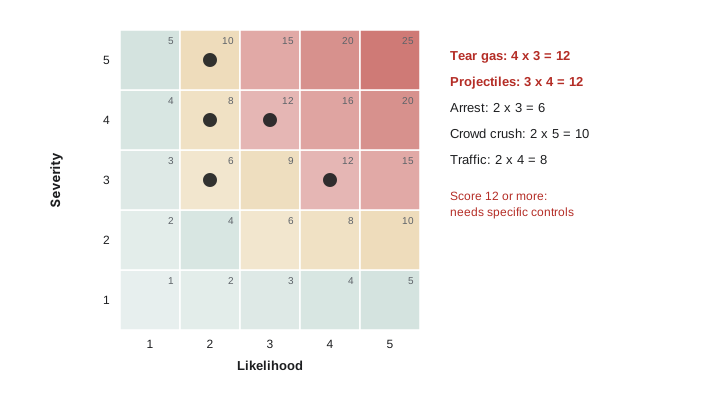
You plan to cover a protest where previous events involved tear gas and some violence. Score each hazard for likelihood and severity from 1 to 5, multiply, and treat any score of 12 or more as needing specific controls: tear gas (likelihood 4, severity 3), projectiles (3, 4), arrest (2, 3), crowd crush (2, 5), traffic (2, 4).
Show solution
- Tear gas: 4 × 3 = 12. Needs controls: respirator, goggles, an upwind position, a partner.
- Projectiles: 3 × 4 = 12. Needs controls: helmet, positions with cover, distance from front lines.
- Arrest: 2 × 3 = 6. Lower; carry ID and a lawyer's number, follow lawful orders.
- Crowd crush: 2 × 5 = 10. Below threshold but severe; plan exits and avoid bottlenecks.
- Traffic: 2 × 4 = 8. Wear high-visibility clothing near roads.
Answer: Tear gas and projectiles both score 12 and need specific controls. Crowd crush scores 10 but its severity of 5 means exits must still be planned. A written assessment shared with your editor makes these decisions deliberate rather than improvised.
Digital safety
Photojournalists face digital threats too: harassment campaigns, doxxing, hacking and surveillance. Protect accounts with strong passwords and two-factor authentication, keep devices updated, encrypt phones and laptops, and limit personal information online. Consider what your images reveal: faces of protesters, license plates or locations of shelters may expose people to danger if published or if devices are seized. Some photographers blur or avoid identifying people at protests where participants face serious risk. Organizations such as the Freedom of the Press Foundation and Canadian Journalists for Free Expression publish digital security guides.
Trauma and the photographer
Photojournalists are at risk of the effects of trauma themselves. Research has found that journalists who regularly cover violence and disasters have higher rates of post-traumatic stress symptoms, depression and substance use than the general population, and photographers and camera operators, who must look closely and repeatedly at disturbing scenes, may be particularly affected. Vicarious or secondary trauma can also affect photo editors and others who view large numbers of graphic images, including user-generated content, without being at the scene.
Signs that trauma is affecting you include intrusive images or memories, nightmares, avoiding reminders, irritability, feeling numb or detached, difficulty concentrating, and using alcohol or drugs to cope. These are normal responses to abnormal events, not signs of weakness, and they often ease with time and support. If they persist for more than a few weeks or interfere with life and work, seek help from a mental health professional.
Protective practices include talking with trusted colleagues after difficult assignments, peer support programs, taking breaks between traumatic assignments, limiting unnecessary exposure to graphic material, for example by viewing images at small size or without sound when editing, maintaining sleep, exercise and connections outside work, and using employee assistance programs where available. Freelancers, who often lack such support, can turn to organizations that offer peer networks and resources. Newsroom leaders have a responsibility to make it normal to talk about these effects.
| Need | Where to look in the US |
|---|---|
| Immediate crisis | Call or text 988 for the 988 Suicide and Crisis Lifeline, or call 911 in an emergency |
| Trauma and journalism resources | Dart Center for Journalism and Trauma at Columbia University |
| Press freedom and safety | Freedom of the Press Foundation; Reporters Committee for Freedom of the Press; NPPA |
| Workplace support | Employee assistance programs; union or guild resources |
Helping or photographing
Photojournalists sometimes face the dilemma of whether to photograph or help. Ethics codes and most practitioners agree that when a person's life is in immediate danger and you are able to help without endangering yourself, helping comes first. In many situations, emergency workers are present and better able to help, and the photographer's role is to document. Photographers who have chosen to document rather than help have faced intense public criticism, and some have carried lasting guilt. Thinking through these situations in advance, and discussing them with colleagues, helps photographers act according to their values under pressure.
Worked problem
Planning check-ins
You will cover a remote wildfire evacuation for 10 hours. Your safety plan says to check in with the desk at regular intervals, and that if you miss a check-in by 30 minutes the desk will start emergency procedures. The desk wants no more than 2 hours to pass between your last contact and the start of procedures. What is the longest check-in interval you can use, and how many check-ins will you make?
Show solution
- Maximum time from last contact to procedures = interval + 30 minutes ≤ 120 minutes.
- So the interval ≤ 90 minutes.
- Over 10 hours (600 minutes): 600 / 90 ≈ 6.7, so 7 check-ins after the start, about every 90 minutes, plus one at the start and one at the end.
Answer: Check in at least every 90 minutes, about seven times during the shift plus start and finish. Agree the plan, including what the desk will do, before you leave.
Common mistakes
MistakeTreating consent as a single yes at the start of a long story.
InsteadConsent is informed, voluntary and ongoing; check in as things change.
MistakePushing in close to photograph a grieving family at a public vigil.
InsteadUse distance, restraint and intermediaries; respect refusals.
MistakeGoing to a risky protest with no plan or protective gear.
InsteadComplete a risk assessment, wear appropriate gear and plan check-ins.
MistakeIgnoring intrusive memories and nightmares after a hard assignment.
InsteadTalk to colleagues, take breaks and seek professional help if symptoms persist.
MistakePublishing identifiable faces of protesters who face serious danger.
InsteadWeigh the risk; consider frames that do not identify people.
Summary and key terms
- Trauma-informed journalism applies safety, trustworthiness, choice, collaboration and empowerment.
- Meaningful consent is informed, voluntary and ongoing, and may need follow-up after a crisis.
- Photograph grief with restraint, respect refusals and follow community protocols.
- Take extra care with children and other vulnerable subjects, and avoid harmful identification.
- Prepare for hostile environments with training, risk assessments, protective gear and check-ins.
- Protect devices and accounts, and consider what images reveal about people at risk.
- Photographers can be affected by trauma; peer support, breaks and professional help protect them.
Practice problems
Work each problem on paper first, then reveal the answer to check.
Name the five trauma-informed principles.
Show answer
Safety, trustworthiness, choice, collaboration and empowerment.
What three qualities make consent meaningful?
Show answer
Informed, voluntary and ongoing.
Why follow up with people photographed in crisis?
Show answer
They may not have been able to give meaningful consent in the moment.
How can you photograph a public vigil respectfully?
Show answer
Use distance and restraint, focus on the community response and respect refusals.
Score a hazard with likelihood 3 and severity 5.
Show answer
15.
What does HEFAT stand for?
Show answer
Hostile environment and emergency first aid training.
Name three signs that trauma may be affecting you.
Show answer
Any three of intrusive memories, nightmares, avoidance, irritability, numbness, poor concentration, substance use.
How can editors reduce exposure to graphic images?
Show answer
View at small size, without sound, and take breaks.
When does helping come before photographing?
Show answer
When someone's life is in immediate danger and you can help without endangering yourself.
A 20-minute grace period and a 2-hour maximum. Longest check-in interval?
Show answer
100 minutes.
Lesson quiz · 5 questions
Score 60% or more to complete this lesson.
Create a free account to save your progress, take quizzes and earn a certificate.