
PHOT-301 · Lesson 10 of 12 · 25 min
Papers and media
Paper is not a neutral carrier for an image; it is part of the image. Its surface, color, weight, texture and ink-receiving coating determine the gamut, the depth of the blacks, the sharpness of detail, the feel in the hand and how the print interacts with light. Choosing paper is a creative decision as much as a technical one. This lesson covers how inkjet papers are made, the main surface categories, paper bases including cotton rag and alpha cellulose, optical brighteners and paper white, weight and thickness, technical measures such as Dmax and gamut volume, matching paper to image, handling and storage, specialty media, and building a paper library.
How inkjet papers are made
Plain paper is unsuitable for photographic inkjet printing because ink spreads into its fibers, producing soft, dull images. Inkjet photo papers have one or more coatings designed to receive ink. Microporous coatings, used in most glossy and luster photo papers, contain fine ceramic particles, often silica or alumina, that absorb ink almost instantly into tiny pores, so prints are dry to the touch immediately. Swellable polymer coatings absorb ink by swelling and were common in earlier glossy papers. Matte coatings absorb ink into a porous surface layer without gloss. Fine art papers combine traditional papermaking with an inkjet-receptive coating. The coating controls how sharply droplets form, how dense blacks become and how saturated colors appear, which is why each paper needs its own profile.
Surface categories
Papers are usually grouped by surface:
- Glossy: a smooth, highly reflective surface giving the deepest blacks and widest gamut, with strong reflections under direct light.
- Luster, pearl, satin and semi-gloss: textured surfaces with moderate sheen, offering deep blacks and wide gamut with fewer reflections, popular for portraits, weddings and exhibitions.
- Baryta and fiber-based gloss: papers with a barium sulfate layer under the coating, imitating traditional darkroom fiber papers, with a slightly textured, glossy surface and deep blacks, favored for fine art and black-and-white printing.
- Matte: smooth or textured surfaces without sheen, giving soft, painterly prints with lower contrast and smaller gamut; matte black ink is required.
- Fine art textured: watercolour-style papers such as cold-pressed or rough surfaces, emphasizing texture and a tactile, artistic feel.
- Specialty: canvas, metallic, Japanese washi and rice papers, translucent and transparent films, and adhesive media.
| Surface | Typical Dmax | Gamut | Character |
|---|---|---|---|
| Glossy | About 2.4–2.6 | Largest | Deep blacks, vivid color, reflections |
| Luster or pearl | About 2.3–2.5 | Large | Deep blacks, controlled sheen |
| Baryta | About 2.3–2.5 | Large | Darkroom look, fine art black and white |
| Smooth matte fine art | About 1.6–1.8 | Smaller | Soft, velvety, no glare |
| Textured watercolour | About 1.5–1.7 | Smaller | Painterly, tactile |
Paper bases: cotton rag and alpha cellulose
Fine art papers are made from different fibers. Cotton rag papers, made from cotton linters, are naturally acid-free and lignin-free and are considered the most archival base for fine art prints. Alpha cellulose papers are made from purified wood pulp, treated to remove lignin and acids; high-quality alpha cellulose papers are also archival and are often less expensive. Resin-coated (RC) photo papers have a paper core sealed between polyethylene layers, giving a smooth, flat base for glossy and luster surfaces; they are durable and economical but less suitable for museum-grade archival work than fiber papers. Paper bases may be buffered with calcium carbonate to resist acids from the environment. For prints intended to last, look for papers described as acid-free, lignin-free and, where available, meeting standards such as ISO 9706 for permanent paper.
Paper white and optical brighteners
Paper white varies from cool, bright whites to warm, natural whites. Bright whites often owe their appearance to optical brightening agents (OBAs), which convert UV light into visible blue light (Lesson 5). OBA papers look striking in daylight but can appear warmer under UV-free lighting and may lose brightness as OBAs degrade with light exposure, causing an apparent yellowing over time. Papers without OBAs have a warmer, natural white that stays stable. Many fine art printers prefer OBA-free papers for archival work, while OBA papers may suit commercial work with shorter display life. The paper white also affects color: images printed on warm papers look warmer, and soft proofing with paper simulation shows this effect. Paper white is measured in CIELAB; a warm natural paper might measure around L* 95, a* 0, b* 3, while a bright OBA paper might measure around L* 96, a* 1, b* −5.
Weight, thickness and handling
Paper weight is measured in grams per square meter (gsm, g/m²), typically 200 to 350 gsm for fine art and photo papers, and thickness in micrometers or mils. Heavier papers feel substantial and lie flat, but very thick papers and boards may need a straight or front feed path. Check the printer's maximum thickness and use the platen gap setting for thick or curled media to prevent head strikes, which leave ink smears. Paper has a printable side, usually the brighter or smoother side, often marked on the packaging; printing on the wrong side produces weak, blurry images. Some fine art papers shed fibers or coating dust, which can clog nozzles or appear as white specks; brushing the surface gently before printing helps.
Measuring papers: Dmax, gamut and more
Several measurements describe a paper's technical performance. Dmax, the maximum density of black achievable, determines how deep shadows can be; density is the logarithm of the ratio of incident to reflected light, so each additional 0.3 of density halves the reflected light.
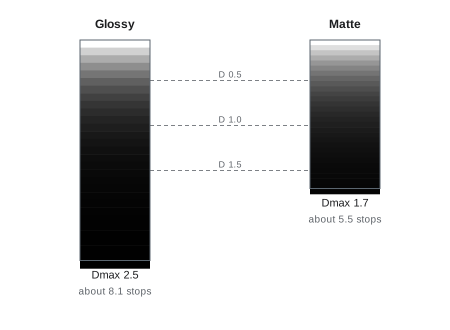
Contrast ratio follows from the difference between paper white and Dmax: a glossy paper with white reflectance about 0.9 and Dmax 2.5 has a contrast ratio of roughly \(0.9 / 10^{-2.5} \approx 285{:}1\), while a matte paper with Dmax 1.7 has about \(0.9 / 10^{-1.7} \approx 45{:}1\). Gamut volume, in cubic Delta E units, measures color range. Other properties include whiteness, OBA content, surface texture, and permanence ratings from independent testing (Lesson 12).
Worked problem
How much darker can glossy blacks be?
A glossy paper reaches Dmax 2.5 and a matte paper Dmax 1.7. How many stops of tonal range do the two papers offer, and what is the difference?
Show solution
- Each stop is a factor of 2 in light, or 0.3 in density (\(\log_{10} 2 \approx 0.301\)).
- Assume paper white density about 0.05 for both.
- Glossy range: \((2.5 - 0.05) / 0.301 \approx 8.1\) stops.
- Matte range: \((1.7 - 0.05) / 0.301 \approx 5.5\) stops.
- Difference: about 2.6 stops, which is why shadows must be opened up for matte papers.
Answer: About 8 stops on glossy and 5.5 stops on matte; matte prints have about 2.6 stops less tonal range.
Matching paper to image
Choosing paper for an image involves its content, mood and display. Images with deep shadows, saturated colors and fine detail, such as night scenes, vivid landscapes and product images, benefit from glossy, luster or baryta papers. Soft, atmospheric images, such as fog, portraits in gentle light, botanical subjects and minimalist compositions, often look beautiful on matte fine art papers, whose lower contrast and texture suit them. Black-and-white images look rich on baryta and warm-toned matte papers. Images to be framed behind glass have fewer reflection problems, so glossy papers become more practical; unframed exhibition prints may favor luster or matte to reduce glare. Viewing distance matters too: heavily textured papers compete with fine detail in small prints but add character to large prints viewed from a distance. Many printers keep a small number of papers they know well rather than trying many.
Handling and storage
Store papers flat in their original packaging in a cool, dry place, at about 40 to 60 % relative humidity and away from light. Allow paper brought from cold or humid places to acclimatize before printing. Handle paper by the edges, preferably with lint-free cotton or nitrile gloves, since fingerprints affect ink absorption and leave marks that appear later. After printing, let prints dry and outgas, especially on glossy and baryta papers, for a few hours to a day before framing or stacking, so that ink solvents evaporate and do not fog glass or cause sticking; interleave stacked prints with archival tissue. Roll papers should be stored in their boxes, supported at the core, and allowed to flatten after printing, sometimes with decurling methods.
Specialty media
Canvas prints are printed on cotton or polyester canvas, coated after printing with varnish to protect the surface, then stretched over wooden bars. Metallic papers have a pearlescent or metallic base that makes highlights shimmer, suiting automotive, architectural and some landscape images. Japanese washi and other papers made from kozo, mitsumata or gampi fibers offer delicate, translucent and textured surfaces with a distinctive feel. Translucent films allow backlit displays and duratrans-style prints. Self-adhesive and wall-covering materials suit commercial installations. Each requires appropriate profiles and often special handling, such as coatings, drying times and mounting methods.
Building a paper library
An efficient way to learn papers is to make a personal paper library: print the same reference image, containing a portrait, a landscape with deep shadows and saturated color, a black-and-white image, a neutral gray ramp and a color chart, on each paper you are considering, using its profile, and label each print with the paper, profile, settings and date. Many manufacturers sell sample packs. Comparing these prints side by side under your viewing light, and in the kinds of light where your prints will be displayed, reveals which papers suit your work. Keep notes on soft-proof adjustments needed for each paper, and narrow your choice to a few papers for most work.
Paper and the look of black-and-white prints
Paper choice has a strong influence on black-and-white prints. Warm-toned papers give a cream or ivory base that softens contrast and recalls traditional warm-tone darkroom papers; cool, bright papers give crisp, modern prints. Baryta papers deliver deep blacks with a subtle surface texture, while matte cotton papers produce a velvety, quiet look. The paper's white also interacts with toning in the driver: a slightly warm tone on a natural white paper can look richer than the same tone on a bright white. Test the black-and-white mode on each paper with a step wedge and a familiar image to learn how they combine.
Environmental considerations
Paper production uses water, energy and raw materials. Some manufacturers offer papers made from bamboo, sugar cane, hemp or recycled fibers, certified forest products, or papers produced with renewable energy. When choosing papers for large print runs or exhibitions, consider environmental claims and certifications alongside quality and permanence. Reducing waste through soft proofing, test strips instead of full prints, efficient nesting of prints on rolls and careful handling also lowers the environmental and financial cost of printing.
Paper for exhibitions and sales
For exhibitions and editions, choose papers that will remain available for years, so that an edition can be completed on the same material. Discontinued papers make it difficult to print consistent editions or replace damaged prints. Buy enough of a paper for an edition, or choose established papers from manufacturers with long track records. Record the paper name, surface, weight and batch on the print log and certificate.
Testing a new paper
Before adopting a new paper, print a test page with a step wedge, a color chart, a skin-tone image and a dark, detailed image using the recommended profile, then check surface durability by gently rubbing a dark area after drying, observe how the paper handles in the printer, and look for coating flakes or dust. Note how prints look under different lights and how long they take to dry before handling.
Common mistakes
MistakePrinting on the wrong side of the paper.
InsteadCheck the printable side, usually brighter or marked.
MistakeIgnoring paper thickness settings.
InsteadUse the right feed path and platen gap to avoid head strikes.
MistakeChoosing OBA papers for archival work without considering aging.
InsteadPrefer OBA-free papers for long-term display.
MistakeFraming prints immediately after printing.
InsteadAllow prints to dry and outgas first.
MistakeHandling paper with bare fingers.
InsteadHandle by the edges or with gloves.
Summary and key terms
- Inkjet papers have receiving coatings that control ink absorption and quality.
- Glossy, luster and baryta papers offer deep blacks and wide gamut; matte papers are softer.
- Cotton rag and quality alpha cellulose bases are archival; RC papers are durable and economical.
- OBAs make paper brighter but change with light and age.
- Dmax determines tonal range; glossy papers offer several more stops than matte.
- Match paper to image content, mood and display conditions.
- Store and handle paper carefully and build a personal paper library.
- Microporous coating
- Ink-receiving layer of fine absorbent particles.
- Luster
- Semi-gloss textured paper surface.
- Baryta
- Paper with a barium sulfate layer imitating darkroom fiber paper.
- Cotton rag
- Paper made from cotton fibers.
- Alpha cellulose
- Purified wood pulp paper base.
- RC paper
- Resin-coated paper with a sealed core.
- gsm
- Grams per square meter, a measure of paper weight.
- Dmax
- Maximum density of black achievable.
- Outgassing
- Evaporation of ink solvents after printing.
- Platen gap
- Distance between printhead and paper.
Practice problems
Work each problem on paper first, then reveal the answer to check.
What does a microporous coating do?
Show answer
Absorbs ink quickly into fine pores.
Which surface gives the deepest blacks?
Show answer
Glossy.
What is baryta paper?
Show answer
A paper with a barium sulfate layer imitating fiber darkroom paper.
Name two archival paper bases.
Show answer
Cotton rag and alpha cellulose.
Why may OBA papers appear to yellow?
Show answer
Brighteners degrade with light exposure.
Typical fine art paper weight?
Show answer
About 200–350 gsm.
Density of a surface reflecting 1 % of light?
Show answer
2.0.
Stops of range from density 0.05 to 2.15?
Show answer
About 7 stops.
Which papers suit soft, atmospheric images?
Show answer
Matte fine art papers.
Why let prints outgas before framing?
Show answer
To prevent fogging and sticking.
Lesson quiz · 5 questions
Score 60% or more to complete this lesson.
Create a free account to save your progress, take quizzes and earn a certificate.