
PHOT-102 · Lesson 9 of 12 · 24 min
Continuous light: LEDs, color quality and mixing sources
Continuous lights stay on, so what you see is what you get: shadows, highlights and reflections are visible before the shutter is pressed, which makes them easy to learn with and essential for video. For decades continuous light in photography meant hot tungsten lamps, but LED technology has transformed the field: modern LED lights are cool, efficient, dimmable, often battery powered, and many can change color temperature or produce any color. Continuous light also has limits, chiefly power and color quality. This lesson covers the types of continuous light, their advantages and disadvantages compared with flash, how to judge color quality with CRI, TLCI and related measures, how to calculate exposure from a light's output, mixing continuous light with daylight and flash, and power, heat and battery considerations.
Types of continuous light
- Tungsten and tungsten-halogen lamps: incandescent sources at about 3,200 K, with a continuous spectrum and excellent color rendering. They are inexpensive and dimmable (with a warming shift as they dim) but very inefficient: most of their energy becomes heat, making them hot to work near and to handle. Fresnel spotlights and open-face lights of this type remain common in film lighting.
- HMI (hydrargyrum medium-arc iodide) lights: daylight-balanced discharge lamps with high efficiency and very high output, used on film sets to simulate sunlight, but expensive and needing ballasts.
- Fluorescent fixtures: tube-based panels designed for photography and film give soft, daylight or tungsten-balanced light with modest heat, now largely replaced by LEDs.
- LED panels: flat arrays of many small LEDs, often bi-color (mixing warm and cool LEDs to adjust from about 2,700 K to 6,500 K), giving soft-ish light without modifiers.
- COB (chip-on-board) LED monolights: a single large LED chip in a housing with a fan, accepting the same modifiers as studio strobes (softboxes, reflectors, Fresnel lenses), offering high output in a compact unit.
- LED tubes and flexible mats: lightweight sources for edge lights, practicals, effects and tight spaces; RGB and RGBWW versions produce any color and effects such as flicker and police lights.
Most professional LED lights can be controlled remotely by app or by DMX (the lighting control protocol used in theater and film), allowing brightness and color to be set from the camera position.
Continuous light compared with flash
Continuous light and flash each have strengths:
- Seeing the light: continuous light shows exactly what the camera will record, including catchlights and reflections on glossy products, which speeds up setup and teaching. Flash relies on modeling lights or test shots.
- Video and hybrid work: video requires continuous light, and the same lights then serve stills.
- Power: flash concentrates its energy in a fraction of a millisecond, so even a small speedlight delivers far more light during a fast exposure than a large LED. A 600 Ws strobe can light a subject at f/16 through a large softbox; to achieve the same exposure at 1/125 s, a continuous light would need enormous output. Continuous light therefore often requires wider apertures, slower shutter speeds or higher ISO.
- Motion: flash freezes motion; continuous light relies on shutter speed, so moving subjects need fast shutter speeds and therefore more light.
- Comfort: bright continuous light makes subjects squint and their pupils contract; flash is over before the eye reacts, though repeated flashes can be tiring too.
- Ambient balance: with continuous light, shutter speed affects the added light and the ambient light equally, so the two-exposure control of flash (Lesson 6) is not available; balancing is done with the power of the lights and with ND or by reducing ambient light.
Color quality
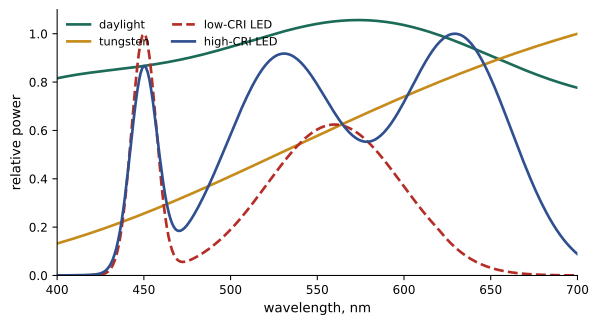
Every light source has a spectrum: the amount of energy it emits at each wavelength. Daylight and tungsten have smooth, continuous spectra, which render all colors naturally. LEDs produce white light by combining a blue LED with phosphors that emit across the rest of the spectrum, or by mixing several colored emitters, and their spectra can have peaks and gaps. Two lights with the same color temperature can render colors differently, particularly saturated reds, skin tones and fabrics, because the camera sensor samples the spectrum differently from the eye. Several measures describe color quality:
- CRI (color rendering index, Ra): measures how accurately a source renders eight pastel test colors compared with a reference source, on a scale up to 100. Photography and film lights should have CRI 95 or higher. The extended R9 value, for a saturated red, is especially important for skin tones and is often poor in cheap LEDs.
- TLCI (television lighting consistency index): designed for cameras rather than eyes, it predicts how much color correction a camera image will need; 90 or higher is considered good for broadcast work.
- TM-30 (Rf and Rg): a newer method using 99 color samples, giving a fidelity index (Rf) and a gamut index (Rg) showing whether colors are rendered more or less saturated.
- SSI (spectral similarity index): compares the spectrum directly with a reference such as daylight or tungsten, useful for matching lights from different manufacturers.
Most LEDs also have a green-magenta tint deviation, often written as plus or minus green, which white balance with a tint adjustment corrects. Lights from different manufacturers, or even different batches, may not match exactly, so using matching fixtures for key and fill, or setting a custom white balance under the main light, avoids patchy color.
Light output and exposure
Continuous light output is usually specified as illuminance in lux at a given distance (commonly 1 m), with a particular reflector or modifier. Because illuminance follows the inverse square law, the output at other distances can be estimated, and exposure calculated from the relationship introduced in Lesson 2:
Worked problem
Exposure from an LED light
An LED monolight with a softbox delivers 8,000 lux at 1 m. The subject is 2 m away. Estimate the illuminance, the exposure value at ISO 100, and the shutter speed at f/4 and ISO 400.
Show solution
- At 2 m: 8,000 ÷ 2² = 2,000 lux (the softbox is not a point source, so this is approximate).
- EV₁₀₀ = log₂(2,000 ÷ 2.5) = log₂(800) ≈ 9.6.
- At ISO 400, two stops more sensitive: EV ≈ 11.6.
- t = N² ÷ 2^EV = 16 ÷ 2^11.6 = 16 ÷ 3,100 ≈ 1/195 s, so about 1/200 s at f/4, ISO 400.
Answer: About 2,000 lux, giving roughly f/4 at 1/200 s at ISO 400. A 400 Ws strobe in the same softbox could give f/11 or f/16 at ISO 100, about four to five stops more for a fast exposure, which is why flash remains the choice for small apertures and freezing motion.
Mixing continuous light with daylight and other sources
Continuous lights often supplement daylight or room light. The aim, as with flash, is either to match the color of the existing light, so the added light looks natural, or to contrast with it deliberately. Bi-color and RGB LEDs make matching easy: measure or estimate the color temperature of the ambient light (or of the window) and set the LED to match. With fixed-color lights, CTO, CTB (color temperature blue, which cools tungsten toward daylight) and green or magenta gels do the job, though CTB gels absorb a lot of light, typically one to two stops for full CTB. Remember that bi-color LEDs often lose output at the mid-point of their range and some shift tint as they change temperature.
Brightness balance follows the principles of the previous lessons: with continuous light, the ratio between added light and ambient light does not change with shutter speed, so to brighten the added light relative to a window background, increase the light's output or move it closer; to darken the background, reduce the ambient light (curtains, ND on windows) or choose a different composition. Combining continuous light and flash is also possible, for example an LED as a background or practical effect and a flash as the key; in that case, shutter speed controls the LED and ambient light together while flash power controls the key.
Dimming and flicker
LEDs are dimmed electronically, either by reducing current or by pulse-width modulation (PWM), switching the LED on and off rapidly. PWM at a low frequency can cause flicker or banding in photographs at fast shutter speeds and in video, especially with electronic shutters. Professional lights use high PWM frequencies (tens of kilohertz) or current control to avoid this, and some have selectable dimming curves. Some cheaper LEDs also shift color noticeably as they dim. Test a light at the brightness and shutter speed you intend to use before relying on it.
Power, heat and batteries
Continuous lights draw power for as long as they are on, so power planning matters more than with flash:
- Mains power: a standard 15 A, 120 V household circuit in North America can supply 1,800 W, but continuous loads should be kept to about 80 % of that, 1,440 W, and several outlets in a room may share one circuit. A few tungsten lights can easily overload it; LED lights draw far less power for the same output (Lesson 12).
- Batteries: many LED lights run on camera-style batteries or V-mount packs rated in watt-hours (Wh). A 150 Wh battery runs a 75 W light for roughly two hours, less in cold weather. Air travel rules limit lithium battery capacity: batteries up to 100 Wh are generally allowed in carry-on baggage, 100 to 160 Wh need airline approval, and larger batteries are not allowed on passenger aircraft; spare lithium batteries must be carried in the cabin, not in checked baggage.
- Heat: tungsten lamps reach hundreds of degrees and can ignite diffusion materials placed too close or burn skin; LEDs run much cooler but their housings and power supplies still get warm, and fans need clear airflow.
Creative uses of continuous light
Continuous light opens techniques that flash cannot easily provide:
- Light painting: in a dark space with a long exposure, a handheld light is moved across the subject, building up light where it is needed, or drawn through the air to create trails.
- Motion and effects: RGB tubes can simulate flickering fire, passing car headlights or television glow, recorded with longer shutter speeds.
- Hybrid sessions: one setup serves stills and video, common in social media and commercial content production.
- Teaching and planning: because the effect is visible, continuous light is an excellent tool for learning how light direction, size and distance change a subject before moving to flash.
Common mistakes
MistakeBuying lights on wattage or price alone.
InsteadCheck output in lux at a distance, CRI or TLCI above 95 and R9.
MistakeMixing lights of different makes for key and fill without checking.
InsteadTest for color and tint differences; use matched fixtures.
MistakeExpecting continuous light to match strobe power.
InsteadPlan for wider apertures, higher ISO or more lights.
MistakeIgnoring flicker from dimmed LEDs.
InsteadTest at the intended brightness and shutter speed.
MistakeOverloading household circuits with tungsten lights.
InsteadAdd up the wattage, keep continuous loads within 80 %, or use LEDs.
Summary and key terms
- Continuous light types include tungsten, HMI, fluorescent and LED panels, COB monolights and tubes.
- Continuous light shows its effect directly and serves video, but has far less power than flash for fast exposures.
- Color quality is assessed with CRI and R9, TLCI, TM-30 and SSI, plus tint deviation.
- Exposure can be estimated from lux at a distance and the inverse square law.
- Match added light to ambient with bi-color LEDs or gels; balance brightness with output and distance.
- PWM dimming can cause flicker; test before shooting.
- Plan mains circuits, battery capacity and heat.
- Continuous light
- A light that stays on during and between exposures.
- COB LED
- A chip-on-board LED monolight accepting studio modifiers.
- Bi-color LED
- An LED light with adjustable color temperature.
- RGBWW
- An LED light with red, green, blue and two white emitters.
- CRI
- Color rendering index, accuracy of color rendering compared with a reference.
- R9
- The rendering value for saturated red in the extended CRI.
- TLCI
- An index of color consistency designed for cameras.
- CTB gel
- A blue gel converting tungsten toward daylight.
- PWM dimming
- Dimming by switching an LED on and off rapidly.
- Watt-hour
- A unit of battery energy capacity.
Practice problems
Work each problem on paper first, then reveal the answer to check.
Name two advantages of continuous light over flash.
Show answer
You see the effect directly; it works for video.
Why does flash deliver more light in a fast exposure?
Show answer
It concentrates its energy in a very short burst.
What CRI should photographic lights have?
Show answer
95 or higher, with good R9.
Why is R9 important?
Show answer
It measures rendering of saturated red, critical for skin tones.
A light gives 4,000 lux at 1 m. What is the approximate illuminance at 2 m?
Show answer
1,000 lux.
What EV at ISO 100 corresponds to 1,000 lux?
Show answer
log₂(400) ≈ 8.6.
Does changing shutter speed change the balance between an LED and ambient light?
Show answer
No; both are continuous, so they change together.
Why can dimmed LEDs cause banding?
Show answer
Low-frequency PWM switching produces flicker.
How long will a 98 Wh battery run a 50 W light?
Show answer
About two hours (less in practice).
What is the continuous load limit on a 15 A, 120 V circuit?
Show answer
About 1,440 W (80 % of 1,800 W).
Lesson quiz · 5 questions
Score 60% or more to complete this lesson.
Create a free account to save your progress, take quizzes and earn a certificate.