
PHOT-102 · Lesson 12 of 12 · 23 min
Lighting safety, documentation and the lighting portfolio
This final lesson brings the course together in two ways. First, it covers the practical responsibilities that come with lighting equipment: keeping people safe from falling stands, trip hazards, heat, electricity and batteries; working considerately and legally in public places and other people's property; and documenting lighting setups so that they can be repeated and explained. Second, it sets out the capstone project, a lighting portfolio that demonstrates control of natural light, flash and continuous light across portraits and still life, with lighting diagrams and written analysis, and explains how the portfolio will be critiqued and assessed.
Stands, booms and overhead equipment
Falling equipment is the most common cause of injury and damage on photo shoots. A light on a stand is top-heavy; a stand with a softbox or umbrella catches the wind; a boom arm extending a light over a subject has its weight far from the stand's center. Good practice:
- Weight every stand with sandbags, placing the bag on the leg pointing toward the load, and add more weight outdoors and under booms.
- Extend the thickest riser sections first, and keep the stand's legs fully spread.
- Counterweight booms on the opposite end and position the stand's leg under the boom.
- Never place a light directly above a person without a safety cable and secure mounting; use a boom angled from the side where possible.
- Lower and collapse modifiers in wind; an umbrella can take a stand over in seconds.
- Assign someone to hold stands in gusty conditions or busy public places.
Overhead frames, large reflectors and any equipment above people need particular care: on professional sets, grip crews are responsible for rigging, and photographers working without crew should keep equipment low and simple.
Cables and trip hazards
Power cables, sync cords and extension leads across walkways are trip hazards for the crew, the subject and the public. Run cables along walls and away from paths, tape them down with gaffer tape (which removes without residue), or use cable ramps across walkways. Leave a loop of slack at each light so that a tug on the cable does not pull the stand over. Battery-powered lights and radio triggers remove most cables and are one reason they have become popular for location work.
Heat and fire
Tungsten and halogen lights become extremely hot: their housings, barn doors and the air above them can burn skin and ignite paper, fabric and diffusion material placed too close. Keep modifiers rated for the light, maintain the manufacturer's minimum distances, use gloves when adjusting hot lights, and never leave hot lights unattended near flammable materials. Even LEDs and strobes have hot power supplies and modeling lamps, and their fans must not be blocked. Strobe flash tubes can shatter, so modifiers or protective glass should cover them when people are close.
Electricity
Mains-powered lighting brings electrical hazards: overloaded circuits, damaged cables, water, and improvised connections.
- Know the load: add up the wattage of everything on a circuit. A standard 15 A, 120 V circuit supplies 1,800 W, with about 1,440 W available for continuous loads (Lesson 9). Strobes draw high current briefly while recycling, which can trip breakers when several recycle at once.
- Inspect cables and plugs before use; replace any with damaged insulation, bent or missing ground pins, or loose connections.
- Use extension cords rated for the load and for outdoor use where appropriate, uncoiled so they do not overheat.
- Keep water away from mains equipment: outdoors and in wet locations, use ground-fault protection (a GFCI) on the supply and keep connections off wet ground, or use battery power.
- Never open a strobe or power pack: capacitors hold lethal charges after the unit is unplugged.
In the United States, mains equipment should be listed by a recognized testing laboratory (such as UL or ETL), and electrical installations follow the National Electrical Code. OSHA regulations apply to employers and crews on commercial shoots, including requirements for electrical safety and the use of ground-fault protection on construction-type temporary power.
Batteries
Lithium-ion batteries in flashes, LED lights and power banks store a lot of energy, and a damaged, defective or overheated battery can catch fire in a way that is hard to extinguish. Use the manufacturer's chargers, avoid charging unattended or overnight on flammable surfaces, store batteries in protective cases, retire swollen or damaged batteries, and keep them away from extreme heat such as a car dashboard in summer. Air travel rules restrict lithium batteries by capacity and require spares to be carried in the cabin with terminals protected (Lesson 9).
People: subjects, crew and the public
Lighting also affects people directly. Repeated flash and bright continuous light can cause discomfort, and some people are sensitive to flashing light; ask subjects about this, avoid rapid strobe sequences, and give breaks. Do not flash directly into the eyes of very young babies or anyone who has asked you not to, and never fire flash at drivers, pilots or anyone operating machinery. When photographing people from vulnerable groups or in sensitive settings, the presence of large lights changes how people behave; sometimes available light is the more respectful choice (PHOT-101, Lesson 11).
On location, equipment occupies public or private space. Sidewalks must remain passable, and stands and cables should not obstruct entrances or emergency routes. Many cities require a permit for commercial photography that uses equipment such as stands and lights in public spaces, even when a handheld camera does not, and parks and heritage sites have their own rules.
In the United States, many cities issue permits through their film offices for commercial shoots using equipment on public property, and federal land agencies such as the National Park Service and the Bureau of Land Management have their own rules for commercial filming and photography, which have changed in recent years; check the current requirements before shooting. Private property, including shopping malls and many transit systems, requires the owner's permission.
Documenting a lighting setup
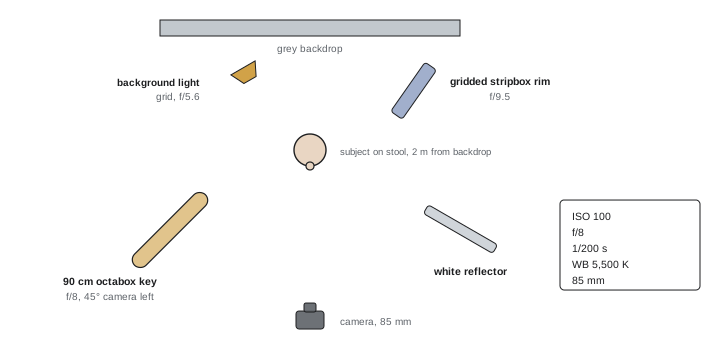
Professional photographers record their lighting so they can repeat it for a client, match it across a series, and explain it to assistants and students. A lighting diagram is a top-down sketch showing the subject, camera, background, each light with its modifier, height, distance and power, reflectors and flags, and any gels. Alongside it, record the camera settings (ISO, aperture, shutter speed, white balance, lens and focal length), meter readings for each light, the ambient exposure, and notes on what you changed and why. Many photographers also keep a pull-back shot, a wide photograph of the whole set, which shows the arrangement more clearly than any diagram.
The capstone: a lighting portfolio
The capstone project is a portfolio of ten to twelve photographs demonstrating your control of light, with documentation for each. The portfolio must include at least one image in each of the following categories:
- Natural light portrait at golden hour, in open shade, or with subtractive lighting, with a description of how you chose the time and position.
- Window light portrait, with control of fill or negative fill.
- Reflector or diffuser used to modify sunlight.
- On-camera flash used invisibly: bounce flash indoors, or fill flash outdoors, with the ambient exposure balanced.
- Off-camera flash on location, balancing the flash against ambient light (for example a subject lit by flash at dusk or against a darkened sky).
- Studio portrait with at least two light sources (or one light and a reflector) and a stated lighting ratio, using a named pattern.
- High-key or low-key portrait.
- Product with glossy, glass or metal surfaces, using the family of angles or bright-field or dark-field lighting.
- Food or still life using a window or a large soft source.
- Continuous light, with color matched to another source or used creatively.
For each photograph, submit:
- A lighting diagram and a pull-back shot where possible.
- Camera settings and the meter readings or flash settings used.
- A description of the light in terms of the five properties from Lesson 1: quantity, quality, direction, color and contrast.
- A short reflection: what you intended, what problems arose, and what you changed. Include at least one earlier attempt for two of the images to show the development of the lighting.
Choose subjects that you care about: portraits of people you know, objects with meaning, food you have cooked. Technically correct lighting of an uninteresting subject is less valuable than thoughtful lighting that serves a picture.
Critique and assessment
Portfolios are presented in a group critique, as in PHOT-101. For lighting work, critique focuses on whether the light serves the picture, and on evidence of control:
- Intention: Is it clear what the light is meant to do? Does the mood match the subject?
- Quality and direction: Are shadows, highlights and catchlights placed deliberately? Are there unwanted double shadows, hot spots or reflections?
- Exposure and contrast: Are skin tones and important detail correctly exposed? Is the ratio appropriate?
- Color: Is the white balance appropriate, are mixed sources handled, and do skin tones look natural?
- Separation and background: Does the subject stand out? Is the background tone controlled?
- Documentation: Do the diagram and notes explain the setup clearly enough that someone else could recreate it?
Assessment weighs technical control of light (about 40 %), the strength of the photographs as images (about 30 %), and documentation and reflection (about 30 %). A portfolio that shows clear learning, including honest discussion of what did not work, scores better than one with polished images but no evidence of understanding.
Where to go next
With this course and PHOT-101, you have the foundations of camera control and lighting. Later courses build on them in specific directions: studio and portrait photography, product and commercial work, documentary and photojournalism, and the digital darkroom. Whatever direction you take, keep practicing the habit at the heart of this course: before you raise the camera, look at the light, describe it, and decide whether to use it, wait for it, move, or change it.
Building a professional practice
The habits developed in the capstone carry into professional work. Keep a lighting notebook or digital library of diagrams, pull-back shots and settings from every shoot; over time it becomes a personal reference of setups that work. Maintain equipment on a schedule, checking stands, clamps, cables, batteries and flash tubes before each job, and pack spares for the items most likely to fail, such as triggers, batteries and fuses. Build a pre-shoot checklist covering permits, power, weather, safety equipment and a backup plan for changing light. Finally, keep studying light outside photography: in paintings, films and everyday scenes. Many of the best lighting ideas come from noticing how light falls on a street corner at a particular hour, then recreating it deliberately.
Common mistakes
MistakeLeaving stands unweighted because the shoot is short.
InsteadSandbag every stand, every time.
MistakeRunning cables across walkways untaped.
InsteadRoute cables along walls or tape them down and use ramps.
MistakePlugging many lights into one circuit.
InsteadAdd up the load and spread it across circuits or use batteries.
MistakeSetting up lights in public spaces without checking rules.
InsteadCheck permit requirements and keep paths clear.
MistakeSubmitting portfolio images without diagrams or analysis.
InsteadDocument each setup and describe the light using the five properties.
Summary and key terms
- Weight stands, counterweight booms and respect wind to prevent falling equipment.
- Route and tape cables, use slack loops and ramps to prevent trips.
- Respect heat from tungsten lights and the hazards of strobe capacitors.
- Plan electrical loads, inspect cables, use ground-fault protection in wet locations.
- Handle lithium batteries carefully and follow travel rules.
- Protect subjects and the public, and check permits for lighting on location.
- Document setups with diagrams, settings and pull-back shots; the portfolio demonstrates control across ten categories.
- Sandbag
- A weight placed on a stand leg to prevent tipping.
- Boom arm
- An arm extending a light over a subject from a stand.
- Gaffer tape
- Cloth tape that holds cables and removes cleanly.
- Cable ramp
- A protective cover for cables across walkways.
- GFCI
- Ground-fault circuit interrupter, protecting against shock.
- Pull-back shot
- A wide photograph showing the whole lighting setup.
- Lighting diagram
- A top-down sketch recording a lighting setup.
- Location permit
- Permission to photograph with equipment in a public or controlled space.
- Critique
- Structured feedback on photographs and their intent.
- Portfolio
- A curated set of work demonstrating skills and vision.
Practice problems
Work each problem on paper first, then reveal the answer to check.
Where is a sandbag placed on a stand?
Show answer
On the leg pointing toward the load.
Why leave a slack loop at each light?
Show answer
So a tug on the cable does not pull the stand over.
What load can be run continuously on a 15 A, 120 V circuit?
Show answer
About 1,440 W.
Why should you never open a strobe power pack?
Show answer
Its capacitors can hold a lethal charge after unplugging.
What protection should mains lighting use in wet locations?
Show answer
Ground-fault protection (GFCI).
Name two lithium battery precautions.
Show answer
Use proper chargers, do not charge unattended on flammable surfaces, retire swollen batteries, avoid heat.
Why might a handheld shoot need no permit when a lit shoot does?
Show answer
Many permit rules are triggered by equipment such as stands and lights.
What does a lighting diagram record?
Show answer
Positions, modifiers, heights, distances, power and meter readings of lights, plus camera settings.
What are the five properties used to describe each portfolio image's light?
Show answer
Quantity, quality, direction, color and contrast.
Which part of the portfolio assessment rewards honest discussion of what did not work?
Show answer
Documentation and reflection.
Lesson quiz · 5 questions
Score 60% or more to complete this lesson.
Create a free account to save your progress, take quizzes and earn a certificate.