
PHIL-330 · Lesson 4 of 12 · 21 min
Surveillance, biometrics and facial recognition
▶ Video coming soon A video version of this lesson is on the way.
Riverton's transit authority has had a difficult year: a string of assaults at two downtown stations, a rise in fare evasion and complaints from riders who feel unsafe late at night. A vendor has offered a system that would connect the network's 900 cameras to facial recognition software. The vendor says it could flag people on a watch list of those banned from transit for violence, find missing persons and help police identify suspects after an incident. The city council will vote in a month. Varga asks the seminar to prepare advice. Mei, who takes the train home from her studio at midnight, says she would feel safer. Sabine says she would feel watched. 'Both of those feelings,' Varga says, 'are evidence. Neither is an argument yet.'
The last lesson treated privacy mainly as a matter of information. This lesson treats it as a matter of power. Surveillance is the systematic monitoring of people, usually by an organization with authority over them or an interest in them, and it raises questions not only about what is known but about who knows, what they can do with that knowledge, and how being watched changes the watched.
Surveillance and power
In the 1790s the English philosopher Jeremy Bentham, whom you met as a founder of utilitarianism, designed a prison he called the panopticon. Cells were arranged in a ring around a central tower, from which a guard could see into every cell, while the prisoners could not see whether they were being watched. Bentham thought the design was humane and efficient: because prisoners could never be sure they were unobserved, they would behave as if they always were, and few guards would be needed.
In 1975 the French philosopher Michel Foucault, in Discipline and Punish, used the panopticon as a model for how modern institutions, including schools, factories, hospitals and armies, shape behavior through observation, records and the internalized sense of being watched. The point was not that everyone lives in a prison, but that visibility can be a form of control even when no one is actively looking. Later scholars have argued that digital surveillance is less like a single tower and more like a web: people are tracked by many organizations, and they often participate willingly, by carrying phones, posting online and using loyalty cards.
In 2019 the scholar Shoshana Zuboff described what she called surveillance capitalism: an economic model in which companies collect data about human behavior, often far beyond what their services require, and use it to predict and influence behavior for profit, especially through targeted advertising. Her critics say the term overstates how well companies can predict and steer behavior, and that targeted advertising is often less effective than its sellers claim. Her defenders reply that even imperfect prediction, at enormous scale, gives companies power that users cannot see or contest.
Chilling effects
One harm of surveillance is the chilling effect: people change lawful behavior because they know or suspect they are being watched. They avoid searching for sensitive topics, attending protests, joining organizations or expressing unpopular views. Chilling effects are hard to measure because they consist of things people do not do, but researchers have found evidence of them. One study found that views of Wikipedia articles on topics related to terrorism dropped noticeably after the 2013 revelations about large-scale government surveillance programs, suggesting that some people avoided reading about lawful topics for fear of being watched.
Chilling effects matter morally because they harm people who have done nothing wrong, and because they fall hardest on activities that a free society depends on: inquiry, dissent, association and journalism. They also tend to fall unequally. Communities that have historically been over-policed, or whose members are vulnerable because of immigration status, religion or political activity, are more likely to change their behavior under surveillance.
Biometrics
Biometrics are measurements of the body or behavior used to recognize individuals: fingerprints, faces, irises, voices, gait and even typing patterns. Biometrics differ ethically from other identifiers in several ways. You cannot change your face if its template is stolen, as you can change a password. Many biometrics can be captured at a distance and without the person's knowledge, so consent and notice are harder to ensure. And biometric data can reveal more than identity, such as age, health conditions or emotional state, although claims that emotions can be reliably read from faces are scientifically disputed.
How facial recognition works
Facial recognition systems detect a face in an image, convert it into a numerical template that captures its distinctive features, and compare that template with others. It is used in two main ways, which raise very different issues.
- Verification, or one-to-one matching: checking whether a person is who they claim to be, such as unlocking a phone or matching a traveler to the photo in their passport. The person usually knows and often chooses to take part.
- Identification, or one-to-many matching: searching a gallery of many faces to find who a person is, such as comparing an image from a camera against a watch list or a database of millions of photos. The person usually does not know.
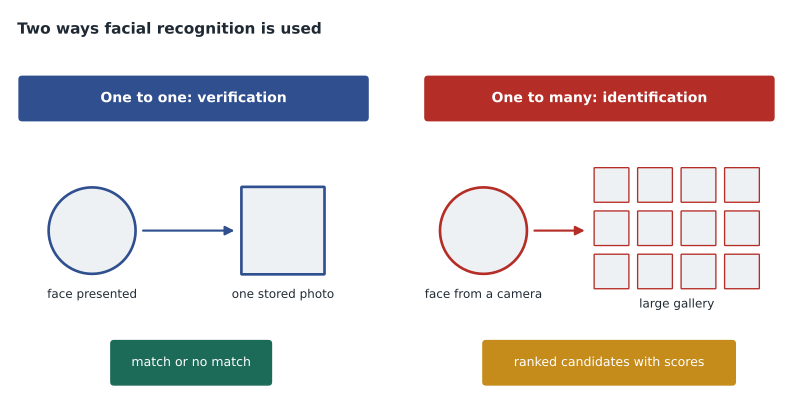
Every comparison produces a similarity score, and the system declares a match when the score passes a threshold. Two kinds of errors are possible. A false match, or false positive, says two different people are the same. A false non-match, or false negative, fails to recognize the same person. Raising the threshold reduces false matches but increases false non-matches, and the right balance depends on the use. Unlocking a phone can tolerate a few false non-matches; identifying a suspect for police cannot tolerate many false matches.
Accuracy, bias and the base rate problem
Facial recognition has improved dramatically since the mid-2010s, and the best algorithms are now extremely accurate under good conditions. But accuracy varies. In 2018, Joy Buolamwini and Timnit Gebru's Gender Shades study found that commercial systems that classified gender from faces made far more errors for darker-skinned women than for lighter-skinned men. In 2019, the U.S. National Institute of Standards and Technology tested about two hundred algorithms and found that many had higher false match rates for some demographic groups, including Black and East Asian people, women, children and older adults, although the most accurate algorithms showed much smaller differences. Accuracy also falls with poor lighting, low resolution, unusual angles and old photos, which are common in real camera footage.
Even an accurate system can produce mostly false alarms when used to search for rare people in a large crowd. This is the base rate problem, and it is easiest to see with numbers.
# Transit watch-list screening: how many alerts are correct? (illustrative numbers)
faces_per_day = 250000        # faces scanned across the network each day
on_watch_list = 5             # people on the watch list who actually ride on a given day
true_match_rate = 0.95        # chance the system flags a listed person who passes a camera
false_match_rate = 0.0001     # chance it wrongly flags someone not on the list

true_alerts = on_watch_list * true_match_rate
false_alerts = (faces_per_day - on_watch_list) * false_match_rate
print("correct alerts per day:", round(true_alerts, 1))
print("false alerts per day:", round(false_alerts, 1))
print("share of alerts that are correct:", round(true_alerts / (true_alerts + false_alerts), 2))correct alerts per day: 4.8 false alerts per day: 25.0 share of alerts that are correct: 0.16
With a false match rate of one in ten thousand, which sounds excellent, the system in the example produces about twenty-five false alerts a day and fewer than five correct ones: only about one alert in six is correct. Each false alert is a real person who may be stopped, questioned or worse. Whether the system is acceptable depends on what happens after an alert: if a trained human compares the images carefully and nobody is approached without further evidence, false alerts may do little harm; if alerts are treated as identifications, they will lead to wrongful stops.
Cases: wrongful arrests and biometric privacy in the United States
In January 2020, Robert Williams, a Black man in the Detroit area, was arrested in front of his family and held for about thirty hours after facial recognition software matched a blurry store surveillance image to his old driver's license photo. He had not committed the theft. Detroit later settled his lawsuit, agreeing in 2024 to policies under which a facial recognition result alone cannot be the basis for an arrest or a photo lineup. Other wrongful arrests based on facial recognition matches have been reported, and most of the publicly known cases involved Black people. Illinois's Biometric Information Privacy Act, passed in 2008, requires informed written consent before private companies collect biometric identifiers and allows individuals to sue; a 2022 settlement under it restricted Clearview AI from selling its database to most private companies nationwide. Several cities, beginning with San Francisco in 2019, have banned or restricted government use of facial recognition.
Arguments for and against
Varga asks the class to build the strongest case on each side of the transit proposal, because good advice to the council must answer the best version of the other side.
| Arguments for | Arguments against |
|---|---|
| Riders, including vulnerable riders, have a right to safety, and the city has a duty to protect them. | Everyone who rides is scanned, though nearly all have done nothing wrong; this treats the public as suspects. |
| The system can find missing persons and identify people who committed violent crimes. | False matches, which are more common for some groups, can lead to wrongful stops and arrests. |
| Cameras already record riders; matching faces only speeds up what staff do now. | Automated identification at scale is different in kind from occasional human review; it makes tracking cheap and constant. |
| Strict rules can limit use to serious cases, with human review of every alert. | Once built, systems tend to expand to new uses and new lists, a pattern called function creep. |
| Many riders support it, and democratic decisions deserve weight. | Chilling effects and loss of anonymity in public fall hardest on communities already over-policed. |
Several distinctions help the council think more precisely. Live, real-time identification is more intrusive than searching recorded footage after a specific incident. Searching against a short watch list of people banned for violence is more limited than searching against a database of every license photo. Use by transit staff to find a missing child is different from use by police to identify protesters. And the governance matters as much as the technology: who decides who goes on the list, who reviews alerts, how long images are kept, whether results are audited for accuracy and bias, and whether the public is told.
Function creep and the value of public anonymity
Function creep is the gradual extension of a system to uses beyond those for which it was approved. License plate readers installed to collect tolls are later used to track stolen cars and then to build records of everyone's movements. Databases built for one purpose are opened to others. Function creep is hard to resist because each extension seems small and useful. One response is to build limits into the design, for example by deleting data quickly or making certain searches technically impossible, rather than relying only on policies that can be changed.
Behind much of the debate is a value that is easy to overlook: anonymity in public. People have always been visible in public places, but mostly to strangers who did not know who they were and would not remember them. Face recognition at scale threatens to end that practical obscurity, turning every public appearance into a recorded, identified event. Some philosophers argue that the freedom to move through a city without being identified is part of what makes public life free; others argue that there is no reasonable expectation of privacy in public and that the benefits of identification outweigh this loss.
Worked problem
Advising the council
Draft the core of the seminar's advice on the transit proposal, applying the lesson's distinctions.
Show solution
- Separate uses: searching recorded footage after a reported violent incident is much less intrusive than live scanning of every rider.
- Apply the base rate lesson: live watch-list screening will produce many more false alerts than true ones, so it should not be used to stop riders without human confirmation and other evidence.
- Limit the gallery: if any matching is permitted, use only a short list of people banned for violence, with clear criteria and review, not general databases.
- Set governance: independent accuracy and bias testing on local camera conditions, logging and audit of every search, short retention, public reporting and a sunset clause requiring re-approval.
- Consider alternatives: more staff at night, better lighting, help points and design changes may address safety with fewer costs.
Answer: Advise against live facial recognition across the network; consider allowing tightly governed searches of recorded footage after serious incidents, combined with non-surveillance safety measures.
Common mistakes
MistakeAccurate facial recognition produces few false alarms.
InsteadWhen searching for rare people in large crowds, even a very low false match rate can mean most alerts are false.
MistakeThere is no privacy in public, so face recognition raises no privacy issue.
InsteadIdentification at scale ends practical obscurity and enables tracking, which is different from being seen.
MistakeBias in facial recognition has been solved.
InsteadThe best algorithms have small differences under good conditions, but real footage and weaker algorithms still produce unequal error rates.
MistakeRules can always stop misuse.
InsteadFunction creep is a recurring pattern; technical limits and sunset clauses help resist it.
Summary and key terms
- Bentham's panopticon and Foucault's analysis show how visibility can function as control.
- Surveillance capitalism describes business models built on collecting and using behavioral data.
- Chilling effects harm people who have done nothing wrong and fall hardest on vulnerable groups.
- Facial verification is one-to-one; identification is one-to-many and raises far greater concerns.
- Error rates can differ across groups, and the base rate problem means most alerts from crowd screening may be false.
- Wrongful arrests and Illinois's biometric privacy law show the stakes and one legal response in the United States.
- Panopticon
- Bentham's prison design in which inmates could always be watched but never know when.
- Chilling effect
- A change in lawful behavior caused by knowing or suspecting one is watched.
- Biometrics
- Measurements of the body or behavior used to recognize individuals.
- One-to-many identification
- Searching a gallery of faces to find who a person is.
- False match
- An error in which two different people are declared to be the same.
- Function creep
- The gradual extension of a system to uses beyond those for which it was approved.
Practice problems
Work each problem on paper first, then reveal the answer to check.
What is the difference between verification and identification?
Show answer
Verification checks a claimed identity against one record; identification searches many records to find who someone is.
In the code example, about what share of alerts were correct?
Show answer
About 0.16, roughly one in six.
Name two findings about accuracy differences in facial analysis.
Show answer
Gender Shades found much higher error rates for darker-skinned women; NIST found higher false match rates for several groups in many algorithms.
What is function creep, and how can design resist it?
Show answer
The extension of a system to new uses; deleting data quickly or making certain searches impossible builds in limits.
Lesson quiz · 5 questions
Score 60% or more to complete this lesson.
Create a free account to save your progress, take quizzes and earn a certificate.