
PHIL-330 · Lesson 10 of 12 · 20 min
Generative AI, creativity and intellectual property
▶ Video coming soon A video version of this lesson is on the way.
Mei brings a portfolio to the tenth session. On one side are illustrations she drew over fifteen years; on the other are images a client generated by typing 'in the style of Mei Tanaka' into an image generator. They are not copies of any picture she made, but anyone who knows her work would recognize the line, the palette and the way she draws hands. 'I never agreed to have my work used to train this,' she says. 'I wasn't paid. And now it's taking my clients.' Theo, who uses a coding assistant every day, says the model learned from her work the way any art student learns from looking at other artists. Mei asks whether an art student can produce ten thousand pictures in her style in an afternoon.
Generative AI systems produce text, images, audio, video and code in response to prompts. They have spread faster than almost any earlier technology, and they raise questions that run from philosophy of art to copyright law to the economics of creative work. This lesson asks how these systems work, whether what they do is creative, who owns what they produce, whether training them on existing works is fair, and what other harms and benefits they bring.
How generative models work
Generative models are trained on very large collections of examples, such as text from books and the web, or images with captions. During training, they adjust billions of internal parameters to capture statistical patterns in the data: which words tend to follow which, or how pixels in images relate to the words that describe them. A large language model generates text by repeatedly predicting a likely next piece of text given everything before it. An image model typically starts from random noise and refines it step by step toward an image that matches the prompt. The models do not usually store their training examples as copies, but they can sometimes reproduce passages or images closely, especially ones that appeared many times in the training data.
A tiny example shows the basic idea of generating text from patterns. The program below learns, from a short training text, which word tends to follow each pair of words, and then generates new text by sampling from those patterns. Real models are vastly larger and more sophisticated, but the principle that output reflects patterns in training data is the same.
# A toy text generator that learns word patterns from a training text
import random
random.seed(4)
text = ("the river runs past the mill and the mill turns slowly in the river light "
        "the light falls on the water and the water runs past the old stone mill").split()
text = text + text[:2]   # wrap around so every pair of words has a next word
model = {}
for a, b, c in zip(text, text[1:], text[2:]):
    model.setdefault((a, b), []).append(c)

state = ("the", "river")
out = list(state)
for _ in range(14):
    nxt = random.choice(model.get(state, ["the"]))
    out.append(nxt)
    state = (state[1], nxt)
print(" ".join(out))
print("patterns learned:", len(model))the river runs past the old stone mill the river runs past the mill and the patterns learned: 24
The output is new in the sense that it is a sequence that may not appear in the training text, but every step comes from a pattern in that text. Theo says that is what all creativity is: recombining what you have learned. Mei says that is what creativity looks like from the outside, and that it leaves out intention, experience and the choice of what to say.
Can machines be creative?
The cognitive scientist Margaret Boden distinguished three kinds of creativity. Combinational creativity produces unfamiliar combinations of familiar ideas, as in poetic imagery or analogy. Exploratory creativity explores the possibilities of an established style or set of rules, as a composer might within the conventions of the sonata. Transformational creativity changes the rules themselves, making possible ideas that could not have been thought before, as with the invention of cubism or atonal music. Generative AI is clearly capable of impressive combinational and exploratory work. Whether it is capable of transformational creativity is debated.
Philosophers also ask whether creativity requires more than producing novel and valuable outputs. Some argue that creativity is a property of agents with intentions, who mean something by what they make and can explain or stand behind it. On this view, a model can produce creative artifacts without being creative, and the creativity, where there is any, lies in the people who build, prompt, select and edit. Others argue that this definition is unfairly tailored to humans, and that if outputs are indistinguishable from creative human work, the distinction does not matter. The debate matters for law and for how we value creative work: if creativity requires a human author, then purely machine-generated works may not be protected, and human creative labor may deserve special recognition.
Three intellectual property questions
Generative AI raises three distinct questions about intellectual property, and it helps to keep them apart.
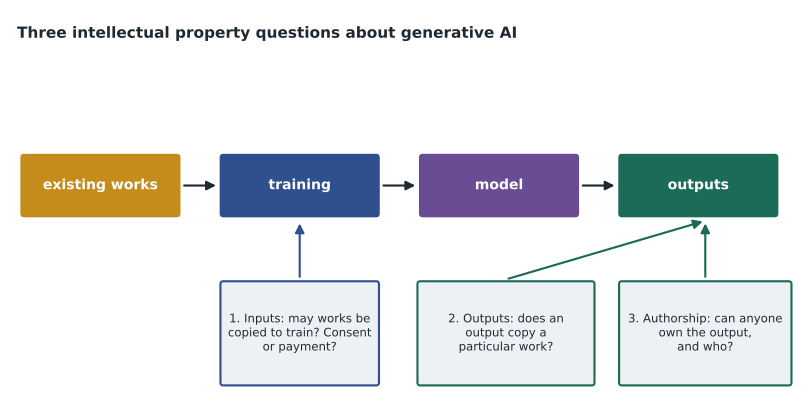
- Inputs: is it lawful and fair to copy existing works to train a model without permission or payment?
- Outputs: does a particular output infringe a particular work, for example by reproducing it or a substantial part of it?
- Authorship: can anyone hold copyright in AI-generated output, and if so, who: the user who wrote the prompt, the company that built the model, or no one?
Authorship and training in U.S. law
The United States Copyright Office has long held that copyright protects only works of human authorship. In 2023 it ruled that a comic book's text and the arrangement of its images could be protected, but not the individual images generated by an AI system from the author's prompts. In Thaler v. Perlmutter (2025), the federal appeals court in Washington, D.C., upheld the Office's refusal to register a work listing an AI system as its sole author. The Office's 2025 report on copyrightability concluded that prompts alone generally do not give enough control over the output to make the user its author, while human selection, arrangement and modification of AI output can be protected. On training, the question is whether copying works to train a model is fair use, judged by four factors: the purpose and character of the use, including whether it is transformative; the nature of the work; the amount used; and the effect on the market for the work. In 2025, two federal judges in California found on the records before them that training large language models on books was fair use, in Bartz v. Anthropic and Kadrey v. Meta, though the Bartz court held that building a library from pirated copies was not, and that case later settled for 1.5 billion dollars, the largest copyright settlement in American history. In Thomson Reuters v. Ross Intelligence (2025), a federal judge in Delaware found that copying legal headnotes to build a competing legal research tool was not fair use. Many other cases, by authors, artists, news organizations and music publishers, are pending.
Sabine notes that the law has so far said little about style. Copyright protects particular expressions, not styles or ideas, so in most jurisdictions an image 'in the style of' Mei that does not copy any of her works is unlikely to infringe her copyright, however recognizable. Some artists argue that this gap should be filled by new rights; others worry that protecting style would restrict the ordinary way artists learn from and build on one another.
The ethics of training
Whatever the law decides, the ethical question remains: is it fair to train models on people's creative work without their consent or payment? The arguments run in several directions.
| Arguments that training without consent is acceptable | Arguments that it is unfair |
|---|---|
| Learning from existing works is how all culture develops; artists learn by studying others. | Human learning is slow, limited and personal; a model can absorb millions of works and compete with all their creators at scale. |
| Models extract statistical patterns, not copies, and outputs are usually new. | The value of the model comes from the works, and the people who made them receive nothing. |
| Requiring permission for every work would make useful models impossible to build, concentrating power in firms that own large archives. | Licensing markets can be built, as they were for music radio and photocopying; impossibility is overstated. |
| Broad access to knowledge and tools benefits everyone, including new creators. | Models can substitute for the work of the very people whose labor trained them, harming their livelihoods. |
Several middle positions have been proposed. One is an opt-out system, in which creators can mark their work as not to be used for training; critics say the burden should be on the user, not the creator, and that opt-outs come too late for work already used. Another is collective licensing, in which developers pay into a fund distributed to creators, as with some existing copyright collectives. A third is transparency about training data, so that creators at least know whether their work was used. A fourth is limiting outputs, for example by refusing prompts that name living artists. Mei says she would accept some of these, but that the principle matters to her: she wants to be asked.
Creative work as a livelihood
Behind the legal arguments is an economic one. Illustrators, translators, voice actors, stock photographers, copywriters and session musicians often earn modest incomes from many small commissions, exactly the kind of work that generative tools can now do quickly and cheaply. Early surveys of freelancers and studies of online job platforms have reported falling demand and prices for some kinds of writing and image work after generative tools became widely available, although the evidence is still limited and varies by field. Defenders of the technology argue that it also creates new kinds of creative work and lowers the cost of making things, so that more people can make films, games and books. Critics reply that the gains go mainly to the companies that own the models and to clients, while the losses fall on creators who have little bargaining power. Mei says she is not against the tools; she has tried them for sketching ideas. What she objects to is a market in which her own past work is used to undercut her future work. Varga says this connects to the previous lesson: who captures the gains of a technology is a question of ownership and power, not of the technology itself.
Beyond copyright: other harms and benefits
Generative AI raises questions beyond intellectual property.
- Deepfakes and impersonation: realistic fake images, video and audio of real people can be used for fraud, harassment, non-consensual intimate imagery and political deception.
- Misinformation and the information environment: cheap, fluent text and images can flood the information environment, and the mere possibility of fakes lets people dismiss real evidence, a problem sometimes called the liar's dividend.
- Hallucination: language models can produce confident falsehoods, such as the fake legal citations in the cases discussed in lesson eight.
- Education and integrity: students can submit generated work as their own, and teachers must rethink assessment; some argue the deeper risk is that students skip the struggle through which skills are learned.
- Homogenization: if many people use the same models, outputs may converge, reducing the diversity of styles and ideas.
- Benefits: generative tools can help people with disabilities communicate, make creative tools accessible to people without training, speed up routine writing and coding, and serve as tutors and assistants.
In 2025, Congress passed the TAKE IT DOWN Act, which makes it a federal crime to publish non-consensual intimate images, including AI-generated ones, and requires platforms to remove them promptly on request. Many states have passed laws on election deepfakes and on the use of a person's voice or likeness. Technical responses include watermarking and content credentials, a standard for attaching information about how an image or video was made and edited.
Worked problem
A policy for Scribe
The Riverton startup from lesson two, which makes the Scribe writing assistant, wants an ethical policy on training data and outputs. Draft its main points.
Show solution
- Training data: use licensed, public domain and openly licensed text where possible; honor opt-out signals; publish a summary of data sources.
- Compensation: join or create a licensing arrangement with authors and publishers for the material the product depends on most.
- Outputs: filter close reproductions of training text; decline requests to imitate named living authors' styles for commercial use; flag when output may contain factual errors.
- Transparency: tell users when text is AI-generated, and offer schools a mode that shows how the tool was used in drafting.
- Accountability: create a process for creators to complain and have their work removed from future training.
Answer: A defensible policy combines licensed data, honored opt-outs, compensation, safeguards on outputs, transparency and a complaint process.
Common mistakes
MistakeGenerative models store copies of their training data and paste them together.
InsteadThey learn statistical patterns, though they can sometimes reproduce training examples closely.
MistakeAnything an AI generates is automatically protected by copyright.
InsteadMost legal systems require human authorship; purely generated output may have no owner.
MistakeIf training is legal, it is ethical.
InsteadLaw and ethics can come apart; consent, compensation and harm to creators remain ethical questions.
MistakeCopyright protects an artist's style.
InsteadCopyright protects particular expressions, not styles or ideas.
Summary and key terms
- Generative models learn statistical patterns from large training sets and generate new outputs from them.
- Boden distinguished combinational, exploratory and transformational creativity; whether machines are creative depends partly on whether creativity requires intention.
- Generative AI raises three IP questions: training inputs, infringing outputs and authorship.
- U.S. law requires human authorship; courts have split on whether training is fair use, depending on the facts.
- Copyright does not protect style, leaving a gap that matters to artists.
- Deepfakes, misinformation, hallucination and effects on education and creative work are harms beyond copyright.
- Generative model
- A model trained to produce new content, such as text or images, that resembles its training data.
- Transformational creativity
- Boden's term for creativity that changes the rules of a domain.
- Fair dealing
- Canadian copyright exceptions for specified purposes such as research, education and criticism.
- Fair use
- The U.S. copyright doctrine permitting some uses judged by four statutory factors.
- Deepfake
- Realistic synthetic media depicting a real person saying or doing something they did not.
- Liar's dividend
- The ability to dismiss genuine evidence as fake because fakes are possible.
Practice problems
Work each problem on paper first, then reveal the answer to check.
Name Boden's three kinds of creativity.
Show answer
Combinational, exploratory and transformational.
What are the three intellectual property questions raised by generative AI?
Show answer
Whether training on works is permitted, whether outputs infringe works, and who if anyone owns outputs.
Does copyright protect an artist's style?
Show answer
Generally no; it protects particular expressions, not styles or ideas.
Give two middle positions on training without consent.
Show answer
Any two of opt-out systems, collective licensing, training data transparency and output limits.
Lesson quiz · 5 questions
Score 60% or more to complete this lesson.
Create a free account to save your progress, take quizzes and earn a certificate.