
PET-450 · Lesson 10 of 12 · 19 min
Risk, probability and expected value
The Spruce Ridge prospect is a mapped structure about 20 kilometers from the Tamarack Lake field, defined by old two-dimensional seismic and a nearby well that had oil shows. Grace believes it could hold a pool like the original discovery, but it could also be a dry hole. The exploration team has put a well into the 2027 proposals, and Diane wants Ethan to value it in a way that can be compared with the development projects. “A development well is a question of how much. An exploration well is a question of whether. You have to put both on the same scale.” This lesson introduces the probability ideas that evaluators use, the expected monetary value, attitudes to risk, and the rules for adding uncertain quantities together.
Probability for evaluators
Three rules of probability carry most of the weight in evaluation work. The probability of an event is a number between 0 and 1. If two events are independent, the probability that both occur is the product of their probabilities. And if an outcome can happen in mutually exclusive ways, its probability is the sum of the probabilities of those ways. Conditional probability, the probability of one event given that another has occurred, extends these rules to linked events and underlies the value of information in Lesson 11.
In practice, probabilities in evaluation are rarely frequencies from repeated experiments. They are degrees of belief, informed by data, analogs and experience. A geologist who says a trap has a 60 percent chance of being present is expressing a judgment, and that judgment can be calibrated by comparing past predictions with outcomes. Companies that track their exploration forecasts against results, prospect by prospect over many years, learn whether their teams are systematically optimistic, as most teams are when they first start checking.
The chance of success
For an exploration prospect, the chance of geological success, Pg, is the probability that a well will find a significant accumulation of movable hydrocarbons. It is usually estimated as the product of the chances that each of the necessary elements is present: a mature source rock that has generated oil, a reservoir of adequate quality, a trap, and a seal, sometimes with a separate factor for timing and migration. Treating the factors as independent and multiplying them is a convenient simplification; where they are linked, for example where the seal and trap depend on the same fault, they should be assessed together.
Geological success is not the same as commercial success. A discovery may be too small, too low in productivity or too far from infrastructure to develop. The chance of commerciality is the chance of discovery multiplied by the chance of development given a discovery. Prospective resources in PRMS are reported unrisked, as the low, best and high estimates if the prospect is a discovery, together with the chance of discovery and chance of development; multiplying the volumes by these chances gives risked volumes, which are useful for comparing prospects but must not be added to reserves or contingent resources.
Expected monetary value
The expected monetary value (EMV) of a decision is the probability-weighted average of the values of its outcomes. For a simple exploration well with two outcomes, success and dry hole,
where NPV_success is the value of the discovery including the cost of the discovery well and its development, and C_dry is the after-tax cost of a dry hole. The EMV is the value the decision adds on average, over many similar decisions; a company that consistently takes decisions with positive EMV, and estimates its probabilities and values without bias, will create value over time even though many individual wells fail. The break-even chance of success, at which EMV is zero, is C_dry / (NPV_success + C_dry), and comparing it with Pg shows how much room there is for error in the probability estimate.
For Spruce Ridge, Grace's assessment gives chances of 0.90 for source, 0.70 for reservoir, 0.60 for trap and 0.80 for seal. A dry hole would cost 5.5 million dollars after tax relief, and a discovery is worth 18 million dollars of NPV10 after the cost of the well and development, using the mean of the success-case volumes.
# Risk: chance of success, expected monetary value, and why P90 volumes do not add.
import random, math
SI = False     # True: Canadian dollars, False: US dollars
random.seed(10)
# Spruce Ridge exploration well: chance of geological success from independent factors
factors = {"source": 0.90, "reservoir": 0.70, "trap": 0.60, "seal": 0.80}
pg = math.prod(factors.values())
dry = 4.8 if SI else 5.5             # dry-hole cost, millions
success_npv = 22.0 if SI else 18.0   # NPV10 of the development if successful, millions (after the well cost)
emv = pg * success_npv - (1 - pg) * dry
print(f"chance of geological success {pg:.3f}")
print(f"EMV = {pg:.3f} x {success_npv} - {1 - pg:.3f} x {dry} = {emv:.2f} million")
print(f"break-even chance of success {dry / (success_npv + dry):.3f}")
# risk aversion: exponential utility with a risk tolerance of R (millions)
for R in (200.0, 50.0, 15.0):
    eu = pg * (1 - math.exp(-success_npv / R)) + (1 - pg) * (1 - math.exp(dry / R))
    ce = -R * math.log(1 - eu)
    print(f"risk tolerance {R:5.0f}: certainty equivalent {ce:6.2f} million")
# eight Phase 2 wells, each with an independent lognormal EUR: P90 of the sum vs sum of P90s
p50 = 42800.0 if SI else 577000.0   # P50 EUR of a Phase 2 well (Lesson 5)
s = 0.35                            # spread of ln(EUR) between wells, including decline uncertainty
z = 1.2816
one_p90 = p50 * math.exp(-z * s)
tot = sorted(sum(p50 * math.exp(random.gauss(0, s)) for _ in range(8)) for _ in range(20000))
u = "m3" if SI else "bbl"
print(f"one well: P90 {one_p90:,.0f} {u}; 8 x P90 = {8 * one_p90:,.0f} {u}")
print(f"P90 of the 8-well total by simulation {tot[int(0.1 * len(tot))]:,.0f} {u}; mean {sum(tot) / len(tot):,.0f} {u}")chance of geological success 0.302 EMV = 0.302 x 18.0 - 0.698 x 5.5 = 1.61 million break-even chance of success 0.234 risk tolerance 200: certainty equivalent 1.32 million risk tolerance 50: certainty equivalent 0.52 million risk tolerance 15: certainty equivalent -1.40 million one well: P90 368,442 bbl; 8 x P90 = 2,947,533 bbl P90 of the 8-well total by simulation 4,127,748 bbl; mean 4,904,256 bbl
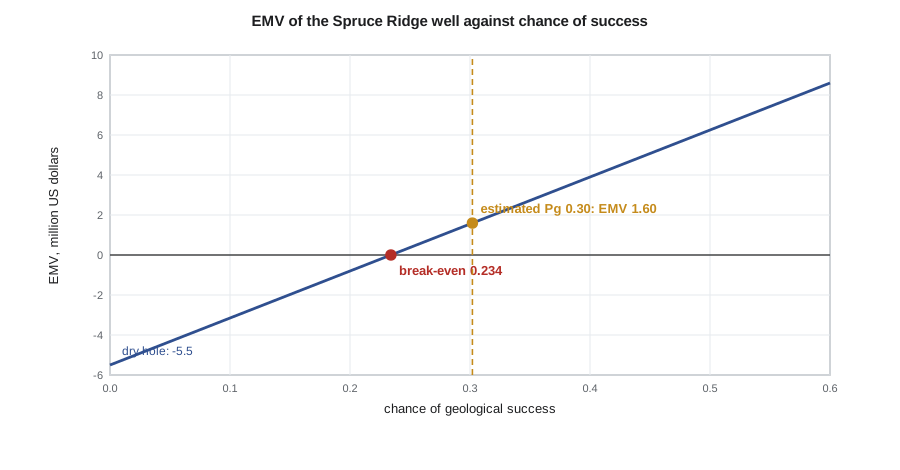
The chance of geological success is 0.302, about one in three. The EMV is 0.302 × 18.0 − 0.698 × 5.5 = 1.61 million dollars, and the break-even chance is 0.234, so the well is worth drilling only if Grace's estimate is not much too optimistic. This EMV is the value that Lesson 9 used to rank the well against the development projects.
Attitudes to risk
EMV is the right decision rule for a company that can take many similar risks and absorb the losses on some of them. It is not right for a company betting a large share of its value on a single outcome: a small company that drills a dry hole costing a fifth of its market value may not survive to drill the next well, whatever the EMV. Decision analysts handle this with a utility function, which values outcomes by their usefulness to the decision maker rather than by their dollar amount. A common form is the exponential utility, with a single parameter R, the risk tolerance, roughly the size of a gamble the company would just be willing to take at even odds of winning R or losing R/2.
The certainty equivalent (CE) of a risky decision is the certain amount that the decision maker would regard as equally attractive. For a risk-neutral company it equals the EMV; for a risk-averse company it is lower. With exponential utility,
where p_k and x_k are the probabilities and values of the outcomes. The script shows that with a risk tolerance of 200 million dollars, large compared with the stakes, the certainty equivalent of Spruce Ridge is 1.32 million, close to the EMV. At 50 million it falls to 0.52 million, and at 15 million, a tolerance typical of a much smaller company, it becomes negative: such a company should farm out part of the well to share the risk rather than drill it alone.
Farm-outs, joint ventures and working-interest partners are the practical tools of risk management in exploration. Taking a smaller interest in more prospects reduces the chance of a run of failures that would cripple the company, at the cost of a smaller share of each success. For a risk-averse company, the certainty equivalent of a portfolio of small interests can be much higher than that of a single large interest with the same total EMV.
Adding uncertain quantities
The same probability ideas govern how reserves are added. Expected values, the means, can always be added: the mean of a total is the sum of the means. Percentiles cannot. The P90 of the sum of several independent quantities is larger than the sum of their individual P90s, because it is very unlikely that every well will turn out at its own low case at the same time. Adding P90s arithmetically therefore gives a total that is more conservative than a true P90, and adding P10s gives a total that is more optimistic than a true P10.
The script shows this for the eight Phase 2 wells. Each well's EUR has a lognormal distribution with a P50 of 577,000 barrels. One well's P90 is 368,000 barrels, and eight times that is 2.95 million barrels. A simulation of the total of eight independent wells gives a P90 of 4.13 million barrels, about 40 percent higher, while the mean total, 4.90 million barrels, is simply eight times the mean of one well.
This is why proved estimates built conservatively well by well, then added, tend to be exceeded in total. The SEC rules apply the reasonable-certainty test to the quantities reported, and PRMS recommends arithmetic summation of category totals for reporting, with probabilistic aggregation used to understand the result. The effect depends on independence. Wells that share a common uncertainty, such as a type curve that may be biased for the whole play, a regional pressure, or the oil price, are positively correlated, and correlation reduces the benefit of aggregation.
Worked problem
Risked volumes and EMV
A second prospect has a chance of success of 0.25, a mean success-case recoverable volume of 1.9 million barrels, a success-case NPV10 of 16 million and a dry-hole cost of 4 million. Find the risked mean volume, the EMV and the break-even chance.
Show solution
- Risked mean volume: 0.25 × 1.9 = 0.475 million barrels.
- EMV: 0.25 × 16 − 0.75 × 4 = 4.0 − 3.0 = 1.0 million.
- Break-even chance: 4 / (16 + 4) = 0.20.
Answer: The prospect adds value on average, but its chance is only 0.05 above break-even, so the estimate of Pg deserves scrutiny before the well is approved.
Portfolios and the gambler's ruin
A company with one exploration well a year and a 30 percent chance of success has about a one in three chance of three dry holes in a row, and for a small company three dry holes may exhaust its exploration budget before the first discovery arrives. Analysts call this the gambler's ruin: a game with a positive expected value can still bankrupt a player who bets too much of his stake on each round. The defense is to take more, smaller positions, so that the law of averages has room to work. When Ethan models a portfolio of five 20 percent interests in similar prospects instead of one 100 percent interest in Spruce Ridge, the expected value is the same but the chance of losing the whole exploration budget without a discovery falls from 70 percent to under 20 percent, assuming the prospects are independent. Diane uses that comparison to support the exploration team's proposal to seek partners.
Common mistakes
MistakeRanking exploration wells by unrisked success-case volumes.
InsteadUse risked values and EMV, with Pg estimated from the individual geological factors.
MistakeUsing EMV alone for a decision that could threaten the company.
InsteadConsider risk tolerance and certainty equivalents; share large risks through farm-outs.
MistakeAdding P90 or P10 values and calling the total a P90 or P10.
InsteadMeans add; percentiles do not. Use simulation to find percentiles of totals.
MistakeAssuming wells are independent when they share common uncertainties.
InsteadModel correlation from shared type curves, regional factors and prices.
Summary and key terms
- Probabilities in evaluation are calibrated judgments; tracking predictions against outcomes improves them.
- The chance of geological success is commonly the product of source, reservoir, trap and seal chances.
- EMV weights each outcome's value by its probability; positive-EMV decisions create value on average.
- The break-even chance of success shows how much room there is for error in Pg.
- Risk-averse decision makers use certainty equivalents; farm-outs share large risks.
- Means add but percentiles do not; correlation reduces the benefit of aggregation.
- Chance of geological success (Pg)
- The probability that a well will discover a significant accumulation of movable hydrocarbons.
- Chance of commerciality
- The chance of discovery multiplied by the chance of development.
- Expected monetary value
- The probability-weighted average of the values of a decision's outcomes.
- Break-even chance
- The chance of success at which EMV equals zero.
- Risk tolerance
- A measure of the size of risk a decision maker is willing to take.
- Certainty equivalent
- The certain value regarded as equal to a risky prospect.
- Farm-out
- An agreement in which a partner earns an interest by paying part of the cost of a well.
Practice problems
Work each problem on paper first, then reveal the answer to check.
Four independent factors have chances of 0.8, 0.7, 0.6 and 0.9. What is Pg?
Show answer
0.8 × 0.7 × 0.6 × 0.9 = 0.302.
Success NPV is 30 million, dry-hole cost 6 million, Pg = 0.2. What is the EMV?
Show answer
0.2 × 30 − 0.8 × 6 = 6.0 − 4.8 = 1.2 million.
Why is the P90 of eight independent wells more than eight times one well's P90?
Show answer
All eight wells are unlikely to be low at the same time, so the total is relatively less uncertain.
Why might a small company farm out a positive-EMV well?
Show answer
A dry hole could be a large share of its value; sharing the cost raises the certainty equivalent.
Lesson quiz · 5 questions
Score 60% or more to complete this lesson.
Create a free account to save your progress, take quizzes and earn a certificate.