
PET-380 · Lesson 12 of 12 · 20 min
Capstone: the Tamarack Lake gathering system tie-in
Six months after joining the facilities group, Ethan presents his recommendation for the 4-22H tie-in to a review panel: Sofia, Mei Lin, Tom Ashworth, Wes Brandt for operations and the facilities manager. The question is simple to state. Should the new pad be tied in with a 6-inch or an 8-inch line, and what operating plan should go with it? Answering it brings together every part of the course: fluid properties, holdup, flow patterns, pressure drop methods, design codes and flow assurance.
This lesson works through the tie-in decision as a complete case study. It sets out the design basis, evaluates both candidate sizes over the production profile, checks each flow assurance threat, reviews the regulatory path and builds the operating plan. Along the way it shows how an engineer turns many partial results into a single defensible recommendation.
The design basis
The basis comes from the earlier lessons. The route is 3.9 miles long with a net rise of 105 ft to the facility, a low point at the creek crossing at 0.9 mile and a 197 ft climb to the ridge at 2.5 miles (lesson 9). The fluids are a light Bakken oil of about 42 °API with associated gas and a water cut rising from 30 to 70 percent over ten years. Tom's forecast gives in-situ liquid rates falling from 6,900 to 1,640 bbl/d and in-situ gas from 184,000 to 56,500 ft³/d over the first ten years. The wellheads can deliver about 290 psig initially, falling as reservoir pressure declines, and the inlet separator at the facility runs at 102 psig. Ground temperature at burial depth falls to about 39 °F in late winter, and the hydrate formation temperature at line pressure is about 57 °F (lesson 10).
The pressure drop method is the one Ethan validated against the north pad line in lesson 7. For the screening calculations in this lesson he uses a simplified Beggs-Brill segregated holdup with a net-climb elevation term, which is fast enough to run for every year of the forecast; the detailed design will repeat the key cases with the validated mechanistic model and a transient simulator.
Hydraulics over the field life
# Capstone: compare 6-inch and 8-inch tie-in options for the new pad over the life of the field
import math
SI = False
g = 9.81
L, climb = 6200.0, 32.0
rhoL, rhoG, muL = 880.0, 15.0, 0.003
years = [(1, 1100.0, 5200.0), (3, 700.0, 3600.0), (6, 420.0, 2400.0), (10, 260.0, 1600.0)]   # yr, in-situ liquid, gas m3/d
def dp(D, qLd, qGd, eps=4.6e-5):
    A = math.pi * D * D / 4
    vsl, vsg = qLd / 86400 / A, qGd / 86400 / A; vm = vsl + vsg; lam = vsl / vm
    NFr = vm * vm / (g * D)
    HL = min(0.98, max(lam, 0.98 * lam ** 0.4846 / NFr ** 0.0868))
    rho_ns = rhoL * lam + rhoG * (1 - lam); rho_s = rhoL * HL + rhoG * (1 - HL)
    Re = rho_ns * vm * D / (muL * lam + 1.2e-5 * (1 - lam))
    f = 0.25 / math.log10(eps / D / 3.7 + 5.74 / Re ** 0.9) ** 2
    return f * rho_ns * vm * vm / (2 * D) * L / 1000 + rho_s * g * climb / 1000, vm, HL
fp, up = (1, "kPa") if SI else (0.145038, "psi")
fv, uv = (1, "m/s") if SI else (3.2808, "ft/s")
for nps, D, cost in (("6-inch", 0.1541, 2.9), ("8-inch", 0.2027, 3.6)):
    print(f"{nps} option (installed cost about {cost} million {'Canadian' if SI else 'US'} dollars):")
    for yr, qL, qG in years:
        d, vm, HL = dp(D, qL, qG)
        inv = HL * math.pi * D * D / 4 * L
        print(f"  year {yr:2d}: dp {d * fp:5.0f} {up}, vm {vm * fv:4.1f} {uv}, holdup {HL:.2f}, liquid inventory " +
(f"{inv:5.1f} m3" if SI else f"{inv * 6.2898:5.0f} bbl"))6-inch option (installed cost about 2.9 million US dollars): year 1: dp 147 psi, vm 12.8 ft/s, holdup 0.34, liquid inventory 250 bbl year 3: dp 76 psi, vm 8.8 ft/s, holdup 0.36, liquid inventory 259 bbl year 6: dp 41 psi, vm 5.7 ft/s, holdup 0.37, liquid inventory 266 bbl year 10: dp 27 psi, vm 3.8 ft/s, holdup 0.38, liquid inventory 278 bbl 8-inch option (installed cost about 3.6 million US dollars): year 1: dp 50 psi, vm 7.4 ft/s, holdup 0.39, liquid inventory 488 bbl year 3: dp 32 psi, vm 5.1 ft/s, holdup 0.40, liquid inventory 504 bbl year 6: dp 24 psi, vm 3.3 ft/s, holdup 0.41, liquid inventory 519 bbl year 10: dp 21 psi, vm 2.2 ft/s, holdup 0.43, liquid inventory 541 bbl
The results show the trade-off clearly. In year 1 the 6-inch line loses about 147 psi, which the wells can supply: 102 psig at the separator plus 147 psi is about 249 psig at the pad, within the 290 psig available. The 8-inch line loses only about 50 psi, which would let the wells flow against a lower back pressure and produce somewhat more early on. By year 10 the picture changes. The 6-inch line still flows at 3.8 ft/s, holds about 278 bbl of liquid and loses 27 psi. The 8-inch line has slowed to 2.2 ft/s, below the 3 ft/s guideline of lesson 9, holds about 541 bbl of liquid, and its pressure drop of 21 psi is now almost entirely elevation loss on the climbs.
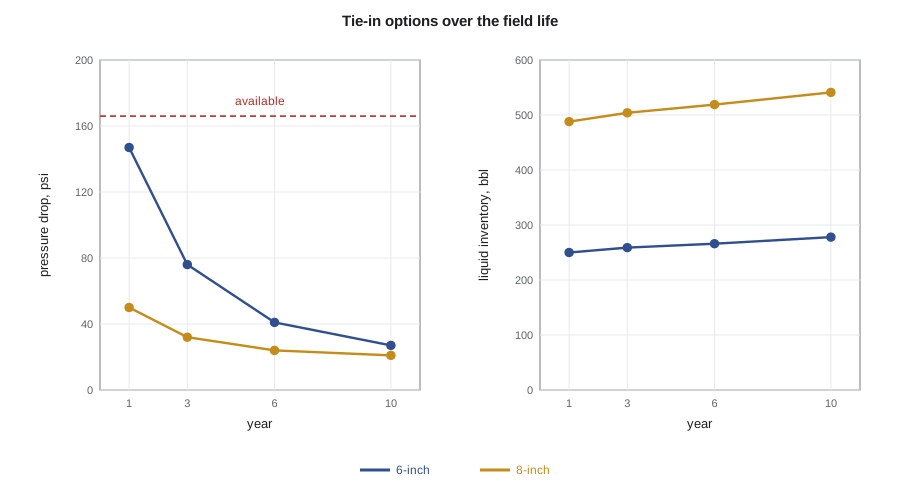
Two further hydraulic effects favor the smaller line late in life. First, the flow pattern: at the 6-inch line's year-10 velocity, the climbs remain in intermittent flow, which sweeps liquid over the ridge steadily, while the 8-inch line drops into stratified flow on the flats and slow, high-holdup flow on the climbs, the conditions that produce terrain slugging (lesson 11). Second, the inventory: every cubic meter of liquid held in the line must eventually be pushed out by a pig or a rate change, and the 8-inch line's larger inventory means larger pig slugs and longer, slower transients after shutdowns.
Back pressure and production
Tom raises the counter-argument. Lower back pressure in the early years means more production when the wells are most productive. Using the pad's inflow performance from his integrated model, he estimates that the 8-inch line would add about 2 to 3 percent to the first two years' oil, because the lower pad pressure lets the wells draw down further. Ethan compares this with the cost difference: the 8-inch line costs about 0.7 million US dollars more installed. At current prices the extra early oil would roughly recover that cost over two years, so on early economics alone the two options are close.
The deciding factors are therefore the late-life operating costs and risks. Here the 6-inch line is clearly better: less liquid inventory, steadier flow on the climbs, smaller pig slugs, less water and sand settling at the creek crossing and so less corrosion risk, and a higher fluid temperature at the battery because the relaxation length depends on the mass rate per unit of pipe perimeter, which is higher in the smaller pipe. Several of these differences translate directly into costs: methanol, corrosion inhibitor, pigging labor, and the risk of a plug or a leak.
Flow assurance review
Mei leads the panel through the threats one at a time, using the approach of lessons 10 and 11.
Hydrates. In winter, both lines will operate below the hydrate formation temperature near the battery, and the creek crossing is the coldest point. The plan is to bury the crossing deeper than the standard depth, insulate the above-ground riser at the battery, and inject methanol at the pad in winter at a rate set by the Hammerschmidt check of lesson 10, adjusted with the field's own operating data. A written hydrate response procedure, including two-sided depressurization, will be in place before start-up. The 6-inch line's higher arrival temperature reduces the methanol rate.
Wax. At year-1 rates the fluid arrives well above the 22 °C (72 °F) wax appearance temperature. By about year 6, the downstream end of the line will drop below the WAT in winter. Pigging every two weeks, started from the first year to establish the deposition rate, will keep any deposit thin, and paraffin inhibitor will be evaluated if pigging returns show significant wax.
Slugging and pigging. The largest liquid arrivals will be pig slugs. For the 6-inch line, with an inventory of 40 to 44 m³ (250 to 280 bbl) at the screening holdup, a pig slug could be about half of that, far larger than the existing inlet separator can absorb. The plan therefore includes a dedicated slug catcher at the battery inlet, sized from a transient simulation of pigging at reduced rate, and a pigging procedure that slows the line during the pig's arrival. For the 8-inch line the slug catcher would need to be roughly twice as large.
Corrosion and sand. The produced water contains dissolved CO₂, and the uninhibited rates of lesson 11 would consume a 3 mm (120 mil) corrosion allowance in a few years. The plan specifies continuous corrosion inhibitor at the pad, corrosion coupons at the creek crossing and at the battery, and in-line inspection within the first five years. Temporary sand traps at the pad will handle proppant flowback from the new wells. Keeping the velocity above about 1 m/s (3 ft/s) on the climbs, as the 6-inch line does throughout the forecast, reduces both settling and under-deposit corrosion.
| Criterion | 6-inch | 8-inch |
|---|---|---|
| Year-1 pressure drop | 147 psi | 50 psi |
| Year-10 mixture velocity | 3.8 ft/s | 2.2 ft/s |
| Year-10 liquid inventory | 278 bbl | 541 bbl |
| Installed cost | 2.9 million USD | 3.6 million USD |
| Early production | Base | About 2 to 3% higher |
| Late-life slugging and corrosion risk | Lower | Higher |
Regulatory path
The regulatory path depends on how the line is classified. As a crude oil gathering line in a rural area, its federal status under Part 195 depends on its diameter and operating stress, and the team will confirm the classification with the company's pipeline compliance group. The North Dakota Industrial Commission (NDIC)'s rules for underground gathering pipelines carrying crude oil or produced water, in North Dakota Administrative Code section 43-02-03-29.1, apply to the line, including the requirements for registration, construction standards, pressure testing, leak detection and records. If any associated gas is later routed separately, its gathering line will be checked against PHMSA's Type C and Type R criteria from the 2021 gas gathering rule. Design and testing will follow the company's standards, which are based on the federal requirements and industry practice.
The recommendation
Ethan's recommendation is the 6-inch line, with the following operating plan: methanol injection at the pad in winter, deeper burial at the creek crossing and an insulated riser at the battery; continuous corrosion inhibitor and corrosion monitoring at the low point and the battery; pigging every two weeks from start-up, with a dedicated slug catcher sized from a transient pigging study; temporary sand handling at the pad during flowback; and a model validation plan that compares measured and predicted pressure drop quarterly, as he did for the north pad line.
He presents the risks honestly. If the production forecast proves high, the 6-inch line will be oversized late in life just as the 8-inch would have been, but less severely. If it proves low early on, the 6-inch line's higher back pressure costs less production than the panel feared. If the gas-oil ratio rises much more than forecast, the 6-inch line's friction could limit the pad in the early years; in that case a short loop line on the steepest section could be added later. Recording these sensitivities in the design basis lets future engineers see what was assumed and why.
Sofia's verdict is short. 'Smaller, steadier and cheaper to operate, with a plan for every threat we know about. Approved for detailed design.' Mei adds one condition: the transient pigging study must be complete before the slug catcher is ordered.
What the course has built
Looking back, each lesson contributed a piece of the decision. Lesson 1 framed the system from wellbore to battery. Lessons 2 and 3 provided single-phase friction and the definitions of holdup and slip. Lessons 4 and 5 described the flow patterns that set the physics in each part of the system. Lesson 6 split the pressure gradient into its components and showed which one dominates. Lessons 7 and 8 provided the empirical and mechanistic methods, and the discipline of validating them against field data. Lesson 9 applied them to sizing, velocity limits, code wall thickness and networks. Lessons 10 and 11 identified the threats that a line must survive, and this lesson combined all of it into a single recommendation with an operating plan.
The same workflow applies to other systems: a gas-condensate trunk line, a produced water disposal network, a horizontal well's tubing design or an offshore tie-back. The details change, but the steps are the same: define the basis, predict the flow patterns over the field life, choose and validate a pressure drop method, size for the whole profile, assess every flow assurance threat, satisfy the governing code and regulator, and write it all down so the operators who live with the line know why it was built that way.
Worked problem
Available pressure check
In year 1 the 6-inch line's pressure drop is 147 psi and the separator operates at 102 psig. The wellheads can deliver 290 psig but need at least 22 psi across the chokes to keep flow critical. Is the 6-inch line acceptable?
Show solution
- Required pad pressure: 102 + 147 = 249 psig.
- Pressure available after the choke margin: 290 − 22 = 268 psig.
- Margin: 268 − 249 = 19 psi.
Answer: Yes, with a margin of about 19 psi, which narrows as reservoir pressure falls but is offset by the falling line pressure drop.
Common mistakes
MistakeChoosing the size with the lowest initial pressure drop.
InsteadEvaluate the whole profile and the flow assurance consequences.
MistakeTreating flow assurance as a later add-on.
InsteadHydrate, wax, slugging and corrosion risks can change the size decision.
MistakePresenting a single answer without sensitivities.
InsteadRecord the key assumptions and how the recommendation changes if they are wrong.
MistakeOrdering facility equipment before the transient studies.
InsteadSize slug catchers from pigging and restart simulations.
Summary and key terms
- A tie-in decision combines hydraulics, flow assurance, cost, regulation and operations.
- Smaller lines have more early friction but less late-life holdup, steadier flow and smaller pig slugs.
- Early production gains from lower back pressure should be weighed against late-life operating costs.
- Each flow assurance threat needs prevention, monitoring and a response plan.
- The regulatory path depends on substance, location and classification.
- A good recommendation states its assumptions and sensitivities.
- Tie-in
- A connection of new wells or a pad into an existing gathering system.
- Production profile
- The forecast of rates over the life of the field.
- Operating plan
- The set of procedures and programs used to run a line safely and reliably.
- Sensitivity
- How a result changes when an assumption changes.
- Loop line
- A parallel line added alongside part of an existing line to increase capacity.
- Transient study
- A time-dependent simulation of events such as pigging, shutdown and restart.
Practice problems
Work each problem on paper first, then reveal the answer to check.
Why does the 8-inch line hold about twice the liquid of the 6-inch line?
Show answer
Its larger volume and slower flow give higher holdup over a larger area.
What argues for the 8-inch line?
Show answer
Lower early back pressure and slightly higher early production.
Why must the slug catcher be sized from a transient study?
Show answer
Pig slugs and restart surges are time-dependent and larger than steady slugs.
Name three items in the 6-inch operating plan.
Show answer
Winter methanol, continuous corrosion inhibitor and pigging every two weeks with a slug catcher.
Lesson quiz · 5 questions
Score 60% or more to complete this lesson.
Create a free account to save your progress, take quizzes and earn a certificate.