
PET-370 · Lesson 7 of 12 · 19 min
Cyclic steam stimulation
Cyclic steam is how many of Prairie Crest Energy Inc.'s California wells began, and it is still how new wells at Tamarisk Hill are started. Lena, the company's senior reservoir engineer, keeps a file of the oldest cyclic jobs on her shelf. 'Every new producer at Tamarisk Hill gets a few cycles of steam before the flood reaches it,' she tells Ethan. 'It warms the near-well region, gets the oil moving and tells us how the well will respond to heat. In the diatomite fields to the west, cyclic steam is the main process.'
This lesson explains cyclic steam stimulation (CSS), also called huff and puff or steam soak: how a cycle works, why it gives high early rates, how its performance declines from cycle to cycle, and how its high injection pressures affect cap rock integrity. It compares CSS with SAGD and steamflooding and introduces the major projects that use it.
A cycle in three stages
In cyclic steam stimulation a single well is both injector and producer. Each cycle has three stages. In the injection stage, a large volume of steam, often several thousand metric tons, is injected over a few days to a few weeks. In the soak stage, the well is shut in for a few days to let the steam condense and give up its heat to the oil and rock around the well. In the production stage, the well is put on pump and produces heated oil and condensed water, at first at a high rate that declines over weeks to months as the heated zone cools and the pressure falls. When the rate has fallen too far, a new cycle begins.
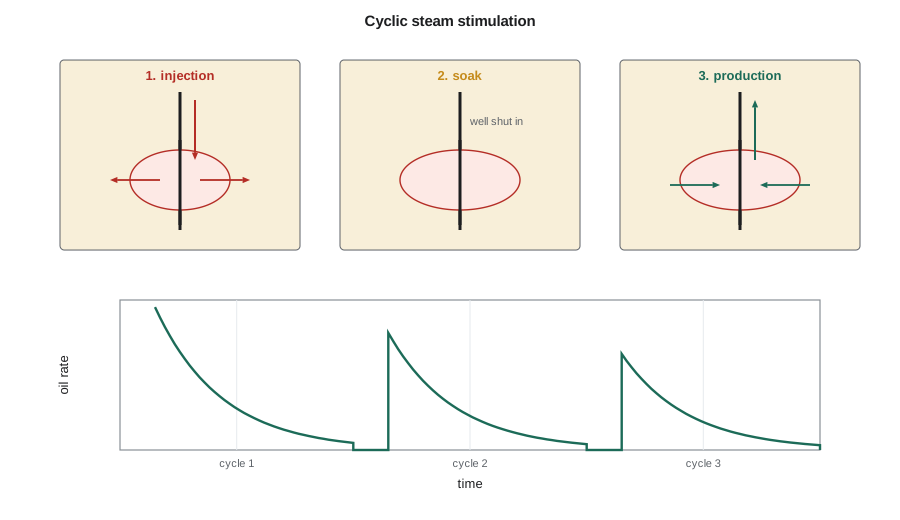
CSS was discovered by accident. In 1959, during a steam injection test in the Mene Grande field in Venezuela, an injection well blew out and, after it was brought under control, it produced heavy oil at high rates. Operators soon realized that a well steamed and then produced could yield much more than a cold well, and the process spread quickly through California's heavy oil fields in the 1960s.
How CSS produces oil
Several mechanisms work together. The heat lowers the viscosity of the oil around the well, which raises its mobility and the well's productivity many times over. Steam injection raises the pressure near the well, and when the well is opened that pressure drives fluids back toward it; at high injection pressures, the formation may also be dilated or fractured, and when the pressure falls the sand compacts and squeezes fluid out. Gravity drainage of heated oil toward the well contributes, particularly in thick sands. Expansion of the rock and fluids on heating, steam flashing as the pressure drops and solution gas also help.
The size of the heated zone can be estimated with an energy balance. The heat delivered to the sand, after allowing for losses, is spread over a cylinder of rock and fluids that is warmed from reservoir temperature to near steam temperature. The radius of that cylinder sets how much oil is mobilized in the cycle.
Here Q_inj is the heat injected, E_h the fraction of it still in the target zone after the soak, h the heated thickness, M_R the volumetric heat capacity of the saturated rock and T_s and T_r the steam and reservoir temperatures. The radius is typically tens of meters, and grows only slowly with more steam, because it varies with the square root of the heat injected.
# Cyclic steam stimulation: heated radius and oil-steam ratio over several cycles
import math
SI = False
h, phi = 15.0, 0.33                  # m, porosity of the target interval
Mr = 2600.0                          # kJ/(m3 K) volumetric heat capacity of the saturated rock
T_s, T_r = 300.0, 15.0               # C, steam and original reservoir temperature
steam_t = 9000.0                     # metric tons of steam per cycle (cold water equivalent)
h_inj = 2200.0                       # kJ/kg delivered at the sandface (hot water plus latent heat)
eff = 0.6                            # fraction of injected heat still in the target zone after the soak
Q = steam_t * 1000 * h_inj * eff     # kJ
r = math.sqrt(Q / (math.pi * h * Mr * (T_s - T_r)))
print(f"heated radius after one cycle ~ {r:.0f} m" if SI else f"heated radius after one cycle ~ {r * 3.2808:.0f} ft")
osr0 = 0.45                          # oil-steam ratio of the first cycle
for c in range(1, 7):
    osr = osr0 * 0.82 ** (c - 1)     # each cycle recovers less as the heated zone depletes
    oil = steam_t * osr
    if SI: print(f"cycle {c}: OSR {osr:.2f}  oil {oil:,.0f} m3  (SOR {1 / osr:.1f})")
else: print(f"cycle {c}: OSR {osr:.2f} oil {oil * 6.2898:,.0f} bbl (SOR {1 / osr:.1f})")heated radius after one cycle ~ 61 ft cycle 1: OSR 0.45 oil 25,474 bbl (SOR 2.2) cycle 2: OSR 0.37 oil 20,888 bbl (SOR 2.7) cycle 3: OSR 0.30 oil 17,129 bbl (SOR 3.3) cycle 4: OSR 0.25 oil 14,045 bbl (SOR 4.0) cycle 5: OSR 0.20 oil 11,517 bbl (SOR 4.9) cycle 6: OSR 0.17 oil 9,444 bbl (SOR 6.0)
The calculation gives a heated radius of about 18 m (61 ft) for the first cycle and an oil-steam ratio that falls from 0.45 in the first cycle to below 0.2 by the sixth. Lena explains why. In each cycle the well draws oil from a region that has already been partly drained, so there is less oil left in the heated zone to produce, and more of the heat goes into rock and water. Operators usually inject more steam in later cycles to reach unheated oil farther out, but the economics deteriorate until the well is converted to a different process or abandoned.
Pressure, fracturing and cap rock
CSS is usually operated at high injection pressure, often above the fracture pressure of the formation, so that large volumes of steam can be injected quickly and the sand is dilated. That makes the process productive, but it also makes cap rock integrity critical. If the injection pressure fractures or reactivates a pathway through the cap, steam and bitumen can escape toward shallower zones or the surface.
California's experience shows why this matters. In the diatomite fields on the west side of the San Joaquin Valley, cyclic steaming at high pressure has been associated with surface expressions, places where oil, water and steam reach the surface. In 2019, after large expressions at the Cymric field, the state's oil and gas regulator, now CalGEM, ordered a halt to new high-pressure cyclic steaming permits, steaming above the fracture gradient, while it reviewed the practice, and it later issued rules on monitoring and managing surface expressions. Alberta had a similar experience at the Primrose project in 2013, where high-pressure cyclic steaming was found to have fractured the cap rock.
CSS in practice
Cyclic steam is used at almost every thermal field in California, to start up new wells before a steamflood arrives and as the main process in thin or low-permeability reservoirs where a continuous flood would be inefficient. In the diatomite reservoirs of the Belridge, Lost Hills and Cymric fields, cyclic steam is often the only practical thermal method because the rock is so fine-grained. In Alberta, Imperial Oil's Cold Lake operation, which began commercial production in 1985, uses cyclic steam on a very large scale from directional wells drilled from pads, and has added follow-up steamflood, SAGD and solvent processes to recover the bitumen between wells.
CSS has clear strengths. It gives a quick production response, needs only one well per drainage point and works in reservoirs that are too thin or too heterogeneous for SAGD. Its drawbacks are its declining performance cycle by cycle, an ultimate recovery that is typically only about 20 to 25 percent of the oil in place, far less than SAGD or a mature steamflood, and the high pressures it needs, with their containment risks. For that reason many CSS projects are designed with a follow-up process in mind, often a steamflood that uses the heated, pressure-depleted region left by the cycles.
Designing a cycle
The main design choices are the steam volume, the injection rate and pressure, the soak time and the length of the production stage. More steam heats a larger radius but with diminishing returns. A short soak avoids wasting heat to the cap and base rock but must allow enough time for the steam to condense; a few days is typical. The production stage is ended when the oil rate falls below an economic limit or the produced fluid temperature drops. Simulation and the history of previous cycles guide each decision, and operators often schedule the cycles of neighboring wells together so that the pressure in one does not drive fluids into another.
Worked problem
Heated radius and oil per cycle
A CSS well injects 12,000 t (about 75,500 bbl CWE) of steam carrying 2,200 kJ/kg to the sand. After the soak, 55 percent of the heat stays in a 66 ft (20 m) interval. The saturated rock has a heat capacity of 2,600 kJ/(m³ K), steam temperature is 572 °F (300 °C) and the reservoir is at 59 °F (15 °C). Estimate the heated radius.
Show solution
- Heat retained: 12,000 × 1,000 × 2,200 × 0.55 = 1.45 × 10¹⁰ kJ.
- Heat per cubic meter heated: 2,600 × (300 − 15) = 7.41 × 10⁵ kJ/m³.
- Heated volume = 1.45 × 10¹⁰ / 7.41 × 10⁵ = 19,600 m³; r = √(19,600 / (π × 20)) = 17.7 m.
Answer: About 18 m (58 ft). More steam enlarges this only with the square root of the heat, so doubling the steam would give about 25 m (82 ft).
Pads, deviated wells and cycle scheduling
Modern CSS projects are developed from multi-well pads, with directional or horizontal wells fanning out from each pad to cover a large area of the reservoir from a small surface footprint. Horizontal CSS wells, which contact far more of the sand than vertical ones, have become common where the pay is thin or where operators want to reach oil between existing vertical wells. Because neighboring wells share the reservoir, the timing of their cycles matters. If one well is injecting at high pressure while its neighbor is producing, steam and hot fluids can flow between them, a problem known as interwell communication, which wastes heat and can damage equipment. Operators therefore schedule cycles in groups, injecting several wells at once and producing them together, and adjust the schedule as the reservoir pressure changes over the project's life.
Monitoring follows each cycle. Engineers record the steam volume and pressure, the soak time, the produced oil, water and gas, and the temperature of the produced fluids, and compare each cycle with the previous ones. A cycle that produces much less oil than expected, or one that returns far less water than was injected, may point to a fracture that has carried steam out of the target zone, and it is investigated before the next cycle begins.
Converting from cyclic to continuous steam
As cycles mature, the regions heated around neighboring wells start to connect, and the reservoir between them is partly heated and depleted. At that point it often makes sense to switch to a continuous process. Some wells are converted to injectors and the others to producers, turning the CSS project into a steamflood; or, where horizontal wells are available, a SAGD-like gravity drainage process is used to recover oil from the upper part of the sand. The heated, depleted reservoir left by CSS is a good starting point for these follow-up processes, because less heat is needed to bring it up to temperature and its pressure is low enough for steam to enter easily.
The decision to convert is economic. Engineers compare the declining performance of continued cycles with the forecast of the follow-up process, including the cost of new wells or conversions, and choose the timing that maximises value. Many California fields made this transition decades ago; in Alberta, Cold Lake's operators have done the same, adding steamflood and SAGD areas to their CSS operations.
Common mistakes
MistakeExpecting later cycles to match the first.
InsteadEach cycle draws from a depleted region; the OSR declines.
MistakeIgnoring containment at high injection pressure.
InsteadSteaming above fracture pressure needs cap rock study, monitoring and pressure limits.
MistakeUsing a long soak by default.
InsteadA long soak loses heat to the cap and base rock; a few days is typical.
MistakeTreating CSS as a complete recovery process.
InsteadRecovery is about 20 to 25 percent; plan a follow-up process.
Summary and key terms
- CSS uses one well for injection, soak and production in repeated cycles.
- Heat lowers viscosity; pressure, compaction, gravity and expansion drive production.
- The heated radius grows with the square root of the heat injected, typically tens of meters.
- Oil-steam ratio declines cycle by cycle as the heated region is depleted.
- High-pressure steaming has fractured cap rocks; containment rules and monitoring now apply.
- CSS gives quick response but recovers only about 20 to 25 percent; follow-up processes are common.
- CSS
- Cyclic steam stimulation, or huff and puff, using one well to inject, soak and produce.
- Soak
- The shut-in period in which steam condenses and heats the oil near the well.
- Heated radius
- The radius of the cylinder of rock warmed to near steam temperature in a cycle.
- OSR
- Oil-steam ratio, oil produced per unit of steam injected.
- Surface expression
- Oil, water or steam reaching the surface through a pathway from a steamed zone.
- Follow-up process
- A process such as steamflood or SAGD applied after CSS cycles.
Practice problems
Work each problem on paper first, then reveal the answer to check.
Why does the OSR fall over cycles?
Show answer
Each cycle draws from a region already partly drained and more heat goes to rock and water.
How does the heated radius scale with steam volume?
Show answer
With its square root.
Why is cap rock integrity critical in CSS?
Show answer
High injection pressures can fracture pathways to shallower zones or surface.
Where was CSS discovered?
Show answer
At the Mene Grande field in Venezuela in 1959.
Lesson quiz · 5 questions
Score 60% or more to complete this lesson.
Create a free account to save your progress, take quizzes and earn a certificate.