
PET-370 · Lesson 1 of 12 · 20 min
Heavy oil and bitumen resources
Two years after the Tamarack Lake wells came on line, Prairie Crest Energy Inc. makes the biggest purchase in its history. It buys the Tamarisk Hill steamflood, a mature heavy oil lease in Kern County northeast of Bakersfield, where steam has been injected into shallow sands for decades. The deal includes a steam plant, about three hundred producers and a block of undeveloped acreage to the north. Ethan Cardinal, who has worked on drilling, completions, production and well testing for the Bakken and Mission Canyon wells, moves to the Bakersfield office to join the new thermal group. His new manager is Dr. Paul Desrosiers, a reservoir engineer who has spent twenty years on steamfloods in California and SAGD projects in Canada. 'Everything you learned in North Dakota still applies,' Paul tells him on the first morning. 'Darcy's law, material balance, nodal analysis. What changes is that the oil barely moves until we heat it.'
This course follows that thermal group through the life of the asset. It begins with what heavy oil and bitumen are, how much of them there is, and why they need special recovery methods. It then works through the geology of the deposits, the thermal properties that control every design, and the main recovery processes: surface mining, steam-assisted gravity drainage, cyclic steam stimulation, steamflooding, solvent and hybrid processes, and cold production. It ends with environmental performance and a development plan with economics for the next phase of the Tamarisk Hill asset.
What makes oil heavy
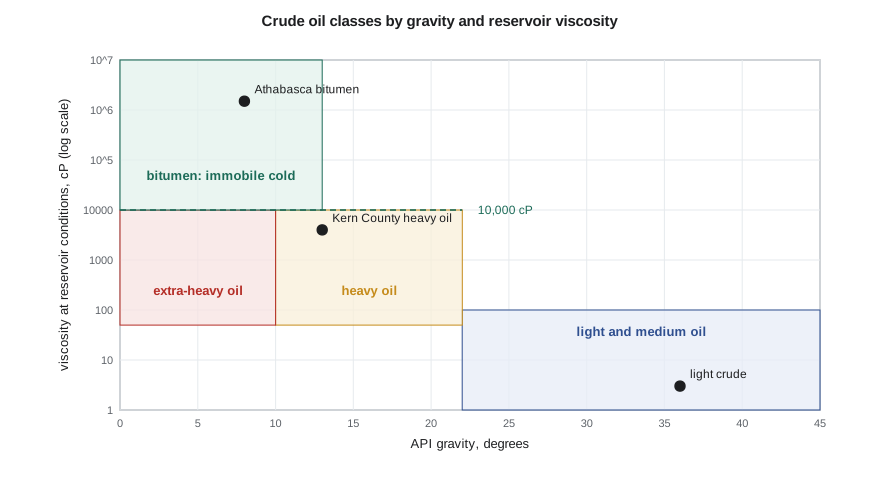
Crude oils are classified mainly by density and viscosity. Density is reported as API gravity, a scale invented by the petroleum industry in which water at standard conditions has an API gravity of 10 and lighter liquids have higher numbers. The conversion is API = 141.5/SG − 131.5, where SG is the specific gravity relative to water at 15.6 °C (60 °F). A typical light crude from the Bakken or the Cardium has an API gravity near 40. By common convention, oil with an API gravity below about 22 is called heavy, oil below 10 (denser than water) is called extra-heavy, and the very viscous extra-heavy oil found in the oil sands is called bitumen.
Viscosity matters more than density for recovery. Heavy oils at reservoir temperature typically have viscosities from about a hundred to tens of thousands of centipoise, compared with about one centipoise for water and a few tenths for a light crude at reservoir conditions. Bitumen at its original reservoir temperature of roughly 7 to 15 °C has viscosities of a million centipoise or more, comparable to cold molasses or soft asphalt. It is essentially immobile in the reservoir. A common working definition, used by the World Petroleum Council and others, treats a crude as bitumen if its viscosity at original reservoir temperature exceeds about 10,000 centipoise.
Heavy oil and bitumen are heavy because of what they contain. They have a large fraction of high-molecular-weight resins and asphaltenes, lower hydrogen-to-carbon ratios than light oil, and more sulfur, nitrogen and metals such as nickel and vanadium. Most geologists think these deposits began as conventional oil that migrated to shallow depths, where bacteria consumed the lighter, more easily digested components and water washed some of the rest away. The process, called biodegradation, leaves behind a dense, viscous residue. That history explains why the largest deposits are shallow and lie at the edges of large basins.
Where the resources are
The world's two largest accumulations of extra-heavy oil and bitumen are in Canada and Venezuela. Alberta's oil sands hold an estimated 1.8 trillion barrels or more of bitumen in place, and in late 2025 in situ projects there produced a record of about two million barrels a day, slightly more than the oil sands mines. In the United States, the largest heavy oil production is in California's San Joaquin Valley, where giant shallow fields such as Midway-Sunset and Kern River were discovered around 1900 and have been produced with steam since the 1960s. Kern River alone has produced close to two billion barrels. Smaller heavy oil and bitumen resources occur in Utah's oil sands, in the viscous oil on Alaska's North Slope, and in heavy oil fields in Wyoming, Texas and elsewhere.
These are some of the largest hydrocarbon resources on Earth, but most of the oil in place will never be produced. The recoverable fraction depends on how thick and rich the deposit is, how deep it is, how much heat can be delivered to it, and the oil price and carbon cost of doing so. That is why the engineer's job on a heavy oil asset is as much about energy efficiency as about rock and fluid properties.
Why conventional methods fail
Darcy's law says the flow rate of a fluid through rock is proportional to permeability and inversely proportional to viscosity. A light oil with a viscosity of 1 centipoise flows a million times more easily than a bitumen of 1,000,000 centipoise in the same rock. Even the excellent permeability of the oil sands, often several darcies, cannot overcome that. A well drilled into cold bitumen produces almost nothing. Pressure depletion, which drives most conventional pools in their early life, gives very low recovery from heavy oil because the viscous oil cannot move toward the wells fast enough, and waterflooding of very viscous oil suffers from an unfavorable mobility ratio: the injected water fingers through the oil and reaches producers early.
Heavy oil recovery therefore follows one of three routes. The first is to dig the deposit up when it is close enough to the surface, as the oil sands mines do. The second is to reduce the oil viscosity in place, mainly by heating it with steam, but also by dissolving solvents into it or burning part of it. The third is to accept low rates and recover the oil cold, using sand production, horizontal wells or polymer floods, where the oil is light enough for that to pay. Every method in this course belongs to one of those routes.
| Method | Main mechanism | Typical setting |
|---|---|---|
| Surface mining | Excavation and hot-water extraction | Bitumen within about 70 m (230 ft) of surface |
| SAGD | Steam chamber, gravity drainage to a horizontal producer | Thick, continuous bitumen sand |
| Cyclic steam stimulation | Inject, soak and produce from the same well | Heavy oil and bitumen with some injectivity |
| Steamflood | Steam drives heated oil between wells | Shallow heavy oil that can flow when warm |
| Solvent and hybrid processes | Dilution with light hydrocarbons, often with steam | Thin or lower-quality pay; emissions reduction |
| Cold production | Primary flow, sand production, waterflood or polymer | Heavy oil of hundreds to a few thousand centipoise |
Resources, reserves and in-place volumes
The volumetric equation from PET-320 still gives the oil in place. For a bitumen deposit, the formation volume factor is close to one because dead bitumen contains almost no dissolved gas, so the stock tank volume is simply area × net thickness × porosity × oil saturation. The oil sands are usually described in metric units: lease areas in hectares or sections, net pay in meters and volumes in cubic meters. California heavy oil fields use acres, feet and barrels, with 7,758 barrels per acre-foot of pore volume.
Reserves classification follows the same frameworks as for conventional oil. In Canada, reserves are evaluated under the Canadian Oil and Gas Evaluation Handbook and reported under National Instrument 51-101; in the United States, companies report under the rules of the Securities and Exchange Commission, and the industry uses the SPE Petroleum Resources Management System. One difference for thermal projects is that reserves are booked only for the parts of a lease that a sanctioned development plan will reach, because each new pad or pattern needs steam capacity, water handling and capital. Undeveloped lease with good bitumen can sit for years as contingent resources until the plant is expanded.
# Heavy oil classes and bitumen in place for a lease
SI = False
def classify(api, mu_cp):
    if mu_cp > 10000: return "bitumen (extra-heavy, immobile at reservoir conditions)"
    if api < 10: return "extra-heavy oil"
    if api < 22.3: return "heavy oil"
    return "conventional (light or medium) oil"
samples = [("lease crude A", 8.0, 2.0e6), ("lease crude B", 12.5, 4000.0), ("light blend", 35.0, 2.0)]
for name, api, mu in samples:
    sg = 141.5 / (api + 131.5)
    print(f"{name:14s} API {api:5.1f}  SG {sg:.3f}  viscosity {mu:>10,.0f} cP  -> {classify(api, mu)}")
if SI:    # metric: area in hectares, thickness in meters, result in m3
    area_ha, h, phi, So = 640.0, 28.0, 0.33, 0.80
    vol = area_ha * 1.0e4 * h * phi * So          # m3 of bitumen in place
    print(f"bitumen in place = {vol / 1e6:.1f} million m3 ({vol * 6.2898 / 1e6:.0f} million bbl)")
    rf = 0.55
    print(f"at {rf:.0%} SAGD recovery: {vol * rf / 1e6:.1f} million m3 recoverable")
else:     # field units: acres, feet, barrels (7,758 bbl per acre-foot)
    area_ac, h, phi, So = 1280.0, 250.0, 0.31, 0.60
    vol = 7758.0 * area_ac * h * phi * So         # bbl of oil in place (no formation volume factor for dead heavy oil)
    print(f"oil in place = {vol / 1e6:.0f} million bbl")
    rf = 0.60
print(f"at {rf:.0%} steamflood recovery: {vol * rf / 1e6:.0f} million bbl recoverable")lease crude A API 8.0 SG 1.014 viscosity 2,000,000 cP -> bitumen (extra-heavy, immobile at reservoir conditions) lease crude B API 12.5 SG 0.983 viscosity 4,000 cP -> heavy oil light blend API 35.0 SG 0.850 viscosity 2 cP -> conventional (light or medium) oil oil in place = 462 million bbl at 60% steamflood recovery: 277 million bbl recoverable
The calculation gives about 460 million barrels of oil in place under the 1,280 acres of the north block, and about 280 million barrels recoverable at a 60 percent steamflood recovery. 'Mature California steamfloods have recovered well over half the original oil in their best sands,' Paul says. 'Whether we get there here depends on the shale breaks, the heat losses and the steam we can afford, and that is what this course is about.'
The energy balance of thermal recovery
Steam-based recovery spends energy to make energy. Burning natural gas to make steam, delivering that steam to the reservoir and lifting the heated oil all consume fuel, and the efficiency of the whole process is summarized by the steam-oil ratio (SOR): the volume of steam injected, expressed as cold water equivalent, per volume of oil produced. A SAGD project with an SOR of 3 burns roughly a thousand cubic feet of gas, or about 1 gigajoule, for each barrel of bitumen. Typical SAGD projects run at SORs from about 2 to 4, and California steamfloods typically from about 3 to 6. A lower SOR means less gas, less water, smaller emissions and lower costs. The SOR returns in almost every lesson, because it ties the reservoir to the plant, the budget and the carbon footprint.
Worked problem
API gravity and specific gravity
A sample of the lease crude has a specific gravity of 1.000 at 15.6 °C (60 °F). Another sample from a nearby lease has a specific gravity of 0.960. What are their API gravities, and how would each be classified?
Show solution
- API = 141.5/SG − 131.5.
- For SG = 1.000: API = 141.5 − 131.5 = 10.0.
- For SG = 0.960: API = 147.4 − 131.5 = 15.9.
Answer: The first sample sits at the boundary between heavy and extra-heavy oil, and the second is a heavy oil. Their viscosities, not these gravities, will decide whether they can be produced cold or need heat.
From reservoir to refinery
Classification also matters after the oil reaches surface. Bitumen and extra-heavy oil are too viscous to move by pipeline on their own, so they are either blended with a light diluent, usually natural gas condensate, to make a product such as diluted bitumen, or upgraded into a lighter synthetic crude. Heavy crudes sell at a discount to light benchmark crudes because refiners need cokers or hydrocrackers to process them and because diluent and transport add cost. That discount, along with the cost of steam, is a key part of the economics of every project in this course, and it is why engineers track density and viscosity from the first core sample to the sales meter.
Common mistakes
MistakeClassifying crude as bitumen by density alone.
InsteadUse reservoir viscosity; bitumen is extra-heavy oil that is essentially immobile, typically above about 10,000 cP.
MistakeApplying a gas-related formation volume factor to dead bitumen.
InsteadDead bitumen has almost no dissolved gas, so the formation volume factor is close to one.
MistakeBooking reserves for the whole lease.
InsteadBook only the volumes a sanctioned development plan with steam and water capacity will reach.
MistakeTreating the SOR as a reservoir-only number.
InsteadThe SOR also reflects heat losses, plant performance and operating choices.
Summary and key terms
- Heavy oil is below about 22 API, extra-heavy oil below 10 API, and bitumen is extra-heavy oil that is immobile at reservoir conditions.
- Viscosity, not density, controls recovery; bitumen can be a million times more viscous than light oil.
- Most heavy oil was once lighter oil that was biodegraded at shallow depth.
- Recovery routes are mining, reducing viscosity in place (heat, solvent or combustion) or cold production.
- The in-place volume uses the standard volumetric equation with a formation volume factor near one.
- The steam-oil ratio links the reservoir, the plant, costs and emissions.
- API gravity
- A density scale in which water is 10 and lighter liquids have higher values; API = 141.5/SG − 131.5.
- Bitumen
- Extra-heavy oil that is essentially immobile at original reservoir temperature, typically above about 10,000 cP.
- Biodegradation
- Consumption of the lighter components of oil by bacteria, leaving a denser, more viscous residue.
- Steam-oil ratio (SOR)
- The volume of steam injected, as cold water equivalent, per volume of oil produced.
- Cold water equivalent (CWE)
- The volume of water that was converted to steam, used to measure steam quantities.
- In situ recovery
- Recovery of oil from the reservoir through wells, as opposed to mining.
Practice problems
Work each problem on paper first, then reveal the answer to check.
Why does high permeability not make cold bitumen producible?
Show answer
Viscosities near a million centipoise make the mobility k/μ tiny even with darcies of permeability.
What is the API gravity of a crude with SG 0.985?
Show answer
About 12.2, a heavy oil.
Name the three routes to heavy oil recovery.
Show answer
Mining, reducing viscosity in place, and cold production.
Why is a lower SOR better?
Show answer
It means less gas, water, emissions and cost per unit of oil.
Lesson quiz · 5 questions
Score 60% or more to complete this lesson.
Create a free account to save your progress, take quizzes and earn a certificate.