
PET-370 · Lesson 4 of 12 · 19 min
Steam generation, distribution and wellbore heat losses
The first piece of equipment Ethan learns at Tamarisk Hill is not a well. It is the row of once-through steam generators beside the plant, each burning natural gas and pumping treated water through a long coil of tubes. 'In a steamflood the reservoir is only half the system,' Paul says. 'The other half is making steam, getting it to the sand with as much heat as possible, and paying for the gas. Our steam-oil ratio is decided as much here as underground.'
This lesson covers the surface side of thermal recovery: how steam is generated, why feedwater must be treated, how steam is split and measured among many injectors, and how much heat is lost on the way down the well. It ends with ways to reduce the fuel and emissions behind every barrel of steam.
Once-through steam generators
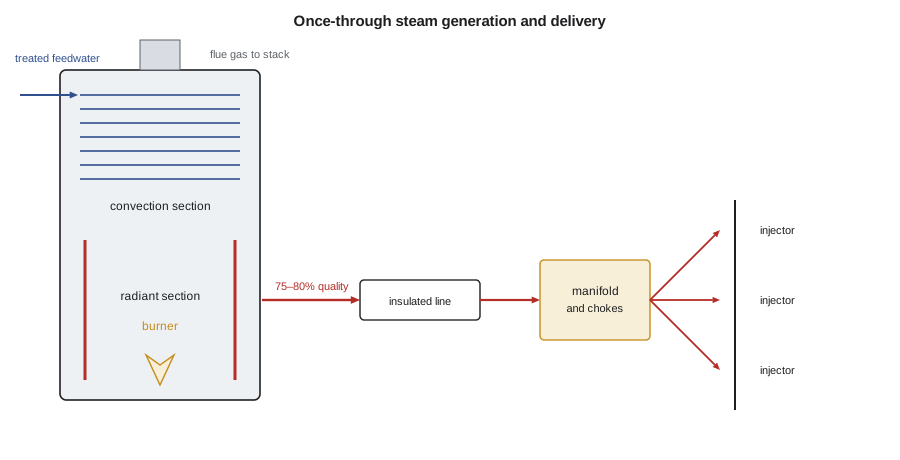
Most oilfield steam comes from once-through steam generators, often called OTSGs. Unlike a utility boiler, an OTSG has no steam drum. Water is pumped into one end of a long tube coil, heated first in a convection section by the hot flue gas and then in a radiant section facing the burner, and leaves the other end as a mixture of steam and hot water. Because the water is never fully evaporated, the dissolved solids stay in the remaining liquid instead of depositing on the tubes. That is why oilfield generators make steam of about 75 to 80 percent quality, and why the quality must be controlled carefully: if it drifts above about 80 percent, scale can form in the last tubes and burn them out.
Feedwater for an OTSG must be softened, because calcium and magnesium form hard scale in hot tubes. California steamfloods usually soften fresh water or produced water with ion exchange and remove oil and suspended solids first. The steam generator efficiency, the fraction of the fuel's heat that ends up in the steam, is typically about 80 to 90 percent. The rest leaves in the hot flue gas. Some fields also take steam from cogeneration plants that make electricity with gas turbines and recover the exhaust heat to make steam, which uses fuel more efficiently than separate power and steam plants.
Splitting and measuring steam
Steam from the generators flows through insulated surface lines to manifolds that split it among many injectors. Splitting two-phase steam is harder than splitting a single-phase fluid. At a tee, the vapor and the liquid do not divide in the same proportion, so the branches can receive steam of different qualities even when the mass rates look balanced. Operators use chokes sized for critical flow, which fixes the mass rate through each branch regardless of downstream pressure, and they measure quality with sampling, orifice methods or ionic tracers. A pattern that receives low-quality steam gets less heat for the same CWE and falls behind.
Steam lines are long and pass through many fittings, and each adds heat losses and pressure drop. Insulated lines lose a few percent of the heat between plant and wellhead; a damaged or wet insulation section can lose much more. Operators survey lines with infrared cameras and repair insulation as routine maintenance, because every lost unit of heat must be replaced with gas.
Heat losses down the well
Steam loses heat as it flows down the injection well to the warmer but still much cooler rock around the wellbore. The heat loss depends on the steam temperature, the earth temperature, the well's completion and how long the well has been injecting. Ramey and Willhite developed the standard methods: an overall heat transfer coefficient combines the resistances of the tubing, any insulation, the annulus, the casing, the cement and the formation, and the formation's resistance grows slowly with time as the rock around the well heats up. In shallow California wells only a few hundred to about a thousand feet deep, the loss is usually small, a drop of a few percent in quality. In deeper wells, or with uninsulated tubing and a wet annulus, it can be much larger, which is why deep steam projects use vacuum-insulated tubing and keep the annulus dry with gas.
Measuring what reaches the sand
The steam that matters for the reservoir is the steam that reaches the sandface. Operators estimate it from the surface rate and quality, the calculated wellbore loss and, where available, downhole temperature and pressure measurements. In a steamflood, temperature observation wells between injectors and producers are the most direct evidence of where the heat has gone. Repeated temperature logs in these wells show the steam zone thickening and spreading, and they often reveal steam override, where the hot zone grows along the top of the sand while the lower part stays cold.
# Steam generation and wellbore heat loss for a steamflood injector
import math
# once-through steam generator (OTSG) duty and gas use
steam_bpd = 3000.0                 # cold water equivalent, bbl/d
lb_per_bbl = 350.0                 # pounds of water per barrel
x = 0.75                           # steam quality at the generator outlet
hf, hfg, h_feed = 488.0, 713.0, 68.0   # Btu/lb at about 700 psia; feedwater at about 100 F
duty = steam_bpd * lb_per_bbl * (hf + x * hfg - h_feed) / 24.0     # Btu/h
eff = 0.85
gas = duty / eff / 1.0e6 * 24 / 1.037      # thousand cubic feet per day (about 1,037 Btu/scf)
print(f"generator duty = {duty / 1e6:.1f} million Btu/h; gas burned = {gas:,.0f} Mscf/d")
# heat loss down an insulated injector, as a crude per-foot loss rate
depth = 1000.0                     # ft
U = 0.5                            # Btu/(h ft2 F) overall, insulated tubing
r_to = 2.875 / 2 / 12              # ft, outside radius of tubing
T_steam, T_earth = 500.0, 90.0
q_ft = 2 * math.pi * r_to * U * (T_steam - T_earth)
loss = q_ft * depth
mass_rate = steam_bpd * lb_per_bbl / 24
dx = loss / (mass_rate * hfg)
print(f"heat loss = {q_ft:.0f} Btu/h per ft, {loss / 1e6:.2f} million Btu/h over {depth:.0f} ft")
print(f"quality drop down the hole = {dx:.3f}, so quality at the sandface ~ {x - dx:.2f}")generator duty = 41.8 million Btu/h; gas burned = 1,137 Mscf/d heat loss = 154 Btu/h per ft, 0.15 million Btu/h over 1000 ft quality drop down the hole = 0.005, so quality at the sandface ~ 0.75
The calculation shows that a generator making 3,000 barrels a day of steam burns about 1.1 million cubic feet of gas a day, and that an insulated thousand-foot injector loses only about half a percent of quality. 'In our shallow wells the losses are mostly in the surface lines and in the reservoir itself,' Paul says. 'Deeper projects have to fight for every percent down the hole.'
Reducing the fuel behind the steam
Because natural gas is the largest operating cost and the largest source of emissions, steamflood operators look for every way to reduce it: recovering heat from produced fluids to preheat feedwater, maintaining steam line insulation, cutting steam to patterns where the steam-oil ratio has risen too high, cogeneration, and electric or solar steam. Solar steam generation, which concentrates sunlight to boil water, has been piloted in California and built at larger scale elsewhere, and electric steam generators powered by renewable electricity are being studied. Each changes the cost and emissions of the steam rather than the reservoir process.
Worked problem
Gas for a day of steam
A generator makes 2,000 bbl/d of 75 percent quality steam from 100 °F feedwater at about 700 psia. With hf = 488 Btu/lb, hfg = 713 Btu/lb, feedwater enthalpy 68 Btu/lb and 85 percent efficiency, how much gas does it burn at 1,037 Btu/scf?
Show solution
- Heat per pound = 488 + 0.75 × 713 − 68 = 955 Btu.
- Water = 2,000 × 350 = 700,000 lb/d, so heat = 6.7 × 10⁸ Btu/d.
- Fuel = 6.7 × 10⁸ / 0.85 = 7.9 × 10⁸ Btu/d, or about 760 Mscf/d.
Answer: About 760 thousand cubic feet of gas a day. At a steam-oil ratio of 4, this generator supports about 500 bbl/d of oil, so each barrel of oil burns about 1.5 thousand cubic feet of gas.
Steam generator water and control
The water fed to a once-through steam generator must be treated carefully, even though an OTSG tolerates more dissolved solids than a drum boiler. Produced water is first de-oiled, then softened, usually in ion-exchange softeners that remove calcium and magnesium, which would otherwise form scale on the tubes. Silica is the other main concern: at high concentrations it deposits as scale at the hot end of the coil, so operators limit the steam quality, and therefore the concentration in the remaining liquid, to keep silica in solution. Dissolved oxygen is removed with chemical scavengers or deaerators to prevent corrosion. Water chemistry is checked several times a day, because a short upset can scale a coil and force a costly shutdown.
An OTSG is controlled by setting the feedwater flow and the firing rate to deliver the target steam rate at the target quality. Steam quality at the outlet is usually inferred from the conductivity of the feedwater and of the separated liquid, or from a heat balance, and the control system adjusts the firing rate to hold it. Too high a quality risks dry-out and tube damage; too low wastes fuel heating water that does nothing in the reservoir. Each generator also has safety systems for flame failure, low water flow and high tube temperature, and modern units have low-NOx burners and flue gas recirculation to meet air quality limits.
Insulated tubing and wellhead equipment
Insulation in the wellbore is one of the most effective ways to reduce heat losses. Vacuum-insulated tubing, two concentric tubes with a vacuum and reflective layers between them, has an apparent thermal conductivity many times lower than bare tubing, and is used in deeper or longer thermal wells. Simpler options include filling the annulus with gas or using insulating coatings. At surface, thermal wellheads are rated for steam temperature and pressure, and include expansion spools and valves designed for thermal cycling. Steam injection lines have expansion loops, insulation and steam traps that remove condensed water.
Steam lines across a field also lose heat. A long, poorly insulated line can lose several percent of its heat before steam reaches the wells, and leaking traps or damaged insulation add more. Field crews inspect lines with thermal cameras, and engineers calculate surface losses with the same heat transfer methods used for the wellbore. Good insulation and maintenance at surface are an inexpensive way to reduce fuel use and emissions.
Whatever the process, the engineer's job is the same: trace each unit of energy from the fuel to the oil, find where it is lost and decide which losses are worth reducing.
Safety around steam
Steam is an energy carrier, and every part of the system that handles it is designed with safety in mind. A leak of high-pressure steam is invisible near the source and can cause severe burns, so crews follow lockout procedures before working on lines and wellheads, wear protective equipment and use thermal cameras to find leaks. Steam generators are inspected under state boiler and pressure vessel rules, and their burners have flame safeguards that shut off the fuel if the flame fails. Wells are equipped with valves that can isolate them quickly, and fields with known shallow pathways monitor for steam or fluids reaching the surface, a hazard for anyone nearby. Training and procedures for these hazards are part of every thermal operator's daily routine.
Ethan finishes the lesson with a short table that compares the energy used to deliver one unit of bitumen or heavy oil to the sales point by each route: mining and hot water extraction, SAGD and steamflooding. The numbers differ widely with ore grade, SOR and wellbore design, but the comparison makes Paul's point clearly: in every route, most of the energy goes into heating water and rock, and the best projects are the ones that waste the least of it.
Common mistakes
MistakeRunning a steam generator above about 80 percent quality.
InsteadHigher quality risks scale deposition in the last tubes.
MistakeAssuming a tee splits steam quality evenly.
InsteadVapor and liquid divide unevenly; use critical-flow chokes and measure quality.
MistakeIgnoring surface line losses.
InsteadSurvey insulation and repair damage; lost heat must be replaced with gas.
MistakeJudging steam distribution from CWE alone.
InsteadUse temperature observation wells to see where heat has gone.
Summary and key terms
- Once-through steam generators make 75 to 80 percent quality steam so that dissolved solids stay in the liquid.
- Feedwater must be softened; generator efficiency is typically 80 to 90 percent.
- Two-phase steam splits unevenly at tees; critical-flow chokes and quality measurement keep patterns balanced.
- Wellbore heat loss follows the Ramey and Willhite methods; insulated tubing and dry annuli reduce it.
- Temperature observation wells show where the heat has gone and reveal steam override.
- Heat recovery, cogeneration and solar or electric steam reduce the gas behind each barrel.
- Once-through steam generator (OTSG)
- A drumless boiler that converts most, but not all, of the feedwater to steam in a single pass.
- Steam quality
- The mass fraction of the steam-water mixture that is vapor.
- Critical-flow choke
- A choke at which flow is fixed by upstream conditions, used to split steam.
- Cogeneration
- Producing electricity and useful heat from the same fuel.
- Overall heat transfer coefficient
- The combined conductance of the wellbore completion and formation that sets heat loss.
- Temperature observation well
- A well used to log temperatures and track the heated zone.
Practice problems
Work each problem on paper first, then reveal the answer to check.
Why do oilfield generators not make dry steam?
Show answer
The remaining water carries dissolved solids out and protects the tubes.
What does a critical-flow choke achieve?
Show answer
It fixes the mass rate to each branch regardless of downstream pressure.
When is wellbore heat loss large?
Show answer
In deep wells, with uninsulated tubing or a wet annulus.
What is steam override?
Show answer
Steam rising and spreading along the top of a zone while lower oil stays cold.
Lesson quiz · 5 questions
Score 60% or more to complete this lesson.
Create a free account to save your progress, take quizzes and earn a certificate.