
PET-260 · Lesson 4 of 12 · 18 min
Natural gas properties
Marcus Obi, who looks after completions and facilities, needs gas properties for a new gathering line and compressor near Watford City. He asks Ethan for the gas compressibility factor, density and viscosity of the produced gas over a range of pressures. Ethan already used a z-factor in PET-250, read off a chart. Now he learns where the chart comes from, how to calculate it, and how to correct it when the gas contains carbon dioxide or hydrogen sulfide.
Ideal and real gases
An ideal gas obeys pV = nRT exactly. Its molecules have no volume and do not attract each other. Real gases behave nearly ideally at low pressure and high temperature, but at reservoir pressures the molecules are close enough together that both their size and their attraction matter. Attraction makes the gas easier to compress than an ideal gas; molecular volume makes it harder. The compressibility factor, z, measures the net effect: it is the ratio of the real gas volume to the volume an ideal gas would occupy at the same pressure and temperature.
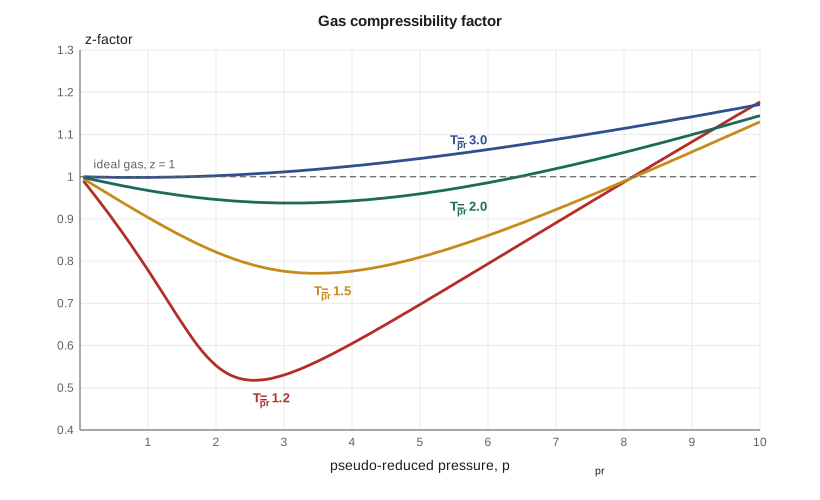
At low pressure z is close to 1. As pressure rises, attraction dominates and z falls below 1, reaching a minimum of about 0.8 to 0.9 for typical natural gases at reservoir temperatures, or lower near the critical temperature. At still higher pressures, molecular volume dominates and z rises above 1. The gas constant R is 8.314 J/(mol·K) in SI and 10.7316 psia·ft³/(lbmol·°R) in oilfield units.
The law of corresponding states
Different gases show strikingly similar behavior when pressure and temperature are expressed as fractions of their critical values. This is the law of corresponding states: gases at the same reduced pressure, pr = p/pc, and reduced temperature, Tr = T/Tc, have nearly the same compressibility factor. For mixtures, Kay's rule defines pseudo-critical properties as mole-weighted averages of the component critical properties, and pseudo-reduced pressure and temperature follow from them.
When only the gas specific gravity is known, correlations give the pseudo-critical properties directly. Sutton's correlations, fitted to many natural gases, are widely used for hydrocarbon gases with little non-hydrocarbon content. For a gas of specific gravity 0.72, they give a pseudo-critical temperature of about 383 °R (213 K) and a pseudo-critical pressure of about 661 psia (4.56 MPa).
The Standing-Katz chart and its equations
In 1942 Standing and Katz published a chart of z against pseudo-reduced pressure for a family of pseudo-reduced temperatures, based on measurements on sweet natural gases. It remains the industry reference. For computers, the chart has been fitted with equations. The Hall-Yarborough method, based on an equation of state for hard spheres, and the Dranchuk-Abou-Kassem equation, an eleven-constant fit, are the most common. Both are solved iteratively, because z appears on both sides. Within the range of the original chart, roughly pseudo-reduced pressures up to 15 and temperatures from 1.05 to 3, they reproduce it to within about one percent.
Gas formation volume factor, density and expansion
With z known, the other volumetric properties follow. The gas formation volume factor, Bg, converts reservoir volume to standard volume; its reciprocal, the expansion factor E, gives standard volumes produced per reservoir volume. Gas density at reservoir conditions follows directly from the real gas law and is needed for pressure gradients, pipeline design and gravity segregation.
In oilfield units Bg = 0.02827 zT/p in ft³/scf, with T in °R and p in psia, or 0.005035 zT/p in reservoir barrels per scf.
Gas isothermal compressibility, cg, is the fractional change in volume per unit change in pressure. For an ideal gas it is simply 1/p, so a gas at 20 MPa (2,900 psia) has a compressibility of about 5 × 10⁻⁵ per kPa (3.4 × 10⁻⁴ per psi), far larger than oil or rock. A real-gas correction involving the slope of z against pressure is added for accuracy. The large compressibility of gas is why gas reservoirs produce mostly by expansion and why pressure falls nearly in proportion to cumulative production in a volumetric gas reservoir, the basis of the p/z plot used in reservoir engineering.
Gas viscosity
Gas viscosity at reservoir conditions is small, typically 0.012 to 0.035 cP (mPa·s), but it rises with pressure because the molecules are packed more closely, unlike liquids whose viscosity falls with temperature. At low pressure, gas viscosity rises with temperature. Laboratory measurement is difficult, so correlations are normal practice. The Lee-Gonzalez-Eakin correlation, fitted to natural gas data in 1966, calculates viscosity from temperature, gas density and molar mass and is accurate to a few percent for sweet gases.
# Gas compressibility factor (Dranchuk-Abou-Kassem fit to Standing-Katz), Bg and viscosity
import math
SI = False
A = [0.3265, -1.0700, -0.5339, 0.01569, -0.05165, 0.5475, -0.7361, 0.1844, 0.1056, 0.6134, 0.7210]

def z_dak(ppr, tpr):
    z = 1.0
    for _ in range(100):                     # successive substitution on reduced density
        rr = 0.27 * ppr / (z * tpr)
        zn = (1 + (A[0] + A[1] / tpr + A[2] / tpr**3 + A[3] / tpr**4 + A[4] / tpr**5) * rr
              + (A[5] + A[6] / tpr + A[7] / tpr**2) * rr**2
              - A[8] * (A[6] / tpr + A[7] / tpr**2) * rr**5
              + A[9] * (1 + A[10] * rr**2) * rr**2 / tpr**3 * math.exp(-A[10] * rr**2))
        if abs(zn - z) < 1e-9: break
        z = 0.5 * (z + zn)
    return z

gg = 0.72                                     # gas specific gravity (air = 1)
Tpc = 169.2 + 349.5 * gg - 74.0 * gg**2       # Sutton pseudo-critical temperature, R
Ppc = 756.8 - 131.0 * gg - 3.6 * gg**2        # Sutton pseudo-critical pressure, psia
T = 180 + 459.67                              # reservoir temperature, R
Mg = 28.97 * gg
print(f"pseudo-critical: Tpc {Tpc:.1f} R, Ppc {Ppc:.1f} psia; Tpr {T / Tpc:.3f}")
print("  p psia      z     Bg ft3/scf   E scf/ft3  rho lb/ft3  visc cP")
for p in (500, 1500, 2500, 3500, 5000):
    z = z_dak(p / Ppc, T / Tpc)
    bg = 0.02827 * z * T / p
    rho = p * Mg / (z * 10.7316 * T)
    K = (9.4 + 0.02 * Mg) * T**1.5 / (209 + 19 * Mg + T)      # Lee-Gonzalez-Eakin viscosity
    X = 3.5 + 986 / T + 0.01 * Mg; Y = 2.4 - 0.2 * X
    mu = 1e-4 * K * math.exp(X * (rho / 62.428) ** Y)
    print(f"{p:7d} {z:8.4f} {bg:11.5f} {1 / bg:10.1f} {rho:10.2f} {mu:8.4f}")
    if SI and p == 3500:
print(f" at {p * 6.895 / 1000:.1f} MPa: Bg {bg:.5f} m3/m3, density {rho * 16.018:.0f} kg/m3")pseudo-critical: Tpc 382.5 R, Ppc 660.6 psia; Tpr 1.672
p psia z Bg ft3/scf E scf/ft3 rho lb/ft3 visc cP
500 0.9498 0.03435 29.1 1.60 0.0132
1500 0.8738 0.01053 94.9 5.22 0.0153
2500 0.8525 0.00617 162.2 8.91 0.0186
3500 0.8848 0.00457 218.7 12.02 0.0225
5000 0.9882 0.00357 279.8 15.37 0.0282At a pseudo-reduced temperature of 1.67, the gas reaches its minimum z of about 0.85 near 2,500 psia and climbs back to almost 1 at 5,000 psia. Between 500 and 3,500 psia, Bg falls by a factor of 7.5 while pressure rises by a factor of 7, the difference being the change in z. At 3,500 psia, each reservoir cubic foot of this gas holds about 219 standard cubic feet, and the gas has a density of about 12 lb/ft³ and a viscosity of about 0.022 cP.
Gas compressibility and pressure transients
The isothermal compressibility of a gas, cg, measures how much its volume changes per unit change in pressure. For an ideal gas it is simply 1/p, so a gas at 1,000 psia (6.9 MPa) has a compressibility of 1,000 × 10⁻⁶ per psi, roughly a hundred times that of oil and three hundred times that of water. For a real gas the z-factor adds a correction term: where z falls with pressure, at low and moderate reduced pressures, the gas is more compressible than an ideal gas; where z rises, at high reduced pressures, it is less compressible. Engineers use the pseudo-reduced form, cpr = cg × ppc, which can be read from the slope of the Standing-Katz chart or computed from the DAK equation.
Gas compressibility matters wherever pressure changes with time. In well test analysis, the total compressibility of the rock and fluids controls how fast a pressure disturbance spreads, and a gas reservoir's large compressibility makes its pressure response very different from that of an oil reservoir. Because gas viscosity and z-factor both change with pressure, the diffusivity equation for gas is not linear. Engineers handle this with the real-gas pseudo-pressure, m(p), introduced by Al-Hussainy and Ramey, which integrates 2p/(μz) over pressure. At low pressures m(p) behaves like p², and at high pressures like p, which is why simple deliverability equations use p² below about 2,000 psia (14 MPa) and p above about 3,000 psia (21 MPa). Material balance for a volumetric gas reservoir has a particularly simple form: p/z falls in a straight line with cumulative gas produced, and extrapolating the line to zero gives the original gas in place.
Sour and impure gases
Carbon dioxide and hydrogen sulfide distort the corresponding-states behavior of a natural gas, because their molecules interact differently from hydrocarbons. If their combined content exceeds a few percent, using uncorrected pseudo-critical properties can give z-factors several percent in error, enough to matter in reserves calculations for sour gas fields. The Wichert-Aziz correction, published in 1972, adjusts the pseudo-critical temperature and pressure using an empirical function of the CO2 and H2S mole fractions. Nitrogen has less effect but is usually handled by computing pseudo-critical properties from the full composition with Kay's rule. Water vapor, present in all reservoir gas, is usually ignored in z calculations but matters for hydrates and corrosion, as lesson 6 shows.
Here A is the sum of the mole fractions of CO2 and H2S, B is the mole fraction of H2S, and the temperature correction ε is in degrees Rankine. The corrected pseudo-critical properties are then used with the Standing-Katz chart or its equations as usual.
Heating value and sales gas
Natural gas is sold by energy content, not volume. The gross heating value of methane is about 37.7 MJ/m³ at Canadian standard conditions, or about 1,010 Btu/scf at US conditions, and heavier hydrocarbons have higher values per unit volume. Pipelines specify ranges of heating value, maximum contents of CO2, H2S, water and hydrocarbons that could condense, and a hydrocarbon dew point so that no liquid forms in the line. Rich gas from oil wells usually passes through a gas plant to remove ethane, propane, butanes and heavier natural gas liquids, which are worth more as liquids. The composition data in a PVT report therefore feeds directly into gas plant design and gas sales contracts.
Worked problem
Gas in place in a small pool
A gas pool has a reservoir volume of gas (pore volume times gas saturation) of 70 × 10⁶ ft³ at 3,500 psia and 180 °F. The gas has a z-factor of 0.885. Find Bg and the original gas in place in standard cubic feet.
Show solution
- T = 180 + 459.67 = 639.67 °R.
- Bg = 0.02827 × 0.885 × 639.67/3,500 = 0.004573 ft³/scf.
- Gas in place = 70 × 10⁶/0.004573 = 1.53 × 10¹⁰ scf, about 15.3 Bcf.
Answer: Ignoring z would give Bg 13 percent too high and understate gas in place by about 11 percent. The real-gas correction is never optional at reservoir pressure.
Common mistakes
MistakeUsing actual critical properties of methane for a natural gas mixture.
InsteadUse pseudo-critical properties from composition (Kay's rule) or gas gravity correlations.
MistakeUsing gauge pressure or °F in the real gas law.
InsteadUse absolute pressure and absolute temperature (K or °R).
MistakeApplying sweet-gas correlations to gas with 10% H2S.
InsteadCorrect pseudo-critical properties with Wichert-Aziz or use an equation of state.
MistakeAssuming gas viscosity behaves like liquid viscosity.
InsteadGas viscosity increases with pressure and, at low pressure, with temperature.
Summary and key terms
- The compressibility factor z corrects the ideal gas law for molecular size and attraction.
- Corresponding states lets one chart, Standing-Katz, describe most sweet natural gases using pseudo-reduced pressure and temperature.
- Dranchuk-Abou-Kassem and Hall-Yarborough reproduce the chart by iteration.
- Bg, gas density and gas compressibility follow from z; gas viscosity comes from correlations such as Lee-Gonzalez-Eakin.
- CO2 and H2S require the Wichert-Aziz correction or an equation of state.
- Compressibility factor
- The ratio of real gas volume to ideal gas volume at the same p and T.
- Corresponding states
- The principle that fluids at equal reduced pressure and temperature behave alike.
- Pseudo-critical properties
- Mixture critical properties defined for corresponding-states correlations.
- Gas formation volume factor
- Reservoir volume of gas per standard volume.
- Expansion factor
- The reciprocal of Bg: standard volumes per reservoir volume.
- Wichert-Aziz correction
- An adjustment of pseudo-critical properties for CO2 and H2S.
Practice problems
Work each problem on paper first, then reveal the answer to check.
A gas at 2,000 psia and 200 °F has Tpc 380 °R and ppc 665 psia. Find ppr and Tpr.
Show answer
ppr = 2,000/665 = 3.01; Tpr = 659.67/380 = 1.74.
Why does z fall below 1 at moderate pressures?
Show answer
Molecular attraction makes the gas more compressible than an ideal gas.
Gas at 3,000 psia, 640 °R has z = 0.87. Find Bg in ft³/scf.
Show answer
0.02827 × 0.87 × 640/3,000 = 0.00525 ft³/scf.
For an ideal gas at 2,500 psia, what is the isothermal compressibility?
Show answer
1/2,500 = 4.0 × 10⁻⁴ per psi.
Lesson quiz · 5 questions
Score 60% or more to complete this lesson.
Create a free account to save your progress, take quizzes and earn a certificate.